
+++ ASTON MARTIN has declared bankruptcy 7 times in its history and is in the midst of another financial crunch. However, there’s good news for investors and owners of the brand’s models, as it’s secured £550 million, or $735 million, in new debt financing, just when it seemed things were getting really hard for the firm. The new financing deal is led by HPS Investment Partners and includes a £450 million ($602 million) secured term loan and a £100 million ($133 million) delayed draw term loan. It has also been granted a £100 million ($133 million) permitted debt incurrence capacity. The British firm notes that the £450 million ($602 million) is being used to repay its £170 million ($227 million) super senior revolving credit facility and £20 million ($26 million) that had been drawn through a £50 million ($66 million) facility provided by members of the Yew Tree Consortium, led by Aston Martin’s billionaire co-owner Lawrence Stroll. “This new £550m debt financing significantly strengthens our liquidity, providing us with both additional resilience and further flexibility to execute our current and future product plans”. Aston Martin chief financial officer Doug Lafferty confirmed. Aston Martin says it expects to boost year-on-year improved financial performance, boost cash flow generation, and improve its margins. It hopes to do this with an “enhanced product mix from the future portfolio of core and special models”. News of this latest financing comes just a couple of months after reports indicated that Chinese carmaking giant Geely could be poised to take over. The company already owns Lotus and the London Electric Vehicle Company, and Geely founder and chairman Li Shufu has a well-established affinity for British cars. Whether or not existing owners and investors of Aston Martin could welcome increased influence of Geely remains to be seen, but the company could take advantage of the Aston’s declining market value, once sitting at approximately £4.3 billion, but now just a tenth of that. +++
+++ Auto shows used to be a big deal, but their popularity and importance has waned. The Geneva Motor Show is dead, while the Detroit Auto Show isn’t worth attending. This means there’s only a handful of events that are worth marking on the calendar. The Paris Motor Show is one of them, especially for European automakers. It takes place in October and will have over 60 brands in attendance. This includes Audi and Mercedes, but BMW will be notably absent. That’s surprising, but the automaker decided to pull out “due to a shift in priorities”. BMW said they remain “committed to a selective presence at automotive shows in the future”, so it likely comes down to major events where they have something new to introduce. A recent example would be Auto China, where the company unveiled a slew of new models including the iX3 Long Wheelbase and 7-Series facelift as well as Mini concepts. However, BMW has been avoiding auto shows for vehicle introductions as of late. The M Concept Neue Klasse debuted at the 24 Hours of Le Mans, while the redesigned X5 was introduced at their plant in Spartanburg, South Carolina. While BMW is far from the first automaker to skip a show, the move comes shortly after the company adjusted their full-year guidance for 2026. At the time, the firm cited an “accelerated” decline in China as well as intense competition in the region. As they noted, a “positive sales volume development in Europe and the U.S. cannot offset the decline in sales in China and the Asia-Pacific region”. The automaker also blamed the war in Iran and other issues. These events paved the way for a “significant decline in profit and free cash flow in the second quarter”. This pushed the automaker to “intensify and accelerate its ongoing cost reduction initiatives”. +++
+++ After a sustained period of extraordinary growth, the car market in CHINA is suffering from some serious growing pains. New car sales have collapsed this year, so much so that it may end up being the worst year for the Chinese auto industry since 2021. Figures from the China Passenger Car Association show passenger vehicle deliveries down 20.2 percent through the first half of the year, with 8.7 million units. The industry body expects a total of 20.4 million new cars to move this year, which would represent a fall of 14 percent from 2025, when dealers sold 23.7 million units. That outlook may be optimistic. The head of Hong Kong/China Industrials Research at Citic CLSA Xiao Feng told that he expects total year sales to be down 20 percent from last year. He predicts that sales of new energy vehicles, including plug-in hybrids and battery-electric vehicles, will drop roughly 5-6 percent this year. Perhaps unsurprising, it’s combustion-powered vehicles that are having the biggest impact on the total sales decline. In fact, ICE sales were down 39 percent year-on-year in June, accounting for 78 percent of the market’s total decline. This has largely been due to rising oil prices, triggered by the conflict in Iran. The Chinese government has also pulled back some of its support for EVs. The cost of lithium has increased, as have the prices of the chips that new and advanced EVs rely so heavily on. Things could improve next year. Feng anticipates a strong rebound in consumer demand, boosted by a surge in exports from Chinese car manufacturers. As the Chinese car market ebbs and flows, a period of significant consolidation is expected. Feng believes that by 2030, there will be just 7 or 8 major EV companies in the country, and foreign brands are expected to have real difficulty competing, likely prompting many to exit the nation entirely. +++
+++ Earlier this year, DACIA confirmed it was looking to launch four new pure-electric cars by 2030. Now, in an exclusive interview, UK managing director Lina Ribeiro has revealed that each of them will be based on an existing nameplate, securing the future of the popular Sandero and Duster. The first model will be the all-new, Renault Twingo-based and Europe-built Spring due on sale early next year. Ribeiro told: “We want to be really competitive in terms of price; we’re really doing everything to have the best value car out there”, insisting that the new version “won’t be very far away” from the current model on price. The UK boss said the next Spring will be a “massive step forward in electrification” and the “big acceleration that Dacia needs for the EV range”. The Spring will be based on the most compact version of parent company Renault’s AmpR Small platform. Dacia’s sub-4-metre-long 5-door city car will get SUV styling cues, including extensive body cladding and the illusion of a raised ride height. Expect a range of around 240 km from the Twingo’s 27 kWh battery. Following in the wheeltracks of the electric city car will be replacements for the Sandero and Sandero Stepway, with Ribeiro confirming that the next-generation supermini will be offered with a choice of petrol, hybrid and electric powertrains from 2028. “We will still have the Sandero and Sandero Stepway. The proposition will be multi-energy, including EV”, Ribeiro told. She insisted the Hyundai Ioniq 3 rival would be a “new car”, although it’s not yet clear whether Dacia will use separate platforms for ICE and EV, or if the company will develop a single architecture appropriate for both. At the moment, all Dacias (except for its sole current EV, the Chinese-built Spring) are built on the Renault Group’s low-cost CMF-B architecture. The big question is whether Dacia will electrify this component set, or base the Sandero EV on the Renault 5’s AmpR Small platform. The 2 architectures share about 70 percent of parts, but Dacia may be loath to introduce additional complexity by having 2 Sandero designs with subtly different proportions due to their different powertrains. Either way, the supermini is expected to be the first model from the group to be offered with a choice of combustion and electric power. Ribeiro wouldn’t confirm the fourth and final EV, but it’s assumed Dacia will focus its efforts on the highly lucrative B-SUV segment, and build on the success of the big-selling Duster. While it’s currently utilising the same CMF-B platform as the Sandero, it’s thought the new model will also move to a multi-energy architecture, allowing it to still be offered with ICE and hybrid powertrains, but with the added appeal of pure-electric power. The Duster is expected to be the last of Dacia’s 4 planned EVs, arriving towards the end of the decade. Ribeiro praised the success of the brand’s small but tough SUV, saying: “We have very loyal customers. I spoke to a customer the other day who was on his fifth Duster. Our customers are evolving with the brand”. Previously, Dacia CEO Katrin Adt told us the brand is striving for two-thirds of its volume to be electrified by 2030, and the four new EVs will be core to it achieving this goal. Ribeiro told that “at this stage, with the product plan that we have, that is it in terms of new models entering new segments”. +++
+++ EUROPE ’s tariffs on Chinese EVs were supposed to slow the advance across the region. Chinese brands responded by pivoting to plug-in hybrids instead, and the results speak for themselves. PHEVs from China now make up more than a third of the region’s plug-in hybrid sales. The tariff wall stands where it was, but the traffic routed around it, because the barrier went up around one powertrain and not the other. Local sales data shows Chinese firms taking a 34 percent share of PHEV deliveries last month, with BYD, Chery and Geely leading the charge, alongside brands with European ownership ties such as Polestar and Leapmotor. Dataforce puts Chinese manufacturers at 11 percent of all new car sales in June and 15 percent of the EV market. That second figure sounds healthy, but EV sales haven’t kept pace with plug-in hybrids, hovering between 10 and 15 percent for the past 18 months. Looking at the hybrid market as a whole, which includes hybrids and plug-ins, Chinese automakers had a market share close to 25 percent. Europe’s answer likely won’t be economic measures aimed specifically to assist local car manufacturers, but rather to punish Chinese firms. The European Commission is moving closer to imposing tariffs against plug-in hybrids imported from China into the region. Handelsblatt reported that as soon as a majority of EU members give their approval to these new tariffs, they can be implemented. It’s understood that tariffs against PHEVs could follow a similar formula to those implemented against EVs in 2024. As such, they could vary between car manufacturers, depending on how they cooperate with European authorities. In the case of the EV tariffs, they vary between 7.8 and 35.3 percent. Importantly, Chinese brands may already have the answer to these new tariffs. Many have already committed to building vehicles in Europe, including BYD, which now operates a plant in Hungary, as well as SAIC, which will build a site in northern Spain. In addition, Dongfeng, Chery, Geely and Leapmotor will or could use existing plants in Europe to build their own vehicles, skirting around any potential new tariffs. +++
+++ GERMANY ’s turn to electric cars stopped being theoretical last month. Battery-electric models outsold every other powertrain in June, taking 28.4 percent of the country’s market and finishing ahead of hybrids for the first time. That figure would have looked absurd 2 years ago in a country whose industrial identity is welded to the internal combustion engine. Figures from the Federal Motor Transport Authority (KBA) reveal that 84.057 new EVs were sold last month, a 78.2 percent rise from June last year. This allowed EVs to narrowly edge out hybrids, which had been the most popular powertrain option the month prior. Hybrid registrations came to 83.315, a hair behind the EV total but still good for a 28.1 percent share. Crucially, both EVs and hybrids are now comfortably outselling traditional petrol-powered vehicles, which held a 20.5 percent share of the market with 60.796 registrations in June. Trailing petrol-powered cars were diesels with 33.862 sales, or an 11.4 percent market share, slightly ahead of plug-in hybrids with 32.212 sold, enough for a 10.9 percent share.
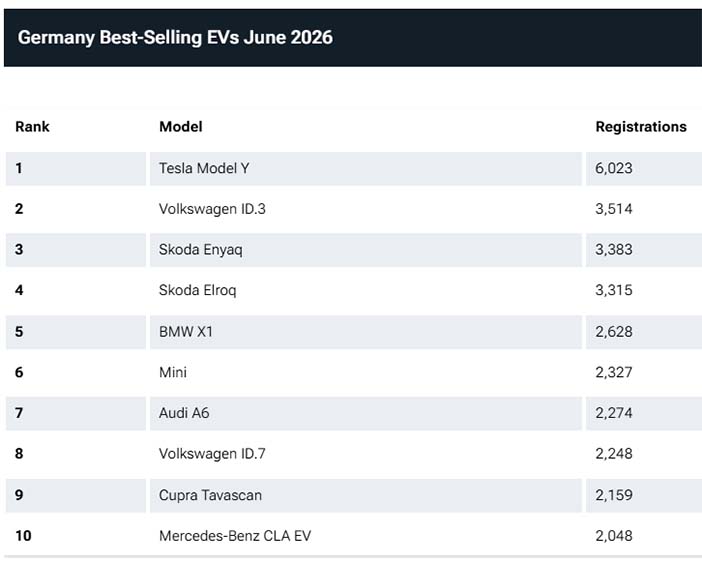
The most popular EV in Germany last month was the Tesla Model Y with an impressive 6.023 sales recorded. This placed it well ahead of the Volkswagen ID.3 in second place with 3.514 registrations, followed by the Skoda Enyaq with 3.383 and the Skoda Elroq with 3.315 sales. Other cars among the top-10 bestselling EVs included the BMW X1, the Mini Cooper E/SE, the Audi A6 e-Tron, the Volkswagen ID.7, the Cupra Tavascan and the Mercedes-Benz CLA EQ. The Model Y proved to be so popular that it was actually the third best-selling new car overall in June. It only trailed the Volkswagen Golf, which recorded 8.117 sales and the Volkswagen T-Roc, with 6.808 units sold. Although EV and hybrid sales are surging in Germany, the vast majority of the nation’s total vehicle fleet still relies solely on fossil fuels. In fact, there are currently 61.3 million registered vehicles on German roads, of which 59.3 percent are powered by petrol and 27 percent by diesel engines. Hybrids account for 6.5 percent while BEVs have a 4.1 percent share. +++
+++ A class action has been filed against JLR (Jaguar Land Rover) in the United States over its mild-hybrid powertrains, particularly those fitted to several Land Rover models from the 2019 to 2024 model years. Given that a good chunk of Land Rovers already came with mild-hybrids by that time, the claimed defect may be lurking in thousands of vehicles on the road without the owners knowing about it. The suit claims JLR knew about the alleged problem for years and failed its obligations to honor warranty claims. While a recall was eventually issued, the company reportedly did not repair or replace the affected vehicles. According to the class-action lawsuit, the issue stems from the faulty DC-DC converters fitted to mild-hybrid models. The recall was announced a few months ago, affecting 170.169 vehicles. There is still no resolution for the matter at the time of writing. The recall report says the system regulating the 48V system fails and reverts to 12V current. Unable to manage the electrical load, it then leads to the eventual shutdown of the vehicle, leaving its owners stranded. The vehicle warns the owner of impending failure within ten seconds of the fault being detected. Land Rover has recommended pulling over as soon as possible, once safe, should the warning pop up. Other failure warnings will appear on the dash. If the driver keeps moving, the vehicle will shift itself into neutral, show a transmission fault, shut down auxiliaries such as exterior lights and the climate control, and eventually, the engine shuts off. The suit claims that it’s incredibly dangerous if owners are faced with that situation. With no official fix in place in the meantime, the ‘wait and see’ response has made more than enough disgruntled owners file the class action lawsuit. Nearly all of the cars Land Rover makes, have this problem. It affects Range Rover and Defender models from 2020 to 2024, Discovery and Range Rover Velars from 2021 to 2024, Range Rover Evoque from 2020 to 2023, 2019 to 2024 Range Rover Sport and 2020 Discovery Sport. Some Jaguars are hit, too, namely the E-Pace from 2021 to 2022 and the F-Pace from 2021 to 2024. The issue isn’t just for North American models, either, as there are also reports of failures in Europe. Worse still, even the mild-hybrid diesels aren’t spared from the DC-DC fault, and more recently, there’s been yet another recall for airbags on certain models. These issues aren’t helping JLR’s bottom line at all, and the company must act swiftly to restore buyer confidence. +++
+++ Development of the LAMBORGHINI REVUELTO SV is reaching a new phase as spy photographers have caught the supercar undergoing testing on the Nürburgring. This is a natural location for the Super Veloce, which is more extreme than the regular model. While the rear wing immediately draws attention, it’s just the tip of the iceberg. The front end is heavily reworked and features a larger splitter as well as a new bumper with triangular air intakes. The profile will be largely carryover, but I wouldn’t be surprised if the production model is equipped with unique wheels and a beefier braking system. The rear end gets new vents above the taillights as well as a revised exhaust system that features circular tips inside a hexagonal surround. While the changes are relatively minor, it’s important to note this is an early prototype. As a result, the upcoming production model could have more extensive updates. The interior should feature a 12.3-inch digital instrument cluster and an 8.4-inch infotainment system. It retains its 9.1-inch front passenger display. The latter is a little surprising as SV models are focused on performance and weight reduction. This means that even if all 3 screens carryover, the car will likely eschew some carpeting and sound deadening material. We also wouldn’t be surprised to find lightweight sport seats and exposed carbon fiber. The biggest mystery is the powertrain, but previous reports have suggested the car could have an upgraded plug-in hybrid powertrain with around 1.200 hp. That would be a huge jump over the standard model, which has a combined output of 1.015 hp. I’m a bit skeptical about the rumored rating as the Aventador SV only had 50 hp more than the regular supercar. Regardless, the Revuelto SV will undoubtedly have some extra oomph. +++
+++ I found out last year from NISSAN ’s bosses that its Nismo performance division is on a charge, and to prove the point, the new Leaf Nismo has just been unveiled. This isn’t the first time the mild-mannered, all-electric Nissan Leaf has been given the once-over from the performance division. Back in 2020, I drove the track-only Nismo Leaf RC and in 2018 Nissan launched the Leaf Nismo, based on the second-generation Leaf. That car was only available to buy in Japan and sadly for Nismo fans here, it looks like Europe won’t be getting this hot version either.
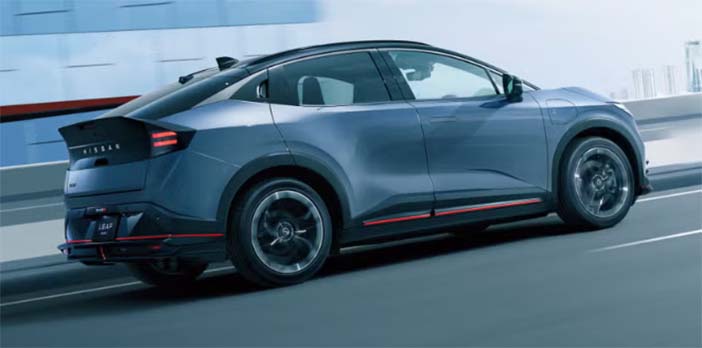
Nissan says the new Leaf Nismo blends “race-bred performance with everyday drivability and further enhances the driving performance of the Nissan Leaf”. While we thought the new third-generation Leaf drove very well for a family electric car, it doesn’t pretend to be a performance car. In an attempt to turn the Leaf into an “agile intelligent sport crossover”, Nismo has fitted bespoke lowering springs, fresh stabilisers and new bushes to increase rigidity and improve steering response. Nissan also claims the Leaf Nismo feels “lighter and more agile than its size and weight would suggest”. As with the X-Trail Nismo unveiled last summer, the hot Leaf also gets fancy new shock absorbers that reduce body roll thanks to swing valves that open and close during cornering. The brake regeneration system has been tweaked too, providing extra force in the higher levels for a “more engaging and rewarding driving experience”. As in the regular Leaf, there are Standard, Eco, Sport and Personal driving modes, although the ‘Sport’ mode has been changed to ‘Nismo’ with bespoke tuning to the electric motor, although no extra power is sent to the front wheels. The Leaf Nismo in B5 form comes with a 53 kWh battery and 177 hp electric motor while the B7 Nismo comes with a 75 kWh battery and the 218 hp motor. But it doesn’t get the Ariya Nismo’s four-wheel drive system. I expect the Leaf’s 0-100 kph times of 8.6 seconds (7.6 seconds for the 218 hp model) aren’t drastically different in Nismo form, although the exterior certainly is.
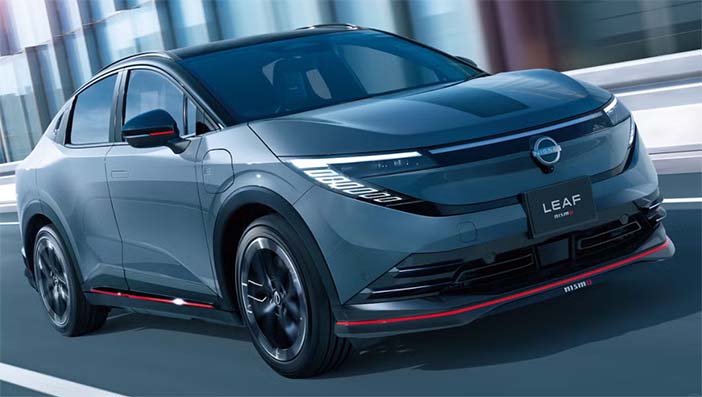
There are two new unique paint finishes, both a variation of Nismo’s Stealth Grey, but way more eye-catching is the bodykit. This includes a reshaped front bumper with an extended lower lip, skirts down the side, and to the rear a unique, Nismo-branded bumper with a ducktail spoiler at the top of the bootlid. The Leaf Nismo also sits on lightweight 19-inch aluminium wheels, wrapped in Michelin Pilot Sport 5 tyres. Nissan says all this creates additional downforce without increasing aerodynamic drag, so expect the range to remain similar to the standard car’s, with the 53 kWh version good for 450 km and the 75 kWh Leaf reaching 600 km.
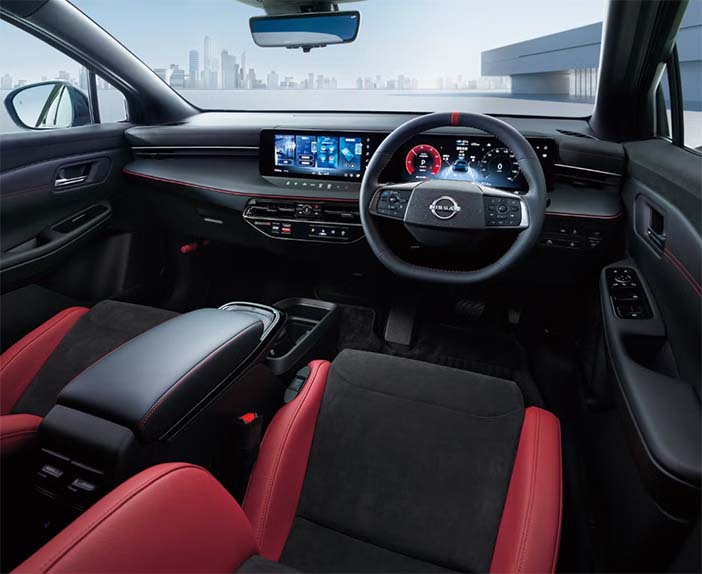
The interior receives some sporty tweaks too, with the exterior’s red accents also found on the dash, doors, the 12-o’clock marker on the steering wheel and the optional two-tone leather Recaro bucket seats. +++