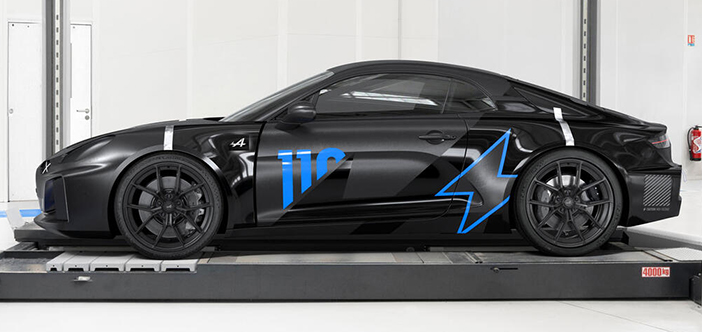
+++ ALPINE has released the first image of the test mule that will be displayed as part of an ‘Alpine moment’ alongside several variants of the outgoing petrol model. It confirmed that the prototype, named A110 Future, is underpinned by the same Alpine Performance Platform (APP) as the production car. However, it appears to wear the previous A110’s bodywork, with wide wheel-arch extensions hinting at the new iteration having a significantly wider track. The APP has been developed with weight reduction as a priority, with aluminium construction and 800V electricals. Notably, it features 2 battery packs, rather than 1 larger unit as is usually the case for high-performance EVs. The 2 batteries are positioned over the front and rear axles, giving a 40:60 weight distribution. That is slightly further rear-biased than the petrol A110, which is split 44:56. Alpine CEO Philippe Krief previously said the split-pack design was chosen so the electric A110 could sit as low as its petrol predecessor, while also bringing more than 550 km of range. He added that it had been conceived to complete three laps of the Nürburgring Nordschleife without the battery derating (losing performance due to heat). The positioning of the rear battery approximately where the petrol engine sits in today’s A110 also presents “an opportunity” to convert the EV to combustion power if needed, said Krief. But he added that this capability has not been included at the cost of the car’s potential as an EV: “If the answer would have been that, it would make the electric car worse. There’s no way we’d have done it”. Alpine confirmed that the A110 will be powered by two rear-mounted motors with silicon-carbide inverters. This suggests a different set-up from the related Renault 5 Turbo 3E mega-hatch, which uses 2 in-wheel motors from Protean for a combined output of 540 hp. The new A110 will have a kerb weight on a par with its ICE rivals today, meaning it will be around 1.500 kg. That’s significantly heavier than the current A110, which is around 1100 kg, but Alpine has previously touted the potential of torque-vectoring technology to make EVs feel as agile as ICE equivalents. Although it’s rare for car makers to present test mules, particularly on a stage as large as the Festival of Speed, Alpine’s decision to do so represents a significant step towards the launch of the electric A110 in 2027. The prototype’s debut will come just a week after Alpine produced the last of 28,701 petrol-powered A110s built at its Dieppe factory. +++
+++ AUDI was the first luxury automaker to enter China in 1988, 6 years before BMW and 17 years ahead of Mercedes. It didn’t take long for the trio to discover that Chinese customers prefer more spacious cars with roomier back seats. They all adapted by stretching the wheelbases of their global models for the locally manufactured versions. Since then, Western brands have launched a myriad of China-only models, including long-wheelbase SUVs. With help from SAIC, Audi has taken things to the next level by setting up a separate car brand specifically for the Chinese market. The recently founded a brand with the same name, but spelled out in capital letters and without the iconic Four Rings. It sells 2 models in China that you can’t get anywhere else. The wagon-esque E5 Sportback led the way before the E7X SUV arrived and a new sedan is also on the way. Why is Audi going through this much trouble? Simple: it believes the era of the global car has come to an end. The days when a one-size-fits-all formula worked are over, and automakers need to adapt their vehicles to suit regional preferences. As the saying goes, different strokes for different folks. In an interview, chief technical officer Rouven Mohr said there are fundamental incompatibilities between what buyers want around the world: “I think the idea of the global car (so one car that fits the world) this is gone, to be honest, because it’s not fitting anymore in the US (and) in China. You need this kind of local-for-local pillar”. His view is echoed by the head of Audi’s fellow Volkswagen brand in China. Last year, Ralf Brandstätter said that while Europeans want “tactile controls, long-term durability, and driving dynamics”, Chinese buyers prefer “AI-first, connected vehicles, with seamless voice control and smart cockpits”. That’s not to say Audi will stop selling its global cars in China. Some of its 4-ringed models will remain, catering to customers who still want one of the long-running nameplates and their German character. However, the CTO believes future growth is likely to come from the second brand. These look completely different inside and out from those wearing the iconic badge, which dates back to 1932, when Auto Union was created. It’s not just the uniqueI models for China that are adopting fresh styling. The core Audi brand is also embracing a new design language. We’ve already seen it on the Concept C and Nuvolari sports cars, and the electric A4 is expected to become the first mass-production model to use it when it arrives in 2028. The “Strive for Clarity” philosophy also brings interior changes, with Audi planning to improve quality and reintroduce more physical switchgear. +++
+++ The new X5 will go down in history as BMW ’s first production model with 5 types of powertrains: petrol, diesel, plug-in hybrid, electric and hydrogen. However, there is still something missing, at least at launch: a big V8. Initially, the luxury SUV will be available only with inline-6 engines on the ICE side, but I bring good news: the 8-cylinder engine lives. Tucked away in the press release for the fifth generation of the Spartanburg-built luxo barge is confirmation that a larger engine is on the way. Unsurprisingly, BMW is reserving the twin-turbo 4.4-liter V8 for an M-flavoured version of its revamped X5. However, I should point out that it won’t be a full-fat X5 M but rather an M Performance model. While it doesn’t have an official name yet, an educated guess tells us it will be called the X5 M60. Yes, without the “i” at the end, because BMW is dropping the letter from gasoline-powered models. It has already happened to many models, including the new X5 for the 40 versions. In the future, the “i” designation will be reserved exclusively for electric vehicles. The new X5 M60 will have to wait since it won’t be available at launch alongside the new Audi Q7 rival. BMW plans to roll out the V8 version sometime in 2027. Most enthusiasts will be thrilled to hear the M Lite variant won’t be a plug-in hybrid but instead deliver a pure V8 experience. We wouldn’t rule out a mild-hybrid setup, but a 48-volt system adds only a minimal weight penalty compared to a much heavier PHEV setup with a substantially larger battery. When it comes to plug-in hybrids, the X5 does get an M Performance version at launch. It’s called the X5 M60e. BMW is also cooking up a third not-quite-M model without a combustion engine: a hotter iX5 derivative. Munich isn’t committing yet to a full-fat X5 M with either gasoline or electric power, but we’d be surprised if one doesn’t arrive in 2028 or later, in both ICE and EV forms. Given that the outgoing X5 had a nearly 8-year production run, BMW is likely to keep the V8 alive well into the 2030s in the new generation. With a new X7 confirmed to debut in 2027 and almost certain to feature the company’s largest engine, the 8-cylinder story is far from over. Additionally, the recently facelifted 7 Series is getting the V8 treatment in 2027 with an M Performance variant. The Alpina side of the BMW Group is also developing a V8-powered 7 Series and will likely do the same for the next-generation X7. BMW technically still builds an even larger engine. However, the twin-turbocharged 6.75-liter V12 assembled at the Hams Hall factory in the UK remains exclusive to Rolls-Royce models. The ultra-luxury brand based in Goodwood had planned to go fully electric by 2030, but that’s no longer the case. As a result, the 12-cylinder powerhouse is also set to continue into the next decade. As for a return to a BMW or Alpina model, I wouldn’t count on it. +++
++ FERRARI is set to offer the thrill of a manual gearbox again after a 14-year hiatus. The 12Cilindri Manuale is the first Ferrari fitted with a clutch pedal (as well as the famous ‘canceletto’ open-gate shifter) since the California and is the first manual V12 from Maranello since the 599 GTB. It will be limited to 1.499 examples and, at €590,000 (without tax), costs 50% more than the regular 12Cilindri. Departing Ferrari commercial chief Enrico Galliera said a manual gearbox has been the number one request from the firm’s client base in recent years. Describing the Manuale as a car that “brings incredible performance and incredible emotion”, he said Ferrari has waited until it could offer something not just rewarding and innovative and “without compromise”. The innovation refers to the most unconventional element of the new Manuale: it has no linkage between the gearlever and the gearbox slung across the back axle. Indeed, the car is homologated as an automatic. But while the 8-speed dual-clutch ’box (DCT) of the regular 12Cilindri is retained, here it can be controlled by-wire through inputs the driver makes with the clutch pedal and gearlever. The potential genius of the system is that the position of the clutch pedal informs the level of engagement of the clutch packs in the gearbox. It means the system is able to replicate everything from languid clutch-riding, if you are babying the 830 hp 12Cilindri Manuale off the mark, to brutal clutch-kicking to initiate slides. It is even possible to stall the car, although authenticity is not pursued to the extent that the system will accept an errant downshift: the driver cannot send valvetrain shards to the heavens by inadvertently slotting first instead of third.
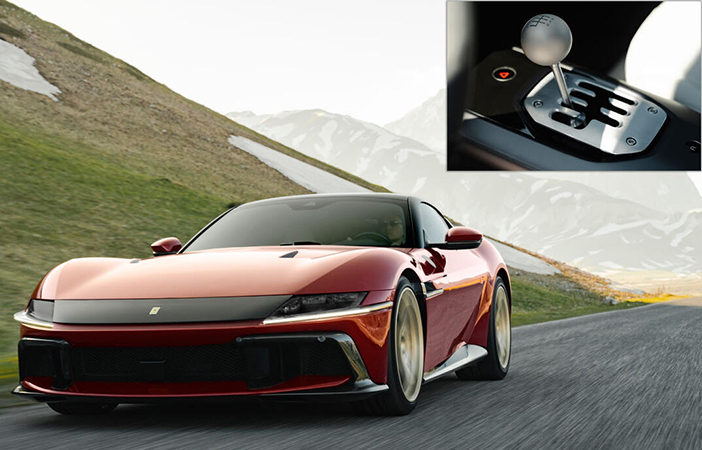
“The DCT remains but we have built up on top a new layer of interaction for the driver, to bring back the legacy experience”, said project lead Valentin Marguet. “Whatever goes through your hand on the lever or your foot on the clutch is built on mechanics. There is no artifice and the electronics are there only to communicate to the car”. It means the Manuale can also be driven in full-automatic mode, which Ferrari expects many owners to revert to in stop-start traffic. Because the manual element has only 6 speeds, to preserve the aesthetics of the open gate, the powertrain needs to revert to automatic mode to reach the car’s highest speeds in 7th and 8th gears, and also to hit its claimed 2.9 seconds 0-100 kph time with the help of launch control. However, the removal of the standard paddle shifters puts the onus on manual mode, which can be initiated below 100 kph simply by depressing the clutch and selecting a gear. The action of the clutch pedal is the result of an intricate series of rollers, rockers and bearings working with a stout spring. This mechanism defines the all-important feel of the pedal action and has been the subject of painstaking development. There is then a separate link that connects the arm of the pedal to a sensor that relays its position, in turn informing the engagement of the clutch packs inside the gearbox proper, all in an instant and with millimetric precision. As a result, a clean upshift or deftly rev-matched downshift should reward the driver and clumsy use of the system will do the opposite. Ferrari says it is not possible for the driver to damage the gearbox. The entire system weighs only 5 kg. Gas nitriding on steel is used in places in the mechanism where wear resistance is critical in retaining a tight feel and minimal play throughout the car’s life, and aluminium is employed elsewhere. The centre console has also been redesigned, with minimalistic buttons for automatic operation and a subtle floating effect for the aluminium gates.
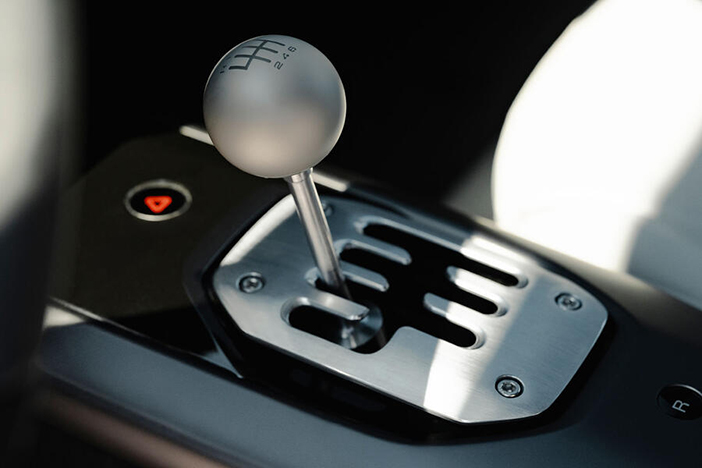
The ball gearknob shows the traditional shift pattern, only backlit in white or orange, depending on the mode. Conceptual work for the system began in 2022, with the development team using a rig to perfect the ergonomics of the pedal box and the nature of the shift, which is broadly modelled on a 599 GTB’s. Every Manuale will come with silver Scuderia shields, a model designation on the flanks and faint, Daytona-style pinstripes across the nose and on the active aero winglets on the rear deck. All examples will also be offered as part of Ferrari’s Tailor Made programme, with special paint and upholstery colours available. Deliveries will begin in early 2027, with Galliera conceding the Manuale is effectively already sold out. +++
+++ FIAT is committed to offering an affordable combustion-powered successor to the current Panda alongside its future affordable city car project. While the current Panda, which dates back to 2012, is only sold as a Pandina Cross in The Netherlands, it remains the best-selling car in Italy and accounted for more than 70% of Fiat’s sales last year. With EV uptake dramatically lower in Italy than in North Europe, Fiat’s European boss Gaetano Thorel said the firm is committed to continuing to serve those customers in the future. Fiat is currently working on an affordable €17.000 city car that will be twinned with the forthcoming Citroën 2CV revival from its fellow Stellantis brand, intended to take advantage of the EU’s planned E-car rules. This will naturally form the entry point of Fiat’s electric car range, sitting above the Topolino and new Multiplina. But Thorel said the firm “hadn’t decided yet” if it would take the Panda name, due to the passionate following for the current model. “The E-car could be the next-generation Panda, but we haven’t decided yet”, Thorel told. “It depends first on future regulations and second that we as Fiat have a duty, particularly in Italy, to think of the millions of Panda owners and give them a solution in the future. “We have a duty to this popolo di Panda (Panda population), which alone has a 7% share of the Italian market every month, to give them an answer for today and tomorrow that is based on their needs and not based regulations”. Thorel didn’t rule out branding both models as Pandas, as Fiat previously did with the technically unrelated combustion and electric versions of the 500. He wouldn’t specify whether Fiat is considering a new petrol Panda or continuing to update the existing model, but he said: “One thing is clear: I need to find a proper answer for my Panda population. We need to find a multi-energy solution”. Thorel noted that the commitment by Stellantis to build the two E-cars in its plant in Pomigliano was “important for us because small cars are Italian territory and it means Pomigliano will have a future”. +++
+++ HONDA and NISSAN grabbed headlines in December 2024 when they signed a MoU (Memorandum of Understanding) to explore a merger. By February the following year, however, the 2 Japanese brands had already decided not to proceed with a single new holding company. Why? Reuters reported at the time that, rather than the initially stated merger of equals, Honda wanted to take control and turn Nissan into a subsidiary. The deal also fell apart because Honda pushed for deeper job cuts and plant closures, which met resistance from Nissan. Although the merger talks ended abruptly only a few months after the announcement, it didn’t take long for reports to emerge about a different type of tie-up between the 2 companies. Now, Honda’s CEO and president has confirmed that a deal with Nissan is close. Nikkei Asia cites Toshihiro Mibe telling shareholders that negotiations between the 2 Japanese brands are “quite far along, with some aspects close to an announcement”. While he didn’t go into detail about what the partnership will entail, Honda’s chief executive said the companies are “proceeding with each project in a win-win relationship”. From that statement, it’s clear the 2 companies aren’t looking to merge but rather to collaborate in specific areas of their businesses. Whether that means joint vehicle development, shared production capacity, or something else remains unclear. There are reports that Honda, Nissan and Mitsubishi are working together to standardize electronic control units (ECUs) for next-generation models. These shared ECUs would be used across the 3 brands in vehicles scheduled to arrive around the turn of the decade. While not all details have been finalized, the ECU is expected to be used in hybrid and electric models. Renault is also likely to have a say in the deal, as it still holds a 15% voting stake in Nissan, down from 43% in 2023. These new negotiations come as Nissan carries out a major cost-cutting program, which includes closing 7 factories, shutting 2 design studios and laying off around 20.000 employees. Under its RE:Nissan restructuring plan, the company is also reducing production capacity from 3.5 million to 2.5 million units. Honda is undergoing significant changes of its own after posting its first annual loss in history. It recently canceled several EV projects due to demand concerns and has abandoned its goal of becoming an all-electric automaker by 2040. Instead, it is now betting on a new generation of hybrids, led by a wedge-shaped sedan and SUV duo expected in 2028. +++
+++ Despite currently making some of the greatest sports cars in the company’s illustrious history, PORSCHE is not off to the best start in 2026. Sales were down for nearly all regions outside of Germany during Q1 and according to new reporting from IT-home, the automaker’s poor performance in China means it will close down 4 regional dealerships. The 4 dealers in Wuhu, Jining, Huai’an and Nanning ceased operations on June 30th and will adjust their sales authorizations. It’s unclear which of these stores will remain open to service existing Porsche customers, and which ones will relinquish their business to other dealers. Before these recent closures, Porsche China managed 116 dealer centers in the country, but there are plans to bring that number down to 80 in the coming years to improve profitability. Each dealer is reportedly losing 20.000 yuan (around $2.941) to 30.000 yuan ($4.413) per delivery. Eliminating unpopular models like the Taycan Sport Turismo will help a bit, but further cuts are still required. The automaker also shut down around 200 DC fast chargers which it likely built at great expense. Porsche plans to streamline departments and perform restructuring. This means around 3.900 jobs will be cut. The company ended 2025 with 41,938 vehicles delivered in China; a 26.3 percent decrease compared to 2024. Sales are still down in 2026 with 7.519 cars sold in Q1 which is down 21.0 percent compared to 2025. In fact, China saw the largest drop-off of any market to begin this year. +++
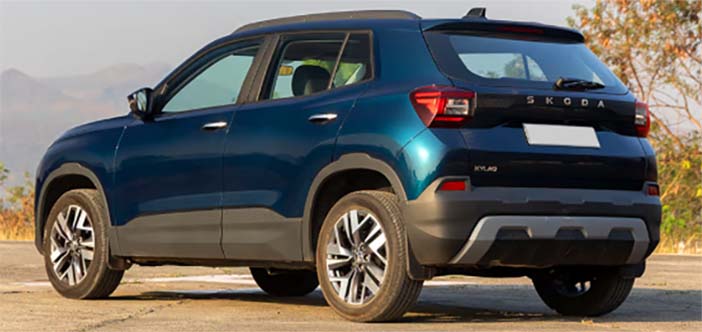
+++ SKODA is evaluating how it can add cheaper combustion-engined and electric models to its European line-up. The European city car market has all but evaporated in recent years as petrol models such as the Ford Ka, Peugeot 108 and Skoda’s Citigo have been axed. The lack of replacements has left customers at the most affordable end of the market unserved, forcing them to consider larger superminis such as the Skoda Fabia. But Skoda is now weighing up an entry into the electric city car class and it could bolster its ICE offering with the Indian-market Kylaq crossover. “We have a project where we are looking at putting components together from various very cost-efficient sources”, said Skoda CEO Klaus Zellmer. Skoda was initially involved in the development of sibling company Volkswagen’s ID.Every1 concept, which will evolve into a replacement for the Up next year, but soon left the project. Zellmer explained: “With the slower than expected growth speed of electric vehicles in the market, Skoda is in a better spot to stay with the petrol Fabia, Scala and Kamiq, where we have reasonable margins, production capacity and engineering very well accepted in the market. Within the bigger Volkswagen Group, we have our colleagues from VW to fish in the city EV market that is currently developing. It’s not very present and the margins are thin”. To that end, a new entry-level Skoda EV is “nothing that you will have this decade”, said Zellmer, but he did suggest that there’s still potential for a model priced below the Fabia, which starts at €24.990 in The Netherlands. Zellmer highlighted the Kylaq, which is shorter than the Fabia and costs the equivalent of just €7.000 in India, as one potential candidate for European import. He said: “If you look at the design and technology, fit and finish: that is something we could look into raising to European standards. If you look at the Fabia, if you squeeze everything out to get below €21.000, and if you look at the price of a Kylaq in India, there’s a massive gap. There’s a business rationale that you can challenge and see whether that makes sense”. The Kylaq is based on an adapted version of the Volkswagen Group’s MQB A0 platform for small cars (a cross-brand asset for which Skoda was given responsibility in 2021), which it shares with the slightly larger Kushaq crossover and Slavia saloon in Indian dealerships. +++