
+++ At present, BMW offers the M2 in base RWD form, with xDrive AWD, and as a special, more hardcore CS model, but it appears that yet another variant may be in the works. The G87 M2 is expected to remain in production for another 3 years, so Bavaria may find further ways to keep it fresh, and a new video shared to Instagram shows what appears to be an M2 CS being tested with camouflage on its front and rear ends. Why BMW is testing a camouflaged version of the car it’s already revealed and launched is a mystery, but I have a couple of plausible theories. The prototype is not wearing the hardcore M Performance Track Kit that the regular M2 has access to, nor does it have similar added aero to the M4 CSL (though this could be a very early development mule that is yet to sprout CSL-specific bodywork). Another possibility is that BMW is developing a less powerful version of the M2 CS with a Handschalter package, i.e., a more focused M2 chassis but less power so that a manual transmission can be fitted. The M3 CS Handschalter was the idea of a small group of people in North America, not the Bavarian mothership, but it’s already a smash hit, and as we’ve theorized before, adopting Porsche’s iterative approach to high-performance special editions could further that success. An M2 CS Handschalter to say goodbye to the G87 would be relatively easy to achieve, though BMW might beworking on a AWD version of the M2 CS. Perhaps with the G80 M3 entering its final model year with the 2027 version, a more powerful take on BMW’s smallest M product combined with the quickness of AWD wouldn’t step on as many toes, and there would still be room to do the M2 CS Handschalter later on, just before the G87 goes away. With the 2027 modelyear M2 only recently being launched and including xDrive for the first time, it’ll be some time before we see what BMW is cooking up with the camouflaged CS prototype. We don’t expect to see the final product until next year at the earliest, and if it’s a manual M2 CS, we could be waiting until 2028. Either way, BMW is unsure how customers will react to the Neue Klasse generation of M cars, even though they will include gasoline-only models. With the G87 M2 becoming one of the most successful M cars during one of BMW M’s most controversial aesthetic eras, the automaker will want to squeeze as much as it can from the compact sports car before it leaps into a new generation with a fresh approach. +++
+++ For electric vehicle enthusiasts, the global EV race has increasingly become a two-horse sprint between hometown hero Tesla and Chinese juggernaut BYD . While BYD remains a dominant force in the international market, even without a passenger car footprint in the United States, recent data indicates that BYD might be lagging behind the targets they set. Yes, BYD sales are rising, but it is still way off its ambitious 2026 annual target. According to recent mid-year reports, BYD has demonstrated undeniable volume-heavy growth. In July alone, the automaker saw its vehicle sales climb 22 percent year-over-year, moving approximately 420.000 cars. This capped off a robust first half of the year where the company successfully delivered 1.81 million vehicles globally. To put that in perspective for an American audience, BYD’s 6-month output heavily dwarfs the combined annual EV sales of traditional Detroit legacy automakers like Ford and General Motors. However, context is everything in the global auto industry. Despite this impressive double-digit growth, BYD is currently falling behind the aggressive pace required to meet its massive 2026 goals. Management previously set a staggering annual delivery target of 5 million to 5.5 million vehicles. To reach even the conservative lower boundary of that 5-million-unit goal, the automaker needs to average roughly 530.000 sales per month for the rest of the year. That represents a steep increase from its current 420.000 monthly run rate, which itself is heavily catalyzed by its growing export businesses as newer markets open up to BYD’s products. Several headwinds could complicate BYD’s path forward. The Chinese domestic EV market is heavily saturated and currently engaged in a brutal price war that threatens profit margins. Furthermore, aggressive expansion into markets like Europe and Latin America faces mounting geopolitical pushback, including steep new tariffs designed to protect local manufacturing. Ultimately, while BYD’s year-over-year growth remains the envy of much of the automotive industry, missing a highly publicized production target could rattle consumer and investor confidence. For American competitors watching closely from the sidelines, this slight bottleneck might provide a crucial window of time to recalibrate their own EV strategies before BYD attempts its next global push. +++
+++ Last year, in the United States, the NHTSA started poking around timing belt failures in a handful of FORD models, including the Focus and Fiesta with the brand’s tiny 1.0-liter 3-cylinder; a separate issue from a 2024 recall involving the same engine. Now, things are getting serious. The agency just bumped its investigation up to a full-blown Engineering Analysis: basically the next level in the defect detective game. This round covers about 135.000 cars, all rocking that 1.0-liter engine. This whole fiasco all started back in December last year, when the NHTSA’s Office of Defects Investigation got a stack of complaints about timing belts going kaput. With an Engineering Analysis, the agency can really get its hands dirty: testing parts, gathering more evidence, and figuring out if a recall is actually on the table. The main suspect here is Ford’s wet timing belt setup. Instead of running dry like most belts, this one lives inside the engine, swimming in oil. NHTSA says the belt material can slowly break down, leaving behind debris that clogs up the oil pump’s pickup screen. As the gunk builds, oil pressure drops, engine lubrication suffers, and suddenly you’re at risk of losing power, or worse, seizing the engine while cruising down the road. Plenty of owners told the agency they saw a low oil pressure warning just before their car gave up. Others said their engines quit with zero warning. NHTSA’s analysis points out that sometimes, drivers don’t get enough heads-up to react safely. So far, there are 355 reported incidents tied to this problem. According to the NHTSA document, the average failure happens around 110.000 km. Even more eyebrow-raising: 98% of these breakdowns happened way before Ford’s original 240.000 km replacement interval. Some of these cars had their maintenance records in order, so it’s not just a case of owners skipping service. Just because the investigation is heating up doesn’t mean a recall is a done deal. For now, NHTSA is rolling up its sleeves for more testing and data crunching. The agency says the evidence so far points to a real safety risk, but they need more technical digging before making any big moves. Ford’s already launched a global customer satisfaction program for cars with the 1.0-liter Fox Classic timing belt. The new advice? Swap the belt at 160.000 km or 6 years (whichever comes first) down from the old 240.000 km target. If you’ve already shelled out for timing belt-related engine repairs, you might be in line for a refund. So, if you own a Focus, Fiesta or Puma from the affected years, you’ll want to keep an eye on this one. Whether it ends in a recall depends on what NHTSA finds next. +++
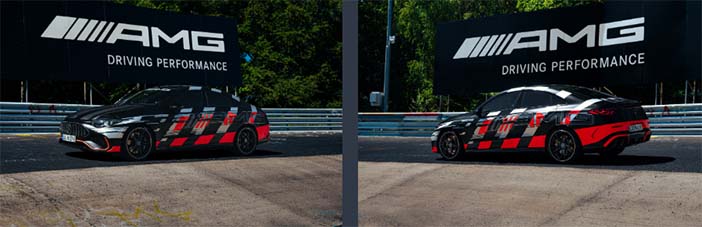
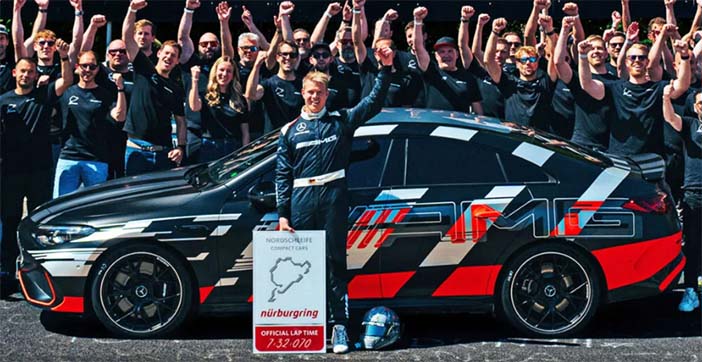
+++ MERCEDES-AMG Mercedes-AMG unveiled the electric CLA 45 last month and the compact performer hasn’t taken a long time to show off its track prowess. The automaker has just reported that the 671-hp EV has set a new record in its segment around the Nürburgring Nordschleife with a time of 7:32.070 minutes. That time moves it past several much more powerful EVs from the likes of Tesla and Porsche, confirming that this all-electric CLA is more than worthy of its AMG badge. The AMG CLA 45 is one of the most powerful EVs of its size. 3 axial flow electric motors combine for outputs of 671 hp and 1.750 Nm of torque. Going quickly in a straight line was never in question, it can sprint from 0 to 100 km/h in just 2.7 seconds, but the new lap time underlines how the car’s chassis, intelligent 4Matic all-wheel-drive system and grippy Pirelli P Zero Trofeo RS tires work together to meet the demands of the famous track. Pleasantly summery air temperatures of around 75 degrees Fahrenheit made for ideal conditions when the CLA 45 completed its record run. “AMG was born on the racetrack. In almost 60 years, we have proven with numerous vehicles that this DNA remains intact to this day”, said Stefan Weckbach, chairman of the Board of Management of Mercedes-AMG and Head of the Mercedes-Benz G-Class & Mercedes-Maybach business units. “The CLA 45 now writes the next chapter of this story. It is the fastest vehicle in its class on the world’s most demanding racetrack. A huge thank you to all the colleagues who made this record possible. I am certain: It will not be the last AMG record on the Nordschleife”. The CLA 45 achieved a quicker time than a few serious EVs. Back in 2022, the Porsche Taycan Turbo S set a time of 7:33 minutes, which the CLA has now beaten. It also beats the original Tesla Model S Plaid (without the Track Pack), which set a time of 7:35.579 minutes in 2021. In case you forgot, the Tesla produces over 1.000 hp. A closer car in size and execution is the Hyundai Ioniq 6 N, which set a time of 7:35.42 earlier this year, putting it over 3 seconds behind the Mercedes. Looking at smaller gas-powered cars, the CLA 45 wasn’t quite as fast as the agile BMW M2 CS, which achieved a run of 7:25.5, but the Mercedes was around a second faster than the lap completed by the Audi RS3 last year. It’s also a fraction quicker than the mighty Porsche 911 GT3 (991). Mercedes-AMG is on a mission to reclaim the magic inherent in most of its products throughout the 2000s and 2010s. It will do so by updating its classic V8 while concurrently launching a range of high-performance EVs like the CLA 45. Showing off the CLA’s capabilities on the Green Hell raises hopes that hardcore machines like the new AMG GT 4-Door will also shatter a few records. In total, AMG plans to launch an astonishing 27 new models over the next 3 or so years. The CLA 45 also gives Mercedes a small, potent EV with few rivals. BMW and Audi don’t have anything comparable in their lineups yet, but an expected M version of the new BMW i3 will make for a fiery match-up with the CLA 45. +++
+++ For years, luxury automakers have been caught in a relentless race to see who could pack the largest touchscreens into their dashboards. Physical buttons were aggressively phased out, replaced by massive digital slabs and minimalist interiors. But after growing frustration from drivers, MERCEDES-BENZ is finally changing its approach. Now, Mercedes-Benz CEO Ola Källenius has acknowledged that while massive digital displays are likely here to stay, the auto industry needs to actively address the lack of tactile and intuitive physical buttons. The German automaker has been one of the biggest pioneers of the digital dashboard revolution. Its signature MBUX Hyperscreen is an absolute behemoth, with its largest variants stretching 56 inches across the entire cabin. While visually stunning, this sweeping transition forced drivers to dig through complex digital menus just to adjust simple, everyday settings. Källenius admitted that the focus on a futuristic aesthetic caused Mercedes to forget about user experience. “Sometimes you get a bit ahead of yourself and do technology for the sake of technology and maybe forget a little bit about the customer”, he noted.
Mercedes invests heavily in user interface design, with Källenius joking in an interview that the infotainment system must be intuitive enough for either a five-year-old child or a Mercedes board member to operate. Despite ongoing efforts to improve advanced voice control technology, overwhelming consumer feedback has sparked a practical reversal in strategy. Moving forward, Mercedes plans to strike a smarter balance by bringing back essential tactile controls. The brand has already started this shift by restoring physical buttons on its steering wheels, moving away from heavily criticized haptic touchpads. “From now on, you will see us reintroduce the most sensible buttons”, Källenius promised. When asked if the automotive industry had reached “peak screen”, the CEO wasn’t completely sure, but he definitively stated, “we’re at low button”. For everyday drivers who just want to turn down the air conditioning without taking their eyes off the road, this admission is a massive win. The giant screens aren’t going anywhere, but the frustrating era of entirely buttonless cabins is officially coming to a close. +++
+++ Not that long ago, pundits were just about ready to prepare NISSAN ’s grave. With shocking losses, dismal sales, and a failed ‘partnership’ with Honda, one could say at the time that Nissan was in its 11th hour. About a month ago, there were even investors allegedly wanting Carlos Ghosn back behind the wheel of the company. But in all fairness to current CEO Ivan Espinosa’s term, Nissan’s recovery is moving at a strong pace. Last time out, the executive said that the Re:Nissan plan is ahead of schedule, although some painful decisions had to be made. Nonetheless, despite the loss of $3.4 billion during the previous financial year, the fruits of everyone’s labor within the company are starting to pay off. During the first-quarter report for financial year 2026-2027, Nissan actually posted profits. It’s a remarkable achievement, especially since it’s been 2 long years since the Japanese automaker was in the black. Considering Nissan had been under Espinosa’s leadership for just a little over a year, it’s looking more and more like he was the man for the job after all. Put this year’s first quarter results for FY ’26-’27 beside the same figures last year, and it’s like Nissan wasn’t bleeding money. In Q1 FY25-26, Nissan posted operating losses of 79.1 billion yen ($502 million) and net income crashed by 115.8 billion yen ($734.4 million). This time around, it gained 77.9 billion yen ($492.2 million) in operating profit and net income is up by 3.8 billion yen ($24.1 million). To further emphasize how much ground the company made up, here’s how much it gained in the span of a year. Nissan managed to gain 157 billion yen ($996.2 million) in operating profit and 119.5 billion yen ($758.2 million) in net income. That is, by all means, a Herculean effort from the brand considering it still had to pay a fair bit of tariffs. Admittedly, though, it’s not all great news for Nissan. Global sales and deliveries are still down as a whole and the company needs to address that as soon as possible. There’s also the matter of Chinese automakers eroding the market share of legacy automakers, tariffs and the Iran conflict. More recently, the Kumamoto earthquake in Kyushu, Japan may force the company to, at the very least, slow down production in its facility in the prefecture. Still, the outlook is looking more and more positive, and the even harder work begins now. Nissan is banking on the North American market to help in its growth, along with the launches of new and redesigned models. Infiniti, its luxury division, is finally getting more attention as well. The company is doing what it can to match ‘China Speed’ by using greater AI assistance in vehicle development. The good news is that U.S. sales and production are up, but the rest of the world has to follow if it wants to sustain profitability. +++
+++ Across the board in the UNITED STATES , affordable cars saw huge sales increases last month. The Hyundai Elantra and Mazda3 saw huge increases month-over-month. Mazda’s cheapest model even saw a major increase of 28.0 percent for the year, with 24.355 sold so far. At Ford, sales for the Bronco Sport and Maverick were also up in a big way, while the Accord, despite its age, experienced a significant increase in July sales. Accord sales are already up 36.1 percent for the year, while Civic sales also increased last month. At Kia, sales for the Seltos (likely with the arrival of the new version in dealers) are booming. They were up 79.1 percent in July and are up 38.4 percent for the year. July was a terrible month for electric vehicles in the United States, not unsurprisingly. That includes the Hyundai Ioniq 5, with sales down significantly compared to last month. Ioniq 9 sales also took a tumble. At Ford, Mustang Mach-E sales declined drastically last month and they are down 50.2 percent so far this year. Sales for the F-150 Lightning were down a whopping 95.0 percent as the automaker turns the pickup into a hybrid. At Honda, the recently discontinued Prologue sold just 1.554 examples. Acura also sold zero ZDXs, down from 665 a year ago. So far in 2026, Acura has sold 108 electric crossovers, which it discontinued last September. High gas prices have consumers seeking relief at the pump and buying hybrids in record numbers. At Hyundai, hybrid sales increased 35 percent year-over-year for the month of July, with Sonata HEV sales jumping an incredible 85.0 percent. Buyers also bought Honda’s hybrid in record numbers, with the Japanese automaker selling 36.000 hybrid vehicles last month. Accord hybrid sales were up 28.7 percent while CR-V hybrid sales jumped 18.4 percent. Civic hybrid sales actually declined by 6.8 percent. At Kia, sales for the Sportage hybrid were up 76 percent. Seltos hybrid sales jumped 61 percent while Carnival hybrid and Sorento hybrid sales increased by 16 percent each. Kia hybrid sales jumped 108 percent last month. July was not a great month for Ford Motor Company as a whole. The mainstream Ford brand was down 9.1 percent for the month, but things were even worse for Lincoln. The luxury brand suffered a 35.9 percent decline in sales compared to July 2025. Most of that decrease is from the Corsair, which saw sales tumble 92.8 percent. The automaker discontinued the model, alongside the Ford Escape (sold as Kuga in Europe), after 2025. The rest of the lineup was better. Sales for the Nautilus and Aviator were down 31.8 percent and 2.7 percent, respectively. Navigator sales declined 2.5 percent last month, while overall Lincoln sales are down 12.6 percent for 2026. The Subaru WRX recorded a stunning 214.7 percent increase in sales last month. The automaker sold 1.438 examples of the sedan, with 8.546 sold so far this year, which is a 24.1 percent increase compared to the first 7 months of 2025. The model continues a sales boom that started earlier this year. After an abysmal sales year, the automaker cut the WRX’s starting price by more than $5.000 for the 2026 model year, which has translated into real results. Despite the WRX, Subaru sales were only up 0.8 percent for the month, and they remain down 3.7 percent for the year. +++