
++ HYUNDAI is exploring plans to deploy Atlas humanoid robots at its Czech manufacturing plant, positioning Europe as the next strategic proving ground after the US for its robotics-powered smart manufacturing vision. Developed by its US subsidiary Boston Dynamics, the robot’s deployment in Hyundai’s own European lines offers a critical real-world testbed to validate operational reliability, safety and workplace integration. If successful, it could pave the way for broader commercial rollout across a largely untapped European market; a high-potential frontier outside China’s fiercely competitive humanoid robotics market. According to recent media reports, Petr Michnik, head of the administration division at Hyundai Motor Manufacturing Czech, said the plant is discussing with Boston Dynamics and Hyundai headquarters about deploying the Atlas robot. While Michnik did not specify a concrete timeline for testing the robots in active production lines at the Czech plant, he was cited in an interview with the Czech-based Automotive Industry Association, saying, “We hope that testing and operating humanoid robots in the Czech Republic can also begin as soon as possible”. Established in 2009, the Czech plant in Nosovice is Hyundai’s sole auto manufacturing plant within the EU and serves as the carmaker’s key European production base. It produces models including the Tucson, Kona and i30. Given the facility’s symbolic status as a key European production base, deploying Atlas robots there would likely establish it as Hyundai’s second testbed for humanoid-led automation, following its US operations in 2028. Automation has already advanced significantly at the Czech plant, where 566 robots are now in operation; more than double the number from 20 years ago. According to the company, automation took over the tasks of approximately 200 workers, all of whom were reassigned to other roles. Describing humanoids as the logical evolution of automation, Michnik projected that they could be adopted on factory floors sooner than autonomous driving cars take to public roads. Experts view Europe as an ideal proving ground for Hyundai to validate Atlas on factory floors and tap into a blue ocean market, where high wages and an aging population are driving demand for advanced automation. Han Jae-kwon, a robotics engineering professor at Hanyang University and chief technology officer of AeiRobot, said, “Don’t assume Hyundai is building these robots just for its own car factories in Europe. They will serve as the initial buyer to pump up early demand. Using their own facilities for initial deployment is the safest way to make the robots learn, adapt and evolve. Once they achieve economies of scale, they can drive real growth, ultimately aiming to supply these robots to diverse industrial sites beyond Hyundai”. Chang Tai-woo, an industrial engineering professor at Kyonggi University, echoed the view and noted, “Europe suffers from a more critical shrink in its labor force than the US due to aging demographics and low fertility rates, with Eastern Europe hit even harder by migration to Western Europe. From this perspective alone, the potential for applying humanoid robotics is exceptionally high”. Unlike the technology-led US market, European demand for humanoid robotics is largely driven by acute necessity. According to an EU report, the population of the 27 EU member states is projected to peak at 453.3 million in 2029 before steadily declining to below 400 million by 2100, representing an overall 11.7 percent decrease from the current 450.6 million. Such demographic pressures inevitably point to a shrinking labor supply across the continent. Eurostat projected in 2023 that between 2022 and 2060, the EU’s working-age population (aged 15 to 64) will decline by 13 percent. Although local startups like the UK’s Humanoid (the region’s first non-listed robotics unicorn valued at over $1 billion) are emerging, Hyundai holds a distinct advantage in leveraging its decades long manufacturing prowess in the automotive sector. Han noted: “The sheer scale and technological advancements in both hardware and software will likely position Hyundai as a leading player in the industry”. Despite its strategic vantage point, Hyundai is taking calculated steps to address potential labor friction following pushback from its labour union over Atlas deployment in domestic factories. Michnik explained that adopting Atlas goes beyond cutting labor costs. The goal is to boost manufacturing quality while creating a safer, less physically demanding environment for workers. “Hyundai’s approach to the European market contrasts with its US strategy”, Chang noted. “While the company focuses on validating commercial and technical feasibility in the US, it must navigate Europe far more cautiously given the strong social sensitivity around labor rights. Even in Eastern Europe, deploying humanoid robots will prove challenging without first addressing potential social conflicts”. Pointing to Europe’s stricter regulations around worker protections and human-robot collaboration, Chang noted that Hyundai will initially lead by demonstrating tangible improvements in workplace safety and working conditions before pushing for broader, long-term adoption. In the US, introducing automation or AI typically moves forward with fewer hurdles unless governed by a specific union collective bargaining agreement, and Hyundai’s US operations currently lack union representation. In contrast, Europe applies a stringent precautionary principle to technology deployment, mandating comprehensive risk assessments that will likely prompt the union at Hyundai’s Czech plant to negotiate the operational impact of the Atlas robot. +++
+++ JAGUAR LAND ROVER has issued a recall notice for more than 20.000 vehicles due to … an electrical issue. It seems like the ghost of The Prince of Darkness never strays too far. The issue today is not related to any shoddy wiring by Lucas Electronics. Instead, affected vehicles may experience a failure of the DC-to-DC converter, which converts voltage between electrical systems. Should the DC-DC converter fail, the affected vehicle will no longer charge the 12 volt system. From there, a cascade of failures in other systems will follow. Soon you’ll lose engine power, and eventually your exterior lighting will go out as well. Both of those remain fairly vital to the overall driving experience. Recall notices are being mailed to owners of affected vehicles by November 13th. After that, the fix is a simple software update, which your local JLR dealer can handle free of charge. Here’s the full list of JLR product that needs an update: 2019-2024 Range Rover Sport, 2020-2024 Range Rover Evoque, 2020-2024 Range Rover, 2020-2024 Discovery Sport, 2020-2024 Defender, 2021-2024 Range Rover Velar, 2021-2024 Discovery, 2021-2024 Jaguar E-Pace and 2021-2024 Jaguar F-Pace. +++
+++ MCLAREN has revealed a new logo for its next-generation cars, taking inspiration from the signage on founder Bruce McLaren’s New Zealand workshop. The minimalist new ‘wordmark’ will feature across all the company’s cars, merchandise and digital channels going forward, as the brand embarks on an era of dramatic expansion and diversification. It has been revealed days after McLaren announced plans to expand its British business with a second factory, to start building its own engines in-house and to grow its line-up by adding new front-engine models that feature 2 rows of seating, including an SUV. The first car to wear the new branding is the McL 6GT, revealed last month at Monterey Car Week in California, and future models will follow in having the brand’s name spelled out across their rear. The logo itself is adapted from the one that featured atop the family workshop in Auckland, New Zealand, owned by the parents of company founder Bruce McLaren, who developed his interest in cars and engineering while helping in the workshop. McLaren claims that it was in this workshop that Bruce built “the racing car that would take him to his first victory”; a modified Austin Seven that he took to a comfortable win in an event at Muriwai Beach.
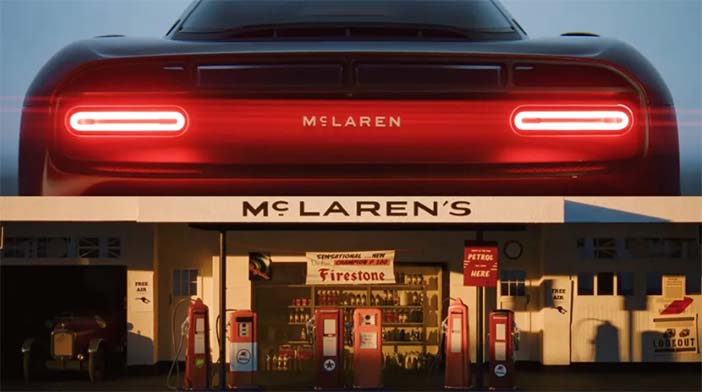
Chief creative officer David Woodhouse cited Bruce McLaren’s “maverick spirit” as a primary influence in the company’s repositioning and said the rebranding is partly aimed at promoting and celebrating the founder’s legacy. “This has been about finding ourselves: coming back to what is essentially us, our founder, the basis of our brand and our mark”, he said at a preview event for the new look. “There’s been a period of not recognising our founder, not showing him, and we wanted to come back to this great foundation of what we’re about”. However, he said that while McLaren took inspiration from the eponymous workshop in its rebranding process, and from Bruce’s first road car in creating the new McL 6GT, “I would caution everyone that this is not a retrospective action. This is not just a retro interpretation of who we are. This is all about the future and the meaning behind the wordmark is about future intent of putting us where we need to be”. He told that he would “not describe the name or the car as retro – I think you need to be very clear about that”. Instead, he explained: it is “finally an acknowledgement of our founder. Every great luxury brand in the world (I’m thinking LV, Hermes, all the big players), they acknowledge their foundation. It’s an absolutely foundational element in everything they do. I think it’s the cleverness of how you utilise that, and how you interpret it. But there’s nothing we’re going to be doing that isn’t going to be future-looking, future-facing”.

The new logo is the debut for a new bespoke company typeface, called McLaren Sans, and will be used in the same form across all applications: on the cars, merchandise, branding activities and digital channels. The ‘Speedmark’ motif that accompanies the name in McLaren’s current logo will remain “as a little identifier”, said Woodhouse, “but the wordmark definitely takes dominance”. The first 3 letters of the name will be used in some applications as a coincidental initialism for ‘McLaren Cars Limited’. Woodhouse said: “That’s a very cool element that you’re going to see in the badging and the nomenclatures going forward”.
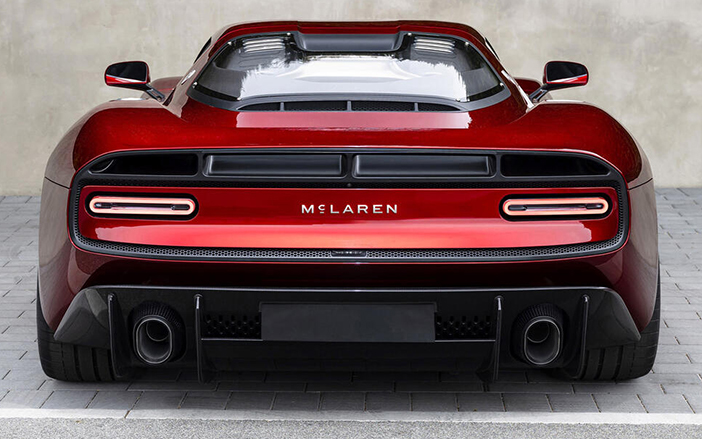
His comment suggests future models could follow the lead of the new McL 6GT in taking the initialism as part of their model name, but he stopped short of confirming this. The new branding also comes with a shift in corporate colour schemes, with McLaren moving to a “more midnight” theme centred around darker colours as a “signifier of premium and luxury”. The firm’s signature Papaya Orange will be more closely associated with its race teams going forward but will continue to be used in some instances across the automotive business. +++
+++ MERCEDES-BENZ told employees in Sindelfingen this week that keeping every German plant open is not guaranteed. Production chief Michael Schiebe said one assembly plant and one powertrain plant could shut down if labor costs do not come down. The warning is conditional as no location has been named and no timetable has been set, but the company has now identified what’s at stake by tying the future of 2 plants directly to whether cost cuts get done. Schiebe laid out the warning during an employee meeting, describing it as a choice between mutually acceptable savings and losing capacity outright. Mercedes-Benz says its goal is still to retain every German site. Schiebe did not get more specific as he described the 2 at-risk sites only by function: a body-shop plant handling final assembly, and a separate powertrain plant that builds engines, transmissions or electric drive components. That narrows the field considerably as Mercedes-Benz has final assembly at Sindelfingen, Rastatt and Bremen. Powertrain production runs across 7 more German sites: Untertürkheim, Affalterbach, Berlin, Hamburg, Kamenz, Kölleda and Arnstadt. None of the 10 locations has been confirmed as the closure candidate and Mercedes has not ranked them by risk. The company’s core argument is cost, not capacity. Mercedes says production in Germany is no longer competitive by international standards, largely because of labor expenses that run higher compared to plants the company runs elsewhere in the world. The comparison Mercedes is making is stark. Costs at its Kecskemét plant in Hungary run 70 percent lower than in Germany, a gap that has already shaped decisions like moving small-car and Baby G-Class production to Hungary. Mercedes is not alone in making this case to its own workforce. Volkswagen has already started its own restructuring after a profit warning, and Audi has flagged closure risk at its Neckarsulm plant for similar reasons. A Mercedes spokesman confirmed Schiebe’s remarks but did not say when a decision would come. That leaves the warning exactly where the company wants it for now, a pressure point in ongoing talks over labor costs. +++
+++ PORSCHE , the premium sports car manufacturer that long served as Volkswagen Group’s “cash cow” (cash generator), has now become the automaker’s biggest headache. Weak sales in key markets like China and the U.S., coupled with deteriorating profitability, are burdening Volkswagen Group’s restructuring efforts. Reuters reported: “Porsche has become a symbol of the difficulties facing the entire Volkswagen Group”, adding, “The brand has lost its dominance in the once-profitable Chinese market and suffered setbacks due to costly misjudgments during the transition to electric vehicles”. Porsche’s share of Volkswagen Group’s total operating profit, which once exceeded 25%, plummeted to below 5% last year. In particular, demand for foreign luxury cars in its key Chinese market has shrunk amid intensified competition with local brands, while sales in the U.S. have declined due to tariff burdens. In the first half of this year, Porsche’s vehicle deliveries fell 16.5% to 122.306 units compared to the same period last year, with revenue dropping 5.1% to 17.23 billion euro. Automotive industry analyst Ferdinand Dudenhöfer assessed, “The era of Porsche as a profit generator has ended”. Porsche’s struggles are also weighing on Volkswagen Group’s overall performance. On the 18th, the group significantly lowered its operating profit margin forecast for this year from the previous 4.0–5.5% to a maximum of 1%. Volkswagen expects one-time costs of approximately 10 billion euros to impact this year’s operating profit, with about 6 billion euros attributed to an impairment loss on goodwill stemming from Porsche’s worsening profit outlook. An impairment loss on goodwill occurs when the value of goodwill recorded on the balance sheet is deemed to have decreased and the difference is recognized as a loss in accounting. Last year, Volkswagen already recognized a 2.7 billion euro impairment loss on Porsche’s goodwill. By recording another 6 billion euros this year, the group has significantly lowered its expectations for Porsche’s long-term profitability and corporate value. Analysts note that as Porsche no longer supports Volkswagen Group’s profits as it once did, its underperformance is also hindering the group’s profitability improvements amid ongoing large-scale restructuring. Ingo Spaihi of Deka, one of Volkswagen’s top 10 shareholders, criticized the downward revision of performance forecasts shortly after agreeing to major restructuring, calling it “a very negative signal”. He added: “The situation remains highly fragile and visibility for future prospects is extremely low. It remains to be seen whether the announced restructuring measures will be sufficient”. Porsche’s standing within the group has also diminished. Its profit margin, once among the highest in the group, has now fallen below Volkswagen Group’s average and is even trailing behind Skoda, the group’s mass-market brand. Independent automotive analyst Matthias Schmidt evaluated, “The Czech brand has effectively become the new Porsche within the group”. Industry observers suggest Porsche’s underperformance could push Volkswagen Group to intensify its restructuring efforts. Bernstein analysts noted that Porsche’s sharply worsened profit outlook could provide CEO Oliver Blume with justification to pursue even more aggressive cost-cutting measures. +++
+++ TOYOTA is known for its expertise in hybrids and its refusal to put all its eggs in the EV basket, which proved to be the right move in such a volatile automotive landscape. The world’s best-selling automaker is now reportedly preparing its first EREVs (range-extender EVs). For those who find it hard to comprehend the different types of electrification, EREVs are basically EVs with the addition of a small gasoline engine used as a generator for the battery pack to extend driving range. This differentiates them from Toyota’s current self-charging hybrid (HEV) and plug-in hybrid (PHEV) lineup, in which the combustion engine is directly connected to the wheels. Toyota plans to start production of EREVs in April 2027. However, the yet-unnamed models won’t go global, as they are specifically developed for China’s growing demand for EREVs. EREVs are being promoted in China as an alternative to pure EVs, albeit without the intense price war. They are also less reliant on the charging network due to having a fuel tank and a convincingly long driving range, often exceeding the 1.000 km threshold. Toyota reportedly wants to build around 200.000 EREVs in 2027, before ramping up annual production to 400.000 units in 2028. To get a better idea of the scale, Toyota sold 200.000 EVs, 180.000 PHEVs and 4.433 million HEVs worldwide in 2025. While it is not clear whether Toyota will introduce EREV variants of existing models, its EV line-up in China includes the BZ3 and BZ7 sedans, the BZ3X SUV, the BZ4X crossover and the BZ5 fastback crossover. The best candidate for an EREV variant is the BZ3X, as its GAC Aion V sibling is already available with an EREV setup using a 1.5-liter engine. It will be interesting to see if the range-extender technology will be applied to Toyota EVs available in other markets. Still, this doesn’t sound like a priority, as hybrid Toyotas are selling like hotcakes. +++
+++ In the UNITED STATES , the electric vehicle market faces a steep recovery nearly a year after the repeal of federal EV tax credits triggered an initial buying surge followed by a prolonged slump. With incentives gone and the Trump administration relaxing fuel-economy standards, automakers are recalibrating their powertrain strategies. Instead of forcing battery-electric lineups, manufacturers are expanding hybrid production and reinvesting in combustion engines to match market demand. Industry analysts view the pivot as a pragmatic move to curb billions in EV program losses. Manufacturers are embracing actual consumer demand rather than speculative targets. The shift offers financial relief to carmakers while benefiting consumers through accessible hybrid models that avoid high price premiums and charging obstacles. Mobility Global data underscores the trend, with July marking the 10th straight month of declining EV registrations. Volume fell 31 percent to 85.714 units, dropping EV market share to 6.2 percent from 8.9 percent a year earlier. Chevrolet and Ford led the slump with EV registrations dropping 72 percent and 69 percent respectively as government incentives expired. Conversely, automakers prioritizing hybrids are seeing strong results. Toyota recorded an 86 percent jump in July EV registrations behind its new C-HR, while its broader alternative-powertrain lineup continues to thrive. The automaker’s strategic plug-in hybrid strategy is capturing efficiency-minded buyers, and Toyota’s hybrid lineup now outpaces its gas-only sales across the country. These shifts are forcing broad strategic delays. In response to consumer demand and altered emissions rules, brands are extending EV timelines. A recent Mazda schedule change pushed its first EV debut to 2029 to prioritize hybrids. With hybrid market share reaching 16.4 percent in July, petrol-electric models are clearly dominating the current transition phase. The industry’s retreat from aggressive EV roadmaps marks a necessary market realignment rather than a retreat from innovation. For years, regulatory mandates pushed production goals ahead of charging infrastructure and buyer readiness. Removing artificial policy support forces automakers to deliver vehicles aligned with consumer lifestyle realities and financial willingness. Hybrids serve as the ideal bridge technology, delivering immediate fuel efficiency without requiring habits to change. By stabilizing profits through gas and hybrid vehicles, automakers secure the capital needed to engineer truly affordable EVs long-term. For now, market demand and not just government mandate, is rightfully dictating the pace of automotive progress. +++
+++ VOLKSWAGEN has a rather interesting problem on its hands. Electric car demand in Germany has picked up so much that the automaker is now receiving more orders for pure EVs than combustion-powered cars. You’d think that would be cause for celebration, especially after years of struggling to convince customers to go electric. Instead, VW is cancelling planned extra shifts at its massive Wolfsburg factory. The automaker is adjusting production because the shift in customer demand has happened faster than expected. In other words, VW has found itself in the unusual position of having too much capacity for ICE-powered cars as more customers switch to EVs. At Wolfsburg, aka “the heart of the VW brand”, planned additional shifts are being scrapped. That means the factory is expected to produce around 580.000 vehicles this year rather than exceeding 600.000. The 88-year-old plant produces the Golf, Tiguan and Tayron. As a refresher, later in 2027, production of the Golf will move to Mexico’s Puebla plant. Yes, the Golf will no longer be made in Germany. Meanwhile, VW plans at least 2 extra shifts in Emden to increase production of the midsize ID.7. Zwickau is also benefiting from stronger demand for the ID.3 Neo, the new name for the company’s compact rear-wheel-drive-based hatchback. But the biggest star in the EV range right now is the new ID.Polo, which has already racked up more than 40.000 orders across Europe. This model is made in Spain, however. VW spent years trying to make EVs work while customers complained about high prices and limited choice. Now the company finally has a batch of smaller, more affordable electric cars arriving as demand for EVs gains traction in Germany. Of course, rising fuel prices are also accelerating the switch to purely electric vehicles. But VW is unlikely to be thrilled, as selling more EVs doesn’t automatically mean making more money. Profit margins remain smaller than those of a comparable ICE car. That’s particularly awkward for a company in the middle of a historic cost-cutting program. The manufacturing implications are significant, considering an EV has fewer mechanical components than a combustion car and generally requires less labour to assemble. That means VW can’t simply replace every combustion vehicle with an EV and expect the existing German production footprint to remain fully utilized. That’s one reason the company’s transition is so painful for its German factories. VW has already announced plans to reduce capacity and employment as part of its restructuring, while the company continues shifting investment toward electric vehicles. With an even cheaper EV launching next year, the ID.Up should convince even more people to make the switch to EVs. That said, the irony is hard to miss. VW desperately needs its EV business to grow. It is now growing. But the faster the market shifts toward EVs, the more pressure factories designed around the combustion engine will face. And Wolfsburg sits right in the middle of that transition, at least until the confirmed electric Golf and T-Roc hit the assembly line in Wolfsburg in the next few years. For now, though, the largest VW factory is still building gasoline-powered cars, and that’s the part of the business German customers seem increasingly less interested in. +++