
+++ Online searches for ELECTRIC CAR have spiked in recent days as an petroltruck driver shortage compounded by panic buying has seen fuel pumps across the United Kingdom run dry. On Monday, 21 % of visits to manufacturer websites saw users click on an electric car. By Tuesday, this had risen to 31 % and remained as high as 28 % on Wednesday, according to automotive analytics firm Sophus3. Furthermore, Google Trends data analysed by Sophus3 for the same week showed a drastic rise in UK searches for the term “electric car”. This data uses an index to show relative volumes of search traffic. On the same day, data showed a figure of 36 represented the standard number of UK searches for “electric car”. This rose to 53 on Thursday, and doubled to 72 on Friday. Saturday and Sunday recorded indexes of 65 and 68 respectively, indicating searches remained at a far higher level than usual. Even before the panic buying of petrol and diesel began, recent trends have shown a huge increase in consumer interest in EVs. New electric car registrations rose 32.2 % year-on-year in the UK in August, according to figures from the Society of Motor Manufacturers and Traders. +++
+++ The infamous moose test has claimed another casualty. This time it’s the FORD MUSTANG MACH-E AWD Long Range, which was tested in an electric 4-way alongside the Tesla Model Y, the Hyundai Ioniq 5 and the Skoda Enyaq iV. According to the Swedish testers at Teknikens Värld, Ford’s electric car not only failed to hit the speed necessary for a passing grade, it didn’t perform well at slower speeds, either. To pass the outlet’s moose test, a car has to complete a rapid left-right-straight S-shaped pattern marked by cones at a speed of at least 72 km/h. The test is designed to mimic the type of avoidance maneuver a driver would have to take in order to avoid hitting something that wandered into the road, which in Sweden may be a moose but could just as easily be a deer or some other member of the animal kingdom elsewhere in the world, or possibly a child or car backing into the motorway. Not only is the maneuver very aggressive, it’s also performed with weights belted into each seat and more weight added to the cargo area to hit the vehicle’s maximum allowable carrying capacity. The Mustang Mach-E only managed to complete the moose test at 68 km/h, well below the passing-grade threshold. Even at much lower speeds, Teknikens Värld says the Mach-E (which boasts the highest carrying capacity and was therefore loaded with more weight than the rest of the vehicles tested in this quartet) is “too soft in the chassis” and suffers from “too slow steering”. Proving that it is indeed possible to pass the test, the Hyundai and Skoda completed the maneuver at the 72 km/h figure required for a passing grade and the Tesla did it at 75 km/h, albeit with less weight in the cargo area. It’s not clear whether other versions of the Mustang Mach-E would pass the test. It’s also unknown if Ford will make any changes to its chassis tuning or electronic stability control software, as some other automakers have done after a poor performance from Teknikens Värld, to improve its performance in the moose test. +++
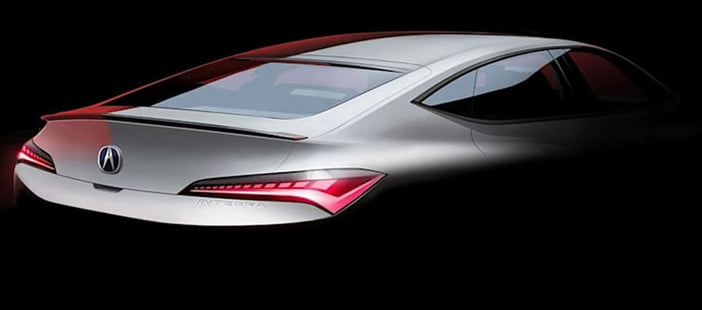
+++ I’m expecting a number of big announcements and debuts this week, like the Jeep Grand Cherokee and Rolls-Royce’s “historic” announcement about electrification. What I wasn’t expecting was Acura to shock us again with another INTEGRA tease. Honda’s luxury arm posted a 7-second clip to Twitter flashing the new Integra’s rear-three-quarter. That tweet came with a link to a landing page at Acura’s site with the image you see below. Although the ILX features the same design language, the switch to a hatch gives us late-model Hyundai Genesis Coupe vibes. That’s not a ding on the Integra, and I have faith in what’s to come. Other than realizing the teased Integra tailgate has a completely different shutline to the new Honda Civic hatchback, the only info we have on the car came in the caption above the image: “Integra Returns In 2022. The fifth-generation Integra will be a premium sport compact with a striking 5-door design. More details about the all-new Integra will be available closer to its 2022 introduction”. Most of this we already knew from the first teaser that dropped in August. The single new addition to our knowledge is the word “sport”. This is a fertile time for reborn nameplates, although not every attempt has stuck the landing (looking at you: Lamborghini Countach). When I mooted ideas for what I’d like a new Integra to be, I wish for “a small, affordable car directed toward enthusiasts”; the kind Acura hasn’t had for a while. I’d be happy with a return of the original Integra with modern underpinnings. Whatever we get, I hope Acura gets it bang on this time. It can’t be that hard to re-create a legendary nameplate that lasted 21 years and still compels pining and lust, can it? Until the next digital hint drops, we’ll go back to pretending not to wait for a surprise from Japan. +++
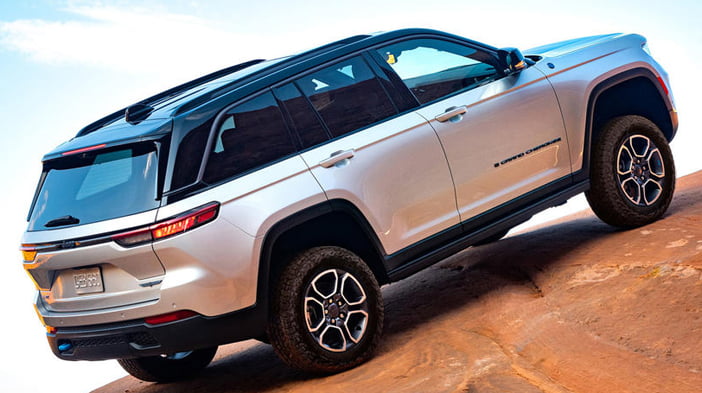
+++ The new JEEP GRAND CHEROKEE will go on sale in Europe in the middle of 2022, offering a plug-in hybrid powertrain for the first time. An electric version is tipped to arrive by 2025. Due to launch in the US early next year, the fifth generation of Jeep’s flagship large SUV has been extensively redesigned with new exterior and interior design, with the firm giving a renewed focus on balancing on-road driving dynamics and off-road capability. The new Grand Cherokee 4xe PHEV features a turbocharged 2.0-litre 4-cylinder petrol engine mated to 2 electric motors, offering a system output of 380 hp and 625 Nm of torque. The alternator is replaced by a motor-generator connected to the engine’s crankshaft, while a larger transmission-mounted motor-generator replaces the torque-converter. A dual-clutch system manages power and torque from the engine and motors. Power for the motors is drawn from a 400 Volt 17 kWh battery that Jeep claims allows for 40 km of electric-only running. 3 driving modes will be offered to manage the energy usage. Notably, the 4xe system will be offered in on the hardcore off-road Trailhawk model, including a 2-speed transfer box, an electric limited-slip differential and Jeep’s Selec-Terrain traction management system. The Trailhawk 4xe will offer 278 mm of ground clearance (90 mm fewer than other Trailhawks) and can be driven through water at depths up to 610 mm. Jeep says that the high-voltage electronics are sealed and waterproof and the battery is protected by underfloor skidplates. The Grand Cherokee includes a raft of other off-roading systems and a new front-axle disconnect option that runs the car in rear-drive mode on smooth roads to boost efficiency. The new Grand Cherokee is built on a new architecture that Jeeps claims was “mission-specific” for the model. It will be offered in two different wheelbases and lengths. The standard 5-seat Grand Cherokee will be 4.910 mm long, compared with 5.204 mm for the 3-row Grand Cherokee L that was tested by Autointernationaal earlier this year. The styling is an evolution from previous models, including a revised 7-slot grille. There’s a lower roofline and numerous other design features (including active grille-shutters, air curtains and redesigned rear pillars) to boost aerodynamic efficiency. Inside, the SUV gains the fastest version of the Stellantis Uconnect infotainment system with up to 3 digital displays (10.1 inch; including 1 dedicated to the front passenger), a 10 inch head-up display, a wireless smartphone charging pad and Apple CarPlay and Android Auto compatibility. As well as the 4xe PHEV, the Grand Cherokee will be offered in the US with a 300 hp 3.6-litre petrol V6 and a 365 hp 5.7-litre petrol V8, both driven through an 8-speed automatic gearbox. While Jeep hasn’t given any details of the European specifications yet, emissions regulations make it unlikely that the V6 and V8 will be offered here. It’s likely that Jeep will focus on the 4xe for our market. +++
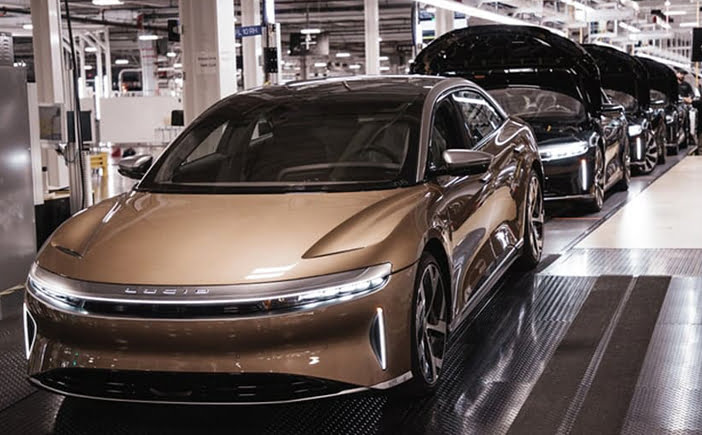
+++ LUCID MOTORS said it will start delivering its luxury electric sedans with a Tesla-beating driving range in late October, in a major challenge to the market leader whose sales of premium models have stagnated. The California-based startup began production of its long-delayed Lucid Air cars at its Arizona factory on Tuesday. The company, founded in 2007, received funding from Saudi Arabia’s Public Investment Fund in 2018 before going public via a shell company in July. Lucid Group’s CEO, Peter Rawlinson, who had overseen Tesla’s Model S development before he left the company in 2012, faces tasks similar to those of Tesla in its early days, including how to address manufacturing challenges and scale up production. “I think the big challenge for Lucid will be execution”, said Sam Abuelsamid, a principal analyst at Guidehouse Insights. “I think that they have a very good car. It’s very attractive”. Lucid said it has received more than 13.000 reservations for Lucid Air models, whose price starts at $77,400. It also said it has increased the planned total production of the top-end Lucid Air Dream Edition to 520 vehicles. That car is priced at $169.000 and will be available in late October, followed by less expensive models: Grand Touring, Touring and Air Pure. A version of the Dream Edition has received an official government rating of a 837 km range, delivering more than 160 km of additional range over its closest rival, Tesla’s Model S, which is priced at $89,990. “The proprietary EV technology that Lucid has developed will make it possible to travel more miles using less battery energy”, said Rawlinson. Lucid has not yet disclosed the battery capacity of the top-end version of the Air, but it said its Grand Touring version has an official EPA rating of 825 km of range with a 112-kWh battery pack. Musk said in June that Tesla has canceled its plan to launch a Model S Plaid+, with a target driving range of 830 km, saying another version is “so good”. Tesla’s combined sales of Model S and Model X luxury models stood at only 1.890 in the second quarter of this year, down from 22.300 during the same period 3 years ago. Tesla does not break out figures for the 2 high-end models. “The Model S doesn’t look fundamentally different from 9 years ago”, Abuelsamid said. “In the premium market, customers are looking for the latest and greatest”. “What Lucid is going to potentially have an advantage is the Air feels like a luxury car, feels a lot more premium,” he said. Tesla CEO Elon Musk in October 2020 cut the price of its Model S, shortly after Lucid announced the pricing of its base model. “The gauntlet has been thrown down! The prophecy will be fulfilled”, he tweeted at that time. Musk reiterated this month that “production is hard”. “Production with positive cash flow is extremely hard”, he said, citing carmakers’ razor-thin margins. Electric vehicle maker Rivian, backed by Amazon.com Inc and now preparing for a public stock listing, earlier this month started production of electric pickups. That move came ahead of similar expected moves by Tesla, General Motors and Ford Motor, which are all preparing to launch such cars too. +++
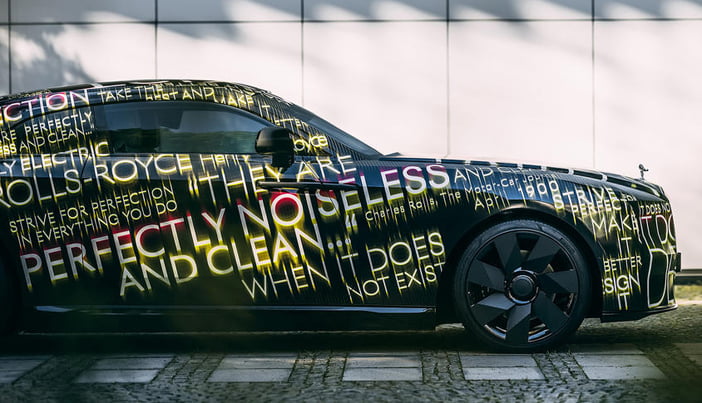
+++ ROLLS-ROYCE will launch its first series-production electric car in late 2023 and has pledged to phase out combustion engines across its entire line-up by 2030. The first product to emerge from this rapid-fire electrification strategy will be the all-new Spectre, which has been previewed ahead of the ‘imminent’ start of what will be a highly publicised on-road development programme. Seemingly based on the Wraith coupé, the development prototype is adorned with one of the best-known quotes from company co-founder Charles Rolls: “Strive for perfection in everything you do. Take the best that exists and make it better. When it does not exist, design it”. The quote’s presence is likely to be a nod to the Spectre’s totally bespoke mechanical make-up, which, Rolls-Royce claims, will be “free of any group sharing strategy”. Rather than using the Cluster Architecture (CLAR) platform that underpins parent company BMW’s new i4 and iX EVs, Rolls-Royce is sticking with the modular ‘Architecture of Luxury’ aluminium spaceframe, used for the current Phantom and Cullinan, that will eventually underpin all Rolls-Royce models. Company CEO Torsten Müller-Ötvös explained that the platform is “scalable and flexible”, allowing for its use in a variety of vehicle segments and “was created to form the foundation of not just different internal combustion engine models, as it now does with Cullinan and Ghost, but models with completely different powertrains”. He said the platform (which brought significant improvements in terms of weight, refinement and rigidity to the 8th generation Phantom) was developed from the start to accommodate an electric powertrain, in addition to the BMW developed V12, which has featured in Rolls’ line-up in various iterations since 1998. Details on what exactly will power the Spectre remain under wraps, and when pressed, Ötvös said only: “We would never use an existing car from the BMW Group and convert it into a Rolls-Royce. That doesn’t work for us”. However, it stands to reason that the 600 hp-plus twin-motor system deployed in the forthcoming iX M60 could find its way into the luxury brand’s models, as it roughly matches the output of the Goodwood firm’s twin-turbocharged 6.6-litre V12. As for the design of the final product, Ötvös suggested that prototypes will give further clues when they hit public roads in the coming weeks, but “what you basically see is what you will later get”. Camouflage obscures most of the test car’s defining features, but the CEO confirmed that it will retain its “fastback-oriented” design into production, which means it will initially sit relatively unrivalled in the nascent electric luxury coupé segment. A series of test cars will be built for the 2-year testing programme and will cover more than 240 million kilometres, equating to roughly 400 years of use, Rolls-Royce says. The beginning of on-road development comes just over a decade after the firm showed off the experimental Phantom-based 102EX concept, with a twin-motor powertrain providing 396 hp and a 71 kWh battery pack giving a claimed 200 km range. The much more radical 103EX concept arrived in 2016 with nearly double that power output and a raft of clues as to how the company will adapt its traditional design cues to suit electric cars. +++
+++ TOYOTA is revving up acquisitions in mobility technology, adding Renovo Motors, a Silicon Valley software developer, to its Woven Planet team, which is working on automated driving. The addition, announced Tuesday, follows the purchase earlier this year of Carmera, a U.S. venture that specializes in sophisticated road mapping updates made cheaper and faster by using crowdsourced information obtained from millions of net-connected Toyota vehicles. The company has not disclosed the value of either deal. Renovo develops automotive operating systems, which Toyota sees as essential for developing programmed vehicles so it can transition to what it calls “a mobility company” that includes more than just cars. Renovo means “new life” or “renew” in Latin. Renovo’s data-management platform enables automakers to continuously learn from their vehicles, using a so-called “complete loop” approach, so vehicles can become safer and more reliable. “In Woven Planet and Toyota, we’ve found partners committed to doing exactly what we have always wanted to do, on a global scale, and that’s a great feeling”, said Renovo chief executive Christopher Heiser. Woven Planet, Toyota’s wholly owned subsidiary, earlier acquired San Francisco-based Lyft’s self-driving division Level 5. Chief Executive James Kuffner said more acquisitions may be coming. “The big picture is Woven Planet creating a ‘dream team’ of software and vehicle engineering people globally to deliver the world’s programmable and safest mobility. That’s the context”, he told. “Always as an executive, you are trying to balance the speed and the growth versus the focus and maintaining company culture. The larger you grow, the risk is that you slow down”, he said. “We will keep growing, but we are going to be careful”. Kuffner declined comment on a recent accident at the Paralympics Athletes Village in Tokyo, when a Toyota bus equipped with automated driving technology bumped into a Paralympian athlete and injured him. The accident is still under investigation and may be an example of the kinds of hurdles to be overcome before the technology can be widely used on public roads. The bus isn’t approved for widespread use on public roads but was shuttling athletes and officials at the Village during the Tokyo Olympics and Paralympics. A human driver was on the vehicle as a safety precaution. President Akio Toyoda has apologized and promised improvements. Major automakers are working on various driving technologies. Vehicles of electric car maker Tesla equipped with its Autopilot driver-assist system have been in several crashes, including fatal ones, in the U.S. Some analysts say companies should avoid suggesting cars sold today with such technology can safely drive themselves. Woven Planet, known previously as Toyota Research Institute, is working on technologies spanning “smart” cities, green energy and mobility solutions and robotics that are meant to eventually become consumer products, said Kuffner, who has worked on Google’s self-driving cars and robots at Boston Dynamics. +++