
+++ APPLE ’s talks with China’s CATL and BYD over battery supplies for its planned electric vehicle have been mostly stalled after they refused to set up teams and build U.S. plants that would solely cater to the tech giant, 3 people with knowledge of the discussions said. The firms informed Apple sometime in the past 2 months that they were not able to meet its requirements, the people said. But the U.S. company has not given up hope of resuming talks with either CATL or BYD, according to one source. Chinese battery makers are more advanced than rivals in the development of lithium iron phosphate (LFP) batteries which are cheaper to produce and sources have previously said Apple favors this battery technology. CATL, the world’s No.1 maker of batteries for EVs, has been reluctant to build a U.S. factory due to political tensions between Washington and Beijing as well as cost concerns, said one of the people with direct knowledge of the talks. The Chinese firm has also found it impossible to set up a separate product development team exclusively working with Apple due to difficulties in finding sufficient personnel, the person added. BYD, which has an iron-phosphate battery plant in Lancaster, California, declined to build a new factory and team that would solely focus on supplying Apple, said 2 of the sources. The stalled discussions have meant that Apple has been considering Japanese battery makers and it sent a group of people to Japan this month, they added. Panasonic is one of the companies that Apple is considering, said 1 of the people. The sources declined to be identified as the talks were confidential. Apple, BYD and Panasonic declined to comment. CATL said in a statement that it denied “the information”. “We are evaluating the opportunity and possibility of manufacture localization in North America”, the statement said, adding that it has a dedicated professional team exclusively for each customer. Any delays in securing battery supplies could further impede EV development for Apple which last month lost the head of its car project, Doug Field, after he decided to return to Ford. Tesla, which has been making some of its Model 3 and Model Y cars in China with LFP batteries from CATL, said this week it intended to use that battery chemistry outside China as well. CATL and BYD use a type of battery pack technology to improve the performance of LFP batteries. Without that, LFP batteries usually offer much shorter driving ranges and lower energy density than the more expensive lithium batteries that use cobalt and nickel. +++
+++ The new BMW X1 is due to arrive next year and the Bavarian marque is preparing a top-flight M35i version to do battle with the Mercedes-AMG GLA 35. The new X1 will utilize an updated version of BMW’s UKL2 platform, which underpins the 1 Series hatchback. For the sporty M35i model, BMW is likely to fit the powertrain and running gear found in the M135i hot hatch, which uses a 2.0-litre four cylinder turbocharged petrol engine producing 306 hp and 450 Nm of torque, driving through an 8-speed automatic gearbox. Power is sent to all 4 wheels via BMW’s xDrive system. The X1 M35i could incorporate a honeycomb mesh design, as used by its M135i hot-hatch sibling. Elsewhere, the M35i is likely to adopt the front bumper design of the forthcoming X1 M Sport model, with a deeply sculpted, aggressive lower grille arrangement. A set of LED headlights with a C-shaped running light signature can also be seen through the disguise. The hot SUV also wears a set of 2-tone diamond-cut wheels, shod in Michelin Pilot Sport 4 S tyres, further underlining the car’s sporting pretensions. The same chunky, baby-SUV side profile of the standard X1 remains, although this range-topping model features a tweaked roof spoiler with 2 vertical fins either side of the central brake light. Interestingly, this car might get a set of quad-tailpipes, integrated into a more sporting rear bumper. To date, only fully-fledged M cars have used 4 tailpipes, so we expect a twin-tailpipe setup to be used for the final production car. Inside, the new X1 is likely to use BMW’s new dashboard architecture that debuted on the iX and has been recently applied on the new 2 Series Active Tourer. This is centred around a curved display incorporating the brand’s latest iDrive 8 infotainment system with fully digital instrumentation. As for sportier touches, the M35i version of the new X1 will gain a sports steering wheel and more supportive seats. +++
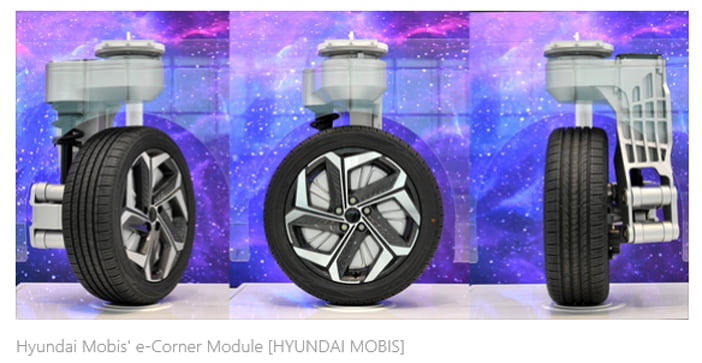
+++ HYUNDAI MOBIS has developed wheel technology that is able to rotate by 90 degrees to enable sharper cornering and easier parking. Hyundai Mobis said it developed wheel technology dubbed e-Corner Module that combines functions for driving, steering, braking and suspension in a package that can be installed on each wheel. The module takes away the need for mechanical parts such as drive shafts that connect the steering wheel to the wheels, according to Hyundai Mobis. “The application of the e-Corner Module takes away the need for some mechanical parts that used to connect components, which allows the vehicle to have more space”, the company said. “It also allows for easier changes in the wheel base and easier design of doors and vehicle size”. Before, a car’s wheel generally was able to rotate 30 degrees, which limited cars making sharp cornering or parallel parking in a compact space. The 90-degree-rotating wheels, according to Hyundai Mobis, allow the vehicle to move from side to side, instead of back and forth, and also a 360-degree rotation on where it stands. The system which was first premiered at the 2018 Consumer Electronics Show is currently under review for mass production, Hyundai Mobis said. It is planning to receive orders from carmakers in the near future. +++
+++ Just a few months after the launch of the all-new MERCEDES S-Class, AMG is almost ready to reveal its substantially more potent take on the luxury flagship. Marking itself out as the Affalterbach-fettled car by its sports wheels, unique grille, bespoke bumper designs and square-tip quad-exit exhaust, the prototype was captured by my photographers on public roads and at the Nurbürgring. Its light exterior camouflage and production ready-interior suggesting a reveal will take place in a matter of months. As with the previous-generation car, the S 63 can be expected to retain the tech-heavy interior and overall proportions of the luxury-focused standard car, while gaining significant chassis tweaks alongside its more powerful engine, which will be exclusively hybridised for this iteration. 2 plug-in AMG-badged variants are inbound, both propelled by a variation of the same twin-turbocharged 4.0-litre V8 that powers the brand’s GT and GLE 63. The standard S 63e 4Matic+ will mate the petrol engine with a 136 hp electric motor for a combined output of around 700 hp, while a more potent range-topper will boost overall output to 840 hp, courtesy of an uprated 204 hp electric motor, as already deployed in the new GT 63 S E-Performance. It’s not yet clear which model has been spotted here, but visual differences between the performance duo are likely to be minimal, as is the case with AMG’s E-Class-based E 53 and E 63. The S65 will not return for this generation, with its V12 engine continuing only in the Maybach-badged range-topping versions of the S-Class and GLS. In 2019, Mercedes launched the S 65 Final Edition as the previous-generation S-Class bowed out of production, taking with it the 12-cylinder engine and marking an end to nearly 30 years of V12 powered non-Maybach models. +++
+++ Edison Motors will ask for a loan of some 700 billion to 800 billion won ($596 million-$681 million) from Korea Development Bank to acquire the troubled SSANGYONG, its chief executive officer said. The electric bus maker-led consortium looks set to be chosen as the preferred bidder for the debt-ridden SsangYong, after a bankruptcy court eliminated its strong contender from the competition, citing doubts over its funding capability. Holding an online press conference, Edison Motors founder and CEO Kang Young-kwon expressed confidence that the consortium led by his company will be able to channel the funding needed to buy SsangYong, the country’s longest-running auto brand. The state-run lender KDB is the main creditor of SsangYong. “It is not a credit loan. It is a secured loan with SsangYong’s assets as collateral, so there is no reason for the KDB to reject it”, Kang said, adding that SsangYong Motor is valued at some 2 trillion won. During a parliamentary audit session Tuesday, KDB chairman Lee Dong-gull sounded cautious on the bank’s financial support, as it has not yet fully evaluated Edison Motors’ business proposal. Edison Motors estimates the acquisition and post-acquisition revival program for SsangYong Motor to cost about 1.48 trillion won to 1.62 trillion won. Of that money, the undertaking fund of 310 billion won and operation costs of up to 530 billion will be raised by the consortium through stock issuance or by attracting outside investments, Kang said. “Even if the KDB rejects the loan request, we can take out secured loans from other banks, albeit with higher interest rates, or even from banks outside of Korea”, he added. While SsangYong has focused its business on SUVs, the Edison Motors chief said he has plans to change SsangYong into a strong player in electric vehicles. Kang also spoke of diversification of its product portfolio to include compact vehicles and sedans as well, if demand exists. For the company to gain profit, he said the annual production volume should triple to some 300.000 vehicles which would include some 150.000 electric vehicles and 50.000 hybrid vehicles, Kang said. “We will make electrified versions of all the existing SsangYong models by transforming Edison Motors’ unique EV systems to fit the forms of SsangYong”, Kang said, explaining that this method would cut costs and time. Setting a goal to achieve a net profit of some 10 trillion won by 2030, Kang said he plans to reopen the second manufacturing line in SsangYong’s Pyeongtaek production plant in Gyeonggi Province, which is currently out of operation. The first and third lines are in operation, so they can continue to produce the SUVs and other passenger vehicles, Kang said. Edison Motors’ new production plant in Gunsan, North Jeolla Province, will be making midsized and large electric buses and trucks while, the headquarters plant in Hamyang, South Gyeongsang Province, will be in charge of developing and producing other mobility vehicles, such as personal air vehicles, electric yachts and ships and electric camping buses, Kang added. During the press conference, the Edison Motors chief also stressed that he will not lay off SsangYong workers, saying it is not necessary. “I am not trying to acquire SsangYong to become a chaebol or anything. If SsangYong goes bankrupt, some 60.000 to 100.000 workers, including all of those from partner companies, will lose their jobs”, Kang said. “I don’t believe restructuring guarantees a return to profit or improvement in performance. I want to revive the company and create a good work environment for the employees”. Last week, SsangYong said it had recommended the Edison Motors consortium as the preferred bidder for the automaker to the Seoul Bankruptcy Court. Edison Motors’ consortium includes homegrown activist fund Korea Corporate Governance Improvement, Keystone Private Equity and electric vehicle component maker Semisysco. By the end of this month, SsangYong and its lead manager the EY Hanyoung accounting firm will submit an official request to the court to approve Edison Motors as the preferred bidder, and then sign a memorandum of understanding with the electric bus maker for the acquisition deal, according to SsangYong. Before signing the final contract for acquisition, the Edison consortium will conduct a two-week due diligence on SsangYong. The biggest supplier of electric buses to the city of Seoul, Edison Motors recorded sales of 80.9 billion won with an operating profit of 5.6 billion won in 2019. +++
+++ STELLANTIS has struck a preliminary deal with battery maker LG Energy Solution (LGES) to produce battery cells and modules for North America, as the world’s No. 4 automaker rolls out its €30 billion electrification plan. Global automakers are investing billions of euros to accelerate a transition to low-emission mobility and prepare for a progressive phase-out of internal combustion engines. Stellantis and LGES’s joint venture will produce battery cells and modules at a new facility with an annual capacity of 40 gigawatt hours (GWh), the 2 firms said. No financial details of the deal were provided. The plant is scheduled to start production by the first quarter of 2024, with groundbreaking expected in the second quarter of 2022, the companies said in their statement. Its location is under review and will be announced later. Stellantis, formed in January from the merger of Italian-American automaker Fiat Chrysler and France’s PSA, has said it wants to secure more than 130 GWh of global battery capacity by 2025 and more than 260 GWh by 2030. The batteries produced under the deal will supply Stellantis’ U.S., Canadian and Mexican assembly plants for installation in hybrid and fully electric vehicles, supporting its goal of e-vehicles making up more than 40% of its U.S. sales by 2030. The company, whose brands include Peugeot, Fiat, Opel and U.S. best-sellers Jeep and Ram, earlier this year announced it would invest more than €30 billion through 2025 on electrifying its vehicle lineup. Stellantis has said it would build 3 battery plants in Europe and 2 in North America, including at least 1 in the United States. Intesa Sanpaolo analyst Monica Bosio said the deal was positive, and a further step ahead in Stellantis’ electrification process. It comes weeks after Stellantis and its partner TotalEnergies agreed to open up their battery cell joint venture ACC to Daimler, to expand their European sourcing of battery cells. Stellantis is also targeting more than 70% of sales in Europe to be of low-emission vehicles by 2030, and aims to make the total cost of owning an EV equal to that of a gasoline-powered model by 2026. +++
+++ South Korean battery maker Samsung SDI and STELLANTIS have agreed to jointly produce electric vehicle (EV) batteries for the North American market, a person familiar with the matter said. Samsung SDI, an affiliate of South Korean tech giant Samsung Electronics, already has EV battery plants in South Korea, China and Hungary, which supply customers such as BMW and Ford. “The 2 companies (Samsung SDI and Stellantis) have struck a MOU (memorandum of understanding) to produce EV batteries for North America”, the person with knowledge of the matter told. The source spoke of condition of anonymity because of the sensitivity of the matter. The person said the location of the battery joint venture is under review and will be announced later. In July, Autointernationaal reported that Samsung SDI may build a battery plant in the United States, citing a company source. South Korea’s Yonhap news agency earlier reported the 2 companies plan to build a factory in the United States, citing industry sources. +++
+++ Many people are passionate about climate change, but not everybody should drive a battery electric vehicle as a means to combat it, TOYOTA chief scientist Gill Pratt said. Pratt’s comments, during a discussion on electric vehicles, appeared to amplify remarks made over the past year by Toyota president Akio Toyoda.
Toyoda and other company officials have said that electric vehicles will play a greater role in reducing emissions, but other solutions should be used, Toyota’s gasoline-electric hybrid models or hydrogen-powered fuel cell electric vehicles. Pratt said Toyota believes in “diversity of drivetrains” to give customers different tools to reduce CO2. “It’s not for us to predict which solution is the best or say only this will work”, he said. Government incentives should be aimed at reducing carbon emissions, not picking which car technology is the best way to achieve those goals, Pratt added, in a reference to proposed bans on internal combustion engine (ICE) vehicles, including hybrids, as a means of achieving carbon neutrality. Toyota was among major automakers that supported the Trump administration in its attempt to bar California from setting its own zero-emission requirements, but the company dropped that support earlier this year. Toyota has said it plans to invest $13.5 billion through 2030 on EV batteries, but so far its plans to roll out new battery electric vehicles (BEVs) seem relatively modest compared with those of U.S. automakers General Motors and Ford, which are spending around $30 billion each through 2025 to electrify more of their vehicle lines. Toyota executives continue to tout the merits of the company’s hybrid vehicles, which have been on the market for more than 20 years, and the company has long explored hydrogen fuel-cell technology. +++
+++ VOLKSWAGEN has produced just 300,000 cars at its main Wolfsburg plant so far this year, a company source with knowledge of the matter said, the lowest figure since 1958 and far behind its average output before the pandemic. The plant, which makes cars from the Golf, Tiguan and Seat brands among others, produced an average of 780.000 vehicles per year in the past decade and the company said in 2018 it aimed to boost this figure to a million. But supply chain problems meant just under 500.000 vehicles made it off the assembly line in 2020. This year’s output is set to be even lower as the chip crisis sets in. Volkswagen has previously said it would have a production shortfall in the high hundreds of thousands due to a lack of semiconductors, a problem plaguing automakers worldwide which the company expects to last well into 2022. A spokesperson said last week that discussions were underway to address the competitiveness of the Wolfsburg plant, which does not yet produce fully electric vehicles, particularly in the face of growing competition from new entrants such as Tesla. The comments followed reports that Volkswagen CEO Herbert Diess had said at a supervisory board meeting in September that a delay in the transition to electric vehicles could cost the company 30,000 jobs; 25 percent of its current employees. +++
+++ VOLVO is looking to raise 25 billion kronor ($2.9 billion) in a Stockholm initial public offering in a test for automakers amid the transition to electric vehicles. The Swedish carmaker, owned by China’s Zhejiang Geely Holding Group, is offering shares at 53 kronor to 68 kronor each (about $6-$8), according to a statement. The deal values Volvo at as much as $23 billion, 11 years after the Chinese firm bought the business from Ford for $1.8 billion. The IPO is set to be Europe’s largest since January. The carmaker, with an ambitious plan to only sell full electric cars by 2030, plans to use the funds to add carmaking capacity so it can nearly double annual sales to more than 1.2 million vehicles. Volvo Cars also plans to construct a battery plant in Europe. “We have a very clear strategy to be an electric company in 2030 and we’ve been on that journey for some years now”, Volvo CEO Håkan Samuelsson said in an interview. “With this, of course, we can secure that transformation, because of course, it’s not free of charge”. Volvo’s projected market capitalization of about $20 billion compares to roughly $65 billion for BMW, while the German premium carmaker produces more than 2 million vehicles versus Volvo Cars’ 660,000 last year. Newer entrants to the industry such as China’s Nio and Tesla have seen their share prices surge past traditional manufacturers even as they sell only a fraction of the number of vehicles. The IPO also comes less than a month after electric-vehicle maker Polestar, controlled by Volvo and Geely, said it will go public in New York via a blank-check merger. The deal implies an enterprise value of $20 billion for the startup, with Volvo expecting to hold a 50 % stake in Polestar after it lists. While the century-old Swedish industry stalwart and Polestar have similar valuations, 4-year-old Polestar has a target of delivering only about 29.000 cars this year. Geely previously attempted to take Volvo public in 2018, but called off the listing after investors were said to balk at its valuation expectations of as much as $30 billion. A group of pension funds and institutional investors have committed to buying 6.4 billion kronor worth of shares in the IPO. The offering of as much as 21 % of Volvo runs through October 27, and the shares are set to start trading in Stockholm on October 28. Goldman Sachs Group and SEB AB are global coordinators on the IPOs, alongside bookrunners Morgan Stanley, BNP Paribas, HSBC Holdings, JPMorgan Chase & Co and Nordea Bank. Carnegie Investment Bank and Swedbank AB are co-lead managers. The IPO is set to be Europe’s biggest since Polish parcel-locker provider InPost SA’s 2.8 billion-euro offering in January. +++