
+++ ASTON MARTIN is currently testing a high performance variant of its first SUV at the fearsome Nürburgring. Reportedly called the DBX S, the SUV should boast some serious performance. It will get an enormous grille with big air inlets at the front, as well as four tailpipes at the back; all signs point to a big engine with big cooling needs under the hood. There will also be massive brakes behind big wheels, which fits well with the high-performance variant of the SUV. First launched in 2020, the DBX has lit up the sales charts, somewhat unsurprisingly. At an investor presentation early this year, the company promised “expansion with derivatives and new car lines,” based on the DBX platform. To date, we’ve also seen a hybrid version of the DBX testing. Unfortunately, I don’t know what engine the DBX S will have under its hood, but rumors suggest that it will be excessive. Currently, the SUV is powered by a Mercedes-derived twin-turbo, 4.0-liter V8 that makes 550 hp and 700 Nm. If Aston Martin wants to stick with the V8, there’s still some power to squeeze out of it as evinced by the Mercedes-AMG GLE 63 S, which uses the same engine and gets 611 hp and 850 Nm of torque out of it. Rumors, however, suggest that Aston Martin may opt to go even more over the top and add a quartet of cylinders. If it so chooses, the automaker currently sells the DBS Superleggera with a 5.2-liter twin-turbo V12 that makes 725 hp and 900 Nm. Regardless of which way Aston Martin goes, the result should be mightily impressive. “O Gymru,” for those who saw it on the windows and were curious, is Welsh for “From Wales,” where the DBX is made. +++
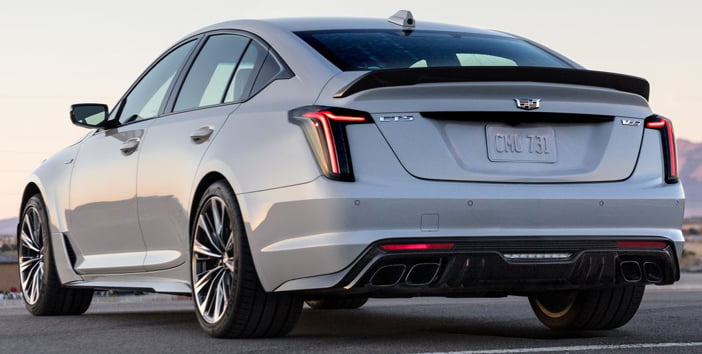
+++ The CADILLAC CT5-V Blackwing, BMW M5 CS, and Tesla Model S Plaid are 3 of the most remarkable performance sedans on the market. Most of the comparisment is focused on the CT5-V Blackwing and M5 CS, which is fitting as these two are the closest of rivals whereas the Model S Plaid appeals to a slightly different kind of buyer. Nevertheless, it is brought along to show just how quick sedans can be when they ditch a gas-guzzling V8 in favor of 3 electric motors. Powering the CT5-V Blackwing is a supercharged 6.2-liter V8 with 668 hp and 893 Nm paired to an eight-speed auto. All of this grunt is sent through its rear wheels and what separates the CT5-V Blackwing from all its competitors is the fact that it can be ordered with a 6-speed manual transmission which Cammisa says is excellent. By comparison, the M5 CS has a 4.4-liter twin-turbocharged V8 with 635 hp and 750 Nm of torque. Unsurprisingly, both the BMW and the Cadillac are blown away by the Tesla in a drag race, but that’s no surprise given that it delivers an extraordinary 1.020 hp. All 3 spent some time lapping the Willow Springs International Raceway during the review. First, the M5 CS set a new sedan record, lapping the circuit in 1:28.76. It was promptly beaten by the CT5-V Blackwing that posted a 1:28.07. Then, the Tesla came along and beat the Cadillac with a 1:27.78 lap. +++
+++ MPV sales have dropped significantly since SUVs are offering a similar level of practicality combined with rugged styling that is more popular with buyers. CITROEN is aware of that and, apparently, they stop offering traditional MPVs sometime in the near future. Citroën’s CEO Vincent Cobée admitted they have been “the last of the Mohicans for a number of years”, referring to the Grand C4 Spacetourer that is still on sale. More importantly, he added that “We need to acknowledge that we’re overly dominating that segment and the segment is fast, fast, fast disappearing”, which could be a hint that the French company is actively considering dropping the model from its range. In summer 2020, Cobée stated: “We will continue to sell the Grand C4 Spacetourer as long as we can as long as we can make it and as long as we can find customers”, adding that they would keep upgrading the existing car but keeping a rather skeptical approach on a possible next generation. It is true that the French company is one of the few automakers that are still offering MPVs alongside Renault (Scénic) and Volkswagen (Touran), although both of the aforementioned models are reportedly walking on thin ice. Most competitors have already used their small and compact SUVs as indirect successors of five-seater MPVs, with medium-sized SUVs and passenger variants of light commercial models taking the role of versatile seven-seaters. We suspect that this will be the case for Citroën in the near future since the range has plenty of models to make up for the demise of the aging compact MPV. The C3 Aircross B-SUV is practical enough for small families while for those who want more room there is the larger C5 Aircross that offers 5 individual seats and a large boot. For buyers who want maximum practicality, there is the Citroën Berlingo that’s available in both regular and long-wheelbase variants, and also comes with a fully electric powertrain. Similarly, the even larger van-based SpaceTourer and E-SpaceTourer take up the upper end of the spectrum. The good thing about van-based proposals is that there is always room for a next-generation model since the development costs are shared between several companies and the LCV segment is growing, hence bringing more money into the automaker’s registers. The end of the line for the C4 Spacetourer started in 2019 when the five-seater version was discontinued for markets outside France, with the production ending in summer 2020. However, the 7-seater Grand C4 Spacetourer kept going and it is still available today after getting subtle updates and a special edition last year. Given its slow sales and Cobée’s statements, though, we suspect that it is living on borrowed time. +++
+++ New allegations of diesel emissions manipulation have been levelled against DAIMLER after a German environmental group claimed to have found 8 new ‘defeat devices’ in a Euro 6-classified Mercedes-Benz E-Class. The Deutsche Umwelthilfe (DUH) organisation discovered that emissions of poisonous nitrogen oxide (NOx) spiked by up to 500% during tests of a 2016 Mercedes E 350d Bluetec. Mercedes parent firm Daimler has previously been forced to recall 774.000 diesel cars after German KBA association found “unauthorised defeat devices” in 4-cylinder diesel engines with an SCR filter using AdBlue to reduce emissions. Daimler argued at the time that car makers are permitted to switch off the SCR filter in diesel engines in the interests of engine longevity. However, critics have argued that car makers have used loopholes in the rules to make cars appear clean in laboratory tests while allowing significantly higher emissions in normal driving. DUH claimed six of the defeat devices found on the 6-cylinder engine in the E 350d related to the SCR filter system, reducing the amount of AdBlue cleaning fluid used, while two affected the vehicle’s exhaust gas recirculation system. DUH said its tests related to a single model but would be relevant to other vehicles using the same engine, citing the ability of manufacturers to use the same registration data for a particular engine across a number of different models. Model lines using the OM642 engine with the Bluetec SCR system, for example, include the E-Class, GLC, GL and G-Class. DUH did not give a figure for the cars affected but estimated the “vast majority” of diesel passenger cars with Euro 5 and early Euro 6a and 6b versions of the six-cylinder engine will be affected. “Daimler couldn’t plausibly claim that the defeat devices were needed for engine protection”, said Jürgen Resch, federal managing director of DUH. “The reason is as simple as it is cynical: it is about maximising profit at the expense of the environment and the health of the city dwellers”, Daimler denies these allegations. 2 of the defeat devices depend on what DUH called an “ageing factor” that lowers the point at which the shutdown devices start. In 2 cases, this happens after just 1 % of the vehicle’s life expectancy, within a few thousand kilometres. A further reduction occurs after around 20% of vehicle life. Another defeat device was activated when the driver selected Sport mode, reducing the amount of AdBlue fluid the exhaust system used to clean emissions. “This I would consider fraud”, Resch said. Previous defeat devices have been focused on emissions reduction at lower temperatures. DUH’s report was funded by the international law firm Milberg, which is leading class action lawsuits on behalf of owners in Europe. A Mercedes spokesperson told: “In our view, these are not to be assessed as illegal defeat devices in the interaction and overall context of the highly complex emission control system. The vast majority of rulings in German regional courts and higher regional courts continue to be in Daimler’s favour. In approximately 95 % of cases, the courts rule in favour of the company. At the regional court level, there are more than 15.500 decisions dismissing lawsuits in favour of the company. In only about 900 cases was the decision against the company. There are now around 900 decisions in our favour at the higher regional courts and only three decisions against us. The German Federal Court of Justice (BGH) has also confirmed key points of Daimler AG’s legal opinion in several decisions. In particular, the Federal Court of Justice (BGH) has held in these and other decisions that an allegedly inadmissible defeat device in the engine control unit alone does not give rise to a claim for damages”. Car makers including the Volkswagen Group, Renault, Nissan, Volvo, Fiat and Jaguar Land Rover have been dogged by claims in Europe that they sought to reduce the effectiveness of diesel emissions reduction systems as the need to reduce tailpipe poisons grew ever tougher. The VW Group’s manipulation was exposed by US regulators in September 2015 in a scandal that has so far cost the company more than €30 billion (£27 billion). The fallout continues to rumble on today as owners seek to recover damages. +++
+++ FISKER ’s electric Ocean SUV will source its batteries from CATL, the 2 companies have confirmed. A statement released by Fisker reveals that CATL “will supply 2 different battery solutions” for the Ocean with an initial battery capacity of over 5 gigawatt-hours annually. The primary high-capacity battery pack will use lithium nickel manganese cobalt cell chemistry while the second high-value pack will be based on lithium-ion phosphate chemistry. “Securing this supply agreement with CATL is another important step in the development of the Fisker Ocean and achieving our battery performance objectives”, chief executive and chairman Henrik Fisker said. “By utilizing multiple chemistries and designing an extremely efficient pack, we will be able to achieve our targeted driving range for the Fisker Ocean Sport and bring segment benchmark-driving range to the longer-range versions of Fisker Ocean”. No details have been provided about the capacities of these batteries but they will work alongside the Ocean’s optional solar roof. Both battery pack solutions are also engineered to support peak charging of over 250 kW. Fisker will unveil the production-spec Ocean at the Los Angeles Auto Show on November 17 and will provide full detailsabout the SUV, including its battery packs, during the event. Earlier this year, Fisker reached a manufacturing agreement with Magna International that will see the contract manufacturer begin production of the Ocean in November 2022. Fisker is also working on a second vehicle known as Project PEAR (Personal Electric Automotive Revolution). This vehicle could be produced at the same Ohio factory as the Lordstown Endurance and will be built by Taiwanese technology company Foxconn. +++
+++ American EV start-up RIVIAN has hit headlines globally after ex-sales and marketing boss Laura Schwab spoke out about a “toxic bro culture” at the company, which she links to her sudden termination last week. In a detailed blog post, Schwab (who previously served as Aston Martin’s president of the Americas) – outlined an abrupt dismissal from her high-ranking executive role at Rivian, which she claims is operated as a “boys club” centred around founder and CEO RJ Scaringe. She is now suing the company over her termination with a lawsuit filed at a California Superior Court in Orange County. She alleges that Rivian has damaged her reputation and cost her “millions of dollars in unvested equity on the eve of the company’s IPO”. Rivian was approached for comment, but the company has so far not responded publicly to the allegations, citing a “quiet period” in the run-up to its planned stock-market flotation. Schwab joined Rivian with 20 years of automotive industry experience, having started at Jaguar Land Rover and worked her way up to become Aston Martin’s first female president. Joining Rivian as it ramped up to put its R1S and R1T 4x4s into production, she said it was a “crushing blow” to discover a “toxic bro culture that marginalises women and contributes to the company making mistakes”. She has alleged that, upon arrival, the company had “no organisation in place to ensure a successful launch of the promised 1.000 vehicles” and that she was excluded from top-level board meetings that had a direct impact on her role vice-president of sales and marketing. Rivian is “dominated by men at the top”, she said, and there’s “a lack of experience among the other executives”. Her concerns about vehicle pricing and manufacturing deadlines were allegedly ignored until raised by her “often less experienced” male colleagues, which she considers a case of “blatant marginalisation”. Schwab learned that another female senior executive was also being excluded from these meetings, in a direct contradiction of the forward-thinking values that Rivian extols publicly. Finally, Schwab outlined her perception of Rivian’s “bro culture” to her HR business partner and came away “optimistic that change would happen”. But 2 days later, she was fired as part of what Rivian called a larger “reorganisation”. Schwab called the termination “bullshit” and said there was no coincidence that it came just two days after she voiced her concerns. Firing the sales and marketing boss “on the eve of an IPO” and as Rivian gears up to a full market launch, “is simply not credible”, she said. Schwab called Rivian’s culture “toxic” and said that it has a pattern of marginalising women but “they’re not the only ones”. She said she has come forward with her story to hold the manufacturer accountable and to encourage other women to question the culture at their workplace. Rivian has had significant investment from industry giants Ford and Amazon and is widely viewed as a credible threat to Tesla. Its IPO could take place as early as next week, with sources suggesting it will seek a valuation of $60 billion. +++
+++ With cars becoming more expensive due to the strict emission regulations and batteries becoming cheaper, it is inevitable that fully electric models will become just as, or even more, affordable than the equivalent ICE-powered proposals in the near future. VOLKSWAGEN is heavily betting on this scenario for the smallest member of the ID family, the ID.2, which is coming in 2025 with a price tag of €22.000 in the Netherlands. The ID.2 was previewed by the ID.Life concept car in Munich last September. The production version might be years away, as it is scheduled for a late 2025 premiere, but the fully working prototype gives us a good idea of the design language. The model will be a B-Segment crossover, while a slightly smaller and lower-riding sibling bearing the ID.1 nameplate will follow later as a successor to the e-Up city car. Instead of looking like a shrunken ID.3, the ID.2 will have its own identity with a boxy shape and a rather minimalist styling approach. Our exclusive rendering shows how the production model could look by toning down some features of the ID.Life. On the profile, the production model will probably feature conventional door handles and mirrors, while skipping the fancy removable roof of the concept. At the front, the covered grille is painted in black with the more conventional headlights sending strong Beetle vibes with the rounded LED graphics. The bumper gets a modern intake similar to the multi-hole pattern introduced by the ID.3 and an aluminum-style skid plate for a more adventurous look combined with the increased ground clearance. Judging from the ID.Life, the ID.2 will have a similar footprint to the ICE-powered T-Cross. The concept car measured 4.091 mm in length, 1.845 mm in width and 1.599 mm in height, with a wheelbase of 2.650 mm. Concept cars tend to have futuristic design features inside that are not intended for production. In this context I guess that the projector creating a 34 inch screen on the windshield, the yoke steering wheel and the hidden touchscreens on the dashboard won’t make it to the ID.2. What will likely make it though is the extensive use of sustainable and recycled materials, the foldable seats plus the lack of infotainment screen which is replaced by the user’s smartphone, at least in the lower trim levels. Underpinning the ID.2 will be a shortened version of the MEB platform that is already used on the ID.3 and ID.4 alongside other fully electric models of the VW Group. It will be called MEB Eco and will be shared with a B-SUV from Seat, a hot-hatch by Cupra, a budget-friendly EV by Skoda and the smaller Volkswagen ID.1. Instead of sizing out the overall dimensions, VW engineers have tweaked several characteristics of the MEB platform in order to make it a better fit for the smaller vehicles of the VW Group and reach the ambitious base price target. Firstly, the electric motor is mounted at the front instead of the rear, which makes the ID.2 a FWD-only vehicle, allowing for more luggage space at the back and a frunk for charging ports and cables. In the ID.Life the e-motor produced 234 hp and 290 Nm, but in production we expect a less powerful unit since this is not a performance-oriented offering, although it will be interesting to see whether VW will launch a performance GTX variant. For cost efficiency, the battery packs in the MEB Eco platform will used lithium-ion phosphate cells instead of lithium-ion nickel manganese cobalt ones. The ID.Life came with a 57 kWh battery capacity offering a 400 km range, although the ID.2 will most likely come with a range of different battery packs. The €22.000 advertised starting price for the ID.2 would make it considerably cheaper compared to B-Segment EVs currently available such as the Peugeot e-208, Opel Corsa-e, Honda e and Mini Cooper SE, and could be on par with the upcoming Renault 5 E-Tech Electric. The production of the VW ID.2 will probably take place in Spain, alongside its sister models. Seat has confirmed its annual production goal of 500,000 urban EVs in its Martorell factory by 2025, and the ID.2 is likely to be part of that family. +++