
+++ AUDI has delayed the introduction of the new A4 e-Tron until 2029 as development of the Volkswagen Group’s long-awaited Scalable Systems Platform (SSP) faces further setbacks. The new electric D-segment car, conceived as a direct rival to the electric-powered BMW i3, Mercedes-Benz C-Class EQ and Tesla Model 3, was originally planned to enter production at Audi’s Ingolstadt plant in Germany in 2028 as one of the first models based on the SSP architecture. However, production of the A4 e-Tron is now not planned to begin before 2029. That leaves Audi without a contender in the increasingly competitive mid-sized exec EV class, into which rivals BMW and Mercedes have recently pitched the i3 and C-Class EQ respectively. The delay leaves Audi facing a significant gap in its electric model line-up: the combustion engine A4, renamed A5 e-Hybrid, in its latest generation, has traditionally played a key role in the German car maker’s annual sales, and the electric equivalent was expected to be a similarly important contributor. It also represents another setback for the SSP, following sibling brand Volkswagen’s announcement that development of the ID.Golf on that platform had been delayed due to cost constraints. When the 800V SSP was announced in 2021, it was intended eventually to replace not only today’s 400V MEB and 800V PPE platforms, but also the MQB, MLB and MSB architectures used by the group’s sprawling ICE car line-up. At the time, the group intended to develop a single architecture that could be used across different segments and drivetrain classes, rather than continuing with separate platforms. Production of SSP models was originally planned to begin in 2026, with the Volkswagen Group projecting that more than 40 million vehicles would eventually be based on it. The new architecture was described as “all-electric, fully digital and highly scalable”, with common hardware, batteries and software providing greater economies of scale across its brands. 5 years later, the introduction of the SSP as the basis for a new generation of VW Group models has slipped by at least 3 years. Volkswagen is due to be the first brand to use SSP: it will underpin an ID.T-Roc that will spawn a closely related ID.Golf in short order. The 2 models are planned to be produced at Volkswagen’s Wolfsburg plant in Germany as part of a wide-ranging restructuring of the firm’s European manufacturing operations, with the petrol Golf moving to Puebla in Mexico. Works council chair Daniela Cavallo previously said the 2 SSP models represented combined annual production volumes of more than 500.000 units. Skoda also has significant plans for the SSP, with the successor to the Enyaq due to become the Czech brand’s first model based on the new platform. The new model is planned to be produced at Skoda’s Mladá Boleslav plant in the Czech Republic, where the existing Enyaq is built. Its timing now places it within the same period as the delayed A4 e-Tron, although Skoda has yet to confirm whether the latest changes to the SSP programme will alter its original plans. Central to the delays to the SSP have been long-running software problems at Cariad, Volkswagen’s in-house software operation. It was originally charged with developing a common operating system and electronic architecture for SSP, including over-the-air updates and technology to support highly automated driving. Under the original timetable, Cariad’s unified software platform was due in 2025, a year before SSP production was scheduled to begin. Those plans have since been extensively revised. The Volkswagen Group has turned to US-based electric car maker Rivian for key elements of the electronic architecture and software for future models sold outside China, and it has hinted at the possibility of exporting its CEA architecture (used for Chinese-market cars) to other global markets. But the latest delay to the A4 e-Tron is not solely software-related: Audi is understood to have demanded significant changes to the version of SSP planned as it seeks to provide the packaging, seating position and interior proportions expected of an A4. Among them is the adoption of individual footwells for both front- and rear-seat passengers rather than the completely flat floor used by many dedicated EV platforms. Creating the footwells has required engineers to rethink the positioning and packaging of the battery beneath the passenger compartment along with other key high-voltage electrical components. An Audi insider has told the changes to the platform structure add to its complexity at a time when the Volkswagen Group is attempting to reduce the number of components shared between its brands. Audi is also understood to have specified a 48V electrical system for the A4 e-Tron in place of the more conventional 12V arrangement initially planned. The higher-voltage system is said to provide greater electrical capacity for more powerful computers and other electronic systems, but it has required further engineering work and changes to elements of the electronic architecture being developed with Rivian. +++
+++ While BYD was setting new production-car land speed records, the brand quietly demonstrated new but possibly more important infrastructure for everyday drivers. The Chinese automaker showcased a fully automated robotic charging arm designed to eliminate manual plug-ins. The system utilizes visual recognition and force-feedback control to autonomously locate the charging port, open the vehicle cover, and insert the heavy connector without the driver leaving the cabin. This robotic hardware operates within an energy ecosystem that utilizes solar panels and battery storage to manage power delivery. During the demonstration, the station reached an astonishing 1.000 kW of output.
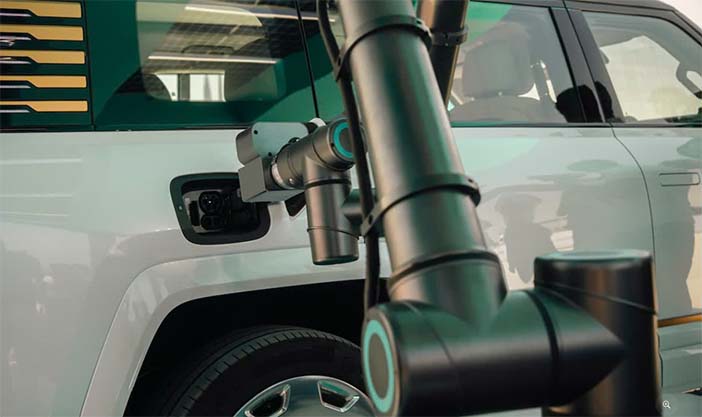
While retail fast chargers are expanding rapidly across domestic parking lots, this new BYD power threshold easily outpaces standard global infrastructure capabilities. According to a recent report from Car News China, the robotic demonstration aligns with the brand’s recent advancements in battery chemistry. The automaker introduced its second-generation Blade Battery earlier this year, supported by infrastructure that offers even faster 1.500 kW capabilities in optimal conditions. Utilizing this architecture, BYD claims their new EV battery can safely jump from a 10 to 70 percent state of charge in just five minutes. The physical hardware also integrates perfectly with automated valet software. A compatible electric vehicle can autonomously park itself inside the charging bay, allowing the robotic arm to immediately take over the refueling process. Although a highly publicized four minute charge remains restricted to controlled environments, BYD is moving fast to commercialize their hardware, planning 20.000 flash-charging stations in China by the end of 2026 and targeting 3.000 units across Europe by 2027. BYD is not the only manufacturer pursuing a hands-free future. Huawei previously demonstrated a similar 600 kW robotic charging arm alongside the Maextro S800 luxury sedan. However, this newest 1.000 kW iteration from BYD, paired directly with integrated solar generation and battery energy storage, represents a much more comprehensive approach to upgrading the global charging grid.
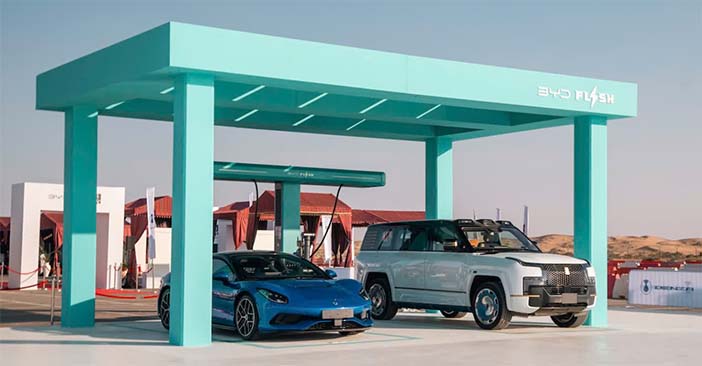
While I am genuinely excited about a future where drivers never have to wrestle with dirty charging cables in the rain, a healthy dose of skepticism is required here. Scaling complex robotics across public locations will be incredibly expensive, and existing stations already struggle with basic software reliability. Still, if BYD can successfully commercialize this automated ecosystem, it will fundamentally fix the most frustrating part of electric vehicle ownership. +++
+++ HONDA is readying a new generation of models for its new hybrid era, and the most important of them all has just been previewed. An all-new CR-V, with a new design language, new technology package and an even more efficient hybrid powertrain is coming soon; we’ll just have to wait our turn in Europe. As the Japanese company’s global highest seller, this will be one of the first models to undergo such a substantial overhaul across the board.
Until now it has been previewed only by a badge sporting a new font, but we know that Honda has been working on introducing some big changes from the car we know today. The first and most obvious will be a new design language, one that will shake off the solid, if slightly safe-edged look of today’s car for something more progressive and inspirational. Honda has already previewed what this new language could look like in a couple of other forms, starting with the hybrid saloon concept that was revealed earlier this year. This far more angular styling didn’t just sit on top of familiar proportions, but shaped the car’s elegant fastback shape that Honda’s been working on for a few of its future models. However, a more relevant teaser could be the Avancier that’ll be sold in some overseas markets. This previewed an ultra-clean SUV shape and hi-tech details like flush LED lighting and new badging; all elements that we’re expecting to see on the new CR-V. Honda will also introduce the Asimo infotainment system. This is a far more advanced set-up that, as is the case on many European rivals, combines all the digital systems of the car into one or two completely connected interfaces. These also run on something much closer to a software-defined electrical architecture, giving it a more robust connection to online services and by extension the ability to be given Tesla-like software updates over the air. Finally, the new CR-V should also be one of the first cars to benefit from the new Honda Hybrid system. This new tech has been designed to deliver greater efficiency than the current car, with electric motors responsible for a majority of the drive, and the petrol engine instead working more as a generator. However, whether the CR-V that we will see in the next few months includes this technology from the off remains to be seen. That’s because it will first be revealed in its American specification. US versions will be available with Hybrid version in future, but with a desire to compete with the all-new Toyota RAV4, and a much more competitive Nissan X-Trail (or Rogue in the USA) Honda’s keen to get its new model in production and on sale as quickly as possible. This means that there might be a reasonable wait until the Japanese-built right-hand-drive models reach the UK and Europe. US production, by contrast, will begin in mid-2027 for 2028 model year cars. +++
+++ BMW has confirmed the stoppage of MINI production at its Oxford plant for 2 weeks in November, citing parts shortages. No more information was given, but unconfirmed reports suggest the parts in question are wire harnesses following a Russian attack on a Ukrainian supplier late in October. BMW didn’t say when production would restart but said in a statement that it “remains in close contact with our supplier network and currently expects the shortage to be temporary”. The stoppage is bad news for Mini workers and customers. Oxford builds the petrol 3-door and 5-door Cooper models, as well as the Convertible. Electric models all come from China. The temporary stoppage will also affect BMW’s steel pressing plant in Swindon and engine plant in Hams Hall. Car production across Europe was disrupted when Russia invaded Ukraine in February 2022. The country is a European centre of excellence for the making of wire harnesses, which is harder to automate and therefore usually situated in countries with low costs. The supplier at the centre of the disruption is reportedly Kromberg & Schubert, whose Rovantsi plant in Ukraine was hit by Russian missiles on 16 October. “The company’s operations have been halted. Our absolute priority is the safety, life and health of every employee”, the company said in a statement to the Kyiv Post. “We are currently evaluating the ongoing situation and coordinating all subsequent steps”. Car makers usually have a back-up supplier in case of disruption, but this can take time to bring online. BMW last year built 124.271 Mini Cooper models in Oxford last year, a sharp decline compared with production figures in the last decade. The plant built 234.501 cars in 2018, nearly double last year’s figure. New generation Minis have been built in Oxford since 2001, with over 4.5 million built since. The Oxford assembly and the Swindon pressing plant together employs around 3.000 workers. +++
+++ Dutch start-up SANRIVATTI is aiming to reinvent the hypercar by introducing an unusual motorcycle-style driving position for its new V10 track toy. Its Apex position drapes the driver head-first on a centrally-mounted frame. It claims this brings a significant improvement in forward visibility compared with a normal seat, as well as fostering a greater sense of connection with the machine. Founder Santiago Sanchez told it is “a total coin flip” of a traditional car’s architecture: “You feel as one. It’s not that you’re sitting in the car, like on a sofa eating popcorn and watching a movie. Now you’re in an active position, an aggressive stance and you’re forced to be in the moment”. Sanchez said that placing the driver head-first means “things are not coming at you, but you’re going towards the corner”; the more aggressive posture encourages drivers to attack bends. Although it is inspired by a motorcycle, Sanrivatti’s design retains a conventional steering wheel and pedals – which, Sanchez said, will be connected to the corresponding elements of the car mechanically, rather than by-wire. The posture is not, however, completely flat. Riding a motorcycle at speed places considerable stress on the body, and cars are capable of generating much greater lateral G-forces through corners partly because of the tyres’ greater contact patch area. Sanchez said Sanrivatti had found a “sweet spot” between something too aggressive, as with a superbike, and something too “passive”. The company is also working on what it calls a ‘G-force neutralising system” (GNS) to counteract the loads on the body. Sanchez suggested this would be a “kind of leaning mechanism” but declined to share further details as development work is ongoing.
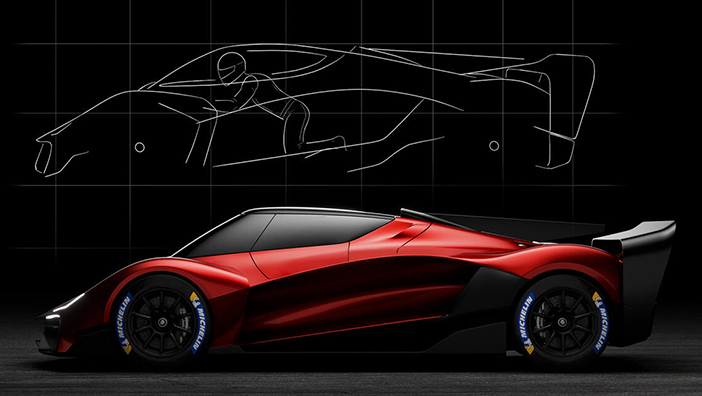
Sanrivatti has now revealed its first prototype, the One, indicating the specification of the track-only car that it plans to build in 2030. It uses a 800 hp naturally-aspirated Judd V10; a choice inspired by “the most emotional-sounding F1 engine”, and is targeting an 1.100 kg dry weight and 330 kph top speed. Sanchez said it had been built with Belgian circuit Spa-Francorchamps in mind, but that “it’s not about numbers”, rather “the connection that you feel with the car”. Work is ongoing to finesse the car’s dynamic characteristics, with significant thought put into the impact of the driver’s weight; in most supercars, the 60-100 kg of ballast provided by the person at the wheel is usually situated as low and long as possible, but here it is set high and short. “That changes your steering geometry, your suspension geometry and how the car has to behave in such a position”, said Sanchez. The proposed GNS system, allowing that weight to shift within the car while moving, will further complicate matters. Asked about crash safety, Sanchez said this was “the first question we asked ourselves” and affirmed that it would not be compromised by the head-first positioning. Sanrivatti also plans to run its own driver development programme to help buyers acclimatise to the new way of interacting with the car, particularly at high speeds. “We will be teaching our clients in a staged way. Not, obviously, just saying ‘here are the keys’ ”, said Sanchez. He added that building his own hypercar had been a lifelong dream, and he is confident in the company’s odds of success given the meteoric growth in the niche supercar and hypercar industry. Assisting Sanchez is Paul Arkesden, an industry veteran who previously led the engineering of the McLaren P1, headed vehicle development for McLaren Special Operations and later became vice-president of engineering and product development for Singer. Sanchez also hinted at bigger hopes for the future, which could include road-going vehicles, saying: “There are a lot of places that we can apply the Apex position and take it to another level. But for now, all focus is on the Sanrivatti One”. +++
+++ With SCOUT ’s first development prototypes already underway, the automaker is well on its way to bringing the Traveller SUV and Terra pickup to market. The first 2 models will begin production sometime in 2027, with the first customer models rolling off the line in 2028. Ahead of that eventual production date, Scout shared data showing which customers might be making the switch to the brand’s new pickup and SUV. During a media presentation at its manufacturing facility in Blythewood, South Carolina, the automaker offered insight into its potential customer base, and the data is interesting. Scout currently has around 212.000 reservation holders combined for its 2 models. Of those reservation holders, most of them currently own vehicles from brands like Ford, Jeep and, of course, Rivian and Tesla. Scout data shows that the number one vehicle owned by current reservation holders of the Traveller is the Ford Bronco, followed closely behind by the Jeep Wrangler. Given that the Traveller is a direct competitor for both of those models, the data isn’t all that surprising. But further down the list, things get interesting. Current F-150 owners have shown lots of interest in the Traveller, while Tesla Model Y and Model 3 owners rank 6th and 7th, respectively. Rivian R1T customers are currently 9th on Scout’s list for the Traveller: Terra reservation holders drive unsurprisingly also largely Ford vehicles. The F-150 and Bronco rank first and second in Scout’s customer data, while the Wrangler comes in third and Tesla falls to 4th. Other pick-up trucks like the Jeep Gladiator and Ford Maverick aren’t far behind either, with the Toyota Tacoma a bit further down the list. It should be said that not all 212.000 reservation holders for the Terra and Traveller will become customers. However, Scout is optimistic it can convert many of them. There are a few years left before we see these models on the road, but the early data offers some interesting insights into who might be making the switch. +++
+++ Remember the S-FR? The cute little sports car debuted as a concept at the 2015 Tokyo Motor Show, promising an affordable, lightweight alternative to larger performance cars. However, much to the dismay of budget-conscious enthusiasts, TOYOTA never gave it the green light for production, leaving the rear-wheel-drive coupe on the long list of promising concepts that never made it to showrooms.
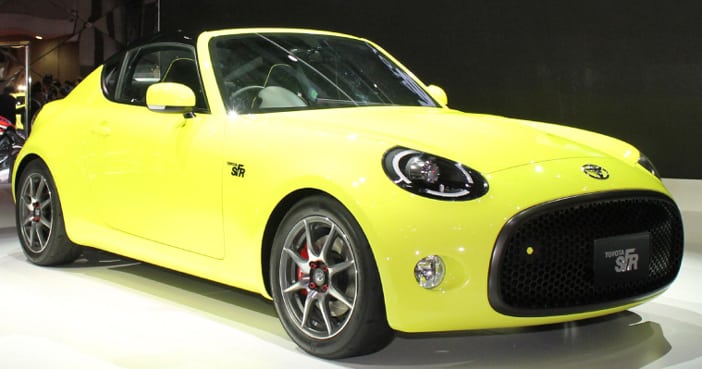
Now, there’s a glimmer of hope that the S-FR could finally happen, albeit in a very different form. According to a new report from Japanese publication Response, Toyota is considering reviving the nameplate as a tiny rear-wheel-drive sports car built to kei-car specifications. If the rumours are accurate, the production model could arrive as early as next year. The biggest clue comes from Daihatsu, which has been working on a next-generation Copen. The promising K-Open concept unveiled at the 2025 Japan Mobility Show previewed a radical departure from the already-discontinued front-wheel-drive roadster, switching to a more engaging, tail-happy rear-wheel-drive setup. Daihatsu’s concept measures just 3.395 mm long, 1.475 mm wide and 1.230 mm tall, with an 2.265 mm wheelbase. Those are precisely the dimensions reportedly being considered for the new Toyota S-FR. As for weight, the K-Open tipped the scales at just 850 kilograms. That’s a substantial downsizing compared to the original concept. When Toyota introduced the S-FR, it measured 3.990 mm long, 1.695 mm wide and 1.320 mm tall. It also had a 2.480 mm wheelbase. The original concept was a 4-seat coupe with a front-midship engine layout, rear-wheel drive and a 6-speed manual gearbox. Its rounded headlights and generous grille paid homage to the company’s diminutive Sports 800, although, to be honest, it looked like an angry modern Mini Cooper. A production version would reportedly take a different approach, embracing Japan’s kei-car regulations to keep dimensions and costs down. Power could come from a turbocharged 660cc 3-cylinder engine producing a mighty 64 horsepower. Buyers might get to choose between a 5-speed manual and a CVT, with power going exclusively to the rear wheels. Those figures hardly sound exciting on paper, but that’s not necessarily the point. A lightweight sports car with modest power and a manual gearbox could deliver the kind of driving experience that’s becoming increasingly difficult to find. Toyota hasn’t revealed the car’s weight, engine placement, or suspension configuration, so it’s too early to conclude its handling credentials. There’s also a question mark over seating capacity. The original S-FR concept accommodated four people, whereas the K-Open is strictly a 2-seater. Toyota could retain the original car’s 2+2 configuration, but a 2-seat layout would arguably make more sense given the substantial size reduction. The rear seats would likely be borderline useless anyway. Daihatsu has already gone beyond simply displaying a pretty concept. The company has developed a running prototype to investigate the feasibility of a rear-wheel-drive sports car within kei-car dimensions. A second iteration, called the K-Open Running Prototype 2, appeared at the Tokyo Auto Salon in January, with the engine pushed slightly toward the back for a front-midship layout for better weight distribution. Daihatsu has been using these experimental vehicles to explore packaging solutions, a low center of gravity, and optimized weight distribution. However, the company has yet to approve a production model officially. If Toyota and Daihatsu decide to share the engineering, the 2 brands could offer distinctly different interpretations of the same basic formula. Daihatsu could revive the Copen as an open-top roadster, while Toyota could sell the S-FR as a fixed-roof coupe. That would give buyers 2 ways to enjoy an affordable, rear-wheel-drive sports car without requiring an entirely separate development program. The reported 2027 arrival date should be treated with caution, though. Neither Toyota nor Daihatsu has confirmed plans to put the S-FR or K-Open into production. The matching dimensions are certainly intriguing, but they don’t automatically confirm that the two companies are developing mechanically related vehicles. Still, the idea makes plenty of sense. In an era when sports cars are becoming heavier, more expensive, and increasingly complicated, a little rear-wheel-drive machine with a 660cc engine and a manual gearbox sounds refreshingly old-school. However, we can’t realistically expect Toyota to build every car the rumour mill has been talking about. Ideally, the S-FR would slot below the GR86, GR Yaris, GR Corolla, GR Celica, GR Supra, GR MR2 and the new V8-powered GR GT supercar. But it’s hard to imagine all those new and returning nameplates together. It’s simply not feasible from a business perspective, so something has to give. That said, Toyota is serious about expanding the line-up for Gazoo Racing, which is now a standalone brand. In a perfect scenario, there would be a whopping eight GR-branded cars, though we could easily imagine the S-FR with a Scion badge now that the brand is making an unexpected comeback. +++
+++ VOLKSWAGEN has pulled the wraps halfway off its next hot compact SUV. Camouflaged prototype photos published this week show the 2027 Volkswagen T-Roc R wearing quad exhaust tips, a reworked rear bumper and noticeably wider wheels than the standard car. The teaser comes as Volkswagen’s R performance sub-brand builds anticipation for a reveal that multiple reports now place before the end of this month. The powertrain underneath the camouflage is not known yet. The second generation T-Roc reached showrooms in late 2025. It’s based on the MQB evo architecture shared with the updated Golf. That shared platform is what makes an R variant possible in the first place. It’s why enthusiasts have been watching for this prototype since Volkswagen’s earlier teaser last November. The new photos show a body kit with sharper lines than the outgoing T-Roc R, plus wheels that look both larger and wider. The rear end carries a revised lower bumper with two separate pairs of exhaust outlets, four tips in total. Volkswagen doesn’t bother with quad pipes on a mild-mannered SUV, so that exhaust layout is the clearest visual signal of the car’s performance intent. Spy shots reportedly show 19-inch wheels on the test mule, a jump that would separate it further from lesser T-Roc trims. Volkswagen’s R division has published the images on social media without a specifications sheet, leaving the powertrain, pricing, and market rollout as open questions for now. Outlets covering the prototype are working from one assumption: the T-Roc R borrows its engine from the current Golf R, a turbocharged 2.0-liter 4-cylinder paired with all-wheel drive that produces about 333 hp and 420 Nm of torque. If that transplant happens as expected, it would mark a real jump over the outgoing T-Roc R, which topped out at about 300 hp and 400 Nm. Volkswagen hasn’t confirmed the engine swap, so the Golf R comparison is the industry’s best guess. A 48-volt mild-hybrid system is also speculated as a likely addition, driven by tightening emissions rules. The bigger question hanging over the whole program is whether this generation becomes Volkswagen’s last new petrol-powered R model before the brand’s hot hatches and SUVs pivot to electric architecture. Nothing about that transition timeline has been confirmed. +++