
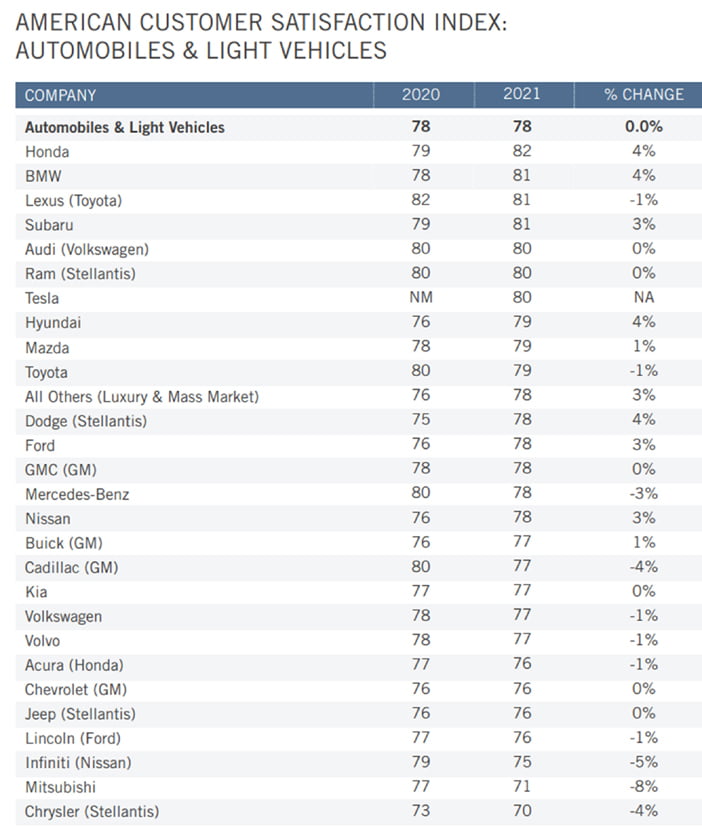
+++ A study from the AMERICAN CUSTOMER SATISFACTION INDEX has revealed that owners of vehicles from Honda are the most satisfied in the automotive industry. The ACSI Automobile Study 2020-2021 was put together based on interviews with 4.888 customers chosen at random and contacted via email between July 6, 2020 and June 28, 2021. Customers were asked to evaluate their recent experiences with major automotive brands. Results are based on a 0-100 scale. As mentioned above, Honda took out the top spot with a score of 82 out of 100, a 4 pe cent improvement over the 79 that it scored in last year’s study. Following closely behind was BMW with a score of 81, also a 4 percent improvement over the 78 that it recorded in 2020. In third was Lexus with 81, a drop of 1 point from 2020 and leaving it equal with Subaru. Tied in fifth place were Audi, Ram and Tesla. The only other car manufacturers above the industry average of 78 were Hyundai, Mazda, and Toyota, all with ratings of 79 out of 100. A number of brands scored between 78 and 76, including Dodge, Ford, Mercedes-Benz, Nissan, Buick, Cadillac, Kia, Volkswagen, Volvo, Acura, Chevrolet, Jeep, and Lincoln. There were 2 key outliers in the study. The first was Mitsubishi, scoring just 71 out of 100, an 8 percent decrease from the 77 it scored in 2020. The second was Chrysler, who was rated last with a satisfaction rating of 70. The study analyzes vehicle safety, dependability, driving performance, exterior, comfort, interior, quality of mobile app, reliability of mobile app, website satisfaction, technology, gas mileage, and warranties. Customer satisfaction across almost all of these areas fell in 2021 from last year, except for satisfaction on gas mileage and warranties that remained steady. +++
+++ The highlight of my 2021 has been being able to spend time in the company of colleagues and industry folk in person for the first time in a long time (although at the time of writing it seems that may have to take a back seat for a while). We have a car industry that’s very much focused on a bright future, with technology to the fore. And one company in particular that has impressed me is AUDI . Talking to Audi CEO Markus Duesmann earlier in the year, he was bold enough to admit that Tesla had a clear lead when it came to technology. His plan was to ensure Audi developed a new software-first approach, just as Tesla has. That may make Audi a follower, but there are plenty of other areas where the company leads, including a clear understanding of its brand values. My current long-term test car is an Audi Q4 e-tron, a model that, like many of its forebears, shares much with its Volkswagen Group siblings. Yet more than any other Audi for a very long time, it feels more Audi. I’ve spent plenty of time driving the 4 brands’ new models based on the Group’s MEB electric car platform. While Volkswagen, Skoda and Cupra have done a better than average job of differentiation, their cars still feel similar in so many ways. Not the Audi; there’s no hint of sharing and the Q4 e-tron feels unique, right down to the feel of the doors as you open and shut them. Clever. +++
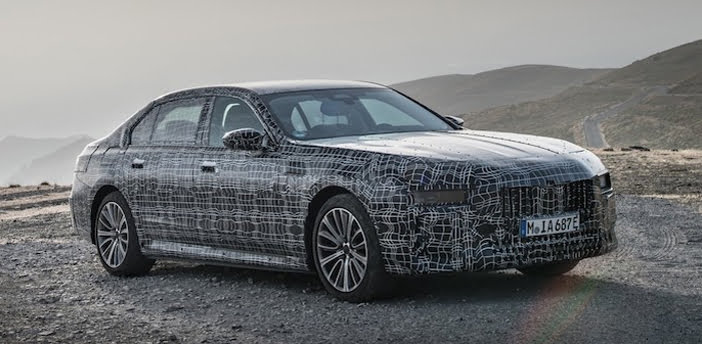
+++ BMW is gearing up to launch the 7th generation version of the 7 Series, which will become a new rival for the likes of the new Mercedes EQS and the stalwart Tesla Model S when it goes on sale at the end of 2022. It’ll go on sale alongside the 7th generation combustion-engined 7 Series. This new official image show the EV tackling the later stages of its development programme, with the brand’s engineers testing the capability of its battery pack in warm weather. These are famously difficult conditions for an EV, as the heat negatively impacts the amount of energy the batteries can store, therefore lowering its driving range. The i7 prototype in BMW’s official “spy shots” is still heavily camouflaged, so there’s nothing new to glean on the design front. The car’s shape is more that of a traditional three-box saloon than the ultra-curvy, hatchback-style EQS. A long bonnet and high shoulder line combines with a low nose, while the rear follows the classic large saloon format. BMW also will introduce a new headlight design, first spotted on the facelifted version of the X7. The current car’s combined daytime running lights and main headlamps will be ditched in favour of split units, with the latter located lower down in the bumper. As is customary on recent BMWs, the next i7 (and its combustion-engine sister car) will feature enormous kidney grilles, while the streamlined nose references that of the iX SUV. Buyers will also be able to choose between standard and long-wheelbase layouts. BMW is yet to release technical specifications for the electric i7. However, the company claims that the car’s suspension, steering, braking, driving dynamics and stability systems have been “designed to raise the balance between sportiness and ride comfort that’s typical of the brand’s luxury sedans to the next level”. Given that the EV will be going toe to toe with the Mercedes EQS, we expect BMW will need to achieve a maximum range of around 400 miles to remain competitive in the segment. The EQS is capable of 772 km on a single charge, thanks to its 107 kWh battery. It’s expected that the i7 will be based on BMW’s modular CLAR platform and powered by its fifth-generation eDrive technology, which also appears in the new i4 saloon and iX. Using this EV drive system should dramatically reduce production times, because it groups the electric motor, transmission and electronics into a single unit. The layout also cuts the overall mass and size of the system, which translates into a little more range. The i4 and iX already share the same drive systems, and I expect the i7 will follow suit. We anticipate that the electric limousine will launch with those cars’ 516bhp dual-motor, four-wheel drive setup in xDrive50 flagship guise. That system has enough grunt for a 0–100 kph time of 4.6 seconds and a top speed of 200 kph in the iX; figures that the i7 should match or even beat, as it’ll be a bit lighter and more aerodynamic. We expect a lesser 326 hp xDrive40 badged variant will also join the range, offering a 0–100 kph time of around 6 seconds. An M variant hasn’t been confirmed. The i7’s will also likely be offered with the same 71 kWh and 105.2 kWh batteries as the iX. That should be enough for a range of around 400 km on the smaller unit, with the larger battery clocking a maximum of more than 600 km. Rapid charging will also be offered. Prices for the new i7 are yet to be confirmed. For reference, the iX starts from just under €87.000 in the Netherlands, while the i7’s biggest rival, the Mercedes EQS, is nearly €120.000. Expect the i7 to fall somewhere between those two cars when it goes on sale. +++
+++ As they scour the globe for the lithium, nickel and cobalt resources needed to keep CHINA on top in the electric vehicle (EV) stakes, Chinese battery and EV makers are fretting about supply of another mineral closer to home: graphite. Graphite, in both natural and synthetic forms, is used for the negative end of a lithium-ion battery, known as the anode. Around 70 % of all graphite comes from China, and there are few viable alternatives for batteries. Chinese producers have their work cut out keeping up with global demand for graphite, which has surged along with rapid growth in the battery market in recent years. Consultancy Benchmark Mineral Intelligence (BMI) sees a roughly 20.000 tonne graphite deficit in 2022, versus a similar-sized surplus last year. About 20.000 tonnes of graphite is enough to make batteries for roughly 250.000 EVs, an industrial source said. Top global EV battery maker CATL is “desperate” to secure supply of key ingredients such as graphite to keep up with rising orders, said a person with knowledge of the matter. “There’s not enough graphite in the market for domestic players to grab,” said the source, who asked not to be identified because the person was not authorized to speak to the media. “Demand from clients such as Tesla is growing rapidly while supply of raw materials has been extremely tight”, the source said, adding that the recent power rationing on industry had exacerbated the situation. The upcoming Winter Olympics in Beijing is set to make supply of the dark grey form of carbon even tighter as authorities look to ensure a blue-sky backdrop to the showpiece event by ordering energy-intensive and high emitting industries like graphite to slash output, said a source with Chinese EV maker NIO , with knowledge of the graphite market. “Graphite is in severe shortage and all companies are snapping up purchases”, said the source, who also declined to be named as he is not authorized to speak to the media. George Miller, an analyst with BMI said Northeast China’s graphite mines tend to close during the winter months due to extreme cold temperatures, leaving graphite processors no option but to try and fulfill orders from inventory. “Graphite consumers, whether within China or outside, are fighting over a limited stock of material”, he said. BMI forecasts that global demand for battery anodes will grow by an average of around 27% per year over the next decade, driven by the lithium-ion sector. Anode-grade graphite flake prices on the Chinese domestic market are up almost 40 % year-to-date at 4.500 yuan ($707) per tonne, testing the record highs seen in 2018, according to BMI. Reflecting the rapid growth in the EV market, China’s auto sector sold 2.99 million EVs and plug-in hybrids in the first 11 months of 2021, a 170 % rise on the same period in 2020. Tesla, the world’s most valuable EV maker, registered its support for U.S. Section 301 tariff waivers on imports of both artificial and natural graphite from China to be reinstated as many tariff exclusions expired. “Tesla has concluded that no company in the United States is currently capable of producing graphite to the required specifications and capacity needed for Tesla’s production”, the company said in a public comment lodged with the U.S. Trade Representative recently. CATL is studying using the natural form of graphite in battery anodes as an alternative to artificial graphite because of greater availability, said the first source, even though it may not give the same level of performance. “We have heard indications that Chinese anode producers are shifting their anode blends towards a higher percentage of natural feedstock”, Miller said. +++
+++ DAIMLER and Mercedes-Benz are celebrating a strong year and giving eligible employees in Germany a generous bonus of €6,000. The Board of Management and the General Works Council for the German car manufacturer will pay out the bonus to approximately 100,000 eligible tariff-scale employees throughout the brand’s home country, expressing its gratitude for their work during a year hampered by the Covid-19 pandemic and the semiconductor shortage. Daimler has not yet announced financial results for the year but notes it has experienced strong “success” throughout the 2021 financial year. “Our company’s extraordinary development is a team achievement”, member of the Board of Management of Daimler AG and Mercedes-Benz, responsible for Human Resources and director of Labour Relations, Sabine Kohleisen said in a statement. “I would like to wholeheartedly thank all of the colleagues who contributed to this accomplishment with their great dedication. Because last year wasn’t easy, I’m delighted that we can pay our employees a record profit-sharing bonus”. Daimler frequently pays out bonuses to its employees in Germany but it has never been as significant as this year. By comparison, the automaker provided employees with a profit-sharing bonus of €597 in early 2020 and a one-time appreciation bonus of up to €500. “This is the right message to the employees after another turbulent year with the coronavirus, the crisis in the semiconductor industry, the resulting short-time work and the increased work from home”, added chairman of the General Works Council of Daimler and Mercedes-Benz, Ergun Lümali. “Our colleagues are the key to the success of our company. Therefore, it is only more than fair to reward their tireless dedication with an extraordinarily high profit-sharing bonus. On behalf of the General Works Council, I would like to thank them for this outstanding commitment in 2021”. +++
+++ RIVIAN will announce that it’s building a $5 billion battery and assembly plant east of Atlanta that’s projected to employ 7.500 workers, sources briefed on the decision told. The plant could grow to as many as 10.000 workers, sources said, which would make it among the largest auto assembly complexes in the United States, rivaled by behemoths such as the 11.000-worker BMW complex in Spartanburg and Ford’s 8.600-worker plant in Louisville. Rivian will be the largest industrial announcement in Georgia history, surpassing the 4.400 worker Kia complex that opened in West Point in 2009. Georgia has had a number of failed auto plant recruitments. Rivian will give Georgia Governor Brian Kemp another point to bolster his claims that he has been an excellent steward of Georgia’s economy, even as he faces Republican and Democratic challengers when he runs for reelection next year. The city of Fort Worth, Texas, offered Rivian a $440 million incentive package to lure the plant during the summer, while published reports indicate Rivian also considered sites in Arizona and Michigan. Rivian told Fort Worth its plant would make 200.000 vehicles per year, with workers paid at least $56.000 a year. Founder and CEO Robert Scaringe told in November that the ability to recruit good workers was the most important factor in the decision. Rivian’s existing plant in Normal, like most auto plants that have opened in recent decades, is not unionized. Georgia officials are unlikely to detail the full incentive package offered to Rivian on Thursday, but the company could max out what Georgia calls its “mega project tax credit” for companies that hire at least 1.800 people or invest at least $450 million. That could be worth $118 million in state income tax credits. Local governments are likely to abate property taxes. Kia got more than $450 million in incentives for its plant southwest of Atlanta. Georgia has promised $300 million of incentives to the $2.6 billion, 2.600 worker battery plant being built by SK Innovation in Commerce, northeast of Atlanta. Rivian, like Tesla, deals with its customers directly instead of through dealers. Its arrival in Georgia could prompt the state to loosen a law that mostly prohibits manufacturers from selling directly. Rivian currently plans 2 models for consumers: the R1T pickup with a base price of $67.500 and the R1S SUV, with a base price of $70.000. Amazon, which owns a slice of the company, has ordered 100.000 delivery vans, launching Rivian into the commercial vehicle business. Rivian is flush with cash following a $11.9 billion stock offering November 10 that took the company public, allowing it to finance the new plant. Its market value is nearly $95 billion, more than either General Motors or Ford. The company argues that electric vehicle adoption is at the “tipping point” and it is well positioned for success because trucks and SUVs have long been the most profitable vehicles sold. But some analysts question whether it needs another plant besides the former Mitsubishi plant in Illinois, that Rivian bought for $16 million in 2017. Rivian says it has a yearly capacity of 150.000 vehicles, but is looking to expand there as well. “It seems like it might be a little premature to invest that much in another large plant just yet”, said Sam Abuelsamid, principal mobility analyst for Guidehouse Insights, who said Rivian also may be looking for a manufacturing site in Europe. Given the size of the Georgia plant, Abuelsamid expects it to make other parts for the vehicles, similar to electric vehicle leader Tesla making seats at its factory in Fremont. Rivian has cash in the bank, but will burn through that quickly unless it starts delivering vehicles and generating cash, jeopardizing its market darling status, Abuelsamid said. The company needs more retail customers and commercial vehicle buyers other than Amazon, he said. “If actual deliveries don’t start picking up, the markets could turn against them as they have with some other EV startups not called Tesla”, Abuelsamid said. “Unlike Tesla, Rivian will be facing serious competition in a much shorter time frame than the near- decade head start that Tesla had”. Ford and GM plan to start selling their own electric pickup trucks in the next 2 years, while Tesla also plans a new pickup. That’s part of a wave of electric vehicle investment, with SK’s $5 billion battery plant northeast of Atlanta just one example. Ford announced in September it would spend $11.4 billion to build 3 battery factories and an assembly plant in Kentucky and Tennessee. The LMC Automotive consulting firm expects U.S. sales of new fully electric vehicles to hit nearly 400,000 this year, nearly double last year’s figures. But they still make up only about 2.6 % of sales. The firm expects sales to grow to more than 730.000 next year and more than 2 million by 2025. Even at 2 million, EV sales still would be only about 12 % of U.S. new vehicle sales. +++
+++ TOYOTA said it planned to build 800.000 vehicles globally in January, a record for the month, as it ramps up production to make up for output lost to parts shortages. “We will continue to maintain our production forecast of the 9 million unit level” for the year to March 31, the company said in a press release. The production plan for January represents an increase of 60.000 vehicles from a year earlier. The world’s largest automaker by volume has been affected by a shortage of parts supplied by Covid-19 hit factories in Malaysia and Vietnam. The company this week said those shortages are forcing it to halt some manufacturing in Japan in December, resulting in lost production of 14.000 cars for the month. +++
+++ VINFAST made a splash at the Los Angeles Auto Show with the VF e35 and VF e36, but they’re pulling out all the stops for CES as they’ll show their full lineup of 5 electric vehicles. Besides the aforementioned crossovers, VinFast will unveil 3 new models. Little is known about them, but they’ll compete in the A, B and C segments. As a result, they’ll slot beneath the D segment e35 and E segment e36. While the company isn’t ready to talk specifics, they said the upcoming models will have the “elegance” of Pininfarina and Torino Design “crafted” into them. Furthermore, the models promise to have a modern design that optimizes aerodynamics, while also “upholding aesthetics that reflect each segment’s unique features”. VinFast said they new models be equipped with advanced driver assistance systems including fully automated parking, a summon feature, lane assist, and a collision warning system. Other tech features will include a voice and virtual assistant as well as e-commerce services. The company also said we can expect “several smart features developed by VinFast engineers and leading brands in the vehicle-technology industry”. There’s no word on specifics, other than brief mentions of artificial intelligence and machine learning technology, but the automaker will use the event to announce strategic partnerships with suppliers as well as “industry-leading companies”. It remains unclear when the new models will arrive. VinFast has previously said deliveries of the e35 and e36 are slated to begin in the 4th quarter of 2022. +++
+++ VOLKSWAGEN will roll out a major upgrade to the often criticised infotainment system of the eighth-generation Golf with new hardware and software to speed up the system and add extra voice control functions. The latest Golf uses the MIB3 infotainment system, which was designed for a dashboard featuring a greatly reduced number of physical buttons. But the system has drawn criticism for being slow to respond and occasionally buggy. Volkswagen has revealed that latest versions of the new Golf will now feature an upgraded infotainment system with a number of hardware improvements. Changes include a more powerful System on Chip (SoC), which is a new central processing unit that, VW claims, offers triple the graphics performance of and 25 % more computing capacity than the previous system. This is linked to a major software update that includes a number of changes to the way the system works. In a bid to prevent people from selecting the wrong controls, VW has now set the system to automatically disable the haptic buttons and volume slider when a user puts their finger near the screen. The update has also enhanced the infrared sensors to enable gesture control from a greater distance. In addition, VW has made a major revision to the voice recognition control, which, it says, has been optimised to be faster and give more precise responses to general questions. The system now has greater understanding of natural voice control, so saying “I’m cold” will prompt the car to turn the heating up. The digital microphone can now recognise the difference between the driver and passenger, meaning it can also set the air conditioning separately. The firm also claims that the voice control now has a 95 % comprehension rate. The updated hardware will be offered initially on new models only, but Volkswagen said it plans to roll out the new software to existing Golf models in the coming months. +++