
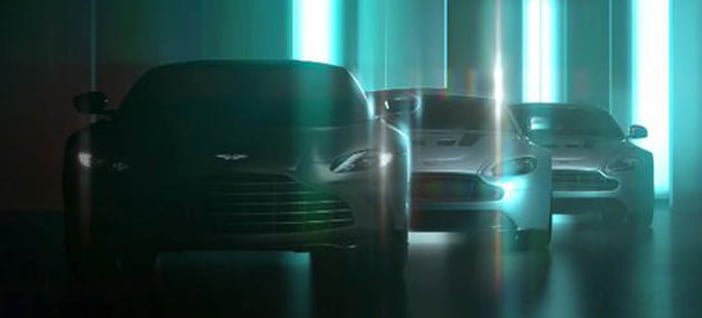
+++ The ASTON MARTIN V12 Vantage will return for one final generation in 2022, and a new teaser hints at how it will be marked out from the standard V8 car. Shown next to its predecessors in a darkened image, the new 12-cylinder car looks to feature a bespoke front end with a much larger front grille (similar to that of the hardcore Vantage F1 Edition) and new vertical air intakes. Just about visible is a downforce-enhancing front splitter, which will likely be made from carbonfibre. Aston previously announced that the new Porsche 911 Turbo S rival will arrive in 2022 but didn’t share any details of the model’s design or technical specifications. Spy photographers previously spotted a Vantage testing at the Nürburgring with a V12; a powerplant that isn’t offered in the current Vantage but appears in the related V12 Speedster. The V12 Speedster’s 5.2-litre engine produces 700 hp and 720 Nm, giving it a 0-1000 kph sprint of 3.5 seconds and a top speed of 295 kph. The spied Vantage mule featured an updated front grille, a large twin exhaust, additional air intakes and a bonnet bulge that was suspected to hide an engine larger than the V8 of the current Vantage. Aston Martin CEO Tobias Moers previously outlined plans to introduce 10 new derivatives of existing models within the next two years, with the V12 Vantage being one of them. The British firm faces challenges to make its V12 engine compliant with Euro 7 emissions standards, but Moers admitted that “aficionados for a V12” would make the endeavour worthwhile. Other changes for the Vantage are expected to include chassis upgrades and a new infotainment system. It’s expected that the current Vantage, introduced in 2018, will be replaced in 2025 by an all-electric sports coupé. A plug-in hybrid model is also under consideration. This would use a new electrified transaxle supplied by Mercedes-AMG and shared with its next-generation C63. +++
+++ In CHINA , the share of Chinese passenger car brands in the domestic market continued a streak of expansion in November, data from an industry association showed. Over 1.02 million Chinese brand passenger cars were sold in the country last month, up 7.2 percent year-on-year, according to the China Association of Automobile Manufacturers (CAAM). The market share of these brands accounted for 46.6 percent in the country during the period, up 5.2 percentage points year-on-year. In the January-November period, the sales of Chinese passenger cars went up 25.1 percent year-on-year to reach 8.4 million, with the market share up 6.4 percentage points over one year earlier to 44.1 percent. China’s auto sales rose 4.5 percent year on year to nearly 23.49 million units in the first 11 months of 2021, data from the CAAM showed. Meanwhile, auto production rose 3,5 percent year on year to 23.17 million units, according to the data. The better-than-expected performance of the auto industry came as the country’s measure to ensure adequate power supply and stabilize raw material prices have taken effect, the association said. In November alone, auto sales totaled about 2.52 million units; down 9,1 percent year on year. Sales of passenger vehicles went down 4.7 percent year on year to over 2.19 million units in November, according to the data. However, sales of new energy vehicles (NEVs) in November rocketed 121.1 percent year on year to about 450,000 units. In the January-November period, NEV sales amounted to about 2.99 million units, surging by 166.8 percent year on year and accounting for 12.7 percent of the total sales of new vehicles., the CAAM data showed. China aims to raise the proportion of NEVs in its sales of new vehicles to 20 percent by 2025, according to a development plan for China’s NEV industry released in 2020. Sales of new energy vehicles in China surged in November, driving the country’s automotive market to speed up its green transition, according to the China Passenger Car Association. NEV sales for the January-November period jumped 178.3 percent year-on-year to top 2.51 million units. Chinese NEV manufacturers had strong wholesales last month, with 14 of them seeing their wholesales above 10.000 units. Wholesales of China’s leading NEV manufacturer BYD reached 90.546 units, while Tesla China followed with 52.859 units last month, according to the CPCA. China’s exports of NEVs also remained strong. Manufacturer Tesla China exported 21.127 NEVs in November, while SAIC Motor exported 6.110 units. +++
+++ China’s BAIC Group has become Mercedes-Benz parent DAIMLER ’s largest shareholder, said the German carmaker. Daimler said BAIC has held a 9.98 percent stake since 2019, but the Chinese carmaker does not have plans to further increase its stake in Daimler. Another Chinese carmaker Zhejiang Geely Holding Group now ranks second after BAIC, with a 9.69 percent stake in the German car group. BAIC has been Daimler’s main partner in China for years and operates Mercedes-Benz factories in Beijing through Beijing Benz Automotive. The 2 companies have collaborated in areas such as production, research and development and sales since 2003. Daimler holds a 9.55 percent stake in BAIC’s listed arm in Hong Kong and a 2.46 percent stake in BAIC BluePark, an electric car subsidiary. The German carmaker said its partnership with BAIC has been a role model for Sino-German cooperation for almost 2 decades. Ola Källenius, chairman of the board of management at Daimler and Mercedes-Benz, welcomed the information on the size of BAIC’s stake, saying in a statement: “We are happy about the engagement of all long-term oriented shareholders, who support our strategy”. Mercedes-Benz has unveiled a plan to go “electric only” by 2030, wherever market conditions allow. It said China plays a major role in this strategy. By the end of 2021, it has introduced four electric Mercedes-Benz models into China. Three of them are locally produced and local production of another model is planned for 2022. “During our partnership with BAIC, China has emerged as the largest global market for Mercedes-Benz and as a key driver of the shift towards electric mobility and digitalization. BAIC’s shareholding is a reflection of their commitment to our joint successful manufacturing and development alliance in the world’s biggest car market”, said Källenius. In China, Mercedes-Benz now has over 700 dealer outlets in more than 240 cities, serving about 5 million customers. It delivered 592.203 new vehicles in China in the first 3 quarters of 2021, with year-on-year growth of 4 percent. +++
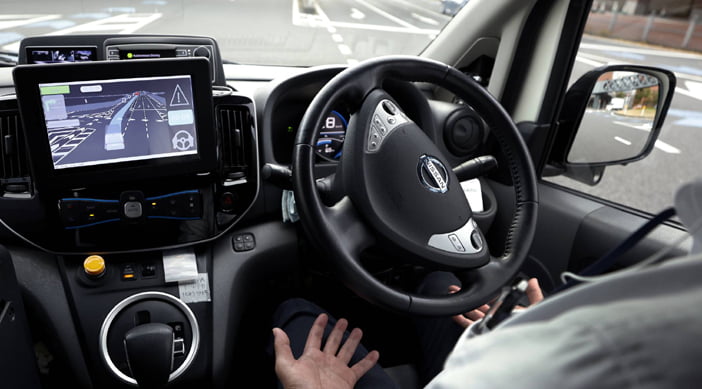
+++ NISSAN is carrying out Japan’s largest demonstration to date of autonomous vehicles in Yokohama as the automaker moves toward rolling out a commercial automated service. Although regulations and the need for further technology improvements mean a full-scale launch is still some years away, Nissan has been testing the self-driving taxi service in Yokohama, near its corporate headquarters. Passengers can book rides via a smartphone app that covers some 650 routes and embark and disembark from 23 points around the city. For now, the autonomous taxis have operators sitting ready to take over in case the vehicles’ various sensors encounter a situation that requires human assistance. The goal is to eventually have such “safety drivers” monitor a fleet of such taxis remotely. In this way, savings on driver fees could lead to lower fares versus conventional taxis, according to Nissan. The service is one part of Nissan’s “Ambition 2030” long-term strategy announced earlier this week. Also included are plans to equip over 2.5 million vehicles with its “ProPilot” semi-autonomous driving system and spend some ¥2 trillion ($17.7 billion) on electrifying more of its fleet. The automaker also envisions the automated taxi service addressing a shortage of public transport drivers. With Japan’s population aging rapidly and declining, elderly people’s inability to get around, especially in rural areas, has emerged as a growing social issue. Nissan has been testing similar autonomous shuttles in Namie, a town in Fukushima Prefecture that was damaged and temporarily evacuated during the March 2011 earthquake and tsunami. So far, the service has proved popular with test passengers, with one middle-aged rider booking taxis in Yokohama 38 times in the recent 29-day testing period, according to Jun Watanabe, a manager in Nissan’s business partnership development division. Other users, however, reckon they’re still better when it comes to navigating traffic jams, he said. “It was a bit of a shock to have cars driving themselves”, especially for elderly passengers, Watanabe said. But they started to visibly relax after a couple rounds in the back seat, he said. The cars’ cameras even picked up some beginning to unfurl newspapers or browse their smartphones on their second or third time around, he added. +++
+++ Toyota and Honda have been sued by an American patent holding company alleging about a dozen PATENT INFRINGEMENTS over their use of communication technologies for connected cars, sources familiar with the matter said. On October 19, Intellectual Ventures Management LLC filed lawsuits with federal district courts in Texas against the 2 Japanese firms and U.S. automaker General Motors concerning the use of in-vehicle Wi-Fi networks, among other claims, they said. The lawsuits, which relate to patents used in Toyota’s Prius and Honda’s Accord, only concern the U.S. market and are not expected to directly affect sales in Japan even if the courts rule in favor of the patent management firm. Both Toyota and Honda refrained from commenting on the lawsuits. The market for connected cars is expected to grow with the utilization of 5G networks in vehicles. But the suits over patent infringement indicate the challenge that auto and auto parts makers face to strengthen management of intellectual property amid rapid technological advances. Intellectual Ventures, which was founded by a former executive of Microsoft Corp, is believed to possess over 70,000 patents, using patent fees as its main source of income. +++
+++ Until recently selling vehicles was the paramount way for carmakers to make money. That is changing, with SOFTWARE rising as a source of revenue as vehicles become computers on wheels. Vehicles capable of over-the-air updates are viewed as key for automakers to generate recurring revenue through new technologies and subscriptions for video entertainment to driver-assist features. Stellantis expects its software services and subscriptions to generate 4 billion euros ($4.5 billion) a year in 2026 and 20 billion euros in 2030. It gave the estimate as it unveiled its software strategy last week. The strategy will enable car buyers to install innovative features and services via regular over-the-air updates to keep their vehicles modern years after they have been built, said Stellantis. “Studies show that customers spend an average of four years of their lives in their vehicles and this is only increasing”, said the carmaker. It is planning to build vehicles from 2024 on an architecture that is fully updatable over the air. It is to break today’s bond between hardware and software, enabling developers to create and update features and services quickly without waiting for a new hardware launch. Based on the architecture, AI-based applications such as navigation, voice assistance, e-commerce marketplace and payment services as well as autonomous driving capabilities will be upgraded wirelessly. The carmaker said a majority of all its new vehicles will be fully updatable over the air by 2024. It expects to have more than 34 million monetizable connected cars by 2030, from 12 million today. Stellantis said “monetizable” is defined as the vehicle’s first five years of life. “Software will improve our business model, disconnecting hardware from software… shifting the center of gravity of our business”, Stellantis CEO Carlos Tavares said. Tavares said profit margins for those services are expected to be more comparable to those of a technology company rather than a traditional automaker. The additional revenue stream could potentially double what the automaker makes today, CFO Richard Palmer said. Stellantis is the latest of a slew of carmakers that have made software a pillar of their future business. Volkswagen established its software subsidiary Cariad in 2020, which now has around 4.500 engineers. The German car group expects the proportion of internally-developed software in their cars to rise from 10 percent currently to 60 percent by 2025. Volkswagen said that its CEO Herbert Diess will assume responsibility for Cariad from 2022. It believes that nearly one-third of revenue in the global mobility market is expected to come from software-based services by 2030. To tap into this potential, Volkswagen has earmarked 30 billion euros for digitalization, including autonomous driving, by 2026, which is an increase of around 10 percent on the previous plan. “By 2030, the world of mobility will have seen the greatest transformation since the transition from horses to cars at the beginning of the 20th century”, Diess said. “The future of cars, the future of individual mobility, will be bright”. Carmakers in China and the United States are speeding up efforts in smart functions as well. Qin Lihong, president of Chinese startup Nio, said autonomous driving will be the most prominent feature of smart vehicles in coming years. Chinese technology companies including Huawei and Baidu are exploring the segment as well, offering their autonomous driving solutions to carmakers. In the United States, GM said in October that it aimed to double its revenue by 2030, including $80 billion from technology-driven new businesses such as its Cruise autonomous vehicle unit. Ford has hired the former head of Apple’s car project, Doug Field, to lead its advanced technology and embedded systems efforts. Meanwhile, France’s Renault is teaming up with Google to help design its infotainment systems. +++
+++ TESLA ’s Shanghai plant had delivered over 400.000 vehicles as of November 2021, the US electric car maker said. Deliveries at Tesla’s Shanghai Gigafactory came in at 413.283 vehicles in the first 11 months of this year, up 242 percent from the same period last year. According to the company, it has built more than 1,000 supercharging stations, 8,000 supercharging piles and 700 destination charging stations on the Chinese mainland. Tesla’s made-in-China sedans have been exported to countries including Denmark, Switzerland, Sweden, Spain, the Netherlands and Norway. The current annual production capacity of Tesla’s Shanghai Gigafactory has exceeded 450.000 vehicles, with the localization rate of parts reaching 90 percent, the company noted, adding that 92 percent of Tesla’s metallic materials of battery cells at the Shanghai plant can be recycled. +++
+++ Alphabet’s WAYMO risks losing its lead in the US race to prove robotaxis are a viable business as it sticks to a limited service and rivals backed by automakers near their own launches. Companies including Ford’s Argo AI and General Motors’ Cruise are competing for the billions of dollars in financing needed to automate driving through artificial intelligence software and expensive sensors. Waymo has led the field. In the first and only fully driverless taxi service in the country, Waymo has driven thousands of people since opening a year ago east of Phoenix to anyone who downloads its ride-hailing app. And since August, hundreds in San Francisco have trialled cabs with safety drivers aboard. But Waymo lacks investment from a major automaker, which analysts say could hamper efforts to grow its fleet. Plans Waymo touted in 2018 to buy up to 62.000 Chrysler Pacifica minivans and 20.000 Jaguar I-Pace SUVs have not materialized. A big order for cameras to give eyes to its vehicles was scaled back, a person familiar with the matter said. Partnership talks in the past with automaker Hyundai also fell through, another source said. Waymo’s ride-hailing service in Arizona has not expanded beyond suburbs. It inquired about permitting for Phoenix airport rides in 2018 but has not pursued the process or approached San Francisco’s airport at all. Waymo cars still have lessons to learn. Some mall drop-offs in Arizona seen by Reuters blocked access to disabled parking spots for minutes in what disability advocates described as a potential legal violation. Raj Rajkumar, professor of electrical and computer engineering at Carnegie Mellon University, said high staffing costs also could contribute to Waymo’s slow expansion. Riders in Arizona told that support crews in person or monitoring remotely have had to re-direct vehicles paralyzed by, among other sights, freight pallets, an errant stop sign and road-paving gear. Waymo has a different view. Partnerships with several automakers from around the world, rather than investment from just one, serve what it describes as unparalleled ambitions across trucking, grocery delivery and more. Waymo said it has met all production goals by introducing hundreds units of the Jaguar I-Pace. “It would make little sense to place a bet on an individual OEM (Original Equipment Maker) that would increase our risk and give us fewer future paths to market”, the company said. “The future of autonomy is about much more than ride-hail services”. Tekedra Mawakana, co-CEO of Waymo, said the company was in “a robust phase of not only developing the technology but also developing commercial opportunities”. “There’s a lot that goes into doing this the first time”, she said. “Then you build a playbook and it’s just much easier to replicate it in future cities”. Waymo recently began testing in central Phoenix, though without riders. It said personnel costs are not a determining factor in plans, and its system tries to avoid pulling over in disabled parking spots. Cruise aims to be permitted next year for a middle-of-the-night, driverless offering in San Francisco, and Tesla chief executive Elon Musk continues to promise fully self-driving cars. Argo says it will partner with Lyft to open robotaxis in Miami before the new year with a safety driver present. All the companies have missed targets or downsized plans, but some observers see a shift in Waymo’s standing. “Waymo is playing catch-up now”, said Grayson Brulte, president at an autonomous mobility consultancy. Born in 2009 as a project inside Google, Waymo has raised $5.75 billion in funding since 2020. Some analysts viewed the resignations this year of former CEO John Krafcik and other executives as a sign of Alphabet management’s disappointment in the slow progress, a charge Waymo denies. Krafcik remains an advisor. Waymo’s strategy prioritizes safety and incorporating feedback. It has avoided a major accident, a testament to its caution. Hang Zhao, assistant professor at Tsinghua University and a former Waymo scientist, said that though it requires more engineers, Waymo has taken a safe approach to solving AI problems, especially in contrast to Tesla’s tactics. Swamy Kotagiri, chief executive of Waymo investor and auto industry supplier Magna International, told analysts in July that he anticipates “a long road” for fully autonomous cars, adding that even by 2030 only “a small number” would be produced. Waymo’s heady progress and optimism catalyzed the industry, with its then-chief Chris Urmson saying in 2015 that he expected his son to rely on autonomous vehicles in 2020. Waymo’s limited supply in Arizona has led to 30-minute waits this year, according to customer Jordan Ranous, who has turned to ride share service Lyft, where dinnertime trips cost $4 more for pick-up 26 minutes sooner. The majority of people opening Waymo’s app see waits under 10 minutes, and ridership is growing, the company said. Mawakana, a half-year into her elevated role, declined to predict when Waymo would drop safety drivers in San Francisco or might demonstrate profitability. “What we’ve learned is it’s not as important”, she said of forecasts. +++