
+++ BMW won’t scale up its own battery cell production for electric cars until the technology has developed further, the German company said, taking a more cautious approach than some rivals despite record brand sales in 2021. The automaker, which was also upbeat about hitting the top end of its 9.5 % – 10.5 % profit margin estimate for 2021, currently buys battery cells from CATL, Samsung and Northvolt among others, but is building its own pilot plant. “We have secured our needs for the next few years very well with the partners we have”, finance chief Nicolas Peter told, adding BMW wouldn’t rush to scale up its own cell production. “We are not yet at the point where we can say what technology will accompany us for the next 10-15 years”, he said. “That’s why it’s important to invest a lot of resources with worldwide partners in battery cell development”. Works council chief Manfred Schoch has pushed for BMW to ramp up battery output to secure supplies and create jobs. German rivals Volkswagen and Daimler both have direct stakes in battery cell makers. Daimler, which holds 33 % of Automotive Cells Company, said in July it planned to build eight gigafactories to make battery cells with partners. Volkswagen plans to build 6 cell plants in Europe by the end of the decade with partners such as China’s Gotion High-Tech and Northvolt, in which it has a 20 % stake. BMW is working to build battery assembly sites at every factory but will rely on partners for cells, Peter said. The carmaker unseated Daimler for the first time in 5 years as the premium manufacturer with the highest number of vehicles sold in 2021, delivering 2.21 million vehicles compared to Daimler’s 2.05 million. Daimler CEO Ola Källenius has said high deliveries were not the priority under his watch, preferring to raise prices and boost margins rather than maximise the number of vehicles sold. BMW, which has kept output high amid a global chip shortage in part because of its close ties with suppliers, is slightly more cautious on margins than rivals including Daimler and Volkswagen’s Audi, which expects a 9 %-11 % margin for 2021. Still, Peter said the transition to electric vehicles was moving faster than BMW had expected 2 to 3 years ago, with sales more than doubling last year and order books fuller than ever. BMW, which made an early entry into electric vehicles but whose portfolio now lags some competitors, plans to add an extra Saturday shift at its Munich plant from April to meet demand, a spokesperson said. +++
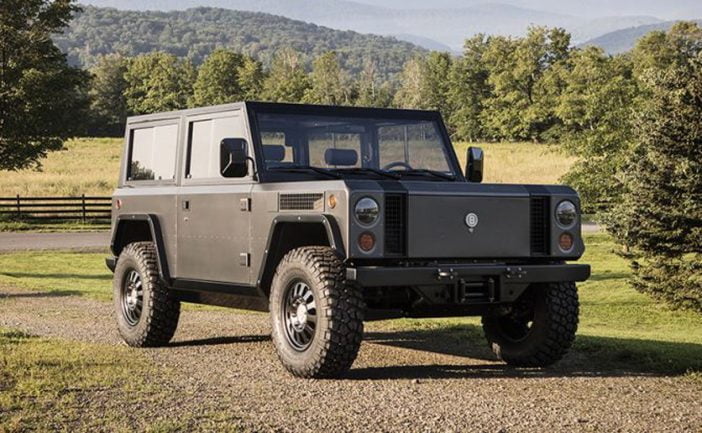
+++ Michigan-based electric vehicle start up BOLLINGER , which has garnered interest worldwide in recent years with its plans to launch a range of rugged, hardcore electric 4x4s, is postponing passenger car development to focus on commercial vehicles. The firm showed its straight-edged B1 SUV and B2 pick-up truck at the 2019 Los Angeles motor show in near-production-ready form, even going so far as to announce pricing details and confirm plans to ship them to Europe. But now founder and CEO Robert Bollinger has announced that development of the two vehicles will be indefinitely postponed as the company shifts its focus to developing electric goods vehicles. In an email to media and customers, Bollinger said: “We started out making the B1 and B2 in 2015 with a dream to make the best trucks on the planet. The off-road capable, all-wheel-drive B1 and B2 are powerful, innovative and distinct. We’ve put countless hours of hard work and passion into making something we are all very proud of. However, today we’re postponing their development and shifting our focus to commercial trucks and fleets. This is a vitally important move for us, because it enables us to continue the development of our technology and to make a real impact in the green future of automotive”. The company hasn’t made any concrete announcements regarding the launch of the €130.000 off-roaders since their debut, and although the cars appeared in LA for a second time in 2021, it was reported that several early deposits had been refunded. Any remaining deposits will now also be refunded until Bollinger is in a position to “resume the B1 and B2 programme”. Sales director Chet Parsons told in 2019 that more than half of the first year’s production run of 1.000 – 1.250 units (then scheduled to get under way in 2021) had been accounted for. The manufacturer’s vehicles were envisioned as low-volume alternatives to the Rivian R1S and R1T, the Tesla Cybertruck and the new GMC Hummer EV, but Bollinger hadn’t identified a production partner to build the customer cars, nor had it obtained investment from an established manufacturer, as Rivian had. Bollinger’s commercial vehicle range will comprise trucks ranging in size from Class 3 to Class 6, which essentially means it will offer extra-large pick ups and small lorries, using a variation of the architecture that underpins the B1 and B2. The B1 and B2 are already Class 3 size, but Bollinger’s commercial vehicles are targeted at a different section of the market and so will take a different form entirely, with the first example could be shown in March. However, Bollinger will continue to offer a unique ‘passthrough’ loadspace that runs through the cabin and into the loadbed, as well as a variety of battery sizes. It is unclear if the passenger cars’ 630hp, 900 Nm dual-motor drivetrain will be carried over to the commercial vehicles, but the claimed 2.360 kg payload and 3.400 kg towing capacity would no doubt be a boon for commercial buyers. Bollinger told that the B1 and B2 will return when “we succeed providing commercial platforms that will give us economies of scale” and its battery pack technology has been validated for public use. Bollinger hinted at plans to target the commercial market in 2019, when it said it had talked to interested buyers in the mining, scientific, and fire and rescue industries. It said that customers would be able to buy a bare B1 or B2 chassis for conversion into a vehicle that best suited their needs. +++
+++ Tesla aims to start initial production of its much-anticipated CYBERTRUCK by the end of the first quarter of 2023, pushing back its plan to begin production late this year, a person familiar with the matter told. The person said the delay comes as Tesla is changing features and functions of the electric pickup to make a compelling product as competition heats up in the segment. Tesla is expected to make limited production of the Cybertruck in the first quarter of 2023 before increasing output, the source said. Tesla, the world’s top electric car maker, makes electric passenger cars but has missed out on the pickup segment, which is profitable and hugely popular in America. Ford and Rivian are ahead of Tesla in launching electric pickups. Ford said early this month it will nearly double annual production capacity for its red-hot F-150 Lightning electric pickup to 150.000 vehicles ahead of its arrival this spring at U.S. dealers. CEO Elon Musk, who unveiled the futuristic vehicle in 2019, had already delayed its production from late 2021 to late 2022. “Oh man, this year has been such a supply chain nightmare & it’s not over!”, he tweeted in late November, when asked about the Cybertruck. Tesla recently removed a reference to its production schedule from its Cybertruck order website. Last month, the website said, “You will be able to complete your configuration as production nears in 2022”. Now “in 2022” has been omitted. Tesla plans to produce the Cybertruck at its factory in Texas, which is expected to start production of Model Y cars early this year. Tesla will reveal its full financial results for 2021 on 26 January alongside a revamped product roadmap, which could also give a timeframe for the launches of the long-awaited Roadster and Semi. Musk will attend the earnings conference call despite stating last year that he would no longer do so. The company will also hold a live question and answer webcast. The firm delivered more than 936.000 vehicles in 2021 after a strong fourth quarter in which it achieved production and delivery figures of 305.000 units and 308.000 units respectively. Tesla has not detailed which models will be discussed in the roadmap update, but it is expected that its long-awaited Cybertruck will be one of the subjects of discussion. Musk previously confirmed that the Cybertruck’s range-topping specification will go into production first but has not yet indicated a price. The top-spec model was previously listed as a tri-motor model with 800 km of range. News on the upcoming Roadster has also been thin on the ground since last year, when Tesla confirmed production would commence in 2023, which is 6 years after its initial reveal. The 1040 hp, tri-motor Model S Plaid, revealed early last year, has also yet to make its way to the European market. It is expected that Tesla will give an update at the webcast about its electric Semi HGV, following the start of low-volume production at its Nevada factory. +++
+++ DACIA ’s commitment to selling low-cost cars will allow it to build lighter and more efficient vehicles for longer than rivals, according to CEO Denis Le Vot, which in turn will mean that the firm won’t have to produce costlier plug-in hybrids and EVs to reduce its CO2 emissions to avoid expensive fines. While Dacia does now sell the Spring in some markets, its only other commitment to electrification is to add its first PHEV, a version of the new 7-seat Jogger, in 2023. Le Vot believes this cautious approach is critical to keeping the brand’s price advantage. “We stand for exceptional value, and we’re able to offer that by giving our customers everything they need but never anything superfluous”, he said. “Today, airconditioning is considered essential, so we offer that. But electric seats with many adjustments? They aren’t essential, so we don’t offer them. In turn, that means that our seats, which are still very comfortable, are much lighter than those used by our rivals. That’s one detail, but there are many. And that means we produce much lighter and in turn low-emission cars, meaning we don’t need expensive electrification technology on them to meet all our regulatory requirements”. Le Vot cited the example of the Jogger, pointing out that it weighs around 20% less than rivals at 1.200 kg in its base form. This means it can be powered by a more efficient engine that emits around 10 % less CO2, according to its official test certification. He hopes that by standing apart from the mainstream rush to electrification, Dacia will continue to attract value-conscious new car buyers and typical used car buyers, especially in today’s market, where high used prices have pushed new prices up. Luca de Meo, boss of parent company Renault Group, said last week that Renault’s own line-up will go all-electric in Europe by 2030, but acknowledged that Dacia is likely to follow later, “at the last possible moment”. Le Vot said: “Let me be clear: we accept our environmental responsibility and will hit all our targets. But by creating lightweight, clean cars, we’re offering more customers a way of doing more for the environment at a lower ticket price. We will be ready with electrification when we need to be, but by then the costs of the investment in the technology will be amortised and we will be able to offer the technology at an affordable price”. However, Le Vot also says: “70 % of Sanderos are sold as Stepways; the average client isn’t looking at low cost”. +++
+++ 2021 saw the end of FORD ’s 43-year reign as the United Kingdom’s leading car brand. It took over the number 1 spot in 1977 as British Leyland crumbled and despite occasionally bullish promises from Vauxhall, it was never really threatened by its Luton rival. Indeed, a decade ago, the-then Ford CEO said privately, “I have told my team to stop worrying about Vauxhall. It is Volkswagen we need to watch”. Those words turned out to be prophetic. VW outsold Ford in the early part of 2020, and in 2021 Wolfsburg pulled out a big lead. So how did VW manage to grow its UK presence? Strangely, VW has not actually grown its share at all: in 2011, it took 9.2% of the market and was in third place, and in 2021, it has taken…9.0% of the market and is market leader. VW has a unique position in the UK as a semi-premium brand, enabling it to withstand the rise of the premium brands (Audi, BMW and Mercedes) above it, and the Koreans (Hyundai and Kia) below it. Effectively, it has stood still, while its major rivals from 10 years ago have gone backwards. Ford has had no such good fortune, despite some deep strategic thinking. In the early 1990s Ford decided that there was no future in its decades-long tradition of designing cars that were just good enough (when the UK competition had been Austin Allegros and Vauxhall Victors), that was not difficult, of course. Prodded by the legendary Richard Parry-Jones, Ford decided that Asian manufacturers could always undercut Ford on price, so it had to find a new battleground. RPJ, as he was known, developed the concept of turning Ford from engineering also-rans to the global leader in vehicle dynamics. The idea would have seemed preposterous at the launch of the dire 1990 Escort, but the first Mondeo, then the Puma and, most famously, the 1998 Focus, delivered on the promise. Then Ford tackled the bane of all European volume manufacturers: over-capacity. Unfortunately, this meant the closure of Dagenham, but it did mean that Ford were one of the very few non-premium manufacturers to sell all it could make. As the 2007 Financial Crisis hit, Ford of Europe’s factories were running at full capacity and profit that year doubled to $744 million. However, that was as good as it got, at least from a financial perspective. Buyers still benefited from the Richard Parry-Jones legacy: the 2008 Fiesta was head-and-shoulders above its rivals. However, its rivals steadily narrowed the dynamic gap, or found ways of negating it. The interior of the Golf Mk7 was such a thing of beauty that buyers probably signed on the dotted line before bothering to find out that the Focus was a nicer drive. Today Ford of Europe only really competes in the supermini and small family car segments. The current Fiesta looks broadly the same as the 2008 model, and has dropped behind the Volkswagen Polo, let alone the Vauxhall Corsa. The Puma is doing well, but it is the only Ford that is No. 1 in its segment. The Ford Focus, the leading family hatchback for 20 years, is now in 4th place, and the Kuga is in fifth position. That is like trying to win a 4×400 relay when 3 of your runners are off the pace. So where does Ford go from here? The short answer is light commercial vehicles (LCVs). Ford’s new mantra is that the Transit Custom is Britain’s bestselling vehicle, with Ford taking a stellar 34.4 % of the overall LCV market. The Transit is the one Ford that’s been impervious to attack for decades. In fact, it has never done better. What was initially designed in Britain to compete with long-dead brands like Bedford, Austin-Morris and Commer (in whose death the Transit played a major role) is now the bestselling medium-sized van in the world. It has even managed to drag the US van market out of the stone age, prior to the Transit’s US launch in 2014, the Ford E-Series van had been basically unchanged since 1975. A Ford spokesman says he could see no reason why the Fiesta couldn’t retake the Number One slot in the Uk. He added that, as LCVs currently have the longest waiting lists, they are being prioritised for production over cars (the fact that LCVs traditionally have higher profit margins may also play a role in that decision, of course). He went on to make a very interesting point about the wider market. It is natural to assume that, post-COVID and post-microchip crisis, the market will revert to its pre-2019 norm. He wondered if that is necessarily true: “The UK market of 2.5 million cars was made up of pull (demand) and push (manufacturer incentives), and people assumed that couldn’t be changed. Now, supply is different and the market is different. We now have a market of stronger residual values and a very different relationship between supply and demand. Maybe there could be a structural change in the market”. While that is a fascinating question for the medium term, there is little doubt that Ford is shifting its European centre of gravity in the here-and-now. It announced a strategic tie-up with VW in 2020 that will see VW using the Ranger and Transit platforms, while Ford will use VW’s MEB platform for at least one passenger car. Ford USA no longer makes any car smaller than the Edge and Mustang Mach-E, so internal platform sharing looks difficult. The spokesman was quoted in May 2021 saying: “The midsized vehicle segment in Europe is very important, and there Volkswagen has a lot more scale than Ford, so it makes sense to use MEB”. That does not sound like a strong commitment to developing new Ford European passenger car platforms. Could the 2030 Fiesta be a Volkswagen ID2 with “Handling by Ford” badges? +++
+++ RENAULT will go all-electric in Europe by 2030, accelerating a previous plan to achieve 90 % EV sales in the region by that date. CEO Luca de Meo said: “Renault will be 100% electric in 2030 in Europe”, imposing a deadline that matches those set by Fiat, Ford and Peugeot, to name a few. The announcement came as part of a progress report to a small group of French reporters on de Meo’s radical Renaulution transformation strategy for the Renault Group, which will have the company launch 24 new vehicles by 2025, expand its EV offering and reinvent Alpine as an electric-only performance brand. Importantly, however, de Meo forecasted that value-oriented Dacia will go all-electric “at the last possible moment” to maintain its affordable pricing structure, possibly after 2030 if the conditions aren’t right. The announcement comes as Renault prepares to launch the new Mégane E-Tech Electric, R5 Electric and 4Ever as the first additions to its new-era EV family. A further 2 new EVs are due by 2025. De Meo has previously come out in support of the UK government’s 2030 ban on new ICE car sales, recognising it as an attempt to position the country “in a better place on the starting grid” and promising that Renault would “do our best to live up to that and see if we’re good enough”. However, more recently, Renault Group R&D boss Gilles Le Borgne condemned the European Union’s proposed 2035 ban on hybrid vehicles, arguing that 2040 was a more realistic deadline, given the rate of infrastructure development and the relative cost of EVs today. Now, De Meo says: “We have an obligation to participate in the transition” to carbon-neutrality across the industry, hence the accelerated EV transition timeframe. Renault won’t reveal its full 2021 results until 18 February, but de Meo told reporters that since the transformation plan was implemented, fixed costs have been lowered by €2 billion, hybrid sales have climbed to 60 % of total volume and development time has been slashed by 25 . +++
+++ TESLA is turning to Mozambique for a key component in its electric car batteries in what analysts believe is a first-of-its-kind deal designed to reduce its dependence on China for graphite. Elon Musk’s company signed an agreement last month with Australia’s Syrah Resources, which operates one of the world’s largest graphite mines in the southern African country. It’s a unique partnership between an electric vehicle manufacturer and a producer of the mineral that is critical for lithium-ion batteries. The value of the deal hasn’t been released. Tesla will buy the material from the company’s processing plant in Vidalia, Louisiana, which sources graphite from its mine in Balama, Mozambique. The Austin, Texas-based electric automaker plans to buy up 80 % of what the plant produces: 8.000 tons of graphite per year, starting in 2025, according to the agreement. Syrah must prove the material meets Tesla’s standards. The deal is part of Tesla’s plan to ramp up its capacity to make its own batteries so it can reduce its dependence on China, which dominates global graphite markets, said Simon Moores of United Kingdom-based battery materials data and intelligence provider, Benchmark Mineral Intelligence. “It starts at the top with geopolitics”, Moores said. “The U.S. wants to build enough capacity domestically to be able to build (lithium-ion batteries) within the USA. And this deal will permit Tesla to source graphite independent from China”. Moores said producing the batteries in the U.S. will reduce some of the questions Tesla is facing about its ties to China, where there are environmental concerns at some mines. The automaker also has set up a showroom in the region of Xinjiang, where Chinese officials are accused of forced labor and other human rights abuses against mostly Muslim ethnic minorities. The battery industry has been confronted with a short supply of graphite in recent months, Moores said. Graphite stores lithium inside a battery until it’s needed to generate electricity by splitting into charged ions and electrons. It comes as every major automaker is racing to get into electric vehicles amid concerns about climate change. Tesla is making almost a million electric cars per year, and sourcing enough batteries is its biggest constraint, he said. “They’ve upped their own battery manufacturing capacity,” Moores said, but still “they can’t get enough batteries”. A new battery factory that the company is building in its new hometown of Austin, Texas, will allow it to get closer to self-sufficiency, but Moores said it is still buying batteries from other manufacturers, “and that won’t change this decade”. For instance, Tesla has a deal with Panasonic to make battery cells at the automaker’s battery factory near Reno, Nevada. The deal with Syrah is part of a broader effort by automakers to secure relatively scarce raw materials for batteries as demand for electric vehicles is expected to grow, said Sam Abuelsamid, principal e-mobility analyst for Guidehouse Insights. The deal also brings the graphite processed in Louisiana much closer to Tesla’s U.S. factories. “The pandemic pointed out to us that we’ve got these long, long, long supply chains, and it doesn’t take much to disrupt a supply chain”, said Donald Sadoway, a professor of materials chemistry at the Massachusetts Institute of Technology. “Somebody could all of the sudden say, ‘We’re going to jack up the prices,’ or ‘We’re going to refuse to ship it’ “. It’s unlikely that the Tesla deal with Syrah will rankle the Chinese government because China has plenty of markets for its graphite, including increased domestic electric vehicle production, Abuelsamid said. China, though, is Tesla’s biggest global market. It has a giant factory near Shanghai and sells about 450,000 vehicles per year there, compared with about 350,000 in the U.S., Abuelsamid said. For the Australian mining firm, the deal is “crucial” because it has a non-Chinese purchaser for its graphite product, Moores said. Syrah’s graphite mine in Mozambique’s northernmost province, Cabo Delgado, is one of the world’s largest, with an ability to produce 350,000 tons of flake graphite a year. Cabo Delgado has faced violence in recent years by Islamic extremists, an insurgency that has recently extended inland from coastal areas toward the neighboring Niassa province. The mine is on the main road connecting the Cabo Delgado and Niassa provinces, a thoroughfare that has been recently upgraded by a Chinese contractor. At a ceremony to reopen the road in December, President Filipe Nyusi called for vigilance so the road isn’t used by insurgents. +++