
+++ There’s a simple but crucial secret behind how car brands from CHINA have managed to develop cars so quickly at costs much lower than those faced by manufacturers in Europe, but it also runs counter to the way traditional car makers work: they share parts. The ability to use standard parts across multiple models isn’t new, and it is one the big reasons why global car giants such as the Volkswagen Group and Stellantis have grown to the size they are. The more you build (or source) of a single part, the cheaper it becomes. But China has gone one step further by breaking 2 unwritten rules: the first is that parts should be built to the car makers’ exact specifications; the second is that to stand out among competitors, parts should be differentiated. +++
+++ Much of the auto industry in JAPAN is ramping up after the devastating July 28 earthquake. Toyota, Nissan, Mitsubishi and many suppliers have restarted production. But Honda is still waiting for relief. Honda’s 2 assembly plants in Japan will remain closed through mid-August as the automaker struggles to get parts from an affected supplier. The earthquake hampered supply of key vehicle parts and will likely slash output by nearly 20,000 vehicles. The automaker and supplier impact goes hand-in-hand, even if one was not directly damaged by the earthquake. Affected suppliers can disrupt parts deliveries to automakers, and when automakers shut down a plant because of damage, suppliers sometimes have to halt their output. The auto industry has become accustomed to supply chain snarls triggered by natural disasters, geopolitical issues and the Covid-19 pandemic over the last years. Automakers and suppliers have developed countermeasures to ensure they are prepared for whatever comes. They are building flexible, diversified supply chains and increasing localization, supplier executives told. +++
+++ PEUGEOT will launch seven new cars in Europe by 2030 and roll out key new technology for owner Stellantis, under the giant car group’s new FaSTLAne strategy. The first 4 cars are brand new electric versions of the 208 and 2008, plus updated versions of their petrol/hybrid equivalents. “Then on the C-segment we will bring 3 new models, replacing the 308 hatchback, the 308 SW estate and the 408”, Peugeot CEO Alain Favey told me in a meeting at Le Mans. Stellantis has 14 car brands, but Peugeot is one of only four with the elevated status of a global brand; the others are Fiat, Jeep and US truck brand RAM. What does that mean? “It’s based on our size: Peugeot sells 1.1-million cars a year and we have the ambition to sell 1.5m in 2030”, explains Favey. “And our scale, which allows us to swallow some additional costs better than a brand with smaller volumes. There’s a benefit for Peugeot: we access new technology first, which is very important because innovation has always helped drive the brand’s appeal”. A textbook example is the new STLA One electric vehicle architecture, which will be rolled out to 2-million vehicles across almost every Stellantis brand, after Peugeot gets first dibs. “The new 208 will launch next year inaugurating the STLA One platform and the new 2008 will launch the year after”, says Favey proudly. They will be true Software-Defined Vehicles, deploying the ‘STLA Brain’ electronic architecture, with ultrafast data processing from the car’s digital central nervous system to enable steer-by-wire and deliver next-level efficiency, safety and in-car experience. STLA One is being converted to accommodate hybrid drivetrains, but they won’t be ready for the new E-208’s launch in 2027. “Today’s 208 and 2008 will remain in the range as combustion and hybrid cars”, confirms the boss. Favey doesn’t say so but it’s likely the cars (launched way back in 2019) will get extensive sheet metal changes to bring them in line with the new 208’s look, hinted at by 2025’s Polygon concept car. Like all European car bosses, Favey is acutely aware of the threat posed by new Chinese brands vacuuming up market share. While Stellantis is mirroring Renault and moving to a 24-month development cycle, the CEO seems relaxed about taking slightly longer so long as his cars are “innovative” and stand out. “The Chinese are very, very fast and have the best battery and self-driving technology. But in terms of styling and interior design, it’s [often]more of the same: the best way to be fast is to reproduce what you’ve just done before or what everybody else is doing”, he says. Favey’s masterplan is to unleash eye-catching design and unusual bodystyles, potentially expanding the 408 Fastback philosophy into other market segments. “The 408 is a bit sedan, a bit SUV, it’s a new thing. It’s a car that goes much beyond just the volume it makes, it’s a statement”. He continues: “The important thing for me is on the first look at any new Peugeot, people have to be able to say within a tenth of a second: ‘That can only be a Peugeot’. I keep saying to our design team: ‘Bring me cars that cannot be a Hyundai or a Kia or whatever else.’ Ours need to stand out”. Peugeot showcased 2 concepts at this year’s Beijing motor show amid, Favey reckons, a sea of lookalike designs. The Concept 6 sedan and Concept 8 SUV show an edgy new take on the brand’s design, and the production versions (co-developed with Dongfeng) will relaunch the Peugeot in the world’s biggest car market starting next year. Favey calls the look our “Feline Future design language”. A key aspect is the evolution of the light signature: a series of vertical, claw-like slashes will turn horizontal, evoking the plastic strips on the 205 GTi’s tailgate. It’s another nod to heritage, something the Chinese brands lack. New Peugeots will be underpinned by a renewed focus on quality. The 208 and 2008 now get a completely overhauled 1.2-litre turbocharged petrol engine backed by 1.86-million miles of testing, in a bid to eliminate its predecessor’s warranty claims. “You have to learn from your mistakes and the new Turbo 100 is now the most efficient and best quality on the market”, vows the boss. He hopes the renewed focus on quality and customer service should boost loyalty. That’s important because Peugeot is only holding steady in Europe, no surprise says Favey considering its car line-up (bar the 3008 and 5008) are in their twilight years. But Fastlane’s new model and technology push is charged with driving European volume from 800.000 to 1-million units by 2030. It’s time for Peugeot to floor it. +++
+++ JLR has said “the sky is the limit” for RANGE ROVER pricing, as it looks to increase its bespoke offerings and move firmly into luxury car territory. Range Rover managing director Martin Limpert said: “We don’t want to show up as a car company, we want to show up as a modern luxury company”. Last year the brand sold its first factory-supplied car for almost €600.000: the SV Asilomar edition, which was presented during Monterey Car Week. Limpert told that it could and will go further: “I think the sky is the limit. We want to further evolve that business area. Bespoke is a really big business area for us. We curated for a US customer the SV Asilomar edition, which was sold for €500.000, roughly double the price of the Range Rover SV. But after elevating and curating it with the personal requirements, that’s where we ended up”. Developing its bespoke offerings would put Range Rover firmly into the sphere of Bentley and towards Rolls-Royce. Within the next year it plans on opening another 12 commissioning suites for its bespoke programme, so-called ‘Range Rover Houses’, which it said “offer clients a sanctuary to immerse themselves in luxury experiences and to be among the first in the world to see and drive some of Range Rover’s most exclusive models”. Asked just how expensive a Range Rover could be, Limpert replied: “I don’t see a limit. Honestly, I think it depends on the value that we generate for the customer. It really depends on the levels of personalisation capabilities, where we’re really trying to push the boundaries – from paint jobs, to stitching, to embroidery, to getting a family crest or your family name on different places of the veneers and so on. “In the future, can we use materials that are not currently part of our offering but that the customer wants to be included because they have a historical relationship to it, or something like this. “It really depends ultimately on what value do we generate for our customers?” As if to illustrate the point, Range Rover tuner Overfinch recently announced its 25-off Holland & Holland edition (below), one of which cost its owner €1.2 million, as testament to the amount buyers are willing to pay to make their Range Rover as bespoke as possible. Despite the push upmarket, Limpert said the incoming GT will be a complementary fifth model in the Range Rover line-up rather than a replacement for either of its least expensive models, the Evoque and Velar. “It’s not replacing anything”, he said, although those 2 models are 8 and 9 years old respectively and thought to be up for retirement soon. That would leave the entry point for a Range Rover with the GT, with a predicted starting price around €85.000. Rival premium car manufacturers have shown it’s possible to keep both very expensive and value models in the range: buyers can spend around €35.000 or well into 6 figures on cars from BMW, Audi and Mercedes-Benz. But JLR aims to create bigger spaces between its three SUV marques: Defender, Discovery and Range Rover.
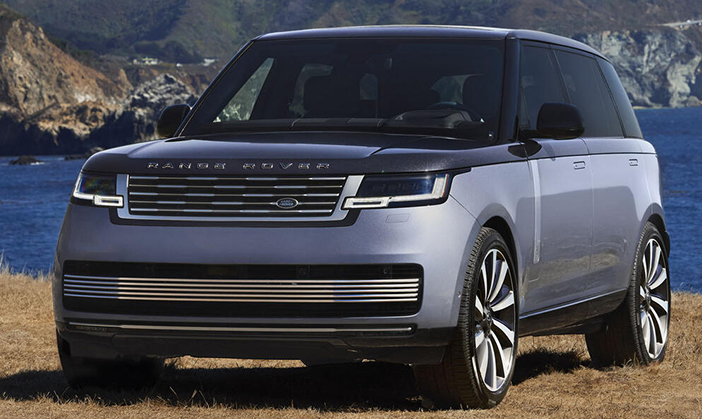
“That’s the whole idea of setting up the House of Brands”, said Limpert of JLR’s move to reframe its three SUV brands, with Land Rover used only as a ’trust mark’ on the SUVs and 4x4s. “Speaking for my brand in that case”, Limpert added, “the equity is already there: customers recognise it more as a Range Rover than a Land Rover already. Defining the difference between the 3 brands, Limpert said: “Defender is all about rugged off-road capabilities, really about pure adventure. This is for those people that really want to go anywhere and do anything”. Discovery, meanwhile, “is all about versatility, family, togetherness. It’s more about where the journey is the destination”. New models and the rebranding, Limpert said, were meant “really to give each their space and their room to define and grow their personalities.” He added: “Not that we want to tell customers which brand to buy”. +++
+++ A new SMART #1 has been revealed in China with some major upgrades under the skin, all of which should be arriving on European models in the next few months. Highlights include a massive upgrade to the car’s charging capability, plus next-gen infotainment software and some styling tweaks. The headline update for the new Smart #1 is the switch to an 800V electrical system that now facilitates much faster charging. This means the same 66 kWh battery pack will top up from 10-80 percent in just 12 minutes, down from more than 30 minutes in the current generation. Smart has not confirmed a specific kW figure, but the new peak DC charging speed is around 360 kW, based on Chinese documentation.
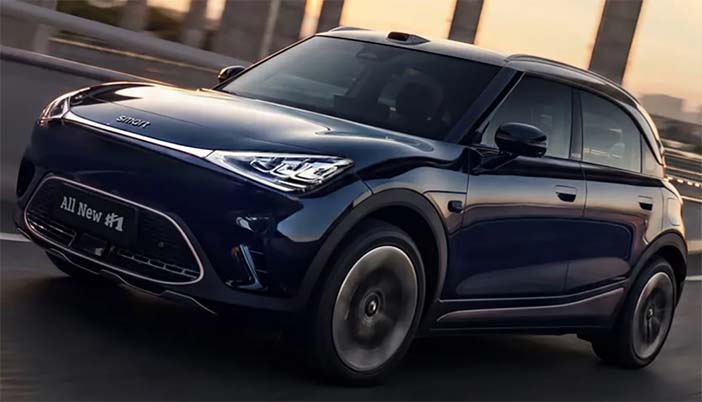
However, while charging is much improved, the new car’s estimated range is similar to before, rated at 435 km on the WLTP test. Smart has also replaced the electric motor for a new unit developed by the brand’s part owner Geely. Peak power is rated at 335 hp with 320 Nm of torque, which will get the new #1 to 100 kph in 6.7 seconds. This represents an increase of 57 hp compared to the existing model, although torque is down by 23 Nm. A new, more connected infotainment system has also been introduced, although the updates are specific to Chinese-market models, and it remains to be seen how much of the new car’s AI-assisted functionality will be applied to European variants. This is also true of the car’s new sensor suite, which in China includes a roof-mounted LiDAR system. Smart hasn’t fundamentally changed the #1’s styling, but there will be new colour and trim choices, fresh wheels and new led headlights. The new variant in China is pivoting in a more luxurious direction, with softer shades and the option of a contrasting gold roof, rather than the brightly coloured options offered for today’s model. This is also reflected inside, where re-designed seats and more opulent materials have been added. The high-specification Brabus model will also feature some of these upgrades, but no official information on that has been revealed so far. I expect the new models to be available in Europe in the coming months. Pricing should stay at a similar level as it is currently. +++
+++ The production-ready design of the new SMART #2 , an electric successor to the famed Fortwo, has been uncovered ahead of its official unveiling in October. The #2 marks Smart’s return to city cars after spending several years launching a range of electric crossovers, which includes the #5, its biggest model yet. It’s due to be revealed in full at the Paris motor show, but new filings with China’s Ministry of Industry and Information Technology (MIIT) have showcased its design 2 months early. It bears a strong resemblance to the old Fortwo, retaining its stubby proportions, although key changes include scowling headlights and rounded units at the rear end.
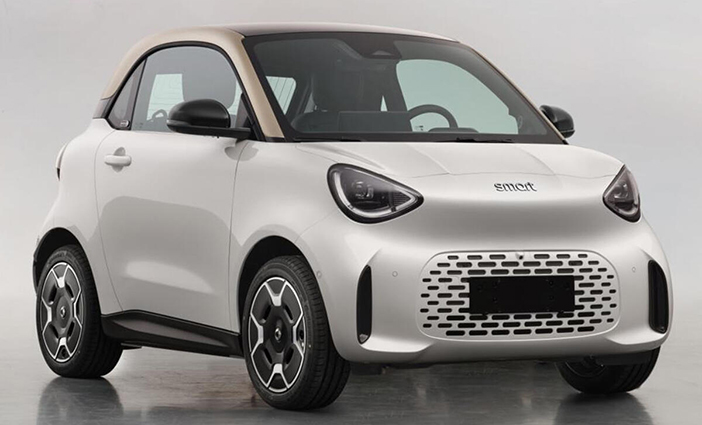
Due in Dutch dealerships next year, the #2 has been designed to offer “uncompromised urban capability”.
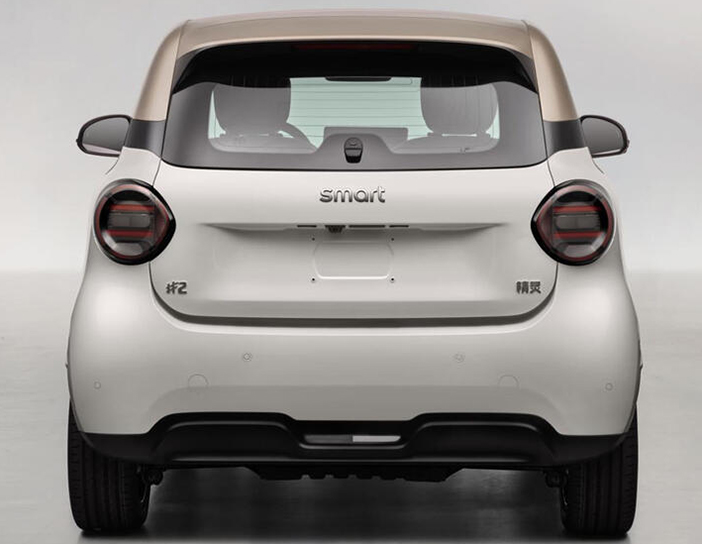
It will be the smallest EV on sale, looking more like quadricycles such as the Fiat Topolino and the Micro Microlino rather than full-sized models such as the Dacia Spring and Fiat 500e. The #2 has been co-developed by Mercedes-Benz and Geely, with the former taking the lead on its design and the latter supplying a bespoke architecture designed around its diminutive size. Full details have yet to be confirmed, but the MIIT filings reveals the #2 has an 82 hp drive motor and a lithium-iron-phosphate battery pack. The car weighs 1.130 kg, thanks to it measuring just 2.75 meter long. Smart previously confirmed the #2 will offer a range of 300 km and be capable of charging its battery from 10-80% in less than 20 minutes. It will also have vehicle-to-load capability, meaning its battery can be used to power external devices. Smart has also claimed it will have a turning circle of just 6.95 meter, smaller than that required of London’s black cabs. The #2 will move the entry-level model upmarket while also attempting to improve its interior space within its compact dimensions, using a bench seat rather than 2 individual chairs. Kai Sieber, head of Smart design at Mercedes, previously said the Concept #2 shows a city car “should spark joy”. Smart has given no indication of pricing ahead of next year’s scheduled launch. Although it has a more luxurious cockpit and vastly superior technical attributes, Smart will not command a premium for the #2 over its short-legged predecessor, which was discontinued in 2024. Smart plans to stretch the #2 and add a back seat to create a successor to the Forfour. Such a model would give the brand a footprint in the increasingly competitive electric supermini market, where it could take on the likes of the Renault 5, Citroën ë-C3 and MG Go. +++
+++ The popularity of Chinese cars in the UNITED KINGDOM is exploding at a rate almost unseen before in the industry. Sales of brands from China are now expanding more than 10 times faster than those from the rest of the world, with new entrants like Omoda-Jaecoo potentially on track to outsell industry titans like Ford. This year saw the best July performance in overall new-car sales since before the pandemic, with 156.571 registrations representing a near-12 percent increase over the same period in 2025. Yet while manufacturers from Europe, Japan, Korea and America experienced an 11 percent rise in sales on average, their Chinese competitors enjoyed a stratospheric 180 percent jump. Broadening the focus to look at 2026 as a whole, Chinese brands have seen a 145 percent rise in sales, and now account for almost 17 percent of all cars sold. Much of this can be attributed to a rapid expansion of individual brands’ line-ups; Jaecoo, for example, only entered the UK market in January 2025 and now boasts a line-up of 4 models. However, much of the brand’s success can be attributed to the huge popularity of the Jaecoo 7, which is the third-best selling car so far this year. The smaller Jaecoo 5 was also in the list of the top-10 best sellers for July.
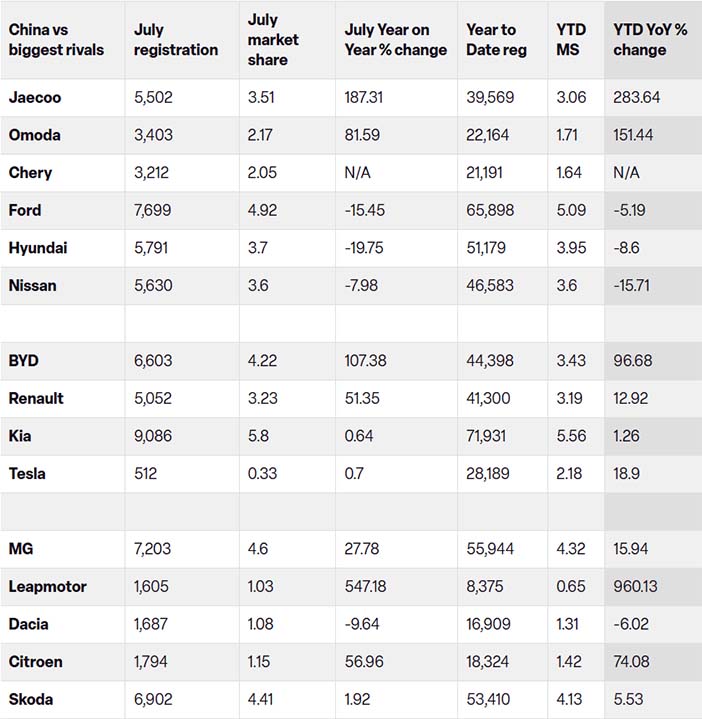
Yet the brand that has benefited from the greatest uplift in sales over the past year is Leapmotor. The part-Stellantis-owned budget marque has registered almost 8.400 cars in the UK so far this year; almost a 1.000 percent increase over the same period in 2025. Once again, it’s easy to point to the arrival of the B10, C10 and B05 which have greatly expanded the brand’s appeal beyond the Dacia Spring-rivalling T03. Yet while Dacia’s total sales so far in 2026 are almost double those of Leapmotor, the pair were neck-and-neck in terms of registrations in July, hinting that thrifty car buyers may be switching sides. China’s invasion of the British car market could well be somewhat of a runaway train, because manufacturers that have been active here for several years are still seeing strong growth. BYD, for example, has a 50 percent greater share of the market than the company deemed its biggest rival, Tesla, although BYD’s range of hybrid models does open it up to a wider customer base. So far this year, the Shenzhen-based conglomerate has sold almost twice as many cars as in the same period in 2025. Some of this is due to a much stronger market this year, although BYD’s share has nevertheless increased by almost 80 per cent, placing it in line with (and sometimes even ahead of) other mainstream EV and hybrid brands including Renault and Volvo. MG, which has been present in the UK in its current form since the early 2010s, is also seeing stronger growth than its key rival, Skoda, even achieving a greater market share year-to-date. For now, the aforementioned VW and Kia remain the UK’s favourite automotive marques. However, as more and more people choose EVs, the balance of power will continue to shift; research from consultancy firm McKinsey and Company found that two-thirds of those owning cars from premium brands would be open to considering a model from another manufacturer when buying an EV. This drops slightly to a still-significant 57 percent for owners of cars from mainstream marques. +++