
+++ ASTON MARTIN has quietly sold control of its own name in everything it does outside cars to keep the lights on. The British sports car maker agreed to hand 50.1 percent of its non-automotive branding rights to US brand group Authentic Brands as part of a $738 million debt package led by HPS Investment Partners, drawing a furious response from existing creditors. The move splits the Aston Martin name in two: one bucket for road cars and Formula 1, another for lifestyle products, merchandise and licensing. Creditors owed about $1.75 billion argue that shifting this intellectual property into a new structure to back the HPS deal moves prime collateral out of their reach and may breach bond covenants. They have already fired a formal legal warning at the company’s board. The company arranged a $738 million financing led by HPS Investment Partners, built around a $606 million secured term loan plus a further $135 million that can be drawn later. Part of that extra funding hinges on transferring a 50.1 percent stake in Aston Martin’s non-automotive intellectual property to Authentic Brands, giving the Reebok and Brooks Brothers owner effective control over future lifestyle licensing. HPS is not just the lender arranging the package; it is also an investor in Authentic Brands, and HPS co-founder Scott French sits on the boards of both Aston Martin and Authentic Brands, a web of roles creditors say tilts the deal away from them. That non-automotive intellectual property covers uses of the Aston Martin name and associated logos on merchandise, luxury goods, and broader lifestyle tie-ups rather than on the cars themselves. Sector reports say key rights, including those linked to the name, have been moved from the UK business into a Cayman Islands subsidiary that then borrowed from HPS. Creditors argue this pushes valuable assets into a new box they do not have claims over if the company ever fell into formal insolvency and a separate Bloomberg account says funds managed by an Authentic Brands UK arm joined HPS in providing the $606 million loan, deepening the financial ties between lender, new IP co-owner, and the carmaker. Earlier this year, Aston Martin raised about $67 million by selling naming rights linked to its Formula 1 operation to AMR GP Holdings, the team entity controlled by executive chairman and largest shareholder Lawrence Stroll. That effectively turned the move into another cash injection from him rather than a pure third-party branding sale. The flashpoint now is a “letter before action” that bondholders have sent to Aston Martin’s board over the HPS package. Lenders representing around $1.73 billion of existing debt are threatening to sue to unwind the HPS transaction and block the disposal of brand assets, arguing that moving core naming rights into an offshore subsidiary, then selling a majority of non-automotive rights, unfairly weakens their position. From their perspective, the Aston Martin name is the crown jewel that would be sold to repay them in a worst-case scenario. Legal commentary likens their pushback to seeking a freezing injunction that would stop a debtor giving away key assets before any court-supervised restructuring. The brand is already under pressure on other fronts too, from technical headaches such as the Aston Martin Valkyrie brake recall over fire risk to the high development costs of new halo projects like the F1-style Aston Martin hypercar prototype. +++
+++ The BMW iX3 is undeniably one of the brand’s most important releases, as it spearheads the next-generation Neue Klasse EV architecture. Its importance is even more pronounced as the company ramps up production, with the company building 50.000 units in just 9 months at its factory in Debrecen, Hungary. While U.S. deliveries are scheduled to begin in late September, production could hit a bump because of low water levels in the Danube River.
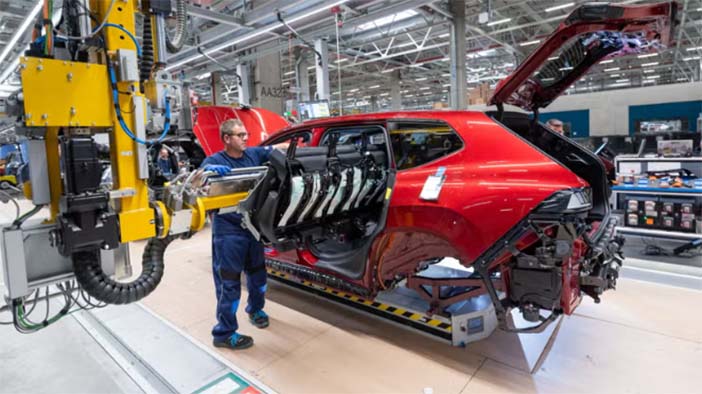
The historic lows forced Hungary’s Paks nuclear power plant to shut down completely for the first time in 44 years, which could in turn affect BMW’s assembly line. BMW has responded to the shutdown by reducing the plant’s energy consumption by roughly 15%. “A package of measures developed at short notice will tap additional savings potential in plant operations, lighting, climate control, and charging infrastructure”, a BMW spokesperson told. Whether this will affect iX3 production remains to be seen. Other automakers, including Mercedes-Benz, could also feel the effects of the shutdown, although its Hungarian plant is currently operating without restrictions. Automakers establish assembly plants in Hungary to take advantage of several benefits, including the country’s low corporate tax rate. Chinese automaker BYD even chose the country for its first European passenger-car plant. For now, BMW benefits from a 50-hectare solar installation around the plant, which can supply nearly all the facility’s power on a sunny summer day. However, because iX3 production runs in 2 shifts, the plant must still draw electricity from the grid after dark. Aside from Hungary, BMW also builds a long-wheelbase iX3 in China. Starting in 2027, the iX3 and its i3 sedan counterpart will also be built in Mexico, although it remains unclear whether U.S.-bound examples will come from there. Either way, imports from Hungary or Mexico would face tariffs under current U.S. trade policy. +++
+++ Uncharacteristic of HONDA , Japan’s second-largest automaker had its fair share of missteps over the last few years. The decision to go all out and all in with EV development had already cost the company dearly, only for it to be canceled with no chance to recoup that investment. Its partnership with Sony had also crumbled, so the promising Afeela won’t ever see the inside of a showroom. As a result, Honda suffered its first loss in nearly 70 years in the aftermath of the financial year 2025-2026. CEO Toshihiro Mibe was under fire in the recent shareholders’ meeting, profusely apologizing for what happened under his watch. But this is Honda we’re talking about, and it’s begun taking steps to bounce back. The Japanese automaker recently published its financial report, and it’s good news. After 6 successive quarters of diminished profits, Honda has reported a rise in profits for the first quarter of financial year 2026-2027. From 244.2 billion yen in the first quarter of the previous financial year, operating profit had more than doubled to 530.8 billion yen ($3.37 billion). Honda posted a net loss of 423.9 billion yen ($2.7 billion) in the last fiscal year. Having bounced back that quickly is a great sign for the automaker. As a result, it’s even adjusted its forecasts to an even more positive outlook. The North American market played a significant role in Honda’s recovery thanks to higher unit sales and demand. Other regions also posted growth, while sales in Europe remained steady. However, the Chinese market hindered progress, as sales continue to slide there. Overall sales are still down compared to last year’s numbers, but Honda found profit in other ways. The weak yen, coupled with strong North American sales, actually did Honda a favor. Expenses were also lessened during the same time period, but the big deal here is curbing costs on tariffs. Honda has been mostly spared from massive tariff expenses thanks to several assembly lines around the world, along with the extensive partnerships with domestic suppliers. But the real MVP here is Honda’s motorcycle division. Whereas the automotive side of things made little but meaningful progress, its motorcycles that pulled Honda up as a whole, as both volume and profit are up. But back to cars, while volume isn’t on the same level, what’s more important here are the profit gains. Of course, the ideal situation is an increase in profits and sales. China is proving to be an anchor in achieving the latter, and it has been a struggle for many legacy automakers for the last couple of years. It won’t be easy to overcome that, but Honda is banking on a different market to make up the difference. That would be North America, and CEO Mibe recently went on record saying the company needs to build another plant in the U.S. The U.S., Canada, and Mexico comprise 40% of Honda’s worldwide sales, which is why the automaker will be investing further in those markets. That said, it also needs to strengthen its position in the Southeast Asian and Oceania markets, as Chinese automakers have been eroding the automaker’s market share in those traditionally strong regions. Right now, Honda cannot afford to put all its eggs in one basket, and it’s been burned before for doing that. With a more multi-pathway approach that’s also more inclusive of emerging markets, Honda could finish this financial year on a much better note than before. +++
+++ LAMBORGHINI has confirmed that its forthcoming hardcore Revuelto SV or SuperVeloce will be revealed in full on August 14. Taking centre stage at the glamorous setting of The Quail as part of Monterey Car Week in northern California, this new model will carry on a legacy of SV cars stretching right back to the original Miura. Packing a sophisticated plug-in hybrid powertrain and radical styling, it’s easy to forget the Revuelto has already been around for 3 years, so a punchier variant now feels very much due, especially considering its Aventador predecessor not only gave us the SV, but the SVJ, S, the roofless Aventador J and of course, the Ultimate. Spy shots reveal plenty about the Revuelto SV, despite the camouflage wrap which aptly includes the warning ‘Attenzione macchina veloce’, or ‘Attention fast car’. The visual enhancements certainly look up to the billing, with a new front fascia with aggressive, angular bodywork under those distinctive 3-pronged headlight signatures. The car was spied on public roads around Germany’s Nürburgring where it has been testing. Don’t be surprised if we see a new entrant in the top 10 quickest Nürburgring lap times, where the old Lamborghini Aventador SVJ still sits in fifth place. At the rear, a larger fixed wing is replacing the active aero wing on the standard Revuelto, while it looks like extra venting has been added above the rear lights.
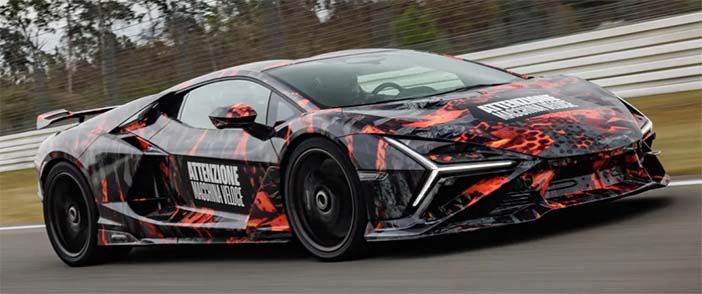
Previous SV models have paired visual tweaks with more power, and we should expect the same of the new Revuelto SV. The Revuelto is already the brand’s most powerful car to date with a 6.5-litre V12 combining with 3 electric motors for 1.001 hp. This allows it to sprint from 0-100 kph in 2.5 seconds, and on to a top speed of 350 kph. There are several ways Lamborghini could enhance the Revuelto, either by reducing the 1.772 kg weight or by increasing power outputs from the V12 or the electrical assistance. Either way, we’ll find out soon just how Lamborghini intends on upping the ante on its flagship supercar. +++
+++ A brand new MAZDA CX-3 is officially in the works, giving the Japanese brand a much needed challenger in the wildly competitive B-segment SUV class here in Europe. Many of Europe’s highest selling cars, such as the Ford Puma and Peugeot 2–8, are small SUVs, and it’s an area of the market that Mazda has been absent from since the first-generation CX-3 was taken off-sale back in 2021. Buried away within the company’s mid-year financial report, news of the model came alongside confirmation that this will be a fully home-grown Mazda, rather than one built in collaboration with an automotive partner as is the case with the Mazda 6e and CX-6e, which are the result of a joint venture with China’s Changan.
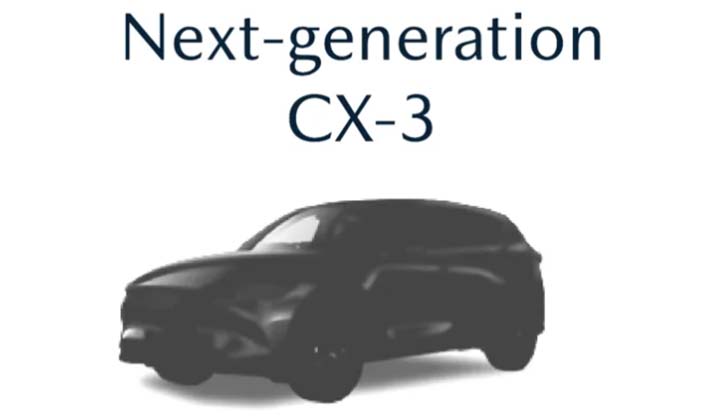
This means that it’ll feature a range of combustion powertrains, possibly including a new hybrid option that we know is already in development. It also suggests that the car may be front-wheel drive only, and could even include a 6-speed manual gearbox on non-hybridised models. Much like the all-new CX-5, I expect the smaller CX-3 to be one of the more capable cars in its class in terms of driving dynamics. I also expect to see the next generation of Mazda’s latest interior design language, as well as fresh digital interfaces and updated safety technology. What will really set the new CX-3 apart from most of its competition, though, is the design, which could draw inspiration from the Mazda Vision X Concept revealed at last year’s Japan Mobility Show. A dark silhouette featured in Mazda’s financial report gives very little away, but we suspect that many of the concept’s new design elements, such as the fared-in front grille, could be seen on the production model. The new CX-3 will be a critical model for the brand, both here in Europe and in its larger global markets. As well as sitting alongside the Mazda 2 Hybrid, which nowadays is just a rebadged Toyota Yaris, it will give Mazda a distinctive new entrant into one of the industry’s most important sectors, where it will be up against a whole host of cars from legacy brands, as well as a range of cheaper (and larger) Chinese models. +++
+++ STELLANTIS boss Antonio Filosa has said he is looking for growth by filling ‘white spaces”’ in the automaker’s line-up with larger models built by Chinese partners Leapmotor and Dongfeng. Because U.S. tariffs have blocked most Chinese vehicles from American markets, these products will reach European buyers instead. Leapmotor will build 2 midsize, or D-segment, vehicles in Stellantis’ Madrid factory, which will be transferred to the Leapmotor International joint venture between the 2 companies. In what would be a strategic reversal, Volkswagen Group may build vehicles designed for China at underused German factories. That would effectively make Europe’s largest automaker a contract manufacturer for a fast-growing Chinese EV company. And Nissan is considering using Chinese-developed platforms for future European electric models as it seeks to slash costs in a region where it has lost money and market share for years, CEO Ivan Espinosa said in May. +++
+++ For decades, legacy automakers taught the fledgling auto industry in emerging markets how to design, engineer and assemble cars and light trucks. Clearly the students are now becoming the teachers. Bloomberg’s report that Honda has outsourced development of a new vehicle program to TATA TECHNOLOGIES is the latest example. Honda, one of Japan’s major automakers and through its large U.S. operations a quasi-domestic producer, is entrusting an Indian engineering services firm with building an end-to-end platform to help cut costs. Tata Technologies, part of the Tata Group, provides engineering and digital services to automotive, aerospace and industrial clients. +++
+++ RijksDienst Wegverkeer, the Dutch road regulator known as RDW, is refusing to disclose how it decided TESLA ’s Full Self-Driving system should be approved for local use. After granting FSD the green light in April, RDW has gone on to push for the system to be adopted across the rest of the European Union, a stance that puts the regulator in the position of advocate for a technology whose approval it won’t fully explain. Emails between the regulator and Tesla, dating back to late 2024, show the automaker pressed RDW to keep every document tied to its FSD safety review out of public view. Tesla’s argument was that publishing the material would expose its commercial secrets. Speaking with Reuters, transportation-safety professor at the University of Leeds, Oliver Carsten, believes it’s in the public interest for details of RDW’s testing and analysis to be published. Similarly, Frank Mutze from local advocacy group European Transport Safety Council says without this information, the public has to trust that RDW “have done their homework”. In June it was revealed that Tesla had shared inflated Full Self-Driving data from the United States with numerous regulators across the EU, including RDW. This data has been found to have exaggerated FSD’s safety by comparing crash rates of FSD vehicles that triggered airbag deployments to federal crash rates for all vehicles, including those involved in less-severe accidents. Similarly, Tesla also compares its cars to the average US vehicle, which is more than 12 years old, without acknowledging that new cars are dramatically safer than older ones. RDW says it did not rely on data provided by Tesla in approving FSD and states it conducted its own “extensive testing” of the technology. An email exchange from April 2025 shows that Tesla reached out to RDW seeking clarification that it would “never” release a document related to the FSD system. Despite this, RDW says it decided to withhold information regarding its evaluation not due to Tesla’s request for secrecy, but of its own accord to protect Tesla’s company secrets. It’s not just Dutch authorities that are keeping information regarding FSD behind closed doors. Regulators in six other European countries, including Germany, Denmark and Norway, also say they will not release data on FSD testing, including information provided to them by RDW. With it appearing increasingly likely that FSD will soon be approved for widespread use across the region, it seems as though consumers will simply have to trust regulators when they say the system is safe. +++