
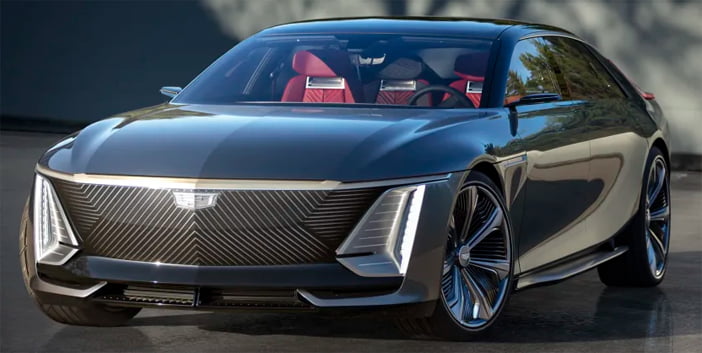
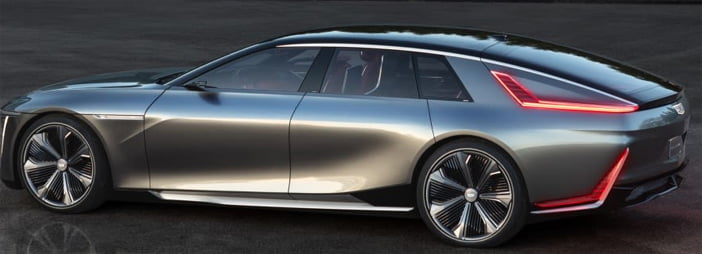
+++ Over 2 years after I first saw the car in person at a private, no-cameras-allowed General Motors EV Day, I can finally show you the CADILLAC Celestiq. Cadillac has officially revealed the Celestiq show car, an electric halo sedan meant to be an expensive and rare aspirational vehicle, and, along with the recently launched Lyriq electric crossover, a glimpse into the future of Cadillac design. Inspired by Cadillac’s 120-year history (specifically pre-war V16 coaches and the 1957 Eldorado Brougham) this Celestiq show car is not just a tribute to the past, but also a big step forward into the all-electric brand Cadillac will become. It uses GM’s new Ultium electric powertrain technology, as well as the automaker’s next generation of hands-free driving technology, called Ultra Cruise. On the outside, the hand-built Celestiq is lengthy in profile, with a long, low hood extending past the gigantic wheels up front, and the rear roofline tapering to completion at the lip spoiler atop the rear fascia. Like the Lyriq, Lighting is a big part of the Celestiq’s outward personality. In addition to the vertical lighting on either side of it, the grille lights up in a warm smile, punctuated by an illuminated Cadillac badge in the center. The rear lighting elements begin on the sides of the car and extend around to the back. There’s also an illuminated crest on the rear, along with a light-up “Celestiq” nameplate. Many screens and more colorful lighting bring the lounge-like interior to life. The centerpiece is a 55 inch LED display stretching across the dash. It features “electronic digital blinds” for privacy to allow the passenger to watch videos without distracting the driver. A screen resides on the back of each of the front headrests, as well as 2 more touchscreen controllers between the front and rear seats. We see some backlit door panel designs similar to those in the Lyriq. There’s also a “Smart Glass Roof” with “Suspended Particle Device” technology, allowing for 4 zones of variable lighting: 1 for each passenger. As far as specifications, Cadillac is still reserving a lot of details for a later date. Nevertheless, folks at Cadillac had plenty to say about the vehicle. “The Celestiq show car is the purest expression of Cadillac”, said Magalie Debellis, Cadillac Advanced Design Manager. “It brings to life the most integrated expressions of design and innovation in the brand’s history, coalescing in a defining statement of a true Cadillac flagship”. Color & Trim creative designer Laetitia Lopez said: “We’ve combined the beauty of function with the beauty of form. We had to reconsider all aspects to immerse the customer, all of their senses, and create a connection with the vehicle through the finest genuine materials, exceptional detailing and advanced technology”. Cadillac has not yet announced timing for production of the Celestiq, but we know it will be hand-built, allowing for plenty of customization. GM recently announced an $81 million investment at its tech center in Warren, where the Celestiq will be produced. +++
+++ FORD is preparing to cut as many as 8.000 jobs in the coming weeks as the automaker tries to boost profits to fund its push into the electric-vehicle market, according to people familiar with the plan. The eliminations will come in the newly created Ford Blue unit responsible for producing internal combustion engine vehicles, as well as other salaried operations throughout the company, said the people, who asked not to be identified revealing internal discussions. The plan has not yet been finalized and details could still change. The move would mark a significant step in chief executive officer Jim Farley’s plan to cut $3 billion of costs by 2026. He has said he wants to transform Ford Blue into “the profit and cash engine for the entire enterprise”. In March, Farley radically restructured Ford, cleaving its carmaking in 2 parts by creating the “Model e” unit to scale up EV offerings and “Ford Blue” to focus on traditional gas burners like the Fiesta. The job cuts are expected to come among Ford’s salaried ranks in a variety of operational functions, according to the people familiar. They may come in phases, but are likely to begin this summer, the people said. Ford employs about 31.000 salaried workers in the U.S., where the bulk of the cuts are expected. Ford declined to comment on possible job cuts, saying that it’s focused on reshaping the organization to capitalize on the growth of electric vehicles. “As part of this, we have laid out clear targets to lower our cost structure to ensure we are lean and fully competitive with the best in the industry”, chief communications officer Mark Truby said in a statement. Farley has said cutting staff is a key to boosting profits, which have evaporated on its electric Mustang Mach-E and other plug-in models amid rising commodity and warranty costs. “We have too many people”, Farley said at a Wolfe Research auto conference in February. “This management team firmly believes that our ICE and BEV portfolios are under-earning”. Ford’s shares tumbled 39% this year through Tuesday, worse than the broader market, amid inflation fears and supply-chain snarls roiling the automotive industry. In March, Farley boosted spending on EVs to $50 billion and set a plan to build 2 million battery-electric vehicles annually by 2026, after selling just 27.140 in the U.S. last year. Last month, Ford’s EV sales rose 76.6% from a year earlier as it rolled out the hot new electric F-150 Lightning pickup. To finance Ford’s electric ambitions, Farley has said he needs the company’s traditional gas-fueled models to make more money. “The funding for that $50 billion, it’s all based on our core automotive operations”, Farley said in a March interview. “That’s why we created a separate group called Ford Blue, because we need them to be more profitable to fund this”. Ford says it has contracts to deliver enough batteries to produce electric vehicles at a rate of 600.000 globally per year by late in 2023. The company said that CATL of China will supply new lithium-iron phosphate batteries starting next year. The deal is in addition to a contract with SK Innovation of Korea that includes building batteries in a joint venture at plants to be built in Kentucky and Tennessee. Ford also is getting batteries from LG Energy Solution of South Korea. Ford says it plans for half of its global production to be electric vehicles by 2030. The ability to make 600.000 EVs per year includes 270.000 Mustang Mach E cars for North America, Europe and China, as well as 150.000 F-150 Lightning pickups in North America. Also included are 150.000 electric Transit vans in North America and Europe, and 30.000 of a new SUV for Europe. Lithium iron phosphate batteries reduce use of scarce minerals such as nickel, the company said, cutting material costs by 10% to 15% over nickel cobalt manganese batteries now in use. Ford also announced multiple other contracts for battery components and raw materials including lithium, from sources in the U.S., Australia, Indonesia and other countries. It also has a target of being able to manufacture EVs at a rate of 2 million per year globally by the end of 2026. +++
+++ HONDA said it would slash production by up to 30% in Japan next month against original plans due to persistent supply chain and logistical issues. 2 lines at its Suzuka plant in western Japan will reduce production by about 10% this month and by about 30% in early August versus previous plans, Honda said. Its assembly plant in Saitama prefecture, north of Tokyo, will also cut back production by about 10% early next month. Honda has not disclosed its monthly production target. Automakers have been unable to shake off the impact of Covid-19 lockdowns in China and a shortage of semiconductors. Toyota said this week its global production for August would be about 700.000 units, down roughly 18% from its plans at the beginning of the year. Honda adjusted its production plan in May but had said it would return to normal in early June. +++
+++ A subsidiary of HYUNDAI has used child labor at a plant that supplies parts for the Korean carmaker’s assembly line in nearby Montgomery according to area police, the family of 3 underage workers and 8 former and current employees of the factory. Underage workers, in some cases as young as 12, have recently worked at a metal stamping plant. It supplies parts for Hyundai’s U.S. assembly plant, which builds the Santa Fe and Tucson. In a statement, Hyundai “denies any allegation that it knowingly employed anyone who is ineligible for employment”. The company said it relies on temporary work agencies to fill jobs and expects “these agencies to follow the law in recruiting, hiring, and placing workers on its premises”. Reuters learned of underage workers at the Hyundai-owned supplier following the brief disappearance in February of a Guatemalan migrant child from her family’s home in Alabama. The girl, who turns 14 this month, and her 2 brothers, aged 12 and 15, all worked at the plant earlier this year and weren’t going to school, according to people familiar with their employment. Their father, Pedro Tzi, confirmed these people’s account in an interview with Reuters. Police in the Tzi family’s adopted hometown of Enterprise also told Reuters that the girl and her siblings had worked at the plant. +++
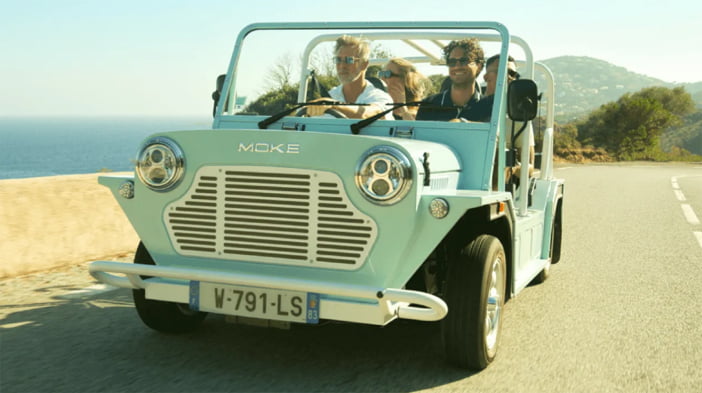
+++ MOKE INTERNATIONAL , the firm behind the iconic Mini Moke, has agreed to sell up to 100 percent of its shareholdings to EVTG (EV Technology Group). The sale comes as Moke launches itself into the electric car world with a pure-electric version of its Mini Moke. Moke says the transaction is valued at $55.1 million and EVTG will own approximately 67 percent of Moke International while maintaining an option to acquire up to 100 percent of the remaining shares. CEO of Moke International, Isobel Dando, said “EV Technology Group’s in-house expertise, and customer-centric technologies will also be invaluable to us as we continue to develop the Electric Moke and more pioneering products”. Wouter Witvoet, CEO of EV Technology Group, added “This exciting investment is extremely close to my heart. I first became interested in Moke International when I tried to rent a Moke in the South of France (I quickly discovered the joy of driving this vehicle in beautiful locales), but also the commercial opportunity to reimagine Moke as a global brand”. The new Electric Moke is already in production and available to order from £29.150. Moke says it’s a continuation of the 1964 Mini Moke, created by Sir Alec Issigonis, the designer for the original Mini. The Mini Moke gained a cult following after celebrities such as The Beatles and Bridget Bardot were seen driving them in coastal resorts. Produced in the UK and reimagined as an EV, the Electric Moke can cover up to 130 km of range on a single charge (Moke says this is enough for four round trips from Cap-Ferrat to Monaco) and takes 4 hours to charge from a Type 2 charger. A synchronous motor offers up 44 hp, or about 10 hp more than the original 848 cc A-Series engine in the classic model. The firm says that’s enough for a 0–50 kph time of 4.5 seconds and a top speed of 80 kph. However, while there’s a little more performance, the switch to electric power has made the Moke pile on the pounds. It weighs 800 kg thanks to the battery pack, which is almost double the amount of the original petrol model. To try and mitigate some of this weight-gain, Moke International has thoroughly reworked the car’s bodywork and chassis, swapping some original steel panels for lightweight aluminium replacements. The brakes and suspension have also been improved to cope with the added bulk, and regenerative braking has been added alongside a new power steering system. The company has added further creature comforts, such as a heated windscreen as standard. Buyers are also invited to customise their cars to their exact taste. There’s a selection of unsurprisingly summery paint finishes such as Wave Blue, Sunlight Yellow, Sunset Orange, Scuba Blue and Granite Grey. Cabin trim can also be customised too. +++
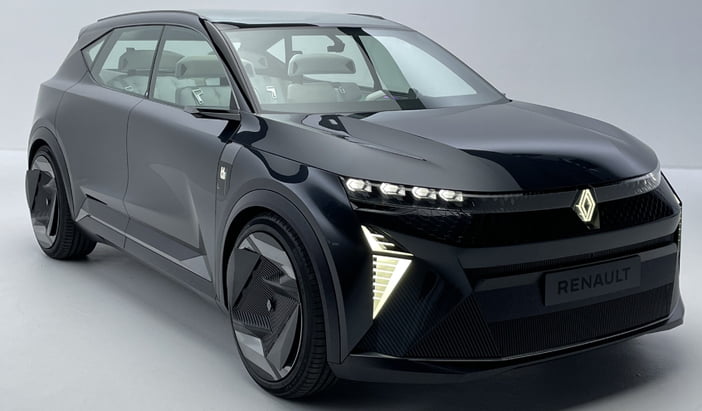
+++ As part of RENAULT ’s so-called ‘Renaulution’, the firm is set to take another retro step forward with a reinvention of the legendary Scenic. The Scenic was removed from Renault’s model range lineup recently, but the nameplate will find itself on a new, all-electric, C-segment SUV, the company has confirmed. The new Scenic will use the all-electric CMF-EV platform that made its debut in the new Megane E-Tech Electric. Whereas that forthcoming Megane is a competitor for Volkswagen’s ID.3, the Scenic will be a rival to the ID.4. The CMF-EV architecture also underpins the award winning Nissan Ariya. Renault unveiled the Scenic Vision Concept in May this year, which previewed the styling of the upcoming Scenic. Lead designer Gilles Vidal, said the concept’s exterior design is representative of the production car and is “more than 90 per cent production car”. As for the interior, the concept’s yoke-style steering wheel and intricately detailed dash won’t make its way onto the finished Scenic. Autointernationaal.nl expects that the new Scenic E-Tech Electric will go on sale in 2024. Renault boss Luca de Meo said: “This concept will announce a future product. When we do concepts, we want to turn them into real cars”. He added: “We are not going to do another MPV. We’re going to make a more progressive model than that”. He added that the Scenic would need to offer “space and range” beyond that of the new Megane E-Tech Electric. The new Scenic will only be available as a 5-seater. When asked at last year’s Munich Motor Show if the CMF-EV platform could support 7 seats, Renault’s executive vice-president of engineering, Gilles Le Borgne, told me: “No, it’s not planned to do that. We can have 4-wheeldrive, but not 3 rows”. However, that doesn’t rule out a new 7-seat Grand Scenic model on a revised CMF-EV platform at some stage. The CMF-EV platform should allow 3 different takes on the Scenic to be offered. A cheaper version with a 40 kWh battery and a range of around 320 miles would target buyers in urban areas, while a 60 kWh battery is likely to appeal to those wanting to take their families on longer journeys. Rapid charging should enable a top-up from 15 to 80 percent in around 30 minutes, while the latest electronic safety and driver-assistance technology should maintain the Scenic’s reputation for excellent crash-safety scores. The Scenic’s Nissan Ariya sister car is available with an 87 kWh battery with either a 242 hp single-motor or 306 hp dual-motor powertrain and it’s possible we could see these feature in a range-topping Scenic. The new Scenic is expected to follow the design of the Megane, with a taller version of its sister car’s new crossover styling, but with a few tweaks to the styling details. Expect the front end to be bluffer than the Megane’s, and with an unusual light treatment featuring LED running lights running vertically up each front corner, along with slim LED headlights and an oversized version of the latest Renault diamond logo in the centre. The back end should feature a tailgate that opens right down to bumper level with the now-familiar full-width light bar that’ll do its best to add a feeling of width to this tall EV. Inside, the taller Scenic should go some way to answering criticisms over a shortage of space in the back seats of the Megane (one of few drawbacks of the new model). The greater height will have huge benefits in the boot, too. And as with the original Scenic, expect some clever seat-folding engineering that will let the car switch simply from 5-seater to Van. Elsewhere, the Scenic is expected to make use of the Megane’s impressive interior technology, with a 12.3-inch digital instrument cluster that’s seamlessly linked to a 12-inch portrait-orientated infotainment screen, powered by Google. Expect eco-friendly sustainable materials to feature throughout the cabin, too. Even though large 20-inch wheels are likely to follow on to the Scenic from the Megane, Renault engineers will probably move the focus more towards comfort to suit more family-orientated buyers. However, unlike with the upcoming new 5 Electric, Renault performance arm Alpine has no plans to fettle either the Megane or the Scenic, concentrating on its own CMF-EV SUV model, the GT X-Over that’s set to arrive after the Scenic in 2025. +++
+++ BMW, the parent company of ROLLS-ROYCE , has submitted the trademark ‘Droptail’ to the EU Intellectual Property Office, hinting a new coachbuilt Rolls-Royce is in the works. Rolls-Royce has recent history in creating limited, bespoke versions of its cars for a few chosen individuals. There was the one-off Sweptail in 2017, which sold for over £10million, and the 3 Boat Tail commissions earlier this year (each costing around £22million) making it the most expensive new car in the world. I don’t yet know any further details about the Droptail, apart from its name, but even that suggests it could be a convertible of some sort, given Rolls-Royce’s inclination to use the word ‘drop’ as part of its drop head nomenclature for its convertible models. Both the Boat Tail and Sweptail used versions of the Phantom’s platform and it’s likely the Droptail will do the same. This means that under the bonnet should sit Rolls-Royce’s twin-turbocharged 6.75-litre V12 engine. There’s also the possibility of a pure-electric powertrain. The Spectre, Rolls-Royce’s new luxury EV, is nearing completion and utilises a modified version of the firm’s Architecture of Luxury platform. The Droptail could also share this adaptation of the underpinnings, dubbed ‘Rolls-Royce 3.0’. Whatever powertrain the Droptail uses, it’s certain to come with a dizzying array of personalisation options inside and out. We also expect the price tag to be equally mind-blowing. +++
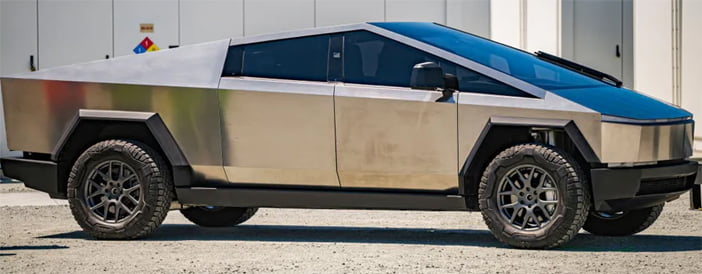
+++ The TESLA Cybertruck took significant steps towards becoming production-ready last month, and now it seems customers will be able to take delivery of their futuristic electric pick-ups from mid-2023 despite production dates being repeatedly pushed back since it was unveiled. At a recent shareholder meeting Elon Musk replied to a question about Cybertruck deliveries, saying “we’re hoping to start delivering them in the middle of next year”. Musk confirmed previously that the American firm will not be launching any new cars in 2022, but it looks like the next car will indeed be the Cybertruck. A prototype version of the long-awaited Cybertruck was seen in California in June. It was present during a grand opening ceremony of the Elkhorn Battery storage facility in Moss Landing, with some notable changes over previous iterations of the vehicle. While the design remains shockingly minimalist and angular, a few more real-word touches appeared. Pictures taken by Tesla employee Nattanan Sirivadhanabhakdi show a new windscreen wiper situated vertically and door mirrors. The wheels have also lost the bizarre covering, with much more conventional alloy wheels with a 6-stud pattern. Inside, there’s a new driver’s display which appears to have been taken from the Model X and the central front seat has been replaced by a centre console. There’s also the yoke steering wheel; a feature first seen on the Model S Plaid. But while it’s gained some more conventional equipment, the Cybertruck is clearly still far from being finalised. Musk has said that once Cybertruck production starts, he hopes to produce a quarter-million Cybertrucks annually but achieving this will take time because the tech is yet to be improved and it is still very costly at this stage. Musk said earlier this year “batteries will probably not be the limiting factor in Cybertruck production”. “I worry more about things like how do we make the Cybertruck affordable despite having awesome technology”. The Cybertruck was revealed in 2019 and has been delayed every year since. Since then, other manufacturers have entered the electric pickup truck space, including Ford with the F-150 Lightning, Rivian with the R1T, GMC with the Hummer EV, and Chevrolet with the Silverado EV, to name a few. Tesla said it has converted approximately 75% of its bitcoin purchases into fiat currency, which added $936 million of cash to its balance sheet. The company has raised prices of its cars several times this year to cope with higher costs of lithium used in batteries and aluminum used for the body, along with other raw materials. Musk has, however, said Tesla would drop prices when inflation cools. Tesla is bracing for a potential recession and mounting competition from rivals. It also faces challenges of significantly boosting production in the second half, after China’s lockdowns hit production of the company and its suppliers. Musk also has said Tesla’s new factories in Texas and Berlin were struggling to boost production, calling them “gigantic money furnaces” which are losing billions of dollars. Musk said he had “a super bad feeling about the economy” in June and began layoffs. +++
+++ VOLKSWAGEN abruptly ousted Herbert Diess, its chief executive officer and architect of the auto industry’s biggest electrification effort, after repeated clashes with labor unions chipped away at his support with key stakeholders. Porsche boss Oliver Blume will succeed Diess within weeks, ending a 4-year tenure in which Diess’ hard-nosed leadership style caused constant friction and undermined his effectiveness. Missteps on key projects including delays at VW’s software unit also contributed to the shakeup, people familiar with the matter said. VW’s board is betting Blume will be a more collaborative and stable leader, said the people, who asked not to be identified discussing private deliberations. He’ll remain the head of Porsche, which VW is trying to list late this year in what could be one of Europe’s biggest-ever initial public offerings. Diess, 63, becomes the latest in a long line of leaders undone by VW’s complex hodgepodge of power centers. Skirmishes between the manufacturer’s controlling shareholder family, trade union and the German state of Lower Saxony that holds a significant stake have undermined performance and ended careers. “Herbert Diess has strategically geared Volkswagen group toward electromobility”, Wolfgang Porsche and Hans-Michel Piëch, leaders of the family with majority voting rights at VW, said in a joint statement. “It is to his particular credit that the Volkswagen Group today is in a strong position for further transformation”. Diess was hired away from BMW in 2015, shortly before VW admitted to rigging millions of diesel vehicles to cheat on emissions tests. He’s arguably pushed the most aggressive electrification effort among legacy car manufacturers, earning plaudits from the likes of Tesla boss Elon Musk. Blume, 54, has been viewed as a potential successor to Diess for some time, though any changeover was seen as years away. VW’s board extended Diess’s contract around this time last year to 2025. He’ll be flanked by Arno Antlitz, who will become VW’s chief operating officer in addition to chief financial officer. Less than 2 hours before VW announced Diess’s departure from the management board, he tweeted out a LinkedIn post wishing employees a happy summer holiday and wrote that the company was in good shape for the second half of the year. Blume started at VW as a trainee at Audi, then rose through the ranks at Seat and the company’s namesake brand before joining Porsche in 2013 as head of production. He managed to largely contain Porsche’s involvement in the diesel-emissions scandal that cost the manufacturer more than 30 billion euros. Diess initiated an ambitious push into battery-cell production and got backing for the IPO of Porsche, which is planned for the fourth quarter. At the same time, he occasionally allowed friction with VW’s unions and other stakeholders to spill over into public. He likened VW to a “tanker” with “old, encrusted structures” in need of breaking up, vowing to modernize the company and move more quickly. VW’s efforts to develop its own software also has been plagued by internal wrangling and delayed important projects, including a line of next-generation Audi EVs and an electric Porsche Macan. While Diess enjoyed wide-ranging support among analysts and investors, VW’s stock price has languished in recent months. Its preferred shares have declined 24% this year, dropping the company’s market value below 84 billion euros, a far cry from a target of 200 billion euros mapped out in 2019. Blume also will be left with the unfinished business of reviving VW’s relevance in the US. Diess had set a target to double market share in the country and planned to spend $1 billion reviving the Scout brand as a maker of electric SUV and pickup models to take on the likes of Ford, General Motors and Rivian. The VW brand, which swung to profitability in the U.S. last year, has long struggled due to the lack of popular SUV models in its lineup. In March, VW pledged $7.1 billion over the next 5 years toward improving its US offerings and boosting battery research and manufacturing capabilities. VW’s board convened this week in Chattanooga, where the automaker produces the Atlas SUV and the electric ID.4. Scott Keogh, who returned the VW brand to profitability for the first time in years, was tapped to head the Scout brand, while Pablo Di Si, an Argentine in charge of VW South America, was named Keogh’s successor as head of the Americas. +++