+++ ALFA ROMEO is finalising its plan to become a fully electric car company by 2027, and its Giulia compact executive car will survive the transition by becoming an EV. It’s expected to sit on the Stellantis STLA Large architecture which will also underpin other EVs from the Italian brand. The current Giulia was first launched in 2016 and it received minor cosmetic tweaks in 2020 alongside a refreshed infotainment system. We’re unlikely to see a internal-combustion engined successor to the Giulia given Alfa’s switch to electrification is just 4,5 years away, so we’re anticipating only mild tweaks to the current model towards the end of its lifespan. The Giulia EV’s underpinnings will offer a minimum of 800 km of range, with battery sizes ranging from 101 kWh to 118 kWh, according to Stellantis investor information. This would give the electric Guilia the longest range of any EV on the market, beating the 770 km Mercedes EQS into second place. It will also have class-leading rapid-charge capability, with up to 30 km of range added per minute. Alfa Romeo’s chief executive officer, Jean-Philippe Imparato, last year said, regarding the future of the Giulia and the firm’s focus on electrification: “Alfa Romeo will have a future for Giulia, and will do the job for SUVs too, because we are Chinese and we are American, but that shape of the Giulia is fantastic, I don’t want to lose this. The car is absolutely gorgeous, so there is a future for this type of car, but it will be a future that will be electrified. It means probably 100 percent full BEV (Battery Electric Vehicle) for Alfa Romeo”. According to Imparato, a move to full electrification for its core saloon is a must as the brand looks to turn its portfolio of models to fully electric by 2027: “I have to make some big choices. If I want to have more than an average level of performance, I must be bold”, he said. “If I say I go electric, I go electric. I’m not half pregnant, if you see what I mean? It doesn’t work. It is a risk, but that’s normal. We are here to take some risks, but we have passed the tipping point for me”. Despite the move to all-electric powertrains, Alfa’s boss outlined that the brand would continue to prioritise the driver-centric and sporty approach its cars have become known for over its 111-year history. “I would love to have this ‘light is right’ tagline for Alfa Romeo”, Imparato said. “Even if I have one tonne of battery behind me, I want to convey an idea of lightness, even if I am electrified. It’s a fundamental of Alfa Romeo and we are building this new range based on that. But it’s not enough, we are working on the vibe you will feel when you drive an Alfa Romeo in 2025”. This won’t be an artificial sound either, according to Imparato. The Frenchman outlined that he doesn’t want to bring fake features to Alfa’s cars, which would not be in keeping with its values. As a result, his innovation team is working on sensations it wants its customers to feel, vibrations, feedback “probably some new sounds and movements, but nothing fake; that is the intention”. On the performance end of the Giulia scale, the Quadrifoglio’s future is not clear. There is potential for more powerful all-wheel drive models to sit on the STLA Large platform, with Stellantis claiming a 0-100 kph time of 2.0 seconds is possible for cars based on this tech. Imparato has said that if Alfa Romeo was not able to deliver the right level of performance a Quadrifoglio model needed to bring in any given sector, the brand would not compromise by building such a car. Alfa Romeo will study a performance-focused Quadrifoglio version on all of its new-car launches, looking to offer this higher-powered, more aggressive option that’s “fully consistent with the Quadrifoglio message that we stand for since the beginning of the brand”. Stellantis will have 3 electric drive modules at its disposal, with the third offering 400 or 800 volt tech and up to 450 hp per motor. It means to reach the required performance level for a Giulia Quadrifoglio it would likely use a dual-motor four-wheel-drive set-up. To protect the characteristics Alfa needs its future cars to have the brand has a member of its product team embedded in the development of the STLA Large architecture. “The guy who is embedded by us to define the specification, the features, the performance, is Fabio Migliavacca, the guy who developed the GTA version for Alfa Romeo. He breathes Alfa Romeo, so he will give the features we need to define this totally clean-sheet design”. It’s unlikely there will be a GTV in the future, however, with Imparato citing the volume of 3-door coupe sales in this segment as a potential sticking point compared with 5-door saloon sales. +++
+++ Volkswagen said on Thursday it would invest over 20 billion euros in a BATTERYCELL business jointly with partners, creating 20.000 jobs and reaching annual sales above 20 billion euros by 2030 as it seeks leadership in the growing market. The PowerCo unit will manage VW’s global battery production and research from raw material mining to recycling, and projects including energy storage systems, the carmaker said at the groundbreaking ceremony for its first European battery cell factory. “Today is a good day for the automotive industry in Germany”, chancellor Olaf Scholz said in a statement ahead of his speech at the ceremony. Volkswagen has repeatedly said making enough batteries to power all cars is by far the biggest challenge of the shift to electric vehicles, and has rolled out a plan to build factories with a joint capacity of 240 gigawatt hours (GWh) by 2030. This includes 6 plants in Europe, of which Salzgitter is the “blueprint” for VW’s future standardized production facilities, and 2 in North America. Salzgitter alone will have the capacity to build 40 GWh, enough batteries in a year to power 500.000 vehicles. “What we have proven a million times over with Volkswagen vehicle platforms: standardizing and scaling up allows for speed and cost optimization with the highest quality”, said PowerCo chief executive Frank Blome. At the ceremony, Volkswagen also presented the standardized prismatic battery cell it had announced in 2021 and which is to be used in up to 80% of the group’s models. +++
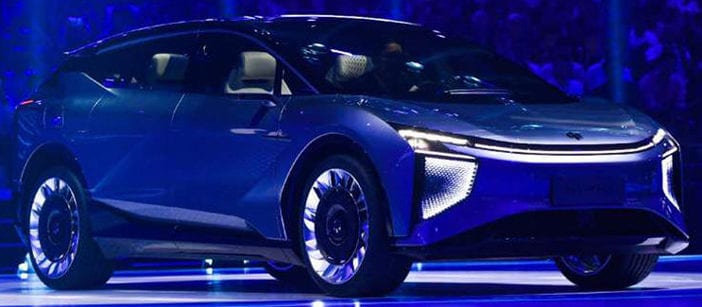
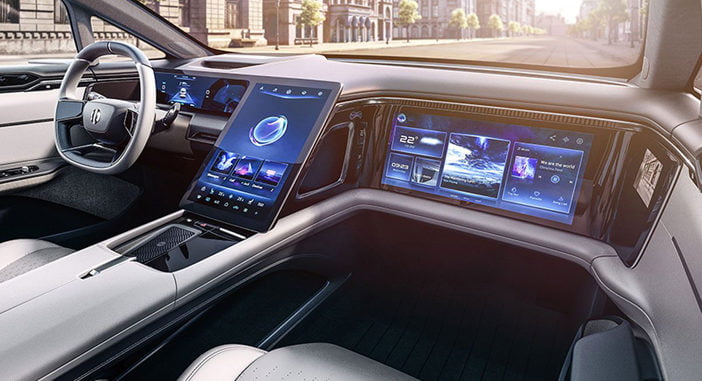
+++ Chinese EV maker HUMAN HORIZONS has revealed an electric 4-door grand tourer equipped with a futuristic interior and intelligent technology. Named the HiPhi Z, it’s the company’s second production car, following the HiPhi X SUV, which went on sale in China last year. The HiPhi Z is powered by a 120 kWh battery pack, giving it a claimed range of around 705 km. HiPhi said the saloon is capable of achieving 0-100 kph in 3.8sec but didn’t share a top speed figure. Under the skin, the HiPhi Z makes use of aluminium double-wishbone air suspension at the front and a five-link system at the rear. It also features rear-wheel steering and an advanced dynamic vehicle-control system. Human Horizons claimed the HiPhi Z’s steering set-up gives it a turning circle similar to that of the Mini hatchback, despite measuring more than 5.036 mm long, 2.018 mm wide and 1.439 mm high. Its exterior features a wrap-around light curtain and intelligent doors that are able to detect keyfobs, other vehicles and people. It also benefits from a rear spoiler to adjust levels of drag and lift, which Human Horizons says improves performance. Inside, the HiPhi Z makes use of an “ultra-futuristic, spaceship-like digital set-up” with a modern artificial intelligence (AI) system called HiPhi Bot, capable of adjusting the conditions for occupants. The system is also equipped with a high-speed robotic arm, which is said to feature a control accuracy of up to 0.001mm and be able to “perform a variety of delicate movements with barely a noise”. Other kit includes ambient lighting, a 23-speaker audio system from Meridian, bucket racing seats and an advanced driver-assistance system that has been developed in-house. The system is capable of braking, steering, accelerating and more advanced manoeuvres, including parking and remote summoning. It makes use of a combination of 34 sensors around the car and lidar technology to scan the surrounding area. Human Horizons has priced the HiPhi Z from $89,000 to $129,000. The car will make its public debut in Shenzhen, China, on 6 July before making an appearance in 11 major cities. Its on-sale date will be announced at the Chengdu motor show in August. +++
+++ HYUNDAI is in the middle of expanding its electric car portfolio and its next EV to break cover will be a large SUV, called the Ioniq 7. It follows on from the Ioniq 5 and the recently announced Ioniq 6 in Hyundai’s bespoke electric range, and as a seven-seater it’ll rival the likes of Tesla’s Model X and the Mercedes EQB. Hyundai has already set a date of 2024 for the Ioniq 7’s arrival, so it’s expected that the model could break cover either late this year or early in 2023. Underpinning the Ioniq 7 will be Hyundai-Kia’s E-GMP scalable platform for electric cars, with the modular architecture’s width and wheelbase length left relatively free. With fewer constraints on these parameters, the size of the battery the large SUV needs to house will be a big determining factor. For reference, the Ioniq 5 crossover’s wheelbase stands at 3.000 mm, which is already 235 mm longer than Hyundai’s own 7-seat SUV, the Santa Fe. However, for the Ioniq 7 this could be stretched further still to improve the amount of cabin space, and the space available to locate a bigger battery in the car’s floor, improving range for this large, bulky and no doubt heavy machine. As a result it will likely accommodate a larger battery than the Ioniq 5 and 6, helping to offset the car’s extra weight compared with that of its mid-size sibling. This could offer up to 100 kWh of energy, with a development in battery chemistry meaning Hyundai will advance to its 4th generation technology by 2023, increasing energy density over current set-ups by between 10 and 20 percent and giving the SUV a range of around 640 km. The E-GMP platform’s 800 Volt electronic architecture will equip the Ioniq 7 with 350 kW rapid-charge capability, meaning up to 100 km of range can be added in only 5 minutes. Given the 7’s positioning as a flagship, though, it could also feature wireless charging. This is a possibility for E-GMP, with Hyundai’s head of Electrification Development Group, Chung Jin-Hwan, highlighting: “It’s in development; we have been resolving many issues that inherently arise with wireless charging”. Regardless, it’s the platform’s clever use of space that will characterise the Ioniq 7, just as it does in its Ioniq 5 stablemate. The relatively slim battery also allows for a fully flat floor inside the cabin, and with the Ioniq 7’s SUV body delivering a higher seating position, the car should offer an incredible level of space and practicality. As platform, battery and electric-motor tech become standardised across the line-ups of both Hyundai and sister brand Kia, with many future models to be underpinned by their E-GMP platform, interior design and use of space will increasingly define these different models. For the 7 expect a similar lounge-style treatment to the 5’s, with a greater focus on usability with a luxury edge. Given the Ioniq 7’s size, it’s likely that the SUV could use the dual-motor set-up from the Ioniq 5, which currently delivers up to 306 hp and 605 Nm, and 4WD capability. In the smaller crossover this is enough for a 5.2 second 0-100 kph time, so the largest Ioniq model should still offer adequate performance. However, this tech in sister brand Kia’s EV6 GT has been tuned to deliver up to 585 hp, so Hyundai could turn up the wick for the Ioniq 7. Many owners of large SUVs also use their cars for pulling trailers or caravans, and this tech should give the 7 a fair towing capacity regardless of power output; the Ioniq 5 can pull up to 1.600kg. Given the proportions of the Ioniq 7 we’re unlikely to see a hot N variant in the style of the Ioniq 5 N and Ioniq 6 N. A previously released shadowy teaser image from Hyundai shows the Ioniq 5, Ioniq 6 and Ioniq 7 together, with the Ioniq 5 in the middle giving a sense of how the 6 and 7 models will differ in design and size. The cabin will be packed with even more connected tech, too, because Hyundai is part of a deal that’ll see a new Nvidia Connected Drive software platform with over-the-air update capability fitted to its new cars from 2022. Expect more advanced autonomous driver-assistance systems as well. The car’s exterior styling will be in keeping with that of the 5, with bold lines and strong surfaces, whilethe Ioniq sub-brand’s trademark LED light treatment will also be shared with the firm’s Prophecy concept, a car that gave us a preview of the new Ioniq 6 saloon. Expect the Ioniq 7 to feature a full-width running-light bar at the front with Parametric Pixel LEDs below. The high bonnet and bluff front end will reinforce the 7’s halo status in the line-up, while with no combustion engine to accommodate, the area underneath the bonnet could offer significant storage capability, including for the car’s charging cables, to further free up boot space. Chunky surfacing down the flanks balances the big glasshouse and merges into a squared-off rear that also features a distinctive LED design. +++
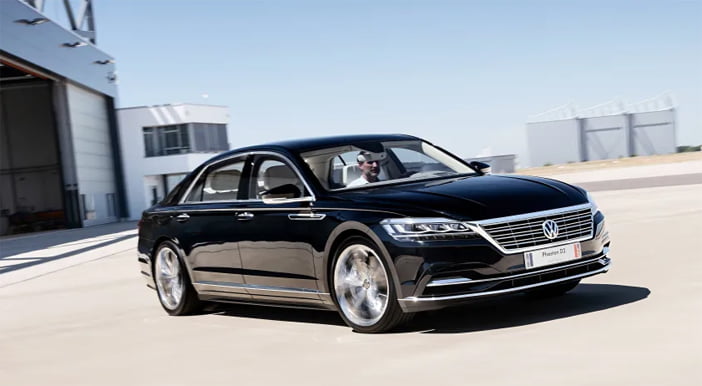
+++ The PHAETON is one of the most interesting Volkswagens and may be a better story than any of the brand’s most iconic models. The massively expensive luxury sedan lasted just a few model years, but VW had plans to update the car for a new generation. The automaker just pulled back the curtain on the Phaeton D2, a luxury car that never made it past the prototype stage. Volkswagen only sold a few thousand of the original cars, likely due to their extreme complexity and price tags. Six-figure price tags hurt, even when they’re sitting on an exotic window sticker, but it’s unheard of on a Volkswagen. The drivable prototype you see here was originally part of a group of four concept cars. The D2 car got the nod but never reached production, thanks to VW’s decision to fully electrify its lineup. This Phaeton is around the same size as a new Audi A8, though Volkswagen didn’t elaborate on powertrain or performance details. Given the automaker’s shifting environmental priorities at the time of its conception, it’s unlikely the car would be fitted with a W12. Still, the V8 or the Europe-only V10 TDI from the first-generation Phaeton would have made a splash. Regarding styling, the car follows the evolution of VW’s other models from the period. The rounded shapes and sometimes goofy-looking lines from early-2000s VWs were replaced by sharper, more upscale styling and design. Inside, the Phaeton D2 has a large curved display that ended up being launched in the 2018 Touareg. It’s easy to see how this car draws a line to new Volkswagens with its tech and design. Beyond the curved display, the touch-sensitive controls on the Phaeton D2’s steering wheel can now be found in the new GTI and Golf R, as well as other models. It’s impossible to know how the Phaeton would look today if it had continued in production, but VW could always pull out a similarly luxurious car to ride on its electrified platform. +++
+++ TESLA started pushing the latest software update, 2022.20, to its EVs over the weekend, bringing with it automatic detection of rough road sections. Available only on the Model S and Model X, this is a feature that customers have requested and that Elon Musk teased as coming to all vehicles since early 2020. Back then, the CEO said that Autopilot would be able to create a “micro maps” of local road specific details, such as potholes or areas with a rough asphalt surface, in order for Teslas to avoid them. That’s similar to what this update appears to bring, although for now Tesla EVs are not able to avoid rough road sections but only soften the shock of hitting a pothole. The function can be explained as follows: “Tesla Adaptive Suspension will now adjust ride height for an upcoming rough road section. This adjustment may occur at various locations, subject to availability, as the vehicle downloads rough road map data generated by Tesla cars. The instrument cluster will continue to indicate when the suspension is raised for comfort. To enable this feature, tap Controls > Suspension > Adaptive Suspension Damping, and select Comfort or Auto setting”. Essentially, this update enables the Tesla Model S and Model X to scan the road ahead for potholes and rough surfaces and increase the ground clearance accordingly to avoid damaging the suspension and creating discomfort for passengers. This appears to be the first step toward giving Autopilot and Full Self-Driving Beta the ability to navigate around rough road sections. For now, Tesla is only adapting the suspension for those conditions. Needless to say, the Tesla Model 3 and Model Y cannot get this feature as they are not offered with adaptive suspension, at least for now. In addition to the adaptive suspension update, the 2022.20 update brings the Green Traffic Light Chime feature that will play a chime when the traffic light turns green or the vehicle ahead starts advancing (unless Traffic-Aware Cruise Control or Autosteer are active). Before the 2022.20 software update, Green Traffic Light Chime was only available with Tesla’s Full Self-Driving (FSD) suite. The final feature introduced by the update is Seat Belt System Enhancement, which uses Tesla Vision to tighten seat belts around passengers earlier “in a wider array of frontal crashes”. +++
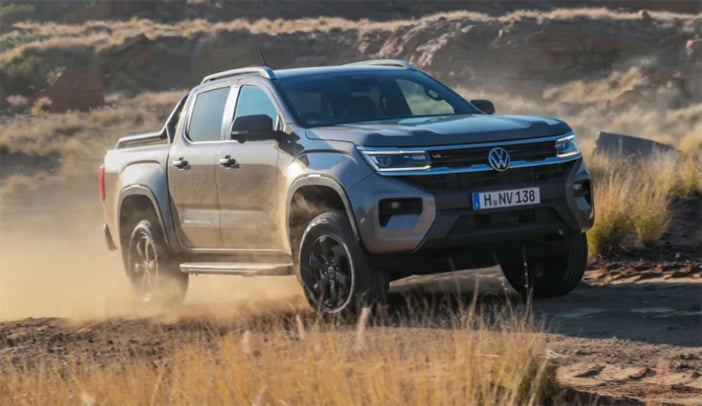
+++ The new VOLKSWAGEN AMAROK has made its debut with a new look inside and out, a much longer list of available tech features, and a longer wheelbase that clears up more space in the cabin. Offered in numerous configurations, the truck will land in global showrooms in late 2022. Volkswagen teamed up with Ford to design the second-generation truck. The new Amarok is closely related to the latest generation of the Ranger underneath the sheet metal, but the collaboration isn’t an exercise in badge-engineering. Visually, the Amarok adopts Volkswagen’s current design language. It’s characterized by a tall, upright front end, sharp-looking headlights with LED elements, and C-shaped rear lights. Keep in mind that the variant pictured in our gallery is an upmarket model; more basic (and basic-looking) trim levels will also be available. At launch, buyers will be asked to choose between a 2- and a 4-door cab. Both body styles stretch 10 cm longer than the corresponding original model, and they ride on a wheelbase that has been extended by 17 cm. This allowed designers to carve out a more spacious cabin. Adding more sheet metal to the wheelbase than to the overall length unlocks another important benefit: the new truck features shorter overhangs, which in turn increase the approach and departure angles to 29 and 21 degrees, respectively. Its water fording capability has been greatly improved as well. Volkswagen notes that the new Amarok can drive through about 50 cm of water, up from 30 cm in the last-generation. More space isn’t the only noteworthy improvement inside. Customers in many markets (including Europe) are increasingly buying a pickup to use it as a daily driver, and they expect to find the same level of comfort and technology that’s offered in wagons and SUVs. To that end, the new Amarok comes standard with a digital instrument cluster and a portrait-oriented touchscreen for the infotainment system, and the list of options includes a Harman Kardon sound system. Adaptive cruise control is one of the 20-plus driving aids offered globally. Globally, the engine palette includes four turbodiesel TDI engines and one turbocharged gasoline-powered unit; note that not all engines will be available in every market, however. On the turbodiesel side of the specification sheet, the entry-level unit is a 2.0-liter 4-cylinder rated at 150 hp and 350 Nm. This engine will primarily be available in Africa. Next up is a 170-horse evolution of this engine, followed by a twin-turbocharged 2.0-liter that develops about 204 horsepower. Finally, the range-topper is a twin-turbocharged, 3.0-liter V6 tuned to deliver up to 250 hp and a stout 600 Nm. On the gasoline-burning side, the lone offering is a 2.3-liter turbocharged 4-cylinder that develops 304 hp and 450 Nm; this engine is shared with the Ranger. Transmission options vary from market to market; they include 10-, 8-, and 6-speed automatic units plus 6- and 5-speed manual gearboxes. Volkswagen’s 4Motion all-wheel-drive system comes standard in many markets, though here again the specifications aren’t as straightforward as they might initially sound. Some markets will get a part-time system while others will receive a permanent system. In its most powerful configuration, the Amarok is capable of towing up to 3.500 kilos and hauling up to 1.200 kilos; that’s more than the base Ford F-150 Lightning. Built in South Africa, the new Volkswagen Amarok will begin arriving on dealer lots in Europe and in several other regions before the end of 2022. Pricing information hasn’t been announced yet. +++