
+++ Among the German luxury big three, only AUDI doesn’t have a production facility in the U.S. While it looks like a sudden decision, the plans to build in America has been decades in the making. There’s now an even greater urgency to set up a production hub stateside, as Audi is taking a beating from tariff payments, further compounded by lower sales. The new Audi production line will be built in Peach County, Georgia. At the moment, it hasn’t broken ground yet, and site grading will begin in 2027. Construction will begin in 2028, and the company aims to complete the facility by the early 2030 and hit the ground running with the vehicle rollout. There’s a lot of catching up to do and delays are not an option. Audi’s production base in Georgia represents a $4 billion investment, and it aims to produce about 200.000 vehicles annually once operations are fully in swing. Once completed, the side will measure 4.500 acres and provide up to 4.500 jobs in the process. The state also promised the German automaker $458 million in tax incentives, along with over $120 million that will see improvements in rail and infrastructure, plus environmental site remediation and construction. Topping it all of is another $430 million water and utilities, road improvements, training and recruitment. But even before the site has broken ground, there are already talks of expansion. If so, it shows that Audi is determined to get up to speed immediately. The report stated that the company will invest another $3 billion into the facility, adding another 3.000 jobs in the site. The so-called second phase will begin in 2033, per the Mid-Georgia Gateway Development Authority. When Audi was asked about the matter, the company declined to comment. But while there is no confimation of the plan, neither is there a denial. Should the second phase push through, the Audi alone could add 7.500 jobs for the state, or maybe even more. Either way, Audi is serious in its investment as it needs to lean more into the U.S market given cratering sales in China. BMW planted seeds in America for production as early as 1992, while Mercedes-Benz announced its plans in 1993. It was BMW that became the first German luxury automaker to complete the construction of the assembly plant. Located in Spartanburg, South Carolina, it was completed in 1994 with production beginning almost immediately. Mercedes-Benz followed suit in 1996 with the completion of its American plant in Tuscaloosa, Alabama, and production started in 1997. It has taken Audi over 30 years to respond to its rivals. If anything, its tariff troubles could’ve been lessened had plans for the U.S facility actually pushed through in the late 2000s. Then Audi of America president Johan de Nysschen, along with other regional heads, pushed for it, but their bosses from Ingolstadt ultimately decided on Mexico. Still, it’s better late than never for Audi. The U.S-market Q7 and Q9 are currently sourced from Slovakia, but will be built in Georgia once construction is completed. If Audi and the entire Volkswagen Group want a return on its investment in America, it could to turn the U.S plant into a major global production hub for its SUVs. +++
+++ BMW executives are hoping to put the Vision BMW Alpina concept, which the company launched at the Villa d’Este concours in May, into full production. If ratified (a final decision has not yet been made) it would be what insiders call an ‘M1 moment’, as BMW prepares to relaunch the Alpina brand after the sale from the founding Bovensiepen family was finalised at the beginning of this year. The mid-engined M1 supercar was the BMW M division’s first bespoke model and set a tone for the performance sub-brand going forward. Alpina was a developer of sports-minded BMWs but technically independent of BMW and registered as a stand-alone manufacturer. However, it had access to early BMW prototypes and engineering data, and so it developed its models alongside base BMWs. Its cars differed from contemporaneous M cars mainly by offering more comfort. It was a differentiation that suited both parties and which BMW is keen to keep when it relaunches the brand. Aware of customer concerns that it might become little more than a trim level, however, BMW would like to make a splash with a stand-alone vehicle.
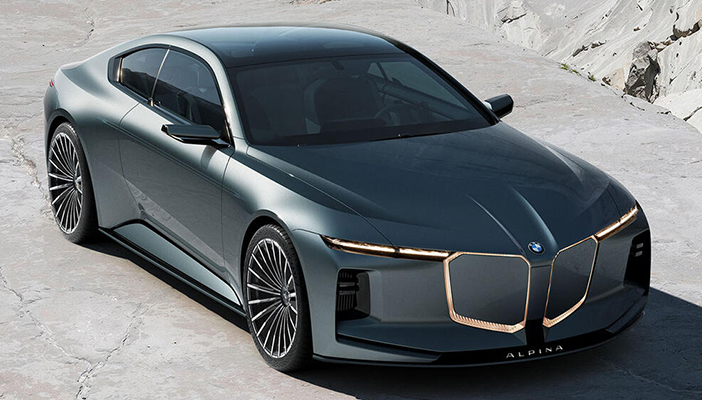
The Vision Alpina is a 5.2 meter long, V8-powered 2+2 coupé of considerable luxury and would fit that bill. Speaking at the launch of the new BMW i3, head of Neue Klasse Mike Reichelt downplayed the likelihood of the Vision Alpina making it to production in concept form but said the designers “had given the engineers a headache” because of demand for the car and that Alpina would like to make “a limited-volume” model. The Alpina name is currently set to be officially relaunched with a version of the 7 Series luxury saloon, whose size alone would differentiate it from BMW’s M division, which doesn’t touch cars that large. Whether BMW is willing to make an M and an Alpina version of the same model is still up for discussion, understands Autocar, but keeping distance between the two is why insiders say a luxury model “makes the most sense”. The previous-generation Alpina B7 was widely respected across the industry and used as a benchmark by rival manufacturers. Meanwhile, the Bovensiepens are launching their own line of cars under their own name. However, since the sale of Alpina they have lost access and advantages they had before: models typically rolled down BMW lines, even with an Alpina chassis number attached, before some final trim work after general assembly at Buchloe in Germany. Bovensiepen cars won’t have this benefit. They are likely to be built by the dozen or the hundred (such as the forthcoming 99-run Spider) which may assuage some disquiet in certain quarters of BMW HQ about the family creating a new car brand. +++
+++ MASERATI is getting ready to preview its future, with 2 familiar nameplates destined to make a comeback. According to a new report, the Italian automaker will unveil 2 concepts on December 10, previewing the next-generation Levante and Quattroporte. Maserati plans to reveal both concepts to establish a new design direction for the brand. The debuts are expected to take place in Modena, Italy, where Maserati is headquartered. Neither concept has been officially confirmed, but the report aligns with recent comments from Maserati and Stellantis executives about the brand’s future product plans. And while a new Levante would mark a relatively familiar return to the luxury SUV segment, the next Quattroporte could be something entirely different. The Levante debuted in 2016, but production ended in 2024 following years of slow sales. It competed against established luxury SUVs such as the Porsche Cayenne, BMW X5 and Mercedes-Benz GLE. Maserati CEO Santo Ficili has already discussed the possibility of bringing back the Levante name, confirming that the company plans to return to the E-segment SUV category. That doesn’t necessarily mean the production model will look anything like its predecessor, though. The December concept is expected to preview Maserati’s future design language, potentially offering an early glimpse at how the next generation of its larger vehicles will look. The more interesting of the 2 concepts could be the next Quattroporte. Rather than reviving the same luxury sedan, Maserati is reportedly considering a much more unconventional body style. Ficili has already hinted at that possibility, suggesting that the future Quattroporte, in his mind, “is not a sedan”. Instead, he envisions something that falls somewhere between a shooting brake and a crossover, describing it as a “very low, big car”. Of course, Ficili’s comments reflect his vision for the car rather than a confirmed production design. The December concept should give us a better idea of whether Maserati intends to follow through with that unconventional approach. +++
+++ Between sensors, radars and cameras, we’re used to cars getting increasingly clever about recognizing their surroundings. However, SONY has come up with a wild idea that takes things in a rather unusual direction. The Japanese electronics giant has filed a patent for an in-car scent system that would release specific fragrances based on ads the vehicle detects. Yes, really. Imagine driving past a billboard promoting a hamburger restaurant and suddenly getting a whiff of freshly cooked beef inside the cabin. Or perhaps you’re watching a chocolate commercial on the infotainment screen when the car decides it’s time to make you hungry. That’s essentially what Sony has in mind. The patent, published by the United States Patent and Trademark Office (USPTO) on November 5, describes a system that combines cameras, GPS positioning, advertising databases, and scent dispensers to turn visual and audio advertisements into actual smells. The system relies on a combination of hardware and online data. An exterior camera would scan the surroundings for billboards, signboards, and digital advertisements. Once it recognizes an ad, the vehicle would check an online scent-management database to determine whether that particular campaign has been registered. The database would contain information about the advertisement, including its associated fragrance, location, direction, validity period, and conditions for releasing the scent. The car would also use GPS to establish whether it’s actually passing the registered advertising display. But wait, there’s more. Sony’s idea goes beyond simply filling the cabin with a generic fragrance. An additional interior camera would analyze the occupants, including their estimated age and gender, to determine who should receive the scent. The system could then direct the fragrance toward specific seats rather than releasing it throughout the entire cabin. For example, a registered advertisement could specify that a particular scent should be released only to passengers matching certain demographic criteria. The fragrance could also be limited to a predetermined period, such as 30 seconds. There’s even a suggestion that the smell could become stronger as the vehicle approaches the billboard. Because apparently, a burger advertisement shouldn’t just make you hungry. It should practically make you taste the food. Sony hasn’t limited the concept to roadside advertising. The patent also describes a system that can match commercials played through televisions, radio broadcasts and connected devices such as smartphones. In this scenario, the vehicle would identify the advertisement based on information such as the broadcasting channel, website, or time slot. It could then select the corresponding fragrance from its database and release it inside the cabin. The hardware would consist of scent cartridges and blowers that direct the fragrance toward individual seats. Sony also references different configurations for positioning these dispensers throughout the cabin. There are potential applications beyond advertising, too. The filing mentions releasing a signature fragrance when starting the vehicle or providing passengers with a preferred scent when entering a taxi. That sounds considerably more appealing than having your commute interrupted by the smell of fast food. As interesting (or unsettling) as the technology sounds, there are obvious questions about privacy and personal choice. The system would rely on interior cameras to analyze passengers and potentially estimate their age and gender. That information would help advertisers determine which occupants should receive a particular fragrance. There’s also the question of whether passengers would actually want their cars to become yet another advertising platform. Modern vehicles already have plenty of screens competing for our attention. Adding smells to the equation feels like taking targeted advertising a step too far. Of course, a patent doesn’t guarantee that Sony intends to commercialize the technology. History has taught us that only a fraction of patented ideas ever make it into production. Automakers would need to adopt the hardware, while advertisers and billboard operators would have to register their campaigns in the scent-management database. That’s a considerable amount of coordination for something that might leave your car smelling like a fast-food restaurant. Still, it’s an interesting glimpse into how far companies are willing to go to make advertising more immersive. We used to complain about pop-up ads. Now we may be looking at cars that could bombard our noses with commercials, too. +++
+++ The government of the UNITED KINGDOM is expected to significantly downscale its electric vehicle sales targets this week, as car makers fall well short of the previously imposed quotas. First secretary of state Louise Haigh will reveal a new-look zero-emission vehicle (ZEV) mandate in the coming days, with targets that are more closely aligned to real-world EV demand. Government insiders are said to suggest that the 2030 EV sales target could be reduced from 80% to 60%, and car makers will continue to have access to various flexibilities within the mandate’s mechanisms until 2034. Under the existing framework, car makers must achieve a series of annually increasing EV sales mix targets on the way to an 80% share by 2030 and a ban on new petrol-or diesel-engined car sales in 2035. But those targets have so far proven out of step with organic consumer demand, forcing many manufacturers to heavily subsidise their electric cars (at significant cost) to drive up demand, or to pay significant penalties for non-compliance. Electric cars have ballooned in popularity in recent months, with recent figures showing more than 500.000 were sold from January to November (a 30% year-on-year increase) and a third of all cars sold last month were electric. That has been driven in part by huge increases in the cost of petrol and diesel, and the greater availability of affordable EVs as manufacturers expand their line-ups. Nonetheless, the Society of Motor Manufacturers and Traders (SMMT) says car makers will fall far short of achieving the mandated 33% EV mix for 2026, forecasting that just 27.2% cars sold over the whole of this year will be electric. It says the gap will then widen next year, when the target increases to 38% and EV sales are expected to reach 32%, and then again in 2028, when EV share will be 14.5 percentage points behind the 52% target. Flexibilities within the mandate mean car makers can mitigate the impact of any shortfall with increased hybrid sales, or defer their targets. The government has been consulting with car makers over changes to the ZEV mandate in light of the disparity and SMMT boss Mike Hawes said last week the outcome of that review process is urgent. “Almost 1 in 3 new cars registered in October was electric: great progress in the transition, but one that comes at enormous cost”, he said. “The industry and government are spending billions to help drivers switch, but that support cannot be sustained indefinitely with the gap to mandated targets set to more than double by 2028, just as a new EV-only tax is introduced. “Higher targets may force supply, but they do not create demand. The ZEV mandate review must deliver substantive reform effective immediately to ensure we have a healthy market and an attractive pitch to investors”. Haigh will finalise the plan after a “crunch meeting” on Wednesday to “settle the dispute between the transport, energy and business departments”. Any move to ease the EV transition for car makers will be met with relief from the automotive industry but it will be viewed by many as a weakening of an important component of the UK’s decarbonisation policy. If the targets were kept and met, the ZEV mandate was expected to achieve 14% of the government’s targeted CO2 reductions between 2028 and 2032. Downing Street told that no decision has been made and a government source was quoted as saying the issue will be approached in a “pragmatic and balanced” way. The government considered a number of options as part of the review process with car makers, ranging from preserving the targets but extending flexibilities that make it easier for car makers to hit them, to simply cutting the 2030 sales mix down to 50%. Whitehall is divided by the proposals, with business secretary Jonathan Reynolds calling for the steepest cut, transport secretary Heidi Alexander arguing for 60% and energy secretary Ed Miliband campaigning to keep the 80% mandate. It is reported that prime minister Andy Burnham has taken himself out of the deliberations, as his wife, Marie-France van Heel, is an advisor to Manchester-based EV charging firm Be.EV. +++
+++ VOLVO will unleash a new midsize electric SUV in 2027. The EX50 is a spacious, cutting-edge software-defined vehicle with 800-volt architecture for fast charging and a big range. The new model will provide the Swedish car maker with a direct rival to the strong-selling Tesla Model Y and Audi Q4 e-Tron, while also bridging the gap between the recently updated EX40 and the all-new EX60 in the Volvo portfolio. Prices are likely to start from just under €55.000, placing the EX50 in the same ballpark as many of Europe’s most popular electric SUV models. The new car was originally conceived as the EX40 replacement, at a time when Volvo was hopeful of phasing out combustion models for an all-electric line-up. Current market conditions mean that’s a pipedream, with the revised XC40 and its EX40 sister car soldiering on. The EX50’s price is a significant chunk less than that of the EX60, while also leaving space for the EX40, and rival the smaller BMW iX1 and Mercedes GLA. Volvo has begun communicating the EX50 to investors. On its recent third-quarter financial results call, the firm said the new car would be a “global BEV” positioned beneath the EX60, targeting a “large, lower-priced market segment” in Europe. It is hoped the model will “further strengthen BEV leadership and improve margins”. Indeed, the maker confirmed that it will reveal 3 new cars in 2027: “one new car for Europe and two China-specific models”. This forms part of Volvo’s promise to launch 13 new cars before the end of 2030. The EX50 will most likely be built in Volvo’s new electric vehicle factory near Košice in Slovakia. The facility has the capacity to build up to 250.000 cars per year, including the closely related Polestar 7 from 2028. The EX60 is manufactured in Gothenburg, Sweden. The new Volvo will be significantly longer and more spacious than the EX40, which measures 4.4 metres and has a modest 410-litre boot and 2.7 meter-long wheelbase. Expect the EX50 to measure around 4.6 to 4.7 metres long, to boost cabin and cargo space and accommodate bigger batteries between the wheels. As for the new car’s design, sources say the EX50 has “a very different character from the EX40” it in effect supersedes. While the original proposal was kicked off under Robin Page, head of global design until 2023, the EX50 is the major project shaped by his short-lived successor Jeremy Offer, who got the Volvo job off the back of his minimalist design at Arrival vans. Offer will have driven Volvo’s current design language (clean surfaces, sharp lines and minimalist visual clutter) forward. Expect a new interpretation of core Volvo design elements, such as the ‘Thor’s Hammer’ headlights and upright rear lights. I think the new model’s overall packaging will be more family-friendly than that of the sleek EX60, with some of that car’s more elegant details dispensed with in favour of more robust elements. This could result in the EX60’s winglet-style door handles being replaced with standard units, plus the use of framed windows and more rugged components such as black plastic on the bumpers. Inside, the full benefit of Volvo’s new electronic architecture will be put to good use. It will take its lead from the EX60 with a horizontally mounted screen in the centre running Volvo’s latest user interface. This has full Google integration, including an AI-powered voice assistant, and gives users the ability to log in with their personal accounts. This will replicate a user’s individual Google Maps, for instance, showing any saved or highlighted locations such as favourite restaurants or location information. Crucially, the ‘software-defined vehicle’ nature of the system will allow for major updates throughout the car’s life, unlocking new features or digital tools currently in development. While Volvo has signalled a return to physical controls in combination with touchscreens, the EX50 may arrive too early to ride this wave. “We have to listen to our customers and really recognise that how the interaction is in the cars of today is, to say it frankly, not appreciated”, recently returned design boss Thomas Ingenlath said. “We have to aim for a better harmony, a better balance, between the interaction that we have with our digital device and the physical interaction”. The EX50 is all but guaranteed to ride on the firm’s new SPA3 platform shared with the EX60. This new architecture is a big step forward for Volvo, because it’s now truly ‘software defined’ and comes with cutting-edge construction methods such as mega-casting and cell-to-body battery packaging. Each of these new technologies offers its own advantages, but fundamentally the aim is to unlock higher range figures, more space for passengers and luggage and deliver improved efficiency compared to models on older platforms, such as the EX40. The EX50’s batteries will likely reflect the EX60’s range structure, with its base 83 kWh and mid-range 95 kWh option good for 615 km and 685 km respectively. The biggest EX60 battery has 117 kWh of gross energy, but the EX50’s wheelbase will be shorter and less accommodating than the 60’s 2.97 meter. I also expect a choice of single and dual-motor powertrains, although it’s unclear whether the battery and motor variations will be fixed in the same way as they are in the EX60; for example, you cannot combine the larger battery with a more efficient single-motor layout. Super-fast charging up to 400 kW is also likely, thanks to the 800V electrical architecture, and we expect slippery aerodynamics to be top of the priority list to squeeze every little bit of efficiency out from the total package. The Volvo’s price point will put it right in the crosshairs of Tesla’s Model Y Premium. Audi’sfacelifted Q4 e-tron is also right in this fight, because it has recently proven to be one of the most popular electric models in The Netherlands. Updated with a new interior and more efficient powertrains, the entry-level Q4 but comes with an uncompetitive range, however. Upgrade to the Performance model, though, that rises to over 550 km. +++
+++ BYD-owned YANGWANG is going after the Rolls-Royce Phantom with a huge electric ‘ultra-luxury’ limousine that promises extensive personalisation options and private-jet-style refinement. It’s called the Altior (meaning ‘higher’ in Latin) and is one of the largest and most opulent cars yet to come from China, or indeed any manufacturer globally. Measuring a colossal 5.6 meter from bumper to bumper (400 mm longer than even the extended-wheelbase Mercedes S-Class), it has a wheelbase of 3.500 mm, which allows the 4-seat cabin to be as cavernous as possible. Yangwang said the imposing new flagship (which will sit above the U7 saloon, U8 SUV and U9 hypercar) is designed to “bring the depth of Chinese culture into a contemporary vision of ultra-luxury”. The brand places a heavy emphasis on the craftsmanship on display throughout the car, which builds on “millennia of aesthetic traditions” from Chinese culture.
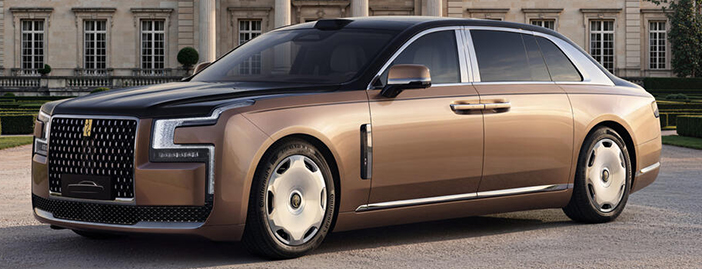
One example is the intricately decorated front grille, which Yangwang described as “a masterpiece of high jewellery” and appears to change pattern in different lights. That ceremonial sense of occasion carries over to the headlights, which feature 12 individually rotating elements that perform a routine when the owner approaches. There are also bespoke patterned umbrellas stored in the back doors, which open backwards like on the Phantom to create “an elegant transition into the cabin”.
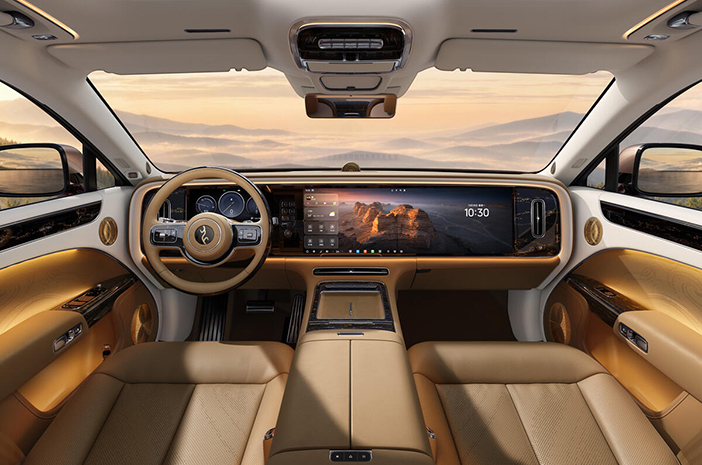
Inside, the air vents are detailed with a special Chinese variety of jade stone, while the seats have been decorated in minute detail using a traditional method of splitting silk spreads. Bucking the Chinese EV trend towards all-out digitisation and minimal dashboards, the Altior features an extensive suite of physical buttons and switches, albeit alongside a full-width, Mercedes-esque touchscreen. Yangwang said it ensured these had suitable sound and feel by tapping them with small hammers during development.
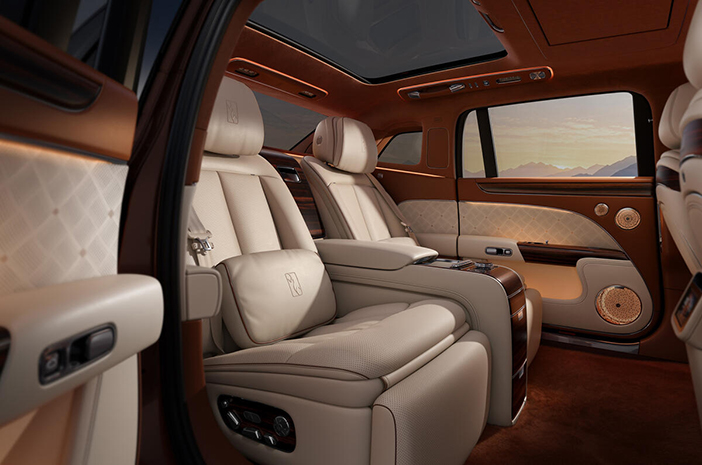
Beyond tactility, Yangwang emphasised the sheer spaciousness and decadence of the Altior’s interior, claiming a huge 1.209 mm of leg room in the rear (that’s half a Citroën Ami), while “aviation-style zero-gravity seats” are said to support a “deeply relaxed” seating position. Each is naturally equipped with a massage function and can fully recline in Relaxation mode, which also closes the blinds, softens the lighting and raises the leg rests. Like in the BMW i7, there’s a 21.4 inch cinema screen that folds down from the ceiling for conference calls and entertainment, while refrigerators in the front and rear ensure the champagne is cold at all times for all occupants.
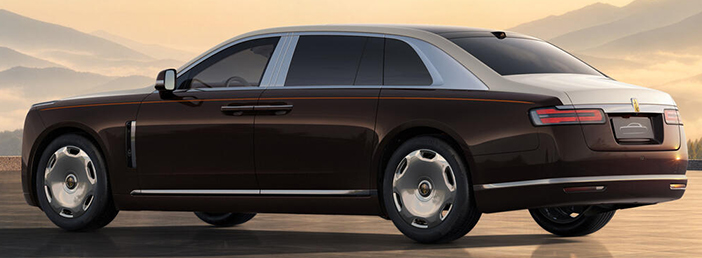
The Altior is based on the same architecture as Yangwang’s other models, so it uses a similar quad-motor electric powertrain (output undisclosed but tank turning confirmed) and rides on the brand’s advanced DiSus active suspension, which monitors the road ahead and prepares the car for bumps and changes in terrain. Full technical details remain to be confirmed, but Yangwang promises a range of more than 800 km per charge. BYD vice-president Stella Li previously said Yangwang was being prepared for a European launch in 2028, but it remains to be seen if the Altior will form part of the line-up over here. It would be the first ultra-luxury electric limousine on the market (Rolls-Royce’s Spectre EV is a coupé) and certainly one of the largest cars ever sold in Europe. +++