
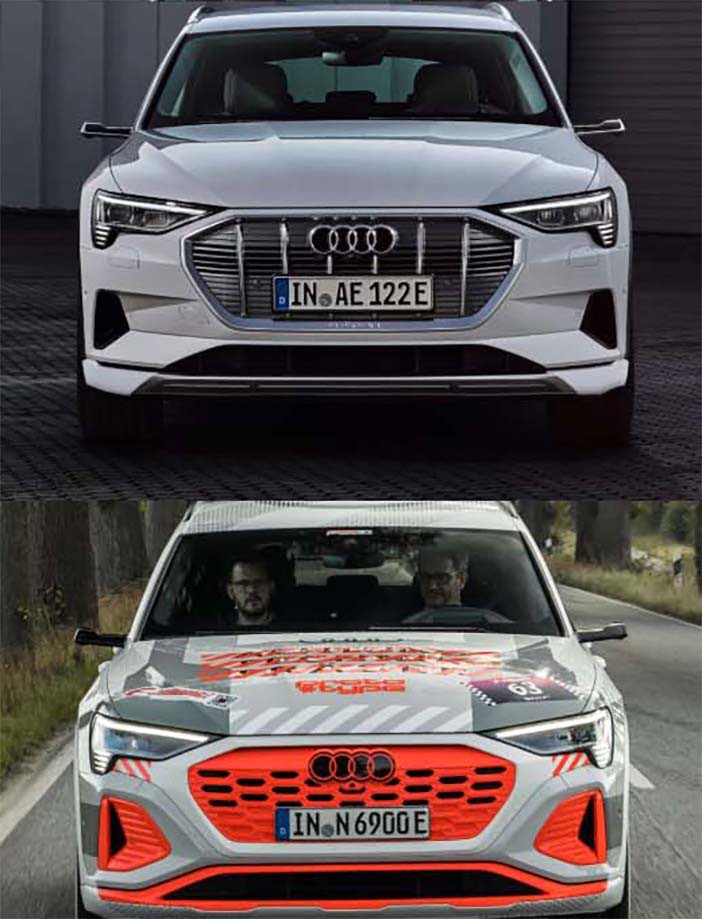
+++ AUDI plans to upgrade its e-Tron and e-Tron Sportback with a new-generation battery, affording them longer ranges, as part of their facelifts during the latter half of 2022. Shown off in near-complete prototype form by the German brand, it is aiming to extend the shelf life of the flagship siblings until at least 2025, when they’re set to be replaced by an all-new SUV, possibly called the Q8 e-Tron. Both variants of the updated e-Tron (the SUV and rakish-roofed Sportback) will also get subtly overhauled styling, with a new-look grille, revised bumpers and redesigned headlight clusters among the updates (current version on top, facelifted model under). Along with the new battery, the e-Tron are earmarked to receive more efficient electric motors and an upgraded electronics system that will enable greater energy recuperation among other enhanced functions. Sources inside Audi say that the upgrades to the powertrain will boost range to more than 600 km for both variants. By comparison, the 95 kWh battery currently used delivers a maximum range of 400 km. The first 2 models in a growing range of electric Audi models, the e-Tron and e-Tron Sportback are based on a modified version of Audi’s MLB architecture, which was originally developed for ICE cars, making them inherently more compromised than an entirely EV-specific creation. The mid-life upgrade for the SUVs is planned despite the pending arrival of the Q6 e-Tron, which is based on the new EV-specific PPE platform that was developed in an engineering joint venture between Audi and Porsche. “There will be a facelift for the e-Tron and the e-Tron Sportback”, a high-ranking Audi official told. “They will both be significantly upgraded with a number of technical updates that will further increase their competitiveness”. Following confirmation of the new Q6 e-Tron at the Shanghai motor show last year, suggestions were that it could replace the e-Tron and e-Tron Sportback. However, while the Q6 e-Tron will also offer both regular SUV and coupé-inspired Sportback body styles, it is described as being smaller than today’s e-Tron flagship pairing. “The Q6 e-Tron will compete in a different market segment to the e-Tron and e-Tron Sportback”, my source said. “It’s smaller: roughly the size of the Q5. However, the dedicated platform will allow it to offer interior and load-carrying space similar to today’s Q7”. The source added that the Q6 e-Tron, which is being developed in parallel with the upcoming new-generation electric Porsche Macan, is planned for launch in 2023. +++
+++ The XM and Z4 facelift will break cover later this week and the M2 in October after a few busy months during which we saw the M4 CSL and the M3 Touring. 2022 also brought us the 3 Series and X7 LCIs, along with the new 7 Series and its electric i7 derivative. Lest we forget the Bavarians have also unveiled the new X1/iX1, so it’s safe to say it has been a busy year thus far. The best is yet to come as the 3.0 CSL’s debut is inching closer. The retro flavoured special edition will finally break cover sometime in November. The highlight of M’s 50th-anniversary celebrations, the Competition Sport Lightweight won’t be the dedicated M model enthusiasts had been expecting to follow the mid-engine M1. Instead, it’ll be a heavily reworked M4 CSL with an astronomical price tag: €750,000. By far the most expensive new BMW ever, the 3.0 CSL will be sold exclusively with rear-wheel drive like the M4 CSL. One major difference between the 2 is going to be the availability of a manual gearbox. As a matter of fact, it is believed the ultra-exclusive performance car will be sold strictly with a 6MT. The engineers are expected to dial the S58 engine to around 560 hp, thus outpunching the twin-turbo 3.0-liter inline-six engine of the M4 CSL by 10 hp and the M4 Competition by 50 hp. Aside from featuring more power, the modern-day equivalent of the 3.0 CSL E9 will shave off weight and reportedly tip the scales at 1.550 kilograms. That would make it 75 kg lighter than the M4 CSL, which itself lost 100 kg compared to the M4 Competition Coupe. With more power having to move less weight, the speedy coupe will allegedly do 0 to 100 km/h in 3.5 seconds, which would make it 2-tenths of a second quicker than the M4 CSL. That might not sound too impressive, but let’s keep in mind we’re comparing a car with manual transmission with one equipped with an ultra-quick automatic. BMW will be making only 50 cars, with 30 units to remain in Europe and eight to be shipped in Asia. It’s not known at this point where the remaining 12 vehicles will go, but the United States sadly won’t be getting any. Production is supposedly kicking off in November and the first cars will be delivered early next year. +++
+++ CITROEN is set to unveil a “significant conceptual family vehicle” by the end of this month. It will be the first car to wear the French manufacturer’s new logo, the one that’s set to feature on all Citroën models from mid-2023. The fresh design is the tenth iteration of the firm’s chevron badge, and arrives as the brand begins its march into an all-electric age. The new badge features larger chevrons embedded in a vertical oval frame, with a flatter aesthetic than the current chrome logo. Citroën’s revised brand identity will also extend to the firm’s online services, as well as its in-car infotainment software and the My Citroen smartphone app, all of which will feature new lettering and colour themes. White and grey will form the basis of the palette, with 2 “signature” colors: Monte Carlo blue and Infrared; picking out certain details. The new colors could extend to the exterior and interior finishes of future models too, with Citroën revealing that its classic Monte Carlo blue shade “will be making a welcome return to the car portfolio in the near future”. The marque has also announced a new slogan as part of the rebrand: “Nothing Moves Us Like Citroën”. Speaking on the new brand identity, Citroën CEO Vincent Cobee said: “As we embark on probably the most exciting chapter in our illustrious 103-year history, the time is right for Citroën to adopt a modern and contemporary new look. Our new identity is an elegant symbol of progress as we move our customers physically in daring, forward-looking vehicles that challenge traditional industry rules, and emotionally by ensuring their entire experience (particularly going electric) is more affordable, comfortable and enjoyable whatever their wants and needs. “Our legacy of inspiring consumers with daring and revolutionary vehicles is energizing us to adopt a different, more inclusive approach to future family mobility, and we firmly believe that customers past, present and future will agree that nothing moves us like Citroën”. +++
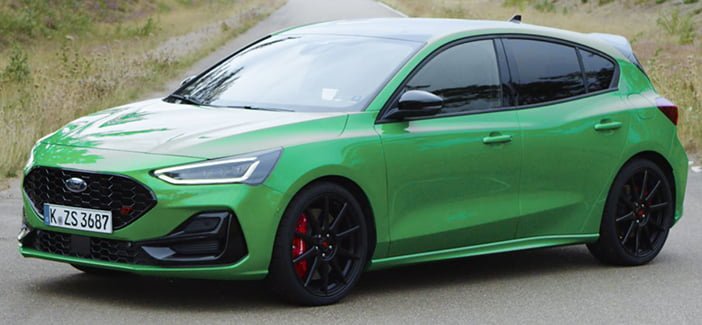
+++ The Focus ST is already one of the best-driving front-wheel drive hot hatches you can buy, as evidenced by the fact FORD didn’t mess around with its chassis during the recent facelift. However, Ford has now looked to cater for those looking for a harder-edged Focus ST with the new Track Pack option. Not many will be able to differentiate the Track Pack from the regular Focus ST from the outside. The subtle styling tweaks include a set of 19-inch alloy wheels in black which are 10 per cent lighter than the stock rims and wrapped in Pirelli P Zero Corsa tyres. Elsewhere, there’s a new black finish to the grille, roof, mirror caps and a new black outline to the ST badges. The Track Pack additions look similar to the ST Edition model from 2021. However, Ford says the new performance upgrades were tested extensively on the Nurburgring. Just like the old ST Edition, this new package is only available for 6-speed manual transmission Focus STs “for optimized weight and driver engagement”. The suspension has been developed with KW Automotive and is made up of adjustable coilovers and new springs that are up to 50 per cent stiffer. The ride height is reduced by up to 25mm compared to the standard ST. Along with the tyres and suspension, the brakes have also been honed for the track with larger discs. They’re now 363 mm in diameter (10 percent larger than before), with Brembo 4-piston calipers. Ford says the braking system should reduce “heat-induced fade during prolonged track sessions”. The powertrain has been untouched for the Track Pack, so here we find a 2.3-litre turbocharged 4-cylinder producing 280 hp and 420 Nm of torque. There’s also an electronically controlled limited-slip differential and to help keep you in place during the corners, the Ford Performance sport seats are also standard-fit. The new Track Pack-equipped Focus ST is available to order now and Ford says first deliveries will begin from November. Unfortunately, Ford has no plans to sell the Track Pack in the Netherlands. +++
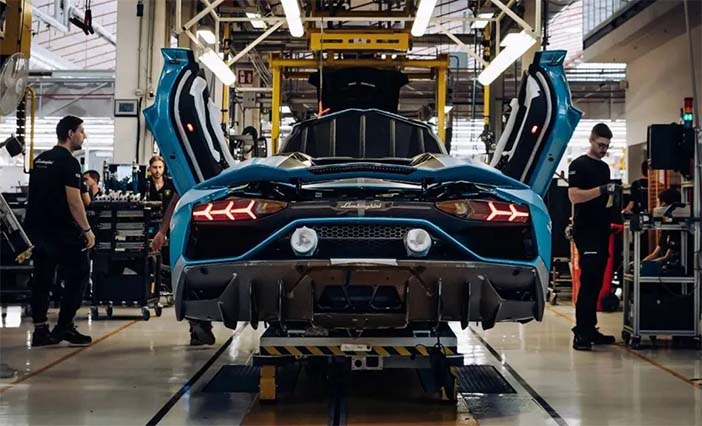
+++ The LAMBORGHINI Aventador has bowed out of production with the completion of the last LP 780-4 Ultimae, which is also the brand’s last pure-V12 production car. The final Lamborghini Aventador Ultimae rolled off the production line in Sant’Agata, Italy, to bring to an end the model’s 11-year run. A plug-in hybrid replacement is expected to be revealed later this year, having been spied testing. Lamborghini made sure the final model was the most powerful, with the 6.5-litre unit producing 10 hp more than in the previous range-topping Aventador, the Lamborghini Aventador SVJ, sending 780 hp to both axles. The Aventador-based Essenza SCV12 produces 830 hp, but is limited to track use. The Ultimae’s 700 Nm torque peak matches the SVJ’s, with which it shares its power- to-weight ratio. But with a 0-100 kph time of just 2.8 seconds and a top speed of 354 kph, the Ultimae is the fastest road-going Aventador. The 350 coupés and 250 roadsters (each sold with a numbered plaque) were offered in a range of unique colour schemes, including a new grey-on-grey option with contrasting red trim elements, while the roadster could be specified with an exposed carbon fibre roof panel. It was also subtly marked out from other Aventadors by way of a unique styling package that “took the best components” of the S and SVJ. The Aventador’s plug-in hybrid replacement will serve as a bridge to pure-electric Lamborghini models in the future. This electrified future will see the Hurácan and Lamborghini Urus also go down the same route, and an all-electric 2+2 introduced in the second half of the decade. Importantly, however, while its replacement will use an electrified drivetrain, it will take the bulk of its power from a large-capacity V12, in line with company boss Stephan Winkelmann’s commitment to the emotional value of its supercars. He told last year that there is “a lot of emotion attached” to the 12-cylinder engine, which he is particularly aware of, having been involved in the launch of the Aventador in his first stint as the boss of Lamborghini in 2011. +++
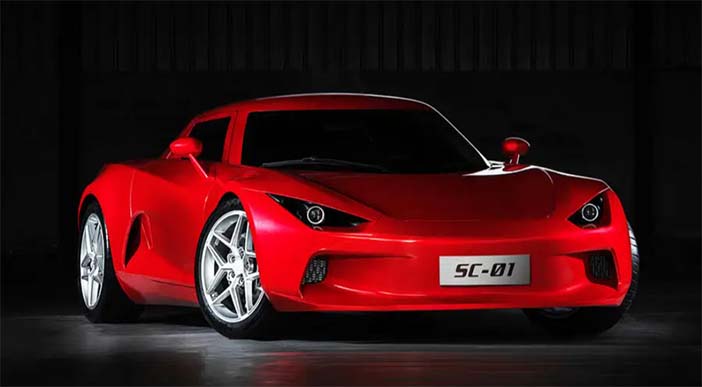
+++ Chinese start-up Small Sports Car ( SSC ) has launched an electric 2-seat sports car that it claims will act as a “national sports car” with “pure driving pleasure”. Called the SC-01, the small, sleek coupé is the company’s first ever car. It’s set to arrive in 2023 with a price of around ¥300,000; the equivalent of around €47.000 in the Netherlands. According to Chinese news site Sohu, it measures 4.085 mm long, 1.820 mm wide and 1.162 mm high and weighs 1.300 kg, meaning it’s similar in size to the petrol-engined Alpine A110 and Audi TT. It features a rear-mounted battery positioned behind the driver cabin, with an electric motor at the front and at the rear. With a total of 440 hp on tap, it can sprint from 0-100 kph in 3.9 seconds. SSC says a mid-mounted battery helps for weight distribution and positions the driver closer to the ground all while reducing the car’s height and wind resistance. It claims a range of 500 km on the not very accurate and too optimistic NEDC test cycle. Figures using the less generous WLTP system haven’t been revealed. Under the skin sits a spaceframe chassis, with horizontal, pushrod-driven shock absorbers, which SSC says contributes to improved rigidity while keeping the car compact. The firm has opted for a “minimalist” interior with no infotainment screen, everything instead being controlled through traditional switches and buttons. SSC says deliveries of the SC-01 will begin in the fourth quarter of 2023, with all components made in China. It’s not clear whether it will be sold in any international markets, such as Europe or North America. +++
+++ A fire at TESLA ’s German plant has prompted area residents to call for a halt to the factory’s operations. The blaze, which thankfully left no injuries, consisted of 800 cubic meters of paper, cardboard, and wood. Although successfully extinguished, it took a reported 50 firefighters to bring under control and gives more ammunition to those opposed to the plant. It’s another black mark for the company’s first European factory, which has been fraught with controversy and roadblocks. While the facility at Grünhide in Germany adds much-needed capacity to fulfill soaring demand, getting the German facility running has apparently created so many roadblocks that it appears Tesla may not be considering Germany at all for future new plants. As reported by Bloomberg, Tesla recently outlined the criteria that will determine how it selects the location for its next plant, and a key point was “As little red tape as possible”, which can be interpreted to be a reference to Germany’s extremely strict regulations and their impact on spooling up the Grünheide facility. Following the plant’s announcement in 2019, the facility ran into months of delays due to legal challenges from environmental groups regarding excessive use of water and threats to local wildlife. After navigating through those issues, Tesla has most recently run into problems with plans to expand the facility by approximately 100 hectares to add more space for parts warehousing and a freight yard, major necessities in the current environment of supply chain bottlenecks. Local authorities in Gruenhide have indefinitely postponed a vote on this plan and have stated that they need clarification from higher authorities. Late last year, Tesla opted to forego €1.14 Billion in state aid by opting to produce a new type of battery cell in the Texas facility rather than in Germany, which some analysts feel indicates dissatisfaction with German bureaucracy. The Wall Street Journal also reported earlier this month that the company was pausing plans for battery cell manufacture in Germany and was considering shipping the related equipment to the US. Elon Musk has previously stated that both the Austin and Grünheide plants are “Gigantic money furnaces” and that there are still a “host of problems” to work through at both locations, but the company’s recent actions indicate a greater willingness to allocate more in the direction of Texas, which could have negative long term implications for the German facility. +++