
+++ When ADRIAN MARDELL was named CEO of JLR (formerly Jaguar Land Rover) on an interim basis late last year, his was a name somewhat from leftfield. He stepped up from his CFO role to replace Thierry Bolloré and clearly left such a good impression amongst the Tata hierarchy that he was last month given the job on a full-time basis. The automotive industry is a big place but a small one at the same time, where everyone seemingly knows – or knows of – everyone, particularly when the top job is at stake. However, while Mardell’s wasn’t a name not widely known externally, internally he’s as well connected and respected as they come. That much was obvious when I sat down with him for an hour last week for an interview. We talked about Jaguar, the House of Brands, the future of Discovery, financial performance, electrification, quality issues, what dealers have told him and of course Mardell himself, as thoroughly a decent leader as you could ever meet and a man with the bit between his teeth to deliver the Reimagine plan. It was also fascinating to discover the life of a CEO and what it entails for someone thrust into that role for the first time. Even though he had no expectation of becoming a CEO, when he found himself there, he realized he had the skills to be an effective company leader. Mardell’s 19 roles at JLR in 32 years have mainly been in finance, and that has had him work with all kinds of different teams on all kinds of different people, from new-model programs to due diligence on acquisitions, to negotiating with governments on new factories. “I’ve spent 29 of the 32 years within different finance roles but importantly working alongside operating teams”, he said. “So most of the people that I know in the company work within different disciplines and different chapters. I understand how you make money in this place like no one else and people have consistently leaned on those skills. But that didn’t necessarily mean I needed to be the chief executive; that’s just what I did for the organisation”. When he got the job, Mardell’s phone lit up with more than 1.000 messages from well-wishers inside the company, which shows how deep his network is and that level of respect. He replied to every single one over the next 4 days. He says life has changed in terms of being recognized outside of the Gaydon offices; something he’s still getting used to. On the weekends, he tries to be back home from any trip to Leamington Spa before 9.30am. But inside the company, he’s a visible presence, walking the Gaydon floors and speaking to people about their work, all with the ultimate goal of trying to make their jobs better. If anyone is alarmed at first to have the CEO on their shoulder, Mardell says they’re disarmed by the end, as he’s already well known for not hiding away in his office. Mardell doesn’t spend his life on planes, limiting foreign travel to around one trip per month. When he goes somewhere, he likes to spend proper time there; a visit to the Nitra factory in Slovakia won’t be a day trip and a trip to China will last several days. He doesn’t work from home very often, instead being in the office as much as possible. When it comes to board discussions where decisions ultimately need to be made, Mardell says he tends to skip the first meeting to ensure that people can speak as freely as possible. In terms of the team around him, he speaks in glowing terms about design boss Gerry McGovern; commercial chief Lennard Hoornik for the fresh perspective he has given the company after working with Dyson; and industrial boss Barbara Bergmeier, whose expertise and problem-solving ability has allowed Mardell to focus more on planning for the future than dealing with the everyday. Early on, he was spending 2 full days a week on the issues of the day. It’s rare to get such insight into how an automotive industry CEO goes about their day job, but then Mardell isn’t the typical automotive industry CEO. He has worked hard, has been a good colleague and is an expert in business and the business. It’s that “I understand how you make money in this place like no one else” quote that stays with me the most: be in no doubt that Mardell has the credentials to run JLR as a successful car company and business rather than simply a maker of good cars. +++
+++ In July, the auto market in CHINA continued its momentum, witnessing the sale of approximately 1.775 million new cars, as the China Passenger Car Association (CPCA) reported. This figure reflects a 2% increase compared to the previous period. Notably, the market experienced substantial activity in the new energy vehicle (NEV) segment, with 421.000 electric vehicles (EVs) and 220.000 plug-in hybrid electric vehicles (PHEVs) sold. NEVs accounted for 36% of the total sales, underlining their growing significance in the market. Regarding market dominance, BYD emerged as the top-performing auto brand in China for the month, with a remarkable sales figure of 219.736 vehicles, securing a substantial 12.38% market share. Volkswagen solidified its position as the second best-selling brand, with sales totaling 178.745 cars and capturing 10.07% market share. Toyota claimed the third spot, selling 134.316 vehicles and representing a 7.57% market share. Honda closely followed in fourth place, with 89.529 vehicles sold and a 5.04% market share. Changan rounded off the top-5, recording sales of 85.248 cars and accounting for 4.72% market share. Interestingly, Tesla’s sales strategy impacted its ranking, as the company typically delivers fewer vehicles in China at the beginning of a quarter, resulting in a lower ranking. In July, Tesla’s sales in the Chinese market ranked 17th. This pattern is consistent with Tesla’s historical trend, often achieving a top 10 ranking only in the final month of each quarter. Within Chinese NEVs, BYD showcased a commanding presence across both the EV and PHEV categories. BYD held a substantial 27% share in the Chinese EV market and an even more impressive 48% share in the PHEV market for the month. BYD continued to assert its dominance in the pure EV market, selling 113.825 vehicles and securing a 27.04% market share. Aion claimed the second position with 45.025 cars sold, constituting a market share of 10.69%. Tesla secured the third spot with 31.423 vehicles sold, capturing a market share of 7.46%. Wuling and Nio completed the top-5 list as the best-selling pure electric brands. Turning attention to the most sought-after models, the top-3 vehicles in the Chinese market for July were the BYD Qin Plus, which sold 37.129 cars, followed by the BYD Song Plus with 29.991 units sold, and the Volkswagen Lavida with 28.898 vehicles sold. Taking a closer look at the best-performing pure electric models, the rankings for July are as follows: the BYD Seagull emerged as the best-selling pure electric model, recording sales of 24.989 units; the Tesla Model Y followed closely with 23.632 units sold; and the BYD Yuan Plus, known as Atto 3 in some exportmarkets, secured the third position with 23.594 units sold. +++
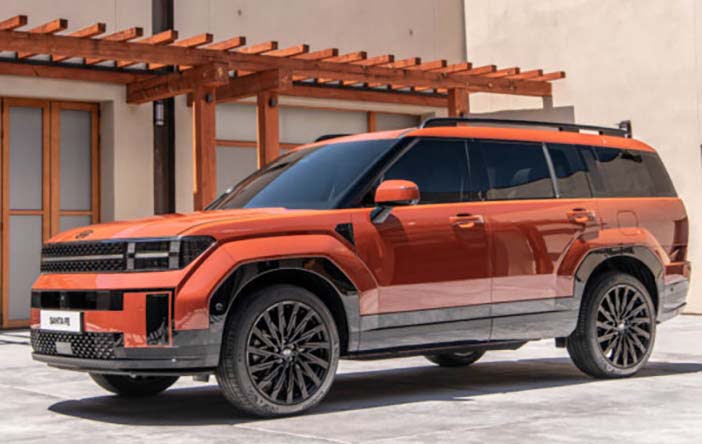
+++ SangYup Lee, design head of HYUNDAI and Genesis, talks us around the outside of the new Santa Fe, whose design represents a radical departure from models that precede it and others in the Hyundai line-up. The 7-seater has a less rounded, more rugged stance than Hyundai’s previous 4x4s and SUVs. “It’s a big change compared to the previous model”, Lee says, and its design direction represents “taking a risk”; one that was later justified by the resemblance with the modern Land Rover Defender and the Ford Bronco. “This is one of our biggest models”, says Lee. “It can’t fail. So this was very important. 4,5 years ago, we first started this project”, he explains. “We always check the big data information to forecast future trends. This was before the pandemic, and one key word that really pops is how ‘outdoors’ culture has become mainstream. We chose the direction to cover both the urban and the outdoors. When you have a box-style SUV, the proportional balance is so important”, says Lee. “It has a very simple body surface with a lot of volume, supported by up to 21 inch wheels, which is unheard of in this segment. “Even though it’s boxy, we want to add more precise details touches. And a lot of the challenges are aerodynamics. From an aero engineers’ perspective, they call a boxy car an ‘aero disaster’. So this is one of our challenges. “This car has a 0.29Cd drag coefficient. We challenged a lot in aerodynamics. It has an active aero shutter on the front, which is quite unusual for this segment, and also it has a vertical air curtain which helps, and we have round wheel openings, which is a significant aero gain as well. “It’s like back in the day, with the 993 type Porsche 9113: the rear fender flare has a lot of softness towards the back. Originally it was more angular, but we realized it’s not really helping the aero. This design is all about form following function and emphasizing what an SUV can do”. We asked Lee how the car looks so big in pictures but not in reality, whereas the Ioniq 5 is the other way around. “That is so true”, he replied. “When you first look at the Ioniq 5, it’s so solid and tight that nobody thinks it has a 3 meter wheelbase. It has lots of corner work. The corners are round as much as possible to create this compact character. The Santa Fe appears to be big because the corners are pulled out as much as possible. You saw the big tailgate: it’s a slab-sized surface and the full width is used as a design element. “Depending on product determines what design tool we want to use. But obviously the intention for an SUV is to say ‘I’m a big boy’ ”. “Caring is our concept” for the interior, Lee claims. The instrument panel is curved so that it’s reachable “when you draw an arc with your arm; this is the curvature”, he says. “And I’ve said this many times: until autonomous Level 4 or 5, the most important thing is that you have your eyes on the road and everything has to be easy to control, and this is why we didn’t get rid of the hard keys (and put everything on a touchscreen). “HVAC is obviously hard keys, because this is one you use all the time, so without even looking at it, you just reach for it”. Behind the rear door, there’s a sunken grab handle sculpted into the body, with a step inside the rear door to climb on. “It’s one of the easiest access to the roof rack in the SUV segment”, says Lee. Also the boot opening is wide. “A saloon has a trunk, an SUV has a tailgate space”, Lee explains. “That’s a lifestyle space, rather than cargo-carrying. So having a strong vertical line to emphasize the cargo area as much as possible, in combination with the shut face, it’s one of the widest tailgates. If you think about it, the shut line isn’t the width of the tailgate, because there are cars like the Audi Q7, which has a clamshell, but that doesn’t show you how wide the space is. That’s defined by the sill inside”. The Santa Fe’s boot opening is almost 1.300 mm wide. “It’s all about family. Every seat has 2 full-sized cupholders and every seat has a USB port”, Lee says. On forecasting what cars will look like 4 or 5 years hence, when design starts, Lee says: “I don’t know what will happen tomorrow, to be honest. This is why we use big data to identify trends. We have to forecast the future of mainstream trends as closely as possible, so we have a big data group internally and we use another externally. Both indicated towards the outdoor lifestyle, particularly during the pandemic. Your car becomes your private safe space. RVs [recreational vehicles]are so popular. We wanted to take the risk, and this is a little bit the reason that our company is a challenger: no risk, no reward. Otherwise, we always end up following the mainstream direction. Then we would become a fast follower, and we didn’t want to be a fast follower”. The Santa Fe certainly isn’t one of those – and neither is it yet another design that looks like it could fit into any point of its manufacturer’s line-up. Lee explains: “We already announced our chess-design strategy. Lots of makers use a family-look strategy, which have a cookie-cutter, Russian-doll consistency. There’s nothing wrong with that, but for us, Hyundai is a customer-centric brand, where lifestyle customers are very different. One Gen Z [person]in a single household is very different from mum and dad and three kids. So ‘chess’ is basically king, queen, bishop, knight; all very different and functionally different but working together as a team. “When you see our very small SUV, the Casper, that’s a very compact, Gen Z-oriented SUV with a lot of animated character. For this one, the Santa Fe, it’s actually the family car, so you can’t use the same design language. So we’re diverse. There are pros and cons, but we believe that being customer-centric is what the brand is supposed to be to elevate our design vision. I wouldn’t say it’s right or wrong; I’d say the customer will decide”. +++
+++ The JAGUAR I-PACE will not be part of the firm’s all-electric line-up, even as a bridging model, and will be taken off sale before the firm’s relaunch in 2025, along with the rest of the current model range. The move, officially confirmed by JLR boss Adrian Mardell, reverses his predecessor Thierry Bolloré’s suggestion that the I-Pace would be made “better and better”, and for it to remain on sale (perhaps even with a second generation) alongside Jaguar’s all-new electric cars. However, the precise end dates for the I-Pace and other Jaguar models have yet to be fully determined while the firm waits to see when it can more precisely commit to a launch date for the new range of models. For now, Jaguar has said it will reveal its first new-era car in late 2024 and launch it in 2025, built on the firm’s bespoke JEA electric architecture. Mardell said: “We don’t want the product to be out of the market for too long, particularly the electrified one (the I-Pace). Now we’re waiting for the confidence in JEA. Right now, people are telling me it’s going to be in the first half of 2025. That’s just under 2 years away. I’d be more confident in that response when we’re 9 to 12 months away. So we’ve got time (we’ve got 9 to 12 months) to work through these decisions”. Mardell said the I-Pace is now mainly sold in the United Kingdom and mainland Europe to help ensure the company is compliant with emissions targets. He added that the car has been a big help in steering development of the firm’s other EVs and that JLR “understands how to develop them” off the back of the I-Pace program. Looking ahead to the future Jaguar line-up, Mardell revealed the volume aspiration for the reborn range will be 4.000 cars per month, compared with just over 5.000 sales per month in the first quarter of the current financial year. Historically, Jaguar volumes have been much higher, but JLR has recently prioritized production of more profitable models (including the Range Rover, Range Rover Sport and Land Rover Defender) due to the chips shortage. In the same timeframe, just over 5.600 Range Rovers and just under 4.700 Range Rover Sports were sold each month, which means the new Jaguars collectively will sit below the duo, if present volumes are maintained. Although JLR’s largest models are all built on a modular MLA architecture, which will spawn its first electric car with the launch of a Range Rover EV in 2024, Mardell said Jaguar needs its own bespoke architecture (JEA) to allow for “exuberant” proportions. Chiefly, this means a longer wheelbase. “The wheelbase on these vehicles and this architecture will be longer. Then you can get the beautiful flows that you need from the vehicle”. As for more precise clues to their conception, less than 2 years out from the scheduled launch, Mardell went only so far as to say that “the design language on them is just gorgeous”. +++
+++ Prototypes of MERCEDES‘ third-generation CLA have started to drop their disguise just weeks before the firm shows off a production-previewing concept at the Munich motor show. Planned for a start to European sales during the first half of 2025, the new CLA is the first of 4 production models earmarked to use the Modular Mercedes Architecture (MMA), a platform that supports both electric and internal combustion engine drivetrains, as showcased by the sleek Vision EQXX concept. Other new Mercedes models based on the MMA include successor models to the existing CLA Shooting Brake, GLA and GLB; all of which are set to be launched by the middle of the decade. Electric versions are set to take the EQC, EQC Shooting Brake, EQA, EQB names into production. Developed to facilitate the transition to drivetrain electrification, the MMA replaces the existing Modular Front Architecture (MFA) with a skateboard-style design that, according to Mercedes CEO Ola Källenius, makes it suitable for a wide range of vehicle types. Central to the developments included on the new platform is an 800 Volt electrical architecture and a silicon-carbide (SiC) power-electronics system. Together, they’re claimed to provide a significant improvement in efficiency. Buyers of the new EQC saloon will be offered the choice of single-motor rear-wheel drive and dual-motor four-wheel drive in combination with either a lithium-ion-phosphate (LFP) or lithium ion battery (Li-ion), the most efficient combination of which is claimed to provide it with a range of up to 840 km at a capacity of around 100 kWh. The permanent-magnet synchronous motors are part of a new range of in-house produced ATS 2.0 units set to feature in all future standard Mercedes EVs. They operate in combination with a new 2-speed gearbox, providing greater performance and a higher top speed than the existing EQA and EQB, both of which are based on an adapted version of the MFA. Källenius, the architect of Mercedes’ net-carbon-neutral Ambition 2039 strategy, has also confirmed that the MMA has been engineered to support a new family of 3- and 4-cylinder petrol engines developed by Mercedes but to be produced in China by partner firm Geely. “We will have an electrified internal combustion engine. We have engineers who have very intelligently packaged a very economical but high-performance next-generation hybrid in the next CLA”, he said in a recent interview. The new petrol-engined family, codenamed M252, is set to provide the CLA with 48 Volt mild-hybrid properties using a gearbox-mounted integrated starter-generator (ISG). “It’s a complete Mercedes development from A to Z”, Källenius said of the new CLA engine. “Just as we have industrialized our current engines in China with good and competent suppliers, we will industrialize this engine in China. Today we export engines from China to Europe, and we will also do this with for the MMA”. Källenius wouldn’t be drawn on whether MMA-based models would be sold with a plug-in hybrid (PHEV) drivetrain. “Prepared to be surprised”, he said. Mercedes is in the midst of an engineering program that uses the new M252 engine as a generator in a range-extender (REx) drivetrain being considered for selected markets, including China. The move mirrors that of Geely’s new Nordthor 8848 petrol engine. It’s used in various models, including the newly launched Galaxy L7 SUV and Galaxy L8 saloon, where it’s offered as a REX, offering up to 1.300 km of range in combination with a 3-speed Dedicated Hybrid Transmission (DHT). REx models have enjoyed an upswing in sales in China recently, owing to their ability to reduce the range anxiety typically associated with EVs while providing extended ranges and relatively short refuelling times. Diesel engines, meanwhile, have been ruled out completely for the new CLA. Moving on from drivetrains, Källenius revealed that the upcoming third-generation CLA would retain the full-width display previewed in the EQXX. “We believe (A) pillar to (A) pillar digital displays are a must”, he said. “All Mercedes-Benz models will have this feature in the future. Definitively in China, but also for the rest of the world”. The new display will be mated with Mercedes’ new MB.OS operating system, as revealed earlier this year. Mercedes plans to produce the CLA with sensors, cameras and software for level-two driver-assistance. Buyers will be able to enable them and other optional features via an over-the-air on-demand service, which uses 5G connectivity. During its model cycle, the CLA is also expected to offer Level 3 assistance in markets where the regulatory framework permits. The styling of the third-generation CLA updates the design of today’s second-generation model. Key elements include a new shark-nose-style front grille set low in the front bumper. Bookmarked by angular headlamps, it’s planned to offer illumination as an option. The rear, meanwhile, receives a heavily raked windscreen and LED tail-lights conjoined by a light band across the width of the bootlid. The saloon stretches to around 4.700 mm in length, with a wheelbase put at close to 2.800 mm. Production of the new CLA and other MMA-based models for the European market is planned to take place at Mercedes’ plants in Rastatt (Germany) and Kecskemét (Hungary). Additionally, production is planned for the company’s plant in Beijing (China). +++
+++ The ongoing cost increase of RAW MATERIALS such as steel and lithium that have driven up car prices over the past year or more has come to an end, car makers have said. “Headwinds for raw materials have disappeared”, Thierry Piéton, Renault’s chief financial officer, said on the company’s first-half financial results call. “We are going into a period where costs should gradually get better”, Renault’s note of optimism about material costs was picked up by other car makers as they told financial analysts of a more settled environment after multiple price shocks delivered first by Covid and then Russia’s war on Ukraine. Other inflationary pressures remain, but there was a sense of relief that the bill of materials for each car was on a downward trajectory for a change. Renault has even acted on the falling raw material prices to make its cars cheaper, while promising investors it wouldn’t damage the company’s vastly improved profit margins. By way of reference, Renault CEO Luca de Meo singled out the newly facelifted Clio and upcoming revamp of the Arkana. At BMW, that still means prices are high. “Yes, we benefit from falling raw material prices, but on the supply chain, we are paying more for material costs than we paid last year”, Walter Mertl, BMW new chief financial officer, said when asked at which point BMW would start to benefit. “I hope that the raw material pricing is still coming down even further in order to get on par with the extra bills we are paying to the supplier side”, Mertl added. The new Stellantis CFO, Natalie Knight, said something similar: “Raw material pricing was higher due to the carry-over effects of first-half 2022 increases”. Some suppliers (for example, Spanish metal parts giant Gestamp) operate what it calls a pass-through system, where falls or rises in base metal costs are immediately passed onto the customers. Others don’t, however, and many suppliers are looking to claw back margins after a tough few months during which they feel excluded from the higher profits earned by car companies switching to a ‘value over volume’ strategy, which reduced the order intake from suppliers. Car makers have been looking to avoid the whiplash on costs and potential shortages that comes from being at the tail end of the supply chain by getting involved with sourcing further along that chain, particularly for battery materials as well as semiconductors. “That is why we started deep sourcing on the chip side, and also have started deep sourcing on the battery raw material side”, Ola Källenius, CEO of Mercedes-Benz, said on his company’s earnings call. Other inflationary pressures remain. “Inflationary factors will continue to be felt in areas outside of raw materials”, Knight at Stellantis said, citing potential wage increase demands from its workforce. Ford, meanwhile, spoke of rising warranty and repair costs as dealers put up prices. Whether car companies will pass on falling raw material costs depends on how confident they are about maintaining record profit margins as part supply returns and competition hots up again. Renault was confident enough to drop the price of the Clio E-Tech hybrid. All eyes will be on lithium prices as countries mandate greater numbers of EV sales. Fisker chief financial officer Geeta Gupta lauded the recent drop in prices for raw materials going into the batteries made by China’s CATL for the company’s new Ocean. She said: “For us to make affordable EVs and for prices to stabilize, battery cost has to go down. There is no other way”. +++
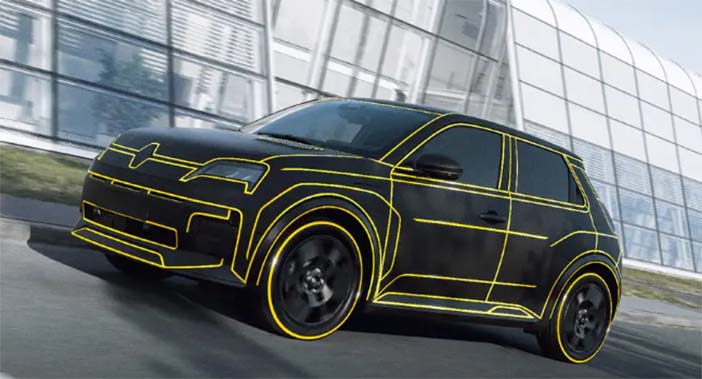
+++ RENAULT is turning to retro design for its upcoming EVs as a means to differentiate its cars from “anonymous” and “cold” rivals. Renault Group design chief Laurens van den Acker told that reinventing classic designs is “irresistible” for CEO Luca de Meo, who revived the Fiat 500 while boss of the Italian firm in the 2000s and, on arrival at Renault, green-lit the retro-styled 4 and 5 EVs for showrooms. Van den Acker said: “I think there’s this unsaid expectation that EVs should look a little bit anonymous, very fluid, very cold. I hope there’s more richness in the future for EVs, and we’re trying to do our best. The Renault 5 and Renault 4 will be full EVs, but they will be legendary icons. At the same time, the Mégane and the future Scenic are just very modern cars”. “For a guy like Luca”, added van den Acker, doing something with Renault’s back catalogue “was irresistible”. The Renault 5 was shown as a concept in early 2021 as the mascot for de Meo’s wide-reaching ‘Renaulution’ transformation strategy and the production car has now entered late-stage testing ahead of a launch next year. The 4 was shown in concept form at last year’s Paris motor show and will enter showrooms (minus the outlandish off-road addenda) in 2025. Both are based on the firm’s new CMF-BEV architecture for small electric cars. Van den Acker continued: “When I came to Renault in 2009, they asked me: ‘When are you going to do an Alpine or a Renault 4?’ I said: ‘Look, I’m hired to design the future, not to design the past’. “But ironically, I think at this time when there’s so much insecurity in the world, where there are many dark clouds hanging left, right and centre, to make a few cars that really talked about the good times, and the times when the brand was alive, and stir all these positive emotions that people have is a good thing. “The amount of people I’ve met that said ‘Oh, that was my first car, the Renault 5’ or ‘I learned how to drive in my aunt’s Renault 4’. “I think these good memories are worth reviving. They’re feel-good products, and that is very rare to have. This is a card we can play that nobody else can play. Even in England, I think the Renault 5 is just massive, right? So why not? Why not give people what they want?” The main reason we have not seen a revived 4 or 5 before is because packaging them faithfully to the originals would not have been possible with a combustion engine, hinted van den Acker. “If the Renault 5 had used an internal combustion engine, it would have had a nose like this”, he said, gesturing at his nose and mimicking Pinocchio. “So in that sense, the transition to EVs is very exciting”. +++
+++ Consumer demand for gas-guzzling SUV models remains healthy despite the pressure on budgets from rising interest rates and high petrol costs, helping the automotive classified websites post sharply higher profits. As households face a squeeze from inflation and rising interest rates, the business had expected to see signs of belt-tightening, such as a move away from SUVs, which are not only more expensive to buy than smaller cars, but generally more costly to run because they use more fuel. However, a company spokeswoman said on Monday that the proportion of searches on platforms for SUVs held steady last financial year, while searches for sedans fell slightly and searches for hatches were broadly flat. The spokeswoman also said there had been minimal change in the price brackets customers were choosing in online their searches, despite the rising cost of living. She said the share of searches targeting electric vehicles had fallen from 12.5 per cent in June 2022 to 5.7 per cent in June this year, though there remained strong demand for electric cars. The trends came as classified websites said it continued to see “robust” demand for vehicles across its businesses, despite the cost of cars surging since the pandemic. The cost of cars has surged about 40 percent compared with before Covid-19, when the supply of cars was choked off by lockdown policies and parts shortages. In the company’s annual report, chief executive Cameron McIntyre and chairman Pat O’Sullivan said inventory levels had improved in the past year, and prices had stabilised since the second quarter of 2022. “Despite these changes as well as the impact of inflation and rising interest rates, we have continued to see robust levels of demand in all our key markets, reflecting the resilience of our business models through economic cycles”, they said. +++
+++ Reports suggested that an VOLKSWAGEN ID.BUZZ camper van would be so heavy that European buyers would not be able to drive it on a standard license, but VW says the project has not been delayed. The ID. Buzz is a hotly anticipated electric van from Volkswagen that harkens back to the Type 2 microbus. But one of the most fondly remembered versions of that vehicle, a camper van, may not be possible right now, according to a report from Germany. The difficulty is reportedly attributed to a relatively simple aspect of the design: the weight. According to a report from Edison in Germany, the development of a long-wheelbase ID. Buzz camper van has encountered delays. The current camper conversion technology indicates that the model’s weight could approach or exceed the limit permitted for drivers with a typical European license. This situation might necessitate owners to obtain an entirely new license to operate it. However, the automaker denies that any such issues, if they actually exist, have required engineers to delay development. Volkswagen USA representative Mark Gillies told that the “stories that the project is appreciably delayed are incorrect”. The rumors trade on the reputation that electric vehicles have gotten for being heavy. With big battery packs required to ease buyers’ range anxiety, the extra weight of electric powertrains has impacted crash testing, vehicle hauling, and more. With the batteries, in addition to a roof tent, a bed, a sink, and all of the other additions required to turn a van into a camper, the model would certainly be a heavy one, whether it challenges European licensing rules or not. Such is the weight of electric vehicles that Europe is already looking into raising the weight limit for licenses, per ADAC. Currently, the Category B license entitles drivers to drive a vehicle with a maximum weight of 3.500 kg, but that could be raised to 4.250 kg, which would solve VW’s camper van issue, if one exists. +++
+++ VOLKSWAGEN is on the cusp of revealing a top-spec all-wheel drive version of its ID.Buzz. Due to use the GTX moniker, it’ll join the ID.4 GTX in utilizing a dual-motor powertrain to give the electric van a mildly sporty make-over. The GTX will debut a fresh front end with a slightly redesigned lower bumper. The new bumper will potentially join a bespoke wheel design, GTX badging and unique colour options to help demarcate the flagship ID.Buzz from lesser versions. A close-up image of the ID.Buzz GTX steering wheel has already been revealed during a VW investor presentation, but it is the same wheel used on the firm’s 2 other MEB platform GTX products: the ID.4 GTX and ID.5 GTX. The steering wheel won’t be the only similarity between those cars, either. The standard ID.Buzz uses a 77 kWh battery (the same as VW’s other GTX offerings) but in the ID. Buzz GTX we expect power to rise from 204 hp to 299 hp, with torque remaining at 310 Nm. The standard ID. Buzz sends drive to the rear wheels only, but the GTX will use a 4-wheel-drive system just like the ID.5 GTX. Performance should increase drastically from the regular car’s 10.2-second 0-100 kph time and the 145 kph top speed may even increase as well. The 410 km range, however, will take a hit due to the extra power and the weight of the additional electric motor on the front axle. Charging for the GTX shouldn’t be affected given it uses the same battery as other ID.Buzz versions. There should be 170 kW charging on board, so the battery can be topped up from five to 80 percent capacity in 30 minutes. Given the GTX versions are designed to be the range-topping trim level in the all-electric VW line-up, the ID. Buzz GTX will probably receive all the equipment featured on the current top-spec 1st Edition model such as 21-inch wheels and a 12-inch touchscreen. I expect to see the GTX join the ID. Buzz line up in 2023, with pricing announced later in the year. +++