
+++ China has drawn up new safety rules for the growing number of AUTONOMOUS VEHICLES on its roads, including a mandatory deactivation override, the government said. The standards taking effect July 1, 2027 will cover autonomous vehicles that require a human back-up driver, as well as independently operating vehicles such as the robottaxis made by US manufacturer Waymo. Under the new rules, manufacturers will have to ensure autonomous systems can match the safety of human drivers, China’s Ministry of Industry and Information Technology said in a statement. Buyers will also have to be informed of any limitations in autonomous systems. The rules standardise interactions between humans and machines to “prevent risks of misuse or abuse”, the ministry said. They will require that autonomous vehicles feature safe procedures to activate and deactivate automated driving, it said. For cars with a human back-up driver, the autonomous system must monitor their readiness to take over. Safety concerns and the cost of developing next-level systems have complicated progress in the introduction of of autonomous vehicles. Beijing warned leading automakers that safety rules would be more tightly enforced after a fatal crash in 2025 involving a Xiaomi car in assisted driving mode. The new rules follow a UN agency’s adoption in June of the first global regulations for fully autonomous vehicles, which China backed. +++
+++ EV makers from CHINA are turning South Korea into their next battleground, using cut-rate pricing and advanced software to challenge the Hyundai Motor Group on its home turf. With BYD and Zeekr already gaining traction, XPeng, Nio and other brands are lining up to enter a market increasingly seen as a test bed for global expansion. According to industry sources, XPeng is recruiting a head of Korean operations, officially signaling its entry to Korea. After establishing XPeng Motors Korea on June 23 last year, the company initially hired staff to handle vehicle certification and regulatory approval. Known for its software-centric vehicle system and autonomous driving technology, XPeng launched VLA 2.0, its next-generation end-to-end AI autonomous driving architecture, in China in March. The company plans to expand the technology to global markets from 2027. Similar to Tesla’s Full Self-Driving system, VLA 2.0 relies primarily on cameras rather than lidar, using artificial intelligence to learn from complex driving scenarios and make human-like driving decisions in real time. Despite its advanced autonomous driving technology, XPeng offers midsize SUVs priced in the 30-million-won range, positioning them to directly compete with Hyundai and Kia’s flagship EV lineups. Nio is also viewed as a strong candidate to enter the Korean market. The company has differentiated itself through battery swapping, battery subscription services and a production model that enables vehicle delivery within 2 weeks of an online order. Other brands, including Chery and Xiaomi, are reportedly finalizing their entry strategies as well. BYD, the earlier entrant to Korea, has set a milestone by reaching cumulative sales of 11.675 units in the first half of this year, nearly doubling its full-year total of 6.107 vehicles in 2025. The company exceeded its initial annual sales target of 10.000 units ahead of schedule and ranked as the country’s 4th-largest imported car brand behind Tesla, BMW and Mercedes-Benz. An industry source said, “BYD has pursued some of its most aggressive pricing strategies in Korea among its overseas markets to establish an early foothold”, adding that it has effectively targeted EV buyers who had traditionally favored Hyundai and Kia. Although BYD vehicle buyers are no longer eligible for the Korean government’s EV purchase subsidies, the company plans to provide its own incentives worth several million won per vehicle, keeping effective purchase prices largely unchanged, and continue expanding its market share. Meanwhile, Zeekr has adopted a premium EV branding strategy. The company started preorders for its first midsize 7X (priced from 52.99 million won) last month, with customer deliveries scheduled for later this year. Experts say that while South Korea is not one of Asia’s largest EV markets by volume, Chinese automakers view it as a proving ground for their product quality, software capabilities and brand competitiveness. “South Korea also provides a relatively accessible market at a time when Chinese automakers face growing trade and regulatory barriers in the US and Europe,” said Lee Ho-geun, an automotive engineering professor at Daeduk University. “Creating a foothold here can help them sharpen their product and business strategies before expanding into more restrictive markets”. Noting that Chinese brands are currently forced to limit some of their advanced driver assistance and autonomous driving features to comply with Korean regulations, Lee added: “Regulatory hurdles will eventually ease, if not for Chinese companies, then for Hyundai and Kia”. +++
+++ HYUNDAI reported weaker sales in July as an ongoing labor dispute disrupted production, making it the only major South Korean automaker to cite a strike as a key factor behind its sales decline. Hyundai said it sold 318.454 vehicles worldwide in July, down 5.1 percent from the previous year. Domestic sales fell sharply by 14.4 percent to 48.113 units and overseas sales dropped 3.2 percent to 270.341 units. A company official said, “July sales were impacted by a slowdown in overall industry demand, strike-related production disruptions and customers delaying purchases while waiting for new models”. Hyundai’s union launched a third round of 4-hour daily partial strikes from July 29 to 31, extending a series of walkouts that began earlier in the month as wage negotiations remained at a stalemate. With no progress made since their 15th round of bargaining on July 8, wage talks have effectively stalled for nearly 3 weeks. The 2 sides remain split over wage and bonus increases, the reinstatement of dismissed union members and an extension of the retirement age. Other automakers saw limited impact from labor strikes. Notably, Hyundai’s smaller sibling Kia, which has yet to go on a strike this year, sold a total of 298.037 vehicles in July, up 13.4 percent from a year earlier. Domestic sales rose 21.3 percent, while overseas sales increased 11.6 percent, extending its growth streak to a fifth consecutive month. GM Korea’s union also staged partial strikes in July, though unlike Hyundai, the walkouts did not involve all production shifts. Following a tentative agreement reached on July 22, union members voted on July 28 to approve the deal and ended the strike. Supported by robust overseas demand and a relatively smaller impact from labor disputes, GM Korea recorded the highest sales growth among domestic automakers. It sold 42.119 vehicles in July, up 30.6 percent from a year earlier. While domestic sales fell 37.5 percent to 766 units, exports surged 33.3 percent to 41.353 units, led by strong shipments to North America. Hyundai said it plans to strengthen sales momentum in the second half of this year by launching new models, including the all-new Avante sedan, and stabilizing production. However, industry watchers warn that a prolonged labour dispute could further weigh on Hyundai’s sales and earnings. With the company already facing a 15 percent US auto tariff, resolving domestic production disruptions is crucial to boosting exports and offsetting tariff-related pressures. Meanwhile, Hyundai’s union is set to hold a central strike committee meeting on August 11 to discuss whether it will pursue additional labor actions. +++
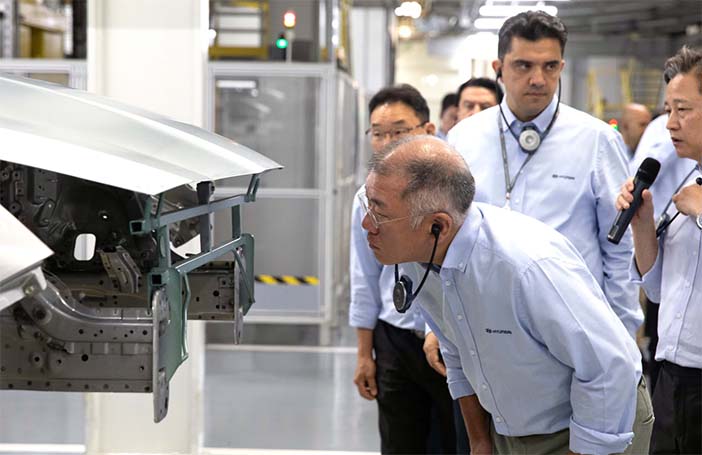
+++ Hyundai Motor Group chairman Chung Eui-sun visited a production site in Türkiye to check the IONIQ 3, which will target the European electric vehicle market. As the small electric SUV will debut in Europe in the second half of the year, the move is seen as a bid to inspect it in person. Chung visited the Türkiye plant of Hyundai in Izmit near Istanbul on the 30th of last month. After closely examining the process from Ioniq 3 body production to the assembly line and urging thorough quality checks, he discussed local production and sales strategies with executives and employees. At the site, Chung said, “From the start of mass production, we must put quality first and enhance market competitiveness with a level of completion that exceeds customer expectations”, and added, “On safety, we must ensure it is recognized as the best car in Europe”. He then also visited the battery plant of Hyundai Mobis. The Ioniq 3 is equipped with Hyundai Mobis’ battery system. Chung’s direct visit to the Ioniq 3 production site is seen as reflecting that it is a key product for Europe.
The B-segment, the class of the Ioniq 3, is a fiercely competitive field in Europe. It accounts for 15% of total demand in the European auto market. The share of EVs in this segment is currently around 14% but is forecast to rise to 33% in 2030 and 65% in 2035. Major European players such as Volkswagen had rushed to launch B-segment EVs. But Hyundai, which lacked a B-segment EV, is aiming for a rebound with the Ioniq 3. The Ioniq 3 will begin mass production in mid-month and will be rolled out sequentially across European countries from the second half of the year. Hyundai aims to break into the upper ranks of EV sales with the Ioniq 3. The EV line-up will expand to include the Inster (Korean name: Casper Electric), Kona Electric and Ioniq 5, Ioniq 6, Ioniq 9 plus the Ioniq 3. The Ioniq 3 features an “aero hatch” design that balances aerodynamic efficiency and interior space, and Europe-tuned driving performance based on the E-GMP platform. For the first time among Hyundai models sold in Europe, it comes with the next-generation infotainment system Pleos Connect, and it also includes the latest SmartSense driver-assistance system. Hyundai has set a goal of selling more than 40.000 units a year starting next year. It is also meaningful that the Türkiye plant is making its first attempt at EV production. Established in 1997 to target Europe, the Türkiye plant is Hyundai’s oldest overseas production base. Starting with the Accent, it has produced Europe-focused strategic models such as the Starex, Matrix and i10, and now the i20 and Bayon, with cumulative output reaching about 3.4 million units. Starting with the Ioniq 3, the Türkiye plant is expected to be used as a forward base to target the European market. In 2013, it established an annual production capacity of 200.000 units. Chung told executives and employees: “Based on the achievements of the past 30 years, we must change how we work to match the changes of a new era”, and added, “We must pursue innovation and strengthen competitiveness so we can become the best corporations in Türkiye across all institutional sector: production, quality and sales”. +++
+++ KGM has secured a $75 million strategic investment from China’s Chery Automobile for the Korean carmaker’s new vehicles and future mobility technology, the companies said. The investment marks the latest step in an alliance that has evolved beyond product collaboration into a long-term strategic partnership focused on future growth. The agreement follows a platform licensing deal signed by the 2 companies in October 2024 and a joint development pact for mid-sized and large SUVs reached in April 2025. Both carmakers also plan to deepen cooperation across software-defined vehicles (SDVs), electrical and electronic architecture, autonomous driving and electrification. KGM Chairman Kwak Jea-sun described the strategic alliances as indispensable for automakers seeking sustainable growth. “Global cooperation has become essential for securing future growth engines”, Kwak told reporters during a press conference. “By combining KGM’s 70 years of engineering expertise with Chery’s outstanding technological capabilities, we will further strengthen our competitiveness and grow into a sustainable future mobility company”. The companies will combine KGM’s vehicle planning, design and engineering expertise with Chery’s electrified powertrain technologies and global vehicle platforms to shorten development cycles and improve competitiveness. Their first jointly developed model, code-named SE10, is scheduled to debut in January 2027. The D-segment SUV will be offered in both plug-in hybrid and 2.0-liter gasoline variants, leveraging Chery’s platform and powertrain technologies while incorporating KGM’s product development knowhow. “Following the upcoming launch of the new strategic vehicle, we will initiate development for a much sought-after C-segment compact car”, KGM CEO Hwang Ki-young said. “We plan to expand the lineup with a range of eco-friendly vehicles over time, and our development roadmap also includes an extended-range electric vehicle powertrain”. The 2 firms also intend to broaden cooperation in future vehicle technologies, including SDV-based electronic architecture and autonomous driving systems; areas increasingly viewed as critical to the industry’s transition toward intelligent, connected vehicles. The investment gives KGM greater access to advanced electrification technologies and global platforms at a time when midsized automakers face mounting development costs and intensifying competition. For Chery, the partnership provides a stronger foothold in Korea while expanding its global collaboration network. The latest signing ceremony featured Chery Automobile chairman Yin Tongyue, Chinese Ambassador to South Korea Dai Bing and Kwak. “Korea and China are leading automotive countries”, Yin said. “We will build on our respective strengths to create genuine synergies through complementary capabilities and shared resources”. When asked about the Chinese carmaker’s potential entry into the Korean market, Chery said it leaves open the possibility, but it will now focus on deepening its partnership with KGM. +++
+++ The PEUGEOT GTi hot hatch is back, and Alain Favey is the man to thank. The genial Frenchman became Peugeot CEO in February 2025, and one of his first big decisions was to green-light the E-208 GTi. Its 205 GTi forebear, unveiled 40 years ago, is one of the brand’s greats, a car which ushered in an era when even mainstream Peugeots like the 306 and 406 were sparkling to drive. With European brands searching for an emotional edge to fight off Chinese rivals, it’s no surprise the boss is doubling down on driving dynamics and reviving the GTi badge to rev up Peugeot’s image. Favey unveiled the new E-208 GTi at the 2026 edition of the Le Mans 24 Hours race, having shown a prototype there a year earlier. “The new E-208 GTi delivers the highest power in its class (281 hp); a bit more than the 205 GTi’s 130”, he chuckles. “It has the best power-to-weight ratio in its segment. And last year we promised to reach 100 km/h from 0 in 5.7 seconds: that is the only promise we haven’t kept, because the production car will take 5.5 seconds!” Petrolheads may regret that this GTi is purely electric, but France’s ‘malus écologique’ tax hikes up prices so dramatically for any petrol or hybrid car emitting more than 108 g/km of CO2 that a petrol GTi is a non-starter. But with a limited-slip differential to manage 281 hp across the front axle, a faster steering rack, lowered suspension and a bespoke battery-cooling system to ensure performance doesn’t drop off, the electric GTi promises to be big fun. But Favey explains that E-208 GTi volume is limited. “Usually when we launch a new car, it’s about selling as much as we can but that’s not the case for GTi, and that’s maybe my Bentley experience coming back, where it’s all about exclusivity and desire. We’re doing GTi because it’s part of our DNA. We believe there’s a halo effect of having a GTi that will make the brand more attractive, and that will help us sell 2008, 3008 or whatever else. It’s not about how many GTis we sell”. Given Favey’s passion for the project and the excellence of previous hot 308s, could more GTi models follow? “There will not be another GTi if it’s not a real GTi”, he reveals. Could a future GTi use a hybrid powertrain? “It could be a hybrid”, he agrees. “But we don’t want to fool anybody. People are such aficionados of hot hatches. You really need to have a product that is astonishing on the market, and the E-208 GTi will be”. Could the GTi brand extend to an SUV, to provide a revenue boost? “No. It is puristic but GTi stands for hot hatch. It’s not a hot SUV. Maybe others do it but we’re not going to do that”, says the boss. Peugeot plans to roll out 7 new cars for Europe in the 5-year window, so will another GTi be one of those? “I would love to, but the answer as we sit here now, is no. We haven’t found a solution so far but we will keep trying”. +++
+++Chinese carmakers are rapidly cementing their presence across SOUTH KOREA ’s automotive industry by expanding beyond low-priced electric vehicles (EVs) into strategic investments and critical supply chains. This puts their Korean counterparts in a state of growing dilemma over their future strategy, as the pace of Chinese carmakers’ inroads is widely seen as much faster and far-reaching than expected. The latest in a series of such moves came when KGM signed a strategic investment agreement with China’s Chery Automobile. Under the agreement, Chery will invest $75 million in KGM and jointly develop mobility technologies with the Korean automaker. The deal followed the rapid expansion of BYD Korea. The Chinese EV maker entered the Korean market in January 2025, and rose to become the nation’s 4th-largest imported carmaker in the first half of this year. Reflecting on the success of BYD Korea, other Chinese carmaker, such as Zeekr and Xpeng, prepares to enter the market directly. The developments suggest Chinese players are shifting from simply exporting vehicles to building a longer-term presence in Korea, a market traditionally dominated by Hyundai and Kia. The timing coincides with a dramatic rise in Chinese-made vehicle sales. According to the Korea Automobile & Mobility Association, China became Korea’s largest source of imported vehicles in the first half of this year for the first time, overtaking Germany. Chinese-made vehicles accounted for 41.2 percent of imported passenger car registrations during the January-June period, compared with Germany’s 30.1 percent. A year earlier, Germany led with a 40.3 percent share. The surge was fueled largely by Tesla models manufactured at its Shanghai plant, alongside growing sales of BYD vehicles produced in China. The figures also underscore a broader structural shift in Korea’s auto market. Electrified vehicles, including hybrids, all-electric cars and hydrogen fuel-cell models, accounted for 57.8 percent of all new registrations in the first half here, surpassing the 50 percent threshold for the first time. For Korean automakers, the challenge extends well beyond vehicle sales. China already dominates global battery materials and components, with companies, such as CATL, tightening its footprint as the world’s largest EV battery supplier. The KGM-Chery partnership illustrates the changing dynamic. What began as a technology collaboration has now expanded into an equity investment, highlighting how Chinese automakers are seeking strategic footholds rather than remaining export-oriented competitors. Auto industry officials also believe Chery could eventually enter Korea under its own brand if early launches by Zeekr and Xpeng demonstrate sufficient consumer demand. The move would further intensify competition in the country’s fast-growing EV market. The influx of Chinese EVs could produce clear consumer benefits by increasing price competition and expanding model choices. At the same time, however, the trend could place growing pressure on Korea’s manufacturing base and automotive supply chain. Industry officials echoed those concerns, arguing that policy support has not kept pace with the market’s transformation. “As Chinese EV makers strengthen their presence not only globally but also in Korea, the competitiveness of our domestic manufacturing base and supply chain is coming under greater pressure”, an industry official said. “The government should consider expanding tax incentives for domestically produced EVs to strengthen local production”. +++
+++ In just a few years, Chinese car companies have taken over their local market, and they are also doing the same in numerous international markets. In doing so, they’ve forced some legacy brands to rethink the market positioning of their models, including TOYOTA . It comfortably remains the world’s largest car manufacturer, but in a recent interview in South Africa, the company’s local PR chief admitted that new Chinese entrants have forced them to shift the all-new RAV4 into a more premium position, as Toyota can no longer compete lower down in the market. “We cannot compete with the emerging Chinese brands directly on an entry-level price point”, Toyota South Africa Motors senior public relations manager Riaan Esterhuysen told. “They have changed that market; they have shaped the market or changed the shape of the market by driving customers down to a lower and mid-tier of the segment or taking used car buyers and upselling them”. This is one of the first times we heard someone from Toyota acknowledge just how significantly brands from China, like BYD, Chery and Geely, have forced it to change. In the case of the new RAV4 it’s now more expensive than its predecessor. This push up the market may lower sales, but could enable Toyota to make more money from the cars it sells. As they have across much of the world, Chinese cars have poured onto South African roads in recent years, and the pace hasn’t let up. They now account for more than 19 percent of new passenger and light commercial sales, a share that looks set to keep climbing as more brands arrive and the established players expand their local line-ups. Unless Toyota can slash its development times and bring prices down, its biggest Chinese rival has room to do real damage. BYD, the largest of the bunch, isn’t shy about saying so. In June, chairman Wang Chuanfu made the audacious claim that within 5 years the company will overtake Toyota. Last year BYD moved 4.6 million vehicles against the 11.21 million sold by the Toyota group, a tally that includes Lexus and Daihatsu, so closing a gap that wide inside 5 years is a tall order. +++