
+++ The AUDI (Q8) e-Tron is being offered at half price to First Auto Work-Audi (FAW-Audi) employees until December 31st this year, shows an internal marketing document. In China, the e-Tron has not been refreshed since its market entry in April 2021. Based on the social media posts by the local dealers, some of the cars have been sitting in the stocks for over 200 days. One dealer said the locally manufactured e-Tron might be taken out of production and that this is the last batch of made-in-China (MIC) e-Trons. Only imported versions will be available in the future, the dealer added. In March, SAIC-Audi joint venture organized a similar campaign for its employees, when it was selling A7 L and Q5 for 70,000-160,000 yuan (9,500-21,800 dollar) cheaper prices. The media also speculated the campaign was organized to clear the inventories. Audi sold just 508 units of the e-Tron in the first 7 months of the year. In July it recorded the highest sales month with 147 units sold. Accidentally or not, its sales have been steadily growing since April when it sold 26 units. The model’s contribution to FAW-Audi sales was minuscule, less than 0.3% throughout the year. +++
+++ BYD is accelerating in the car market of BRAZIL in August, selling 656 BEVs. It is more than the total of all other automakers (511 units). The BYD’s bestseller in the local market is the Dolphin. According to the BYD’s press-release, it has registered 656 battery electric vehicles in Brazil in August. It seems that the secret of the company’s success is a broad model line that comprises Tang EV, Han EV, Atto 3, Dolphin, Song Plus DM-i and recently launched Seal. BYD also rapidly develops local dealership, planning to open 100 stores by the end of the year. Moreover, the Dolphin has apparently become a hot seller in Brazil, with over 4.000 units sold after the market launch, becoming the bestselling EV in the history of the country. We will underline here that BYD is talking about orders, not deliveries. As Brazil-China friendship develops, BYD wants to build 3 factories in the country that will manufacture not only passenger electric cars but also electric buses, trucks, battery materials, etc. BYD also manufactures solar panels in Brazil. +++
+++ Chinese companies led by electric vehicle giant BYD were the talk of the town during the press day at IAA Mobility in Munich. BYD, which had set up one of the biggest exhibition booths at the Messe Munich exhibition center, seemed to draw the largest crowd, filled with hundreds of reporters from across the world as the company announced the launch of its EV sedan, Seal, for the European market during the press conference. A local German journalist who wished not to be named told that the progress that Chinese companies have made since the last IAA 2 years ago was pretty obvious. “The BYD Seal fits the taste of Europeans. BYD cars did not used to be like that 4 to 5 years ago. I think they will be successful in Europe”, he said. “German automakers recognize the rise of Chinese EV competitors, which is a good thing because more competition will push them to develop better cars”. According to BYD, it sold 1.86 million EVs last year to become the biggest EV seller in the world. China currently has the biggest EV market worldwide. The Chinese firm also touted that the fact the company has now entered 15 countries in a span of 11 months. A similar trend could be found with Chinese battery giant CATL, which also drew a huge crowd during its press conference. The exhibition booth of CATL was bustling with numerous visitors every time this reporter went there to check out the scene. Leapmotor, another Chinese EV maker, announced that it will launch its SUV, the C10, to the European market next year, underlining that the company would aim to introduce “globally-oriented” vehicles for customers all over the world. “Our strength is that we have everything that goes in our vehicle from our in-house domain”, a Leapmotor official said. “That means we can lower the cost to provide better products to our customers”. The official emphasized that it does not wish to be labeled as a Chinese firm but rather as a global company, as it is seeking to deliver cars wherever the need is. Zhang Feng, head of the market support department at Dongfeng Liuzhou Motor, which produces auto brand Frothing, said the company even tailored the new hybrid van so that it would better fit the body sizes of Europeans. “Europeans are taller and bigger than us”, he said. “So we made this vehicle to specifically target European customers”. According to the IAA exhibitor directory, there were 671 companies that have each set up an exhibition booth at this year’s event. Chinese firms accounted for 45 of them. China’s participation more than doubled from the previous event in 2021. Germany’s auto giants (BMW, Mercedes-Benz and Volkswagen) led the charge with the biggest exhibitions in the city and outside of the event venue, the Messe Munich exhibition center. The outdoor exhibitions drew hundreds of visitors. BYD once again was no exception to widespread attention. Santana Moreno, a visitor from Spain, said he was surprised when he found out that BYD is a Chinese firm. “I didn’t know about BYD but their cars look fine”, said Moreno. “BYD cars could appeal to people in Spain. If the price is lower than other European EVs and the performance is on par with other cars, I would buy their car”. +++
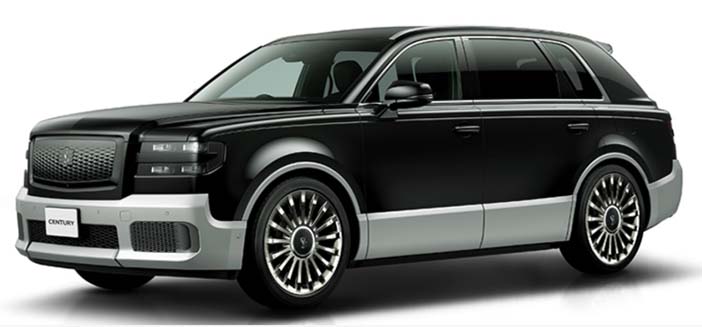
+++ Toyota has unveiled a SUV type of its most luxurious brand, CENTURY , as part of efforts to expand its line-up of premium cars to cater to the demand from wealthy customers. The new model of the chauffeur-driven vehicle, only offered as a plug-in hybrid car, is priced from 25 million yen onwards, about 5 million yen higher than the existing sedan model, making it the most expensive domestically mass-produced car at Toyota. The Century sedans have been used by many VIPs in Japan, such as royal families, top politicians and corporate executives. The new model has fully reclining rear seats, an improved audio system and rear doors that open 75 degrees to ensure ease of entry and exit, according to Toyota. The automaker started to take orders and plans to deliver vehicles to customers by the end of the year. The company aims to sell 30 units per month, it said. The Century was launched in 1967 to commemorate the 100th anniversary of the birth of Sakichi Toyoda, the Toyota group’s founder. The company has sold about 42.000 units of the brand since. The new model, to be produced at its Tahara Plant in Aichi Prefecture, central Japan, will be sold in Japan and overseas, the company said. Its overseas rivals, such as British carmakers Rolls-Royce and Bentley, have also sold luxury SUVs. +++
+++ In August, the automobile market of CHINA continued its robust performance, registering the sale of 1.920 million new cars, as the China Passenger Car Association (CPCA) reported. This figure represents a 2.5% increase compared to the previous month, highlighting the resilience and growth of the industry. Notably, the market witnessed significant activity in the new energy vehicle (NEV) sector, with 491.000 electric vehicles (EVs) and 225.000 plug-in hybrid electric vehicles (PHEVs) finding buyers. NEVs accounted for 37.3% of total vehicle sales, underscoring their escalating importance in the market.
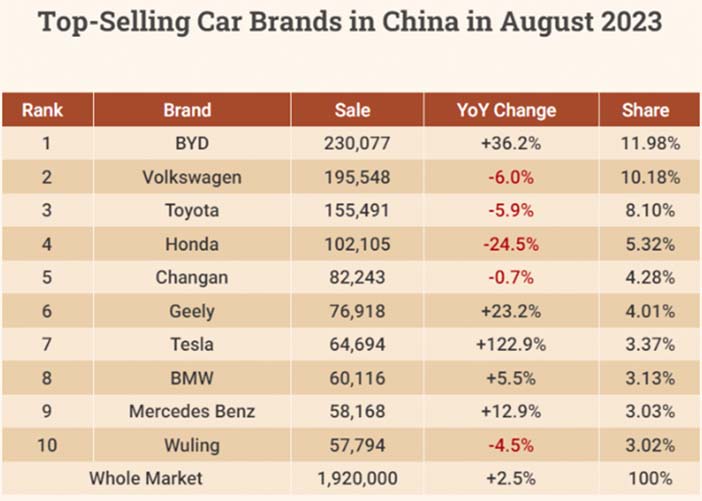
Regarding market dominance, BYD emerged as the top-performing auto brand in China for the month, achieving remarkable sales figures. BYD sold 230.077 vehicles, securing an impressive 11.98% market share. Volkswagen maintained its second-place position as the second best-selling brand in China, with total sales reaching 195.548 cars. This achievement translated to a 10.18% market share. Toyota secured the third spot, selling 155.491 vehicles, equivalent to 8.10% market share. Honda followed in 4th place with 102.105 vehicles sold, capturing a 5.32% market share. Changan rounded off the top-5, recording sales of 82.243 cars, which accounted for a 4.28% market share. Tesla implemented a change in its delivery strategy in the Chinese market. Unlike the previous year, when Tesla typically conducted large-scale deliveries at the end of each quarter, the company now carries out these deliveries in August. This strategic shift led to a remarkable 122% year-on-year increase in Tesla’s sales in China for August, further solidifying its position as a significant player in the Chinese EV market. BYD showcased a commanding presence within the Chinese NEV segment, excelling in both the EV and PHEV categories. BYD captured a substantial 25% market share in the Chinese EV market. Impressively, the brand secured an even more significant 48% market share in the PHEV category for the month.
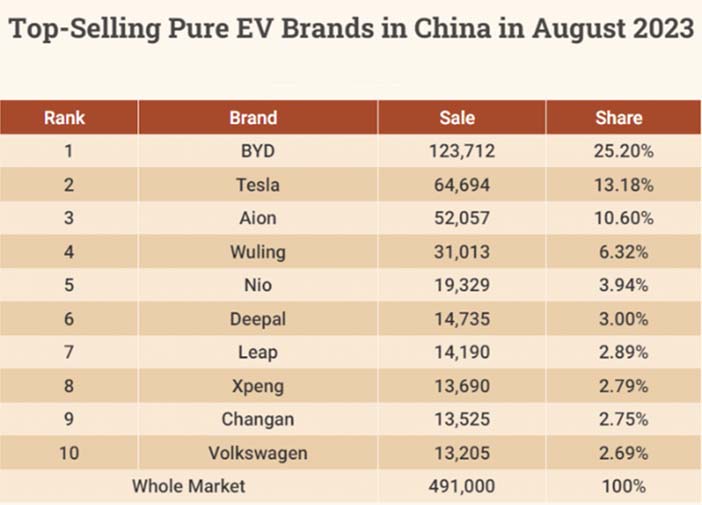
In the pure electric vehicle market, BYD maintained its dominance, selling 123.712 vehicles and securing a notable 25.20% market share. Tesla claimed the second position with 64.694 cars sold, constituting a market share of 13.18%. Aion secured the third spot with 52.057 vehicles sold, capturing a market share of 10.60%. Wuling and Nio completed the top-5 list as the best-selling pure electric brands.
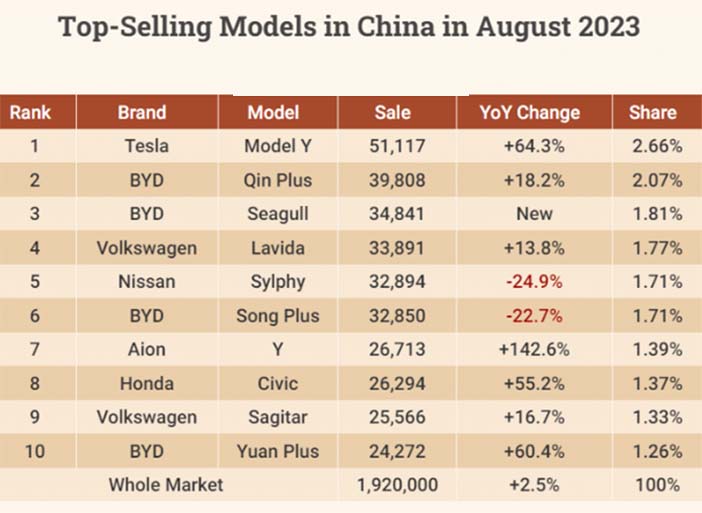
In terms of individual models, the top-3 vehicles in the Chinese market for August were: 1) Tesla Model Y: With an impressive sales figure of 51.117 cars. 2) BYD Qin Plus: This model came in second, with 39.808 units sold. 3) BYD Seagull: The BYD Seagull claimed the third position, with 34.841 vehicles sold. +++
+++ The Hyundai Motor Group, having already spent billions of dollars to respond to the US Inflation Reduction Act, is tackling another protectionist policy looming large in Europe, a crucial market for the carmaker’s extensive EV strategy. The government of FRANCE recently announced its new EV subsidy policy, which is based on measuring the carbon footprint throughout the whole process of car manufacturing from production to shipping. Carmakers importing EVs to France from their faraway home countries like Hyundai are highly likely to be hit hard by the new rules that take effect in June next year. Korea’s related government agencies immediately expressed grave concerns, citing a possible violation of the Korea-EU free trade agreement that bans discriminatory treatment. But industry watchers here say there are not many options left for Hyundai when France seems determined to stop subsidizing vehicles made outside Europe. 2 trade lobby groups, the Korea International Trade Association and Korea Business Association Europe, submitted a complaint to the French government on August 25, calling the new French EV subsidy plan a protectionist strategy aimed at taking on the US Inflation Reduction Act. “The French government’s sea freight carbon footprint was set 10 times stricter than the globally recognized requirements. It gives disadvantages to cars imported from faraway countries like South Korea and disqualifies them from applying for EV tax credits”, the KITA said in the complaint. The group stressed that more internationally accepted standards should be used to calculate the shipment data of carmakers. The European Commission is scheduled to make a decision this month on whether the French government’s measures seem valid. But since they are aimed at non-EU countries, the commission is not likely to put brakes on the matter, the KITA said. The French version of the IRA, unveiled on July 28, tracks carbon dioxide emissions during the processes of steel and aluminum manufacturing, car assembly and raw material transportation as well as battery production. If an EV fails to earn the minimum of 60 environment points, vehicle buyers are not eligible for the existing €5.000 EV subsidy. A Hyundai official declined to comment on the matter due to the sensitivity of the issue. “The company is in talks with government agencies, including the Ministry of Trade, Industry and Energy, to come up with countermeasures by June next year”. EV subsidies are essential for the carmaker to maintain its price competitiveness. Any cut in subsidies is directly linked to its sales. Under its ambitious goal to expand EV production in Europe to take up 54 percent of the market there by 2030, the world’s third-largest carmaker has been ramping up business there. After surpassing 100.000 units in sales in 2021, its sales in Europe hit 143.460 units last year. In France alone, Hyundai was ranked fifth in 2022, selling a total of 16.570 EVs, of which almost 70 percent (or 10.048 vehicles) were produced in Korea to be exported to France to enjoy the EV tax incentive. Its bestselling EVs from the January to June period of this year include Hyundai’s Kona Electric and smaller affiliate Kia’s Niro EV and EV6. Experts say the auto giant might stand alone in the prolonged negotiations with the French government, since other US and European carmakers are expected to see little impact from the new subsidy rules due to their transportation routes being shorter than those of their Asian rivals. “Hyundai’s best bet would be asking for leniency in the CO2 requirement in shipment”, said Choi Jae-won, a chemistry professor at Gyeongsang National University. “It could argue that it’s a double standard to apply the latest EV subsidy restriction because it has been selling electric cars at reasonable prices in Europe by adding little in transportation fees to the price tags”. Choi added that reducing the carbon emissions in the production of steel and aluminum (key car parts materials) will be challenging because they are mostly imported from resource-rich China. “Hyundai should join hands with its battery partners that are building production facilities in Europe and ask their support in reducing CO2 emissions in the manufacturing process”, he said. Currently, LG Energy Solution and Samsung SDI operate three battery cell production plants in Poland and Hungary. Lee Ho-geun, a car engineering professor at Daeduk University, added that the Hyundai Motor Group might have to expedite setting up EV production lines within its European plants. The company has committed to transforming its plant in the Czech Republic as the strategic base for electric cars last year, while considering setting up EV lines within Kia’s Slovakian plant. “Another costly option would be building an electric car manufacturing plant in Europe, renewing its commitment to creating more jobs in France. They can ask for a longer grace period until the plant is completed”, Lee added. +++
+++ The fate of struggling smaller carmakers Renault Korea and GENERAL MOTORS Korea is diverging ever more markedly in the South Korean market. GM Korea managed to bounce back last month, climbing to the No. 3 spot in monthly sales for the first time in 25 months, while Renault’s performance continues to weaken as no substantial new orders come in from headquarters. This suggests that even 1 popular new model can make or break for a carmaker in the Korean market. Renault Korea sold 13.795 cars in the first seven months of the year, down 54 percent from a year ago. But GM Korea sold 23.127, which is up around 7 percent. In July, GM Korea managed to reach the No. 3 spot in sales behind Hyundai and Kia. The reason was GM’s new crossover Trax, which hit showrooms in March, and accounted for about 57 percent of sales, while Renault Korea has no new models coming out this year. At a Renault Korea press conference in Seoul, CEO Stéphane Deblaise unveiled a new sales strategy, which revolves around boosting the appeal of existing models and slashing prices. It is not until the second half of next year that Renault will unveil a new midsize hybrid SUV. In the meantime it will make its money from shipping a facelifted XM3 (known as the Renault Arkana overseas) to Europe starting this month. +++
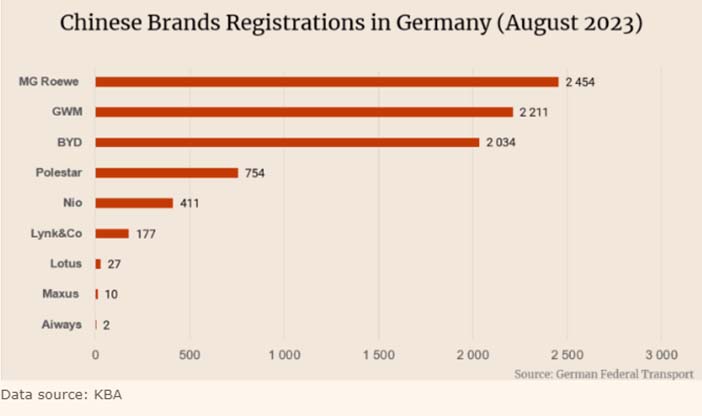
+++ On September 4, the Federal Motor Authority in GERMANY published a Vehicle registration report for August. 273.417 cars were registered in the most populated European country, which is +37.3% compared with last year. All-electric vehicles (BEVs) sales exploded as 86.649 cars were registered, up 170% from July. Plugin hybrids were much less popular and registered 14.552 units, 41% down from the previous month. The most popular among China’s brands in August was SAIC-owned MG, which registered 2.454 cars in Germany, up 9.6% compared with the previous month. The MG 4 received great reviews on the German market and competes directly with the Volkswagen ID.3. Recently, MG launched the performance version Xpower with 435 horsepower. The second most popular Chinese brand was Great Wall Motor (GWM). They grew 10 times (+900%) and registered 2.211 units in August, after having sold only 221 EVs in July. The Ora Funky Cat (Good Cat in China) is the main motor behind the sales. The third spot goes to BYD, which registered 2.034 EVs, up 403% month-on-month. We can’t even compare it with the sales in August of last year, as BYD wasn’t selling in Germany yet. This is a radical step up from Shenzhen-based automaker as their sales were relatively flat in the first half of the year: between 7 to 63 units monthly. From January to August, BYD sold 2.666 electric vehicles. BYD lineup in Germany consists of the Atto 3, Dolphin, Tang and Han. The company recently launched the sedan Seal and unveiled the Seal U, a Europe-dedicated SUV, basically a rebadged Song Plus. Geely Group’s Polestar got the 4th spot, registering 754 cars, down 28%, being one of only two Chinese brands that decreased in August. The other one is also from Geely’s stable: Lynk&Co registered 177 units, down 14%. Nio registered 411 EVs, up 834% from the previous month. In Germany, Nio currently offers the EL7 SUV, ET5 sedan and ET7 premium sedan, and the company recently introduced the ET5 Touring station wagon (shooting brake), later renamed ET5T, and its bestseller Nio EL6 (ES6 in China). In the January to August period, Nio registered 805 electric cars in Germany. +++
+++ HONDA has said that it will adopt Tesla ’s charging standards for its electric vehicle models to be sold from 2025 in North America, joining other rivals in using the global EV leader’s charging port system. Honda will employ Tesla’s North American Charging Standard system for EV models to be sold even before 2025 through the use of an adaptor, the company said. The Japanese carmaker joins Ford, General Motors and other automakers in enabling their vehicles to use the Tesla quick charging network. Among Japanese carmakers, Nissan said in July that it would adopt a NACS port in the North American market starting in 2025. Japanese auto and power companies previously established a group called CHAdeMO to promote the country’s own EV recharging system. +++
+++ Hyundai has come in at the top of the electric vehicle (EV) market in INDONESIA thanks to the growing popularity of its Ioniq 5, the carmaker said. The company said it sold 3.913 EVs in Indonesia from January to July, taking a 56.5 percent market share. The figure is more than double the 28.1 percent share of Chinese EV maker Wuling, which sold 1.944 EVs during the same period. Wuling was the local market leader last year. Indonesia is the world’s 4th most populous country with a population of 277 million and is considered to have great market potential. The country is also expected to serve as a production base for the Southeast Asian market. Under Hyundai’s strategy, the Ioniq 5 became the first EV model to be produced locally by an automaker in Indonesia. Hyundai plans to further accelerate the transition to electrification in Indonesia, which has abundant resources such as nickel, a key material for EV batteries. “In particular, once the joint battery cell plant, which is being built by Hyundai Motor Group and LG Energy Solution in Indonesia begins manufacturing next year, Hyundai will be able to further target the local EV market based on a stable supply chain”. a company spokesman said. Not only is Hyundai leading the Indonesian EV market, but it is also changing the landscape of the local automotive market, which has long been dominated by Japanese automakers. Hyundai has consistently improved its share in the country, from 13th in 2021 to 6th this year through July. During this period, sales increased more than 10-fold from 3.005 in 2021 to 31.965 in 2022, when local production began. This year, the company sold 20.065 vehicles in the first 6 months. Still, there is a wide gap between market leader Toyota with 32.5 percent and Hyundai with 3.4 percent, the company said it is steadily improving its share in Indonesia where Japanese automakers have been doing business for more than 50 years. Hyundai Motor added that it signed a memorandum of understanding with Lippo Malls Indonesia, the largest retailer in the country, on Friday to expand its EV charging stations. Through the collaboration, the 2 sides plan to install EV charging stations at 52 malls operated by Lippo Malls Indonesia. Hyundai said it aims to become a top EV brand in the ASEAN region by gaining a foothold in Indonesia, which has the 4th largest population and the most nickel reserves in the world. Under an ASEAN free trade agreement, vehicles produced at the Indonesian plant can be exported to ASEAN countries without tariffs if they are assembled with 40 percent or more local parts. +++
+++ The first car to feature BYD’s LFP Blade battery will be the new MERCEDES-BENZ CLA based on the 800 Volt MMA platform. Whether Mercedes-Benz will use BYD’s Blade battery only for China’s production or even for the international version remains unclear. On September 4, the Chinese newspaper CBEA reported Mercedes-Benz will start production of electric vehicles with BYD batteries in 2025, citing an anonymous Benz official. CBEA is an official magazine of China Automotive Battery Research Institute (CABRI), a government-funded organization whose shareholders include SAIC, GAC, Dongfeng, Changan, or CATL. CBRI focuses on battery R&D, testing, and certification. The German automaker has rich experience cooperating with BYD. In 2010, Mercedec-Benz (then Daimler) established a 50:50 joint venture with BYD called Denza. However, it was never really successful, so Mercedes exited the JV in December 2021, keeping just a 10% stake. Since BYD took over, things started to move quickly, and in one and half years, Denza started deliveries of 3 new EVs (D9 MPV and two SUVs, N7 and N8), reaching 11.146 monthly deliveries in July. Like most premium automakers, Mercedes-Benz uses Nickel Manganese Cobalt (NMC or ternary) batteries for their EVs. NMC batteries have higher energy density than lithium iron phosphate (LFP) batteries. However, aside from higher prices, there are more downs: NMC uses many precious metals, especially cobalt, whose mining techniques sparked backlash. LFP has a lower energy density. However, it is cobalt-free and also cheaper. Recently, many EV makers moved to using LFP, including Tesla, who started using LFP batteries even for their German-made Model Y. And guess who is the supplier? Yes, it is BYD. Tesla already uses BYD battery inside some of its Model 3 versions and previously obtained a 10 GWh order from Tesla. In April 2021, Elon Musk announced that in the future, two-thirds of Tesla vehicles would use LFP while one-third of NMC. In China, in the first half of the year, LFP installed capacity was more than twice as big then NMC: Ternary battery installed capacity was 48.0 GWh, accounting for 31.5% of the total installed capacity while LFP battery installed capacity was 103.9 GWh, accounting for 68.3% of the total installed capacity. But Tesla is not the only one. On April 16, Toyota launched its second electric car, the BZ3 ‘electric Corrola,’ in China with BYD’s LFP battery, motor and many other BYD techs inside. And yes, the BZ3 is their second EV, so behind Japanese automakers is. Last month, it was revealed that the China-made Kia EV5 will have BYD’s LFP battery inside. The supplier will be FinDreams, Xiangyang branch, wholly owned by BYD’s subsidiary. Moreover, some Ford and Lincoln hybrids (Lincoln Nautilus and Lincoln Z) will also have BYD batteries in China. The ICE version of CLA is positioned as an entry-level Mercedes focused on young buyers. The EV version of CLA is considered a direct competitor of Model 3, Tesla’s most affordable EV. Thus, it makes sense that Mercedes would ditch the more premium NMC batteries in favor of LFP. Also, it is evident that BYD goes hard after CATL customers, who remain the market leader. The first reports about Mercedes-Benz cooperating with BYD on batteries appeared in 2020. At that time, it was reported that MB would start producing EVs with BYD inside in 2024, and MB allegedly visited the FinDreams factory. Mercedes-Benz is 20% Chinese-owned, as the Geely Group owns 10% of the company and Beijing Auto (BAIC) owns another 10%, being the top shareholders. +++
+++ On September 7, NISSAN China released its sales performance data for August. It’s sales for the month reached 64.905 units, reflecting a substantial year-on-year decline of 34.8%. To put this into perspective, in August 2022, Nissan’s sales in China were recorded at 99.570 units. A year earlier, in August 2021, the numbers stood even higher at 113.166 units, marking a consecutive 2-year decline. In August, Dongfeng Nissan, which encompasses the Nissan, Venucia and Infiniti brands, sold 61.967 units. The light commercial vehicle segment under Zhengzhou Nissan contributed an additional 2.938 units. From January to August, Nissan’s sales volume in China amounted to 482.921 units. This figure shows a 35.2% year-on-year decrease compared to the same duration in 2022 when sales reached 745.793 units. Going further back to 2021, Nissan’s Chinese sales during the same period stood at 915.299 units, indicating a significant downward trajectory for 2 successive years. Mr. Shohei Yamazaki, senior vice president of Nissan, chairman of the Nissan China Management Committee and president of Dongfeng Motor, addressed the challenges Nissan faces in the ever-evolving Chinese market. He emphasized the need to ensure sustainable business development and hasten the introduction of new products. “With the launch of the Ariya and Venucia DD-i super hybrid models in July this year and the launch of the all-new third-generation Qashqai in August, Nissan’s presence in China has been further enriched”, Yamazaki stated. The Qashqai, over the past 15 years, has garnered numerous accolades and has witnessed cumulative sales exceeding 1.7 million units in the Chinese market. One of the significant contributors to Nissan’s recent challenges has been the rise of domestically produced electric vehicle (EV) models in China. Nissan’s transition to EVs has been relatively sluggish. Presently, Nissan China offers only one EV, the Ariya, which achieved cumulative sales of 1.469 units from January to July this year. In stark contrast, pure electric vehicles constitute approximately 25% of new car sales in the Chinese market. Yet, EVs account for a mere 0.3% of Nissan’s recent car sales in China, signifying a considerable gap. Nissan’s early success in China was anchored in its competitive pricing and fuel efficiency. However, the landscape has evolved, with EV prices consistently decreasing in the Chinese market, eroding Nissan’s economic advantage. Nissan’s experience in China isn’t unique. Other Japanese automakers like Honda have also faced challenges. Honda, for instance, reported sales of 610.000 vehicles in China from January to July 2023. This figure marks a nearly 25% year-on-year decline compared to the same period in 2022, when sales amounted to 800.000 units. The impact of the evolving Chinese EV market on traditional automakers is becoming increasingly evident, necessitating swift adaptation and innovation to regain a competitive edge. +++
+++ RENAULT KOREA MOTORS has reorganized its sales and marketing team and appointed new executives in an effort to achieve a rebound in the domestic market, the company said. The move is aimed to bring fresh industrial expertise to the organization through a total revamp of its commercial strategy to better respond to market demands. “We recognize the challenges we have faced in recent times, and I am excited to have a new sales and marketing leadership team to lead our commercial goals”, Renault Korea CEO Stephane Deblaise said. Emmanuel Al-Nawakil, the newly appointed chief of Renault Korea’s sales and marketing division, brings a wealth of international experience and sales expertise to the role, having successfully led Alpine’s growth as vice president for sales and operations. With an impressive track record of driving sales momentum for Volkswagen Group and PSA, he is well-prepared to navigate the dynamic landscape of the Korean market and to steer the business as a thriving automotive technology company as a member of its executive committee. Along with the appointment of the new sales and marketing division chief, Renault Korea invites marketing professionals to take proactive steps toward revitalizing its market presence and fortifying its position in the domestic market. Lim Dong-kun, the newly appointed product strategy operation chief, is a veteran of product marketing from domestic carmakers and the high-tech industry. New Brand Strategy Operation chief Ha Eun-young is a brand marketing expert with abundant experience in brand building in the lifestyle and financial industry. She will rejuvenate the Renault Korea brand strategy with her global and domestic expertise. Lee Won-seon, who is tapped as the new marketing communications operations chief, has a track record in the auto industry and other high-paced consumer goods markets and will roll out online and offline touchpoints with customers in a vibrant manner. Park Hae-jung, the new performance and e-commerce operation chief, was recruited from the group’s Mobilize Financial Services, formerly Renault Financial Services Korea. She will lead a commercial drive in marketing with her strengths in finance, insurance and entrepreneurial abilities. “Now we built up a new stronger marketing team that leads customer-centric campaigns and creative brand and product strategies creating synergy with the senior director of sales and network and the new chief marketing officer on the process to the post”, Deblaise said. “I am confident that the company will regain our competitive edge and accelerate the journey toward a thriving automotive tech company”. +++
+++ Hyundai saw its sales plunge to an all-time low in RUSSIA last month, according to the Association of European Business (AEB). The association said Hyundai sold only 6 vehicles in August, which accounts for 0.01 percent of the Russian market share, down 99.9 percent from 2.982 cars a year earlier. “I’m not quite sure if the company managed to sell even 6”, an automobile industry official said. “It is virtually kicking the dirt there”. The carmaker sold 1,605 cars in Russia during the first 8 months this year, a 96.5 percent-drop from the same period last year. The largely botched business this year allowed the company to just 0.4 percent of the Russian market. Hyundai’s lackluster performance is as dramatic as its former prominence in the market before the Russian Invasion of Ukraine in February last year. With its factory in St. Petersburg (the only one in Russia) pipelining 220.000 vehicles each year, including popular models like Solaris and Creta, its market share in the country used to be top over all. But the invasion upended business for Hyundai’s Russian office. While rival foreign brands there vacated the country, Hyundai remained and kept producing cars until July 2022. At the end of that year, the company had sold 45.000 cars. Since 2012, the company sold over 200.000 cars annually. Hyundai’s Russian factory finally gave up and ceased manufacturing operations this year. “Sales have discontinued for over a year since the Russian invasion because the St. Petersburg factory stopped operating”, the official said. “And there was almost no one the company could sell its cars to”. Observers said the plant saw its business losses snowball to almost 500 billion won ($374 million) since the invasion. In its shoes, Russian brand Lada and Chinese brands GWM claimed greater market shares. +++
+++ Imported vehicle sales in SOUTH KOREA fell 2.1 percent last month from a year earlier amid a lack of supplies in some brands, an industry association said. The number of newly registered imported cars came to 23.350 units in August, down from 23.850 units a year ago, the Korea Automobile Importers Distributors Association (KAIDA) said in a statement. The 3 bestselling models last month were BMW’s 520, Mercedes-Benz’s E 250 and Mercedes-Benz’s GLC 300 4Matic. In August, 3 German brands (Volkswagen Group Korea, BMW Group Korea and Mercedes-Benz Korea) sold a combined 16.971 units, down 1.7 percent from 17.273 the previous year. German cars accounted for 73 percent of imported cars sold in Asia’s 4th biggest economy last month, up from the previous year’s 71 percent, KAIDA said. 3 Japanese brands (Honda, Toyota and its premium brand Lexus) sold a total of 1.929 units last month, jumping 33 percent from 1.451 a year earlier. Imported brands accounted for 18.31 percent of the Korean passenger vehicle market in July, down from 21.86 percent a year ago. Their market share for August has yet to be released, KAIDA said. +++
+++ The TESLA Shanghai Giga Factory (GF3) rolled off its 2 millionth electric vehicle on Wednesday. The American carmaker’s factory in China needed 33 months to break its first million units, while the second million was reached in 13 months. The GF3 produced 2 million units in less than 4 years. The GF3 broke ground in January 2019. Under the government’s support branded with the slogan “Tesla Speed”, Tesla started production the same year when the first batch of Model 3 units rolled off production line on December 30th. The millionth unit rolled off production line in August 2022. Meanwhile, the factory became the export hub for the company as over a half of 889.000 Tesla models made in the first half of the year came from the plant based in Shanghai’s Lingang Free Trade Zone (FTZ). The EVs made in GF3 are exported to Asia Pacific, Europe and North America. Currently, the plant’s supply chain is 95% localized, while the local stuff makes 99.99% of the employees. The factory saw a series of upgrades that started in July last year as a part of the preparations for the renewed Model 3 that was presented on September 1st. The new Model 3 is expected to further boost Tesla’s sales in China. It was recently reported that the factory can produce 1 unit in 40 seconds. The GF3 is Tesla’s first overseas factory. It is placed on 860.000 square meter surface and it includes 4 areas: production, testing, component production and connected buildings. It produces Model 3 and Model Y. In July, the factory produced 1 millionth unit of Model Y, which started production in January 2021. +++
+++ Rachel Culin considered herself a TOYOTA loyalist, one of millions of people who appreciated the company’s reliable and fuel-efficient hybrids. But she recently bought an electric Chevrolet Bolt to replace her Toyota Prius because the Japanese automaker had been too slow when it came to selling electric vehicles. “Where are the options for those people who love Toyota?”, Culin, a resident of Mesa, Arizona, said. “It’s really sad”. Once the leading brand for environmentally conscious car owners, Toyota has failed to keep up with changing consumer preferences and a push by governments around the world to greatly reduce the burning of fossil fuels, the main cause of climate change. The company and the Japanese auto industry are facing the biggest business challenge they have confronted since becoming global giants in the 1980s. How they respond could determine whether they remain at the top of the auto industry or become afterthoughts. Toyota, the world’s largest automaker, is the nucleus of power for the country’s large auto industry. It has alliances with smaller automakers such as Subaru and Mazda and wields enormous influence over government officials and industry groups. The company is also a major employer in the United States, with nearly 30.000 workers in Kentucky, Indiana, Texas and other states. Its business decisions can have far-reaching economic and environmental implications. Toyota arguably did more to improve fuel efficiency and cut emissions than any other established automaker by pioneering hybrid cars that augment a gasoline engine with a battery and an electric motor. But having staked so much on hybrids, it has moved slowly to cars that produce no tailpipe emissions. That has opened room for Tesla and BYD, a Chinese automaker, to challenge Toyota’s dominance by offering appealing and affordable battery electric cars. Toyota has lost market share in the United States, and its sales in China have fallen. Japanese carmakers have been here before. But last time they were the insurgents. In the 1970s, with fuel prices soaring, Americans began replacing gas-guzzling cars with small, fuel-efficient Japanese models, challenging the dominance of General Motors, Ford and Chrysler. Toyota’s manufacturing methods became synonymous with manufacturing efficiency and many factories adopted what became known as the “Toyota way” or “Toyota method”. Today, Toyota is the one learning from rivals. The company is adopting techniques from Tesla. In China, it has teamed up with BYD in the hope of absorbing its electric motor and battery technology. “The stage of the battle has changed”, said Sanshiro Fukao, a senior research fellow at the Itochu Research Institute, and “the Japanese auto industry in particular has been very slow to act”. Toyota may no longer be able to take its time. During the pandemic, the global automotive market passed a milestone that caught the world’s major automakers flat-footed. In 2022, sales of electric vehicles surged nearly 70% to 7.7 million, surpassing those of hybrid-electric vehicles for the first time as demand skyrocketed in China, according to IDTechEx, a market research consultancy. Toyota remains highly profitable, earning $8.9 billion in the quarter that ended on June 30. Last year, it sold 10.5 million vehicles, 8 times as many as Tesla. But fewer than 1% of the cars it sold were fully electric vehicles. The absence of electric vehicles has been especially costly in China, the world’s largest car market. In July, Toyota’s sales in China were down over 15% from a year earlier. In the United States, Toyota’s sales have increased, but less than other automakers. From June to August, the company’s share of the passenger car market slipped to 13.8% from 15.1% a year earlier, according to market research firm Cox Automotive. The story is much the same for other Japanese automakers such as Honda, Mazda and Subaru. Even Nissan, which began selling the Leaf electric car in 2010, has fallen behind, failing to produce a car that could rival Tesla’s Model 3 in range, performance or design. Nissan accounted for less than 2% of the electric car market in the United States in the first half of the year. In China, it expects sales could drop by almost one-quarter in the current fiscal year. In May the International Council on Clean Transportation, a nonprofit organization, rated the 20 largest automakers on their progress toward zero emissions. 5 of the 6 companies with the lowest scores were Japanese: Toyota, Honda, Nissan, Mazda and Suzuki. Foreign automakers in China produced electric models designed to placate regulators rather than appeal to consumers, said Christopher Richter, senior research analyst at CLSA, an investment firm. “They didn’t make them as great as they could, and they were behind the learning curve”, he said. Toyota has tacitly acknowledged that it has fallen far behind Tesla and BYD. The decision in January by Toyota scion Akio Toyoda to step down as CEO was widely seen as a recognition that the company needed new leadership to navigate the transformation of the auto industry. The sense of urgency was compounded by the Shanghai auto show in April, said Tatsuya Otani, a journalist who has spent decades reporting on the Japanese auto industry. Chinese vehicles at the show featured onboard controls and entertainment options that made them look more like iPhones on wheels than traditional cars. Japanese executives were stunned to see how much progress their Chinese rivals had made, Otani said. The only all-electric Toyota sold in the United States is the BZ4X, a crossover that the company recalled last year because faulty bolts could cause the wheels to fall off; an embarrassing misstep. In China, the company also offers an electric sedan, the BZ3 (Toyota’s Lexus division sells 1 fully electric model in the United States and 2 in some European countries). On returning from Shanghai, Toyota executives ordered employees to rush out a presentation on the company’s plans for its electric vehicle production. Toyota shared the plan less than 2weeks before the company’s annual meeting, where shareholders, angered by the slow progress on battery-powered cars, proposed a resolution pushing the company to disclose its climate change lobbying. The measure did not pass, but the rare expression of dissent was an indication of how Toyota, once praised as a paragon of clean tech, had fallen out of favor. “They just are not moving quickly enough to EVs at a time when that is where the market and the planet are going”, said Brad Lander, the comptroller of New York City, which owns more than $100 million in Toyota stock through its pension funds and backed the resolution. The company has disputed that characterization, arguing that hybrid cars can help reduce carbon dioxide emissions more and faster than battery electric vehicles, which remain too expensive for many buyers. Factoring in a cleaner manufacturing process for hybrid cars and the limited availability of critical battery materials, such as lithium, hybrids are a safer short-term bet, Toyota executives have said in recent public statements. In Washington, the company has called for less stringent auto emission limits, saying in July that a proposed new standard “underestimates key challenges including the scarcity of minerals to make batteries, the fact that these minerals are not mined or refined in the U.S., the inadequate infrastructure and the high cost” of electric vehicles. “When they do math, the effect on the environment is far greater for hybrids”, said Jeffrey Liker, a professor emeritus at the University of Michigan and the author of several books on Toyota. “In addition to that, they make a whole lot more money”. Sales of all-electric vehicles are growing faster than sales of hybrids. But some analysts predict that hybrid sales will surge as would-be electric vehicle buyers worry that the public charging network is inadequate and unreliable. If that happens, Toyota’s strategy could be vindicated. Anita Rajan, general director of the Japan Automobile Manufacturers Association in the United States, said Japanese automakers were biding their time until they could make electric cars that were as reliable and affordable as the gasoline vehicles. “I don’t know if there’s a benefit in being first to market with these vehicles”, Rajan said. “I think it’s how you’re entering the market and the thoughtfulness that you show for your customers”. In Toyota’s home market, consumers have shown little appetite for battery electric cars, and the government has been reluctant to aggressively push for change in a profitable industry. That could be a problem for Japanese carmakers, which have traditionally honed their technology at home before marketing it abroad, said Kazutoshi Tominaga, a managing director at Boston Consulting Group, which has worked with Japan’s trade ministry to shape national electric vehicle policy. “If Japan, as a market, doesn’t shift to electrification, we don’t have a place to test the product”, he said. Yet BYD has opened 10 dealerships in Japan and plans to have 100 by the end of 2025. The company went so far as to release a video in August calling on Chinese automakers to “demolish the old legends”, widely interpreted as a reference to Japanese and Western automakers. On a recent Sunday, prospective buyers waited patiently to take a BYD for a spin around the Tokyo neighborhood Ikebukuro. Salespeople were quick to point out the car’s eligibility for thousands of dollars in subsidies from Japan’s trade ministry, which has allocated $90 billion to promote battery electric cars. 2 nearby Toyota showrooms were largely empty. Customers are “satisfied” with the current options, said Masaki Nagasawa, the deputy manager of a Toyota dealership in Tokyo. “For people who are wavering, subsidies are an incentive to buy”, but most customers are anxious about electric cars’ range and prefer hybrids, he said. Toyota has said it is working on new production techniques and innovative battery technology that would increase its cars’ range and reduce the time it takes to charge them. The company has said that its lineup will include 10 new all-electric vehicles by 2026 and that it will aim to sell 3.5 million of them annually by 2030. Speaking in Tokyo after the unveiling of a new luxury plug-in hybrid vehicle, Simon Humphries, who is in charge of branding and design and is a director on Toyota’s board, said the company was releasing new electric options “month by month, year by year”. But, he added, while there is an “urgency” to introduce new battery-powered cars, “there’s urgency in every segment”. Electric vehicle companies are moving fast. Tesla is on track to sell nearly 2 million electric cars this year and is building a factory in Mexico, where it is expected to make a car that sells for around $25,000. In the United States, the company’s Model 3 already sells for about as much as a comparably equipped Toyota Camry after federal and state incentives are taken into account. BYD is rapidly expanding outside China, including in Europe, Latin America and Southeast Asia. Its extensive electric lineup includes models that are cheaper than Toyota’s most affordable sedans and a mammoth luxury SUV that sells for around $150.000. Just as Apple, Google and Samsung quickly displaced Nokia and BlackBerry in the mobile phone business, some analysts say, Tesla and BYD could be so far ahead in making electric cars by 2026 that Toyota might struggle to catch up. But Japanese officials are more sanguine. People own cars longer, so the transition will not be as fast as with cellphones, said Naoki Kobayashi, a deputy director of the trade ministry’s automobile division. He acknowledges that Toyota faces a big challenge, but, he added, “unlike with smartphones, we’ve still got time”. +++
+++ So far, the Chinese car makers have not been entering the markets with cheap prices. It is true they can produce at 20% lower costs, but they will not be able to offer that cost level in Europe. They need to spend a lot of money on adapting vehicles to European regulations as well as building a sales network. The prices of the Chinese cars offered in Europe are twice as expensive compared to those in China, said VOLKSWAGEN Group CEO, Oliver Blume, commenting on Chinese brands entering the European markets. The Chinese car manufacturers are not a threat for the European companies. In the past decade, they have learned how to build cars, but we have car knowhow, level of quality and a brand heritage, so we see ourselves well positioned, continued the CEO, who sees the costs as an issue for VW’s electric portfolio. We need to work hard on reducing the costs, but we are confident that they can be reduced quickly, said the CEO. Based on Blume’s words, until the company is able to cut costs and complete a development of its electric portfolio, Volkswagen can rely on internal combustion engine vehicles (ICEV) models to finance the transition. Unlike Nio or BYD, the German car maker can rely on the money from ICEV segment to invest the money needed for the ramp-up of electric mobility, pure EV brands do not have that option, they need to look for financing, explained the CEO. The costs CEO mentioned are expected to be cut by 50% for the entry vehicles once the manufacturer’s unified cell is developed. The idea behind the battery is to have one cell design that can cover over 80% of the company’s portfolio by 2030. The battery is being developed with a Chinese battery manufacturer, Gotion. The Hefei battery maker will also participate in construction of Saltzgitter plant. In May, Gotion said the unified cell plant that will produce 10 GWh of ternary and 10 GWh of lithium-iron phosphate (LFP) unified cells will start operating this quarter. The cell is expected to be the standard part of the VW’s Scalable System’s Platform (SSP), a single platform that should, just like the cell, cover over 80% of the company’s product portfolio. The current developments about the platform are unclear. With the change of CEO in September last year, the German car maker said the project rollout planned for 2026 has been postponed to 2028 or 2029, but then in June this year said the company aims for 2026. The timeline of the SSP rollout was questioned again, when VW announced buying a share in the Chinese EV maker, Xpeng, in exchange for the electronic and electric architecture of Xpeng’s SUV, G9, which flopped. Xpeng will also help the German company to develop 2 new models by 2026. The G9’s powertrain uses China’s first 800 Volt mass-production Silicon Carbide (SiC) platform and incorporates the industry’s first full-scenario ADAS. The car also features 31 lidar sensors, dual Nvidia Drive Orin-X intelligent assisted driving chips and Gigabit Ethernet communication architecture, the G9 has up to 508 Tops of computing power. Along with the Xpeng deal, VW confirmed cooperation between Audi and SAIC Motor. Based on the reports, Audi is interested in SAIC’s premium EV brand, IM Motor, and its platform which is used by the brand’s models, L7 and LS7. The news on the cooperation followed constant delays of new EVs on the company’s Premium Platform Electric (PPE), which serves VW’s luxury segment in Audi and Porsche. The platform can accommodate batteries as long as 2023 mm and support both 400 Volt and 800 Volt electric architectures. The platform can also accommodate vehicles with wheelbases ranging between 2.690 mm and 3.100 mm. +++