
+++ The CUPRA RAVAL electric B-segment hatchback will be revealed in full on 9 April, the maker has confirmed. The model, which Cupra claims is “set to mark a turning point in the brand’s electric strategy”, will go on sale in the autumn. Cupra’s new small electric car will be the first in a wave of affordable electric models (including the Volkswagen ID.Polo and ID.Cross and Skoda Epiq) due from the Volkswagen Group in the coming months. The Raval will get a sporty shape with angular lighting and aggressive bumpers. The nose will feature triangular headlights and a large lower grille opening. Also, we can expect smooth surfacing and flush door handles. The Raval will feature a heavily sculpted tailgate at the rear, with full-width lighting structures and an illuminated badge, as we’ve become accustomed to in other new Cupra models. However, while the lights are distinctive, the aggressive lower bumper and its contrasting diffuser-like elements help hide the car’s relative height, which is quite tall considering its placement in the hatchback B-segment. +++
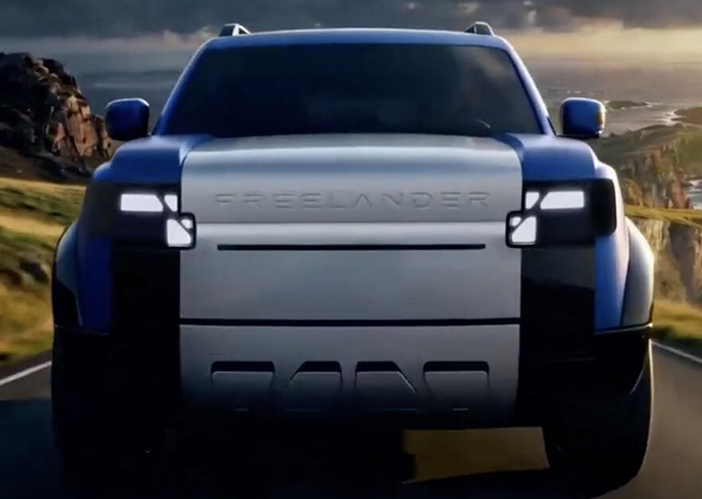
+++ The new FREELANDER brand has revealed its debut model in China as a rugged electrified 4×4, created in partnership between JLR and local giant Chery, and confirmed plans for a rapid-fire expansion into other global markets, including Europe. The first model from the new marque (a sibling to Chery’s existing Omoda, Jaecoo, iCar and eponymous Chery brands) is a mid-sized off-road family SUV based on a new 800 volt architecture which can accommodate pure-electric, range-extender and plug-in hybrid drivetrains. It will be the first in a wave of new Freelander models destined for global sale, with the brand announcing plans to introduce a new model every six months over the next 5 years. Each will be offered with the choice of pure-EV, REx or PHEV power.
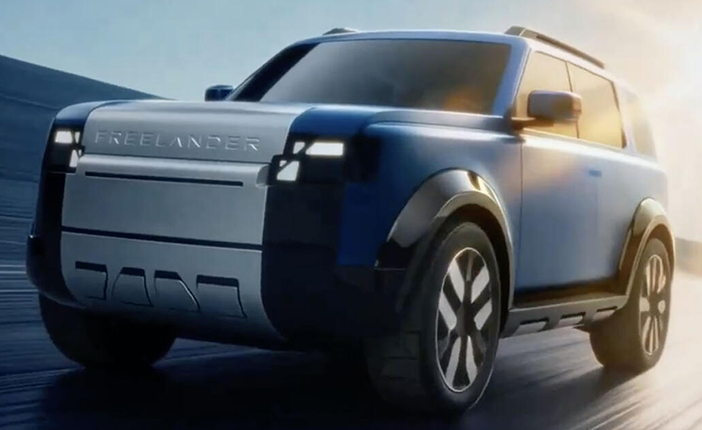
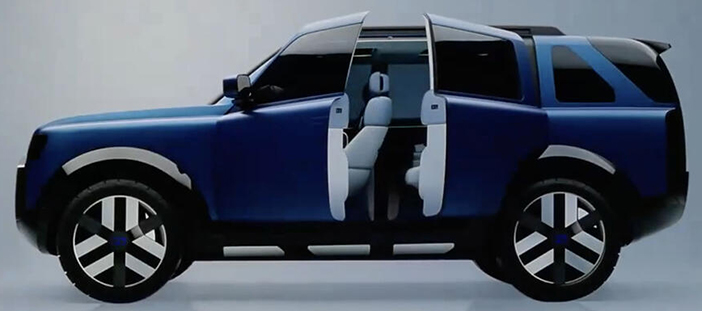
Freelander CEO Wei Lan referenced the historic commercial success of the Freelander (it was Europe’s best-selling SUV for several years) as one motive behind the name’s resurrection, but also outlined the original car’s distinctive blend of attributes as an inspiration. “The genesis of the Freelander lay in recognition of the tremendous success of urban multi-purpose SUVs across European and North American markets, inspiring the creation of an entirely new vehicle that would unite 4×4 SUV capability, urban versatility and sheer driving pleasure”. The name, he said, “embodies an undeniable force, equally at home conquering untamed wilderness and gliding with elegance through the urban landscape. Today, as we speak this name once more, what we carry forward is the premium brand heritage and refined sensibility. We aspire to bring the spirit of British exploration into encounter with the power of China’s new energy technology, igniting between them an inexhaustible and transformative energy”. The new Freelander references the design of its namesake in its distinctive diagonal C-pillar, which nods to the original short-wheelbase car’s detachable hardtop; a motif which is also echoed in the brand’s 2-triangle logo and headlight arrangement. Revealed at a dedicated event in Beijing ahead of its public debut at the city’s international motor show next week, the Freelander will replace the Land Rover Discovery Sport and Range Rover Evoque at JLR-Chery’s Chinese factory in Changsu, which earlier today built the final combustion-powered Evoque.
It has been designed and engineered initially for the local market, but the company has confirmed that variants for export to other countries are in development, as part of a strategy to disrupt the global premium SUV market. Lan confirmed: “International variants are currently in intensive development and shall, after launch in China, make their distinguished entry into the world’s foremost markets”. Confirming that Freelander prototypes have undergone extensive testing in Europe, and that the car has been engineered to be compliant with Euro NCAP rules, he emphasised that exported Freelander models will not be merely adapted versions of the China-market cars, but rather highly bespoke derivatives that are closely tailored to individual market demands. “A truly global vehicle is not engineered through adaption”, he said, “but grown from the very roots of a world-class R&D system”. He added: “From its very first day of existence, every Freelander product is conceived and calibrated for the diverse demands of markets across the world. We are not exporting a Chinese car to the world, but we are building a world car, for the world, from the very beginning”. +++
+++HYUNDAI boss Jose Munoz outlined plans to launch 36 new vehicles in North America by 2030, backed by US production expansion aimed at strengthening profitability amid ongoing tariff pressures. Highlighting North America as its “most profitable market”, Munoz said at a shareholders meeting that the company will introduce extended-range electric vehicles with driving ranges exceeding 1.000 km starting in 2027. It also plans to launch its first body-on-frame midsize pickup truck before 2030, marking its entry into one of the industry’s largest and most lucrative segments. The Hyundai Motor Group Metaplant America in Georgia, completed last year, will serve as one of the company’s major US manufacturing hubs for the new line-up. The facility currently produces the Ioniq 5 and Ioniq 9, with hybrid production set to begin this year, alongside prototype production of Ioniq 5 models equipped with Waymo’s autonomous driving technology.
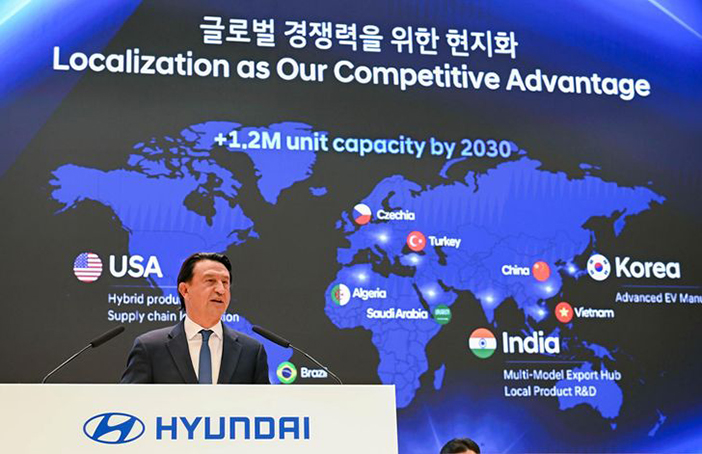
Signaling a shift from Korea-based exports toward stronger US localization, Munoz emphasized that Hyundai has committed $26 billion between 2025 and 2028, exceeding its cumulative investment in the US since entering the market in 1986. The investment includes $12 billion to expand annual US production capacity to 1.2 million vehicles, $7 billion to strengthen the parts and logistics supply chain (including a new steel mill in Louisiana) and another $7 billion to advance autonomous driving, robotics, artificial intelligence and other future technologies through partnerships with US firms. Despite a 15 percent US tariff on automobiles, Hyundai’s North American sales rose 8 percent year-over-year to 1.2 million units last year, marking a fifth consecutive year of record retail sales and a third straight year of record total sales. Key models (including the Tucson, Santa Fe, and Ioniq) each set annual sales records. Munoz emphasized that the company’s multipowertrain sales strategy (spanning hybrids, fully electric vehicles and advanced internal combustion engine cars) has been well-received in the region, with EVs accounting for 26 percent of the retail mix. Hyundai’s premium Genesis brand also broke a record, selling 82.000 units in the US. Hyundai plans to extend its aggressive, region-specific expansion strategy across emerging markets as well. In China, it will roll out 20 new models over five years, targeting annual sales of 500.000 units. In Europe, the company will launch 5 models within the next 18 months, including the Ioniq 3, with all models to offer electrified versions by 2027. For the Indian market, Hyundai will introduce the country’s first locally developed electric SUV and launch the Genesis brand by 2027, as part of 26 new models planned over the decade, supported by a $5 billion investment through 2030. As part of its push to transform into a technology-driven company, Munoz said Hyundai’s strategic partnerships with Nvidia, Google DeepMind and Waymo, along with investments in its subsidiaries (42dot and Boston Dynamics) are strengthening its capabilities in physical AI and autonomous driving. He also reaffirmed the automaker’s plan to deploy Boston Dynamics’ Atlas humanoid robots in manufacturing, with the goal of scaling annual production to 30,000 units by 2028. +++
+++ If you’ve forgotten about the Gemera, I wouldn’t fault you. The Swedish 4-passenger hypercar from KOENIGSEGG was first unveiled back in 2020. It’s finally heading to production now. While their vehicles move incredibly fast, production at Koenigsegg moves a bit more slowly. Still, the company recently expanded its production line, allowing the Gemera to inch closer to customer delivery dates. Koenigsegg, posting to its Facebook page, stated that the Gemera line is up and running alongside the assembly of the CC850. Both are soon to be joined by the Sadair Spear. Gemera buyers are sure to be excited by this news, since they’ve been waiting at least 6 years to get to this point. While the wait is long, the car’s eventual driving dynamics are sure to be amazing. This is, after all, a car Koenigsegg calls a Mega-GT. Power comes from a twin-turbocharged 5.0-liter V8 and a trio of electric motors. The combined output is rated at a breathtaking 2.300 horsepower and 2.650 Nm. Each of the electric motors at the back produces 500 hp. Up front, the Dark Matter motor can deliver 800 hp on its own.
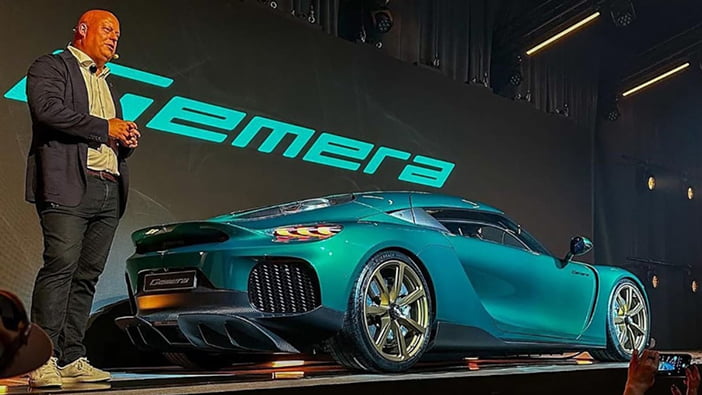
It’s not just a cool name, but an amazing bit of engineering. Koenigsegg uses carbon fiber to reduce the weight of various components of the Dark Matter motor. The total weight is just 40 kilos. All of the power is sent to all 4 wheels courtesy of a 9-speed gearbox dubbed the Light Speed Tourbillon Transmission. The Gemera is Koenigsegg’s first 4-passenger vehicle. And if you bring your family along for a drive, they’ll likely be screaming at you to slow down once they catch their breath. The Gemera should go from 0 to 100 kph in under 2 seconds. The top speed will be well above the 320 kph mark. And the 11-speaker sound system should help drown out the screams of those strapped into the other 3 seats. +++
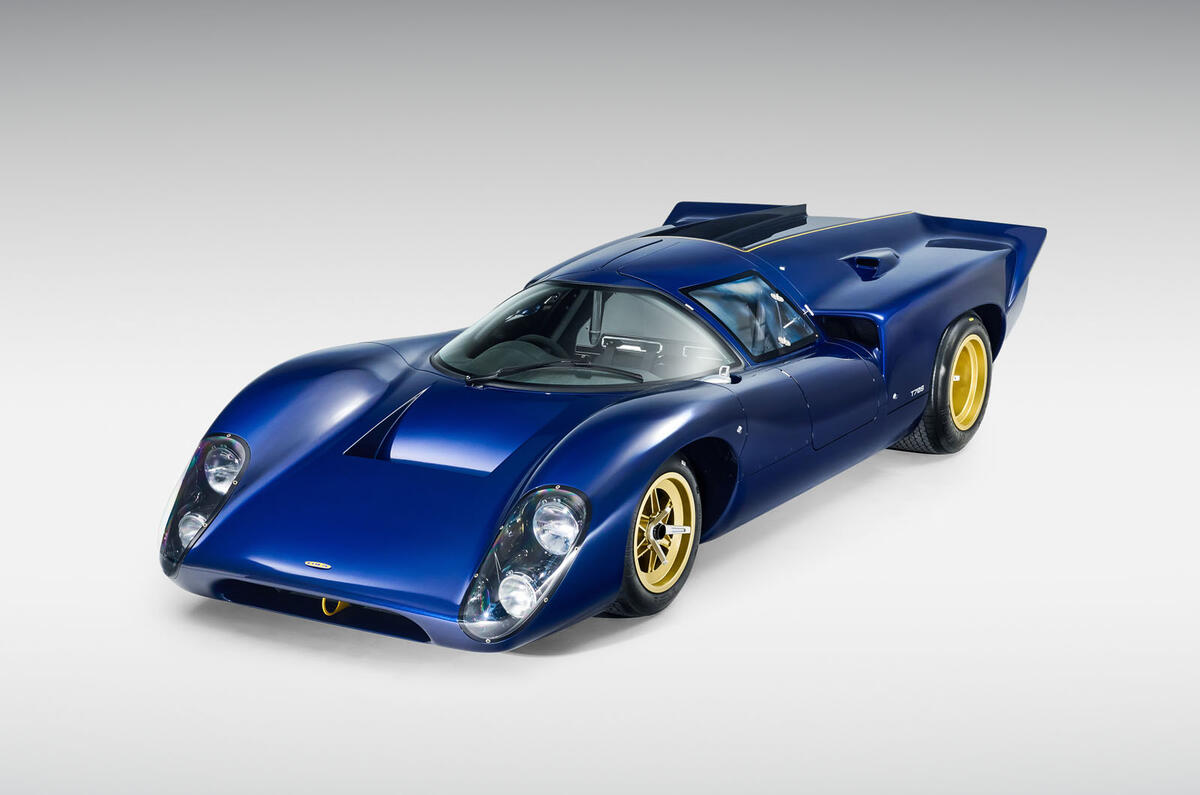
++ The reborn British race car manufacturer LOLA has revived its storied T70 as a 500 hp road-going supercar. A reboot of the Mk3B T70, which scored a one-two in the 1969 Daytona 24 Hours, the T70S GT is powered by a naturally aspirated 6.2-litre Chevrolet V8, mated to a 6-speed Hewland manual gearbox. Yet “I didn’t want this just to be a continuation car; I feel like that’s overdone”, Lola chairman Till Bechtolsheimer told, fresh from racing a Ford Mustang GT3 in the Sebring 12 Hours. To that end, the T70S GT’s gearbox can be switched into a sequential mode for track use, in a similar fashion to the combined automatic/manual ’box used in the Koenigsegg CC850. Underpinning the swooping bodywork is an aluminium chassis, helping the T70S GT achieve a dry weight of just 890 kg. That gives the T70S GT a power-to-weight ratio of 570 hp per tonne, on a par with mainstream supercars like the Lamborghini Revuelto. This allows it to hit 100 kph from rest in 2.9 seconds. Suspension comes in the form of double wishbones and height-adjustable coilovers at both the front and rear ends. Meanwhile, the track-only T70S uses the 5.0-litre Chevrolet V8 and 5-speed Hewland gearbox that the original car used in period. It’s more powerful than the 6.2-litre road car, with 530 hp and lighter too, at 860kg (dry), boosting its power-to-weight ratio to 625 hp per tonne. That cuts its 0-100 kph time to 2.5 seconds and gives a top speed of 325 kph. “The track car is identical to the original”, said Bechtolsheimer. “We’ve got FIA HTP (Historic Technical Passport) papers on the prototype; every one of those race versions of the car will get delivered with FIA papers and will be eligible for historic racing”. Each car’s bodywork, meanwhile, is made from a new composite made from a combination of fibres from plant waste and basalt rock, bonded with resin from sugarcane, rather than the petrolchemical-based glue that’s typically used. Lola claims this new material, which it developed itself, is stronger than fibreglass and yields better refinement than carbonfibre. “It’s not going to impact the performance of the car but it’s going to massively impact the sustainability of the of the build”, said Bechtolsheimer. “What we think we’ve done here is create the first 100% natural composite. There are no petrochemical elements to it whatsoever, and we don’t believe that has ever been done, certainly not in automotive”. The 2 variants of the T70S share the same basic cockpit architecture, with the driving seat slung low and the gearlever nestled next to the driver’s right leg. But where the racer is faithful to its 1960s forebear, the road car makes small concessions to real-world usability: it still goes without screens, favouring analogue dials and controls, but gains chunkier switchgear, air conditioning and cubbies for storing headsets. There’s also a small boot for “modest luggage”. Just 16 examples of the T70S will be built at Lola’s Silverstone base. The company has yet to announce pricing, but Bechtolsheimer said it would land somewhere between “what the very best original T70 would be and your base level”. The launch of the T70S marks a new era for Lola. The original company went bust in 2012 but was revived a decade later by Bechtolsheimer, and it has since entered Formula E in partnership with Yamaha. “One of the things that I love about Lola is that it never did a road car, and so I still don’t really see this as a road car either”, he said. “It’s some small upgrades to to a race car that make it just about roadable and using small production allowances like the IVA test in the UK to get them roadable”. +++
+++ You might have heard of ‘ RANGE EXTENDER ’ hybrids and wondered why they’re still not prevalent in Europe. In theory, they propose a near-compromise-free combination of EV-like electric range with a small ICE engine that can keep the batteries topped up but, as MG’s boss of R&D has just explained, there’s a problem. Qiu Jie told: “It’s very difficult to make range extenders Euro 7 compliant. A range extender won’t pass Euro 7 emissions regulations, but a PHEV will”. If this initially seems confusing, it has to do with how range-extenders work, and a quirk of the Euro 7 testing procedure that uncovers a gap in this type of powertrain’s eco-credientials. Firstly, to be considered a ‘range extender’ hybrid, the car must work largely as an EV, with a correspondingly large battery pack. In certain Chinese-market models, this often sits between 40 kWh and 80 kWh. When the battery is depleted, it calls on a small petrol engine to generate power for the batteries in order to drive the wheels. There is no physical connection between wheels and petrol motor, but it’s at this operating phase that the issue arises. Qui Jie explained that with a low state of charge in the battery, a petrol engine has to work very hard to ensure that it’s producing more power than the electric motors are calling for. Although some owners won’t often find themselves in this situation, the assessment for Euro 7 regulations includes emissions testing for hybrids with a low state of charge, and it’s in this operating phase that it could be very hard to satisfy the Euro 7 rules. Many range-extenders have limited emission-control devices due to the cost of implementing a large battery pack, electric motors and a combustion engine plus all its ancillaries. Plug-in hybrids are different, because their combustion engines generally play a more active role in the car’s general running cycle, and therefore come with more emissions-related tech. Plus, with the engine being directly connected to the car’s wheels, PHEVs are also generally more efficient in their pure petrol modes, in effect acting as an overweight full-hybrid car. +++
+++ Right now, TOYOTA seems like a company with its hands in some very different pots. All-electric family cars like the Urban Cruiser and BZ4X Touring have arrived alongside a new RAV4, but bringing some excitement to the fore is the Toyota Gazoo Racing brand, not just with the incredible GR GT supercar, but also plans for a mid-engined road car, too. We got our first glimpse of a mid-engined Toyota when the Toyota Yaris M Concept was revealed at the Tokyo Auto Salon in January 2025 with a new 2.0-litre high-performance engine. Widely interpreted as a test-bed for a new MR2, with its mid-engined layout, Toyota has since taken the car testing in the Japanese race series Super Taikyu. Although the testing is being done on the track, the turbocharged 4-cylinder engine, which is expected to produce around 450 hp and up to 600 hp in certain applications, seems likely to power a new Toyota sports car. Speaking about the Yaris M Concept, Gazoo Racing marketing manager Mikio Hayashi said the company is “making this car better every day”, further adding that; “all the knowledge and feedback through training this car in motorsport, it’s going to be translated into something else in a road car or mass production car in the future, possibly. We are continuing this path”. As for whether the sports car could revive the MR2 name, Hayashi simply smiled and said: “‘thank you for your suggestion”. GR project general manager Hiroyuki Yamada told last year that the required 4-wheel-drive layout adds another level of complication when developing the mid-engined sports car. Those familiar with the concept have claimed that it’s even more agile to drive than the already highly regarded GR Yaris hot hatch. In 2025, Tomoya Takahashi, president of Toyota Gazoo Racing said: “We’re a bunch of oddballs who love a challenge”, it appears the team are indeed grasping the opportunity. The Yaris M Concept came first in its class in Super Taikyu’s most recent endurance race in Motegi, Japan, beating Subaru’s High Performance X Version II concept. Yamada said Toyota has looked at the Porsche Cayman as an example of a sports car with a mid-engined layout. “Putting the engine in the middle has really transformed it, it’s a completely different story”, added Bart Eelen, head of TGR and Motorsports. +++