
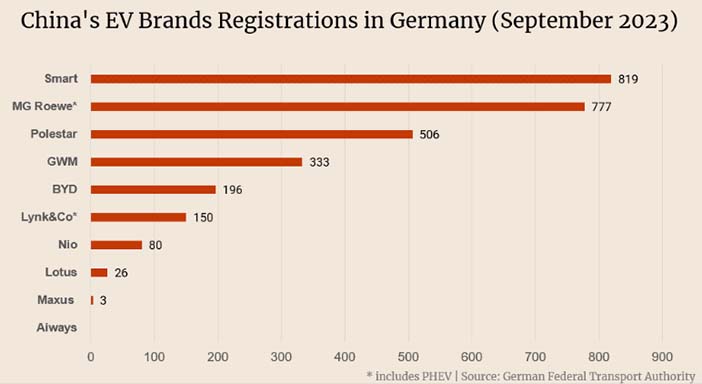
+++ 224.502 passenger cars were registered in GERMANY in September, which is almost the same as in the same month last year. BEVs had a 14% market share, translating to 31.714 registered units. That is 28.6% less than a year ago. Plugin hybrids (PHEVs) registered 15.383 units, accounting for 7% of the market. That is 45% down from last year, revealed the report published by the German Federal Motor Authority (KBA). For more context, the market leader, Tesla, registered 4.216 EVs, down 69% from last year. Among the highest growing brands excelled Geely’s Smart with 137% growth year-on-year and 819 registered cars. Smart sells only 2 vehicles in Germany: the #1 and the #3. Both cars are all-electric and the #1 is made in a Geely plant in Xi’an while the #3 is built in Changxing. The pronunciation is “hashtag one” and “hashtag three”. Still, it sold 72% less than the previous month when Smart registered 2.947 EVs in Germany. MG occupies the second spot with 777 registered cars, 55% down from last year and 68% down from the previous month. The third sport goes to Polestar, which registered 506 cars, 32% down from last month and 24% down from the previous year. Nio registered only 80 cars, down 80% from the previous month. A year-on-year comparison is not available as Nio officially entered the German market in October last year and started deliveries in November. In Germany, Nio offers 2 options: to buy the car in a standard way or subscription. The KBAs track new car plate registrations, so both options were included. Companies often favor the subscription as a leasing alternative. A Nio Germany representative said the ratio of buyout vs. subscription varies from car to car: The ET7 has more subscriptions than sales, but it is about a 50:50 ratio for the ET5 and ES6. BYD registered 196 EVs, 90% down from last month when they sold over 2.000 cars in Germany. The same goes for Great Wall Motors brand Ora, which sold 333 units, down 85% from last month. On September 1, the German subsidy for EV purchases for companies expired. That’s why the August EV registrations and growth were so significant, and September dropped so deep. It also shows which brands have a lot of business sales. The subsidy continues until the end of the year only for private buyers. +++
+++ HYUNDAI said its sales edged down last month from a year earlier, due to weak domestic sales. It sold 357.151 vehicles, down from 357.555 units in September a year earlier. Domestic sales fell 5.3 percent to 53.911 units from 56.910 during the cited period, while overseas sales were up 0.9 percent to 303.240 from 300.645, the statement said. Hyundai plans to focus on high-end models and boost sales of such models in global markets by launching the fully changed Santa Fe and electric models like the performance Ioniq 5 N model. “The company will cope with uncertain business environments by adjusting production and improving its product mix with focus on high-end models in global markets”, it said in a statement. Hyundai plans to launch the N brand’s first EV model, the Ioniq 5 N, in the domestic market later this year and in global markets next year. The N models are aimed at bringing full high performance capability to daily driving. From January to September, Hyundai sales rose 7.7 percent to 3.127.001 autos from 2.904.051 during the same period last year. Domestic sales jumped 13 percent to 563.519 autos in the first 9 months from 496.835 units a year earlier. Its overseas sales were up 6.5 percent to 2.563.482 from 2.407.216 during the same period. +++
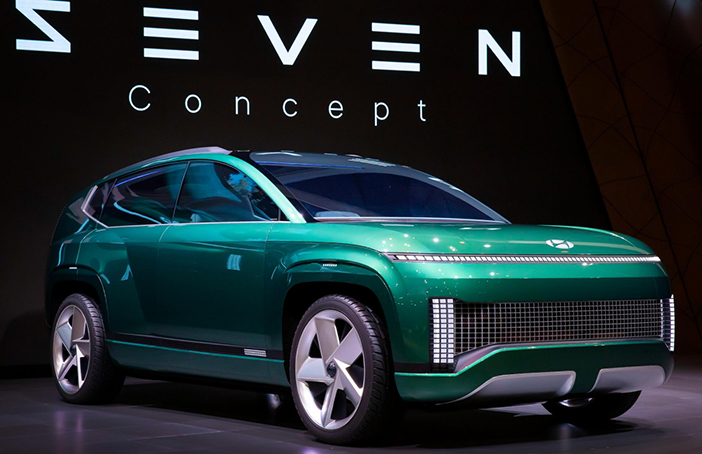
+++ Hyundai will begin producing the IONIQ 7 , the automaker’s all-electric large MPV, in July next year. The car will be produced at the Asan plant in South Chungcheong Province. Hyundai will start construction there at the end of this year to set up the necessary facilities for the Ioniq 7. The site has been manufacturing the Ioniq 6 since last year. With the growth of the Korean market noticeably slowing down this year for electric cars, the country’s leading automaker is looking for a breakthrough with the Ioniq 7. Only 9.624 EVs were sold in the country in August, a sharp drop compared to the sales figure of 30.670 units in February. Hyundai first unveiled the Ioniq 7 as a concept car at the LA Auto Show with the name Seven in November 2021. It caused a splash in the auto world, with its removal of the pillar on the side of the passenger seat, coach doors, swiveling seats and L-shaped sofa in the back with a full glass roof over the body. Some of the Seven’s innovative features, however, will not be turned into a reality for customers. The Kia EV9, which was also showcased at the same event and boasted similar coach doors, ended up having regular doors once it underwent production. As shown with the Seven, the parametric pixel used for the linear headlamps and bumper lamps on the front side will likely continue to carry on Hyundai’s design philosophy and be applied to the Ioniq 7. Considering that the existing Ioniq models eventually came out with exterior designs and specifications similar to their concept cars, the EV is expected to follow the same path. The Ioniq 7 will have a wheelbase of 3.200 millimeters, donning the theme of a moving lounge and boasting a large interior space. Overall, the Ioniq 7 will have a smoother, less boxy shape than the Kia EV9. Hyundai said the Seven is engineered to offer more than the range of 480 km per battery charge, and is capable of charging from 10 to 80 percent in about 20 minutes with a 350 kW charger. +++
+++ Since the start of the Russo-Ukrainian war in early 2022, Russia started buying up used cars from JAPAN in record numbers. However, Japan has since moved to bar most used-car sales to Russia. Soon after international sanctions prompted many of the world’s largest car manufacturers to stop selling their vehicles in Russia, the demand for used vehicles from the Land of the Rising Sun soared. In fact, Russia accounted for more than a quarter of all of Japan’s used-car exports and the prices of these cars averaged almost $8.200, more than double the average price in 2020. Figures released by Russian analytical agency Autostat reveal that over 50% of the 303.000 used cars imported into the country through January-August this year were from Japan. At one point, used car exporter SV Alliance was sending an average of 6.500 used cars to Russia each month but business is now down 70%. Why? Well, in August, the Japanese government banned exports of all cars to Russia, except for subcompacts. This has left exporters scrambling to find places where they can sell vehicles, meaning they are increasing their focus on markets like New Zealand, Africa and Southeast Asia. Vehicles that can still be exported to Russia include the likes of the Toyota Yaris and Honda Jazz. Japan first banned exports of luxury vehicles to Russia in April 2022 and recently added a ban on the export of heavy trucks. A director for automotive trade policy at Japan’s Ministry of Economy, Trade and Industry, Takanori Kikuchi, says the government is “watching to see what kind of an impact” the sanctions will have. Mandatory inspections required for used cars in Japan encourages the sale of new cars. As such, Japan has become a giant among used car exporters and companies have thrived. Many of these exporters have been hit hard by the new bans, including Element Trading, which has seen the share of Russia in its business slip from over 50% to less than 20%. +++
+++ Some 475 companies will exhibit products at the JAPAN MOBILITY SHOW (formerly known as the Tokyo Motor Show) to be held from October. 26, the Japan Automobile Manufacturers Association said. Under its new name, the trade show will include exhibitors from outside the automobile industry, such as electric equipment firms and telecommunications companies, including a conspicuous number of startups. The number of participating companies for this year’s event far outstrips the 192 that took part in the previous show in 2019. The previous highest figure was 361 in 1995, when car navigation systems were popular, with many firms showing off related technologies and products. Formerly, the Japan-based event ranked among the world’s leading auto shows, alongside those of Germany and Switzerland, but in recent years, Japan has lost significant ground to China. A number of major Japanese automakers are planning to introduce prototypes of electric vehicles in an increasingly competitive field. Nissan intends to unveil an EV with an instrument panel and display that “can be customized according to the owner’s mood”. Chinese EV giant BYD also has indicated its intention to participate. +++
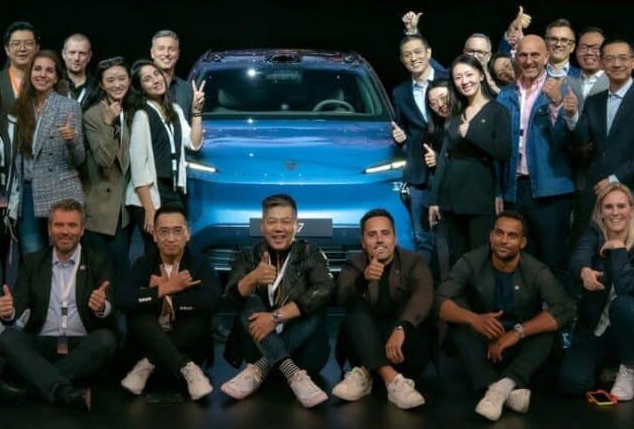
+++ On October 7, NIO will celebrate its market entry into the European Union market. The events will occur in Nio Houses in Berlin, Frankfurt and Düsseldorf. A year ago, when over 1.300 guests gathered in Berlin for the launch ceremony, the company announced expansion into 4 new markets: Germany, Netherlands, Denmark and Sweden. The EU market entry occurred precisely one year after Nio entered Norway in 2021 on September 30. Nio compiled a video to commemorate the beginning of its almost 10-year journey for this action. The Chinese EV startup was founded in 2014 as NextEV; in 2015, they established a design HQ in Munich and an R&D Center in Oxford and California a year later. In 2016, the company was renamed to Nio. In 2017, their hypercar EP9 broke the record at Nurburgring Nordschleife as the world’s fastest electric car. In Europe, Nio delivers 5 models: ET7, EL7, ET5, ET5T and EL6 (ES6 in China due to a lawsuit with Audi). In China, Nio also sells the EC6 and the EC7, but their sales are very low, so Nio probably won’t bring them to Europe. However, a new generation of the large ES8 based on the NT2, the company’s flagship SUV, will most likely make it to Europe as the EL8. In China, most of the sales are contributed to the ES6 & ET5. The backbone of Nio is battery swapping.Nio calls them power swap stations (PSS) and users can use them alongside traditional charging. The Hefei-based company planned to have 120 in Europe by the end of 2023. This goal was later quietly reiterated to 80 PSS. As of October 1, Nio has 26 PSSs in Europe and 15 Nio Houses. In China, Nio currently has 1.931 PSS and has conducted 29.7 million battery swaps. On September 28, Nio reached the record and swapped 75.000 batteries in a single day. There are also 122 Nio Houses in China, which work as premium showrooms. In the 12 months since its market entry in October 2022 to October 1, Nio registered 1.269 vehicles in Germany. 411 of those registration took place in August, but only 80 in September. Nio offers 2 customer options in Europe: buying or subscribing. Registration numbers contain both options as they track new vehicles that received a plate and road permit. In September, Nio delivered 15.641 EVs. This marks a year-on-year increase of 43.8%. However, compared to the previous month, Nio’s September deliveries saw a decline of 19.1%. It seems the Hefei-based startup is getting a reality check about how difficult it is to compete in an ultra-conservative market in a luxurious segment. In China, premiums might be already redefined, but it will take some in Germany, where Mercedes and BMW owners won’t give up their status symbol anytime soon. I’m sure all Chinese EV brands are watching Nio’s struggle closely in Europe and learning lessons. For free. Time will tell wether Nio sits on enough cash to keep pushing into European hearts for the next 5 years, as earning a premium brand reputation takes a lot of time. +++
+++ TESLA is gaining momentum in a struggle among automakers for dominance in electric vehicle charging systems in North America. But there are also moves to prevent Tesla from dominating the entire EV-related market as the automaker is seen to be seeking profits by commercializing such information as driving conditions and vehicle charging history. Since spring, Tesla’s EV charging system has been emerging as the industry standard in the U.S. market. In May, Ford said that it would adopt Tesla’s EV charging method. General Motors and Mercedes-Benz AG joined the move in June and July, respectively. Japanese companies, including Nissan and Honda, also followed suit. This week, Hyundai and Kia announced they will do the samen. What is driving this is Tesla’s large fast-charging network. About 17.000 of the approximately 30.000 fast chargers in the United States are based on the North American Charging Standard (NACS) developed by Tesla. The Combined Charging System (CCS) Combo 1, a U.S. standard for charging electric vehicles, accounts for 30% of the total and Japan’s Chademo EV charging standard account for 15%. Unlike gasoline-powered vehicles, it is important for EVs how many charging stations they are able to access. Honda, which will adopt the Tesla system in 2025, is developing equipment that will allow EVs compatible with the conventional U.S. charging system to be connected to the Tesla system. However, since it takes time and effort to connect and disconnect the equipment, the company is believed to have judged that fully adopting the Tesla system will be more convenient. Companies that use the Tesla system are wary of the growing dominance of the automaker through its charging network. By opening its charging network to competitors, Tesla can collect the usage fee for the charging facilities. It is believed that Tesla is also able to collect various data through the network, including on each vehicle’s driving conditions and charging history. Tesla has not disclosed specific information regarding the data. But a senior official of Japan’s Economy, Trade and Industry Ministry said the current dominance of Tesla could be even stronger if the company turned the data into a business since EVs are, according to a major Japanese automaker, a “treasure chest of data”. In July, 7 automakers, including Honda, General Motors and Hyundai, announced the establishment of a joint venture to develop charging facilities in North America. They aim to build 30.000 charging stations that will be compatible with the Tesla and U.S. charging systems by 2030. Honda also agreed with BMW and Ford in September to establish a joint venture that will utilize EVs to ensure a stable supply of electricity. They are apparently aiming to take the initiative in building information infrastructure that connects EVs and electric power companies. +++
+++ Meaningful progress has been made in negotiations between the striking UNITED AUTO WORKERS union and Detroit’s 3 auto companies, according to a person with direct knowledge of the talks. The person said that progress was reported at all 3 companies, with some offers being exchanged. Another said there was more movement in talks with Stellantis, but with less at Ford and General Motors. Neither person wanted to be identified because they aren’t authorized to speak publicly about the bargaining. UAW president Shawn Fain will update members on bargaining toward bringing to an end the nearly 3-week-old strikes against the companies. It wasn’t clear exactly what Fain will announce as part of the union’s strategy of targeted strikes against the companies, with automakers perceived as making progress in the talks being spared additional job actions. But the report of progress raises the possibility that the union may decide not to expand its walkouts at one or more of the companies. The union has so far limited the strike to about 25.000 workers at 5 vehicle assembly plants and 38 parts warehouses. Fain has announced strike expansions on each of the past 3 Fridays. Ford said that it increased its offer to the union on Monday night, but provisions made public by the company were close to previous offers. The company said its 7th offer raised the general wage increase to over 20% over 4 years without compounding. It also said the company raised its 401(k) retirement contributions and confirmed profit sharing was offered to temporary workers. Those workers also would see a pay raise from $16.67 per hour to $21. Ford, which had made early progress, was spared from the second round of strikes, and its parts warehouses remain open. Stellantis was exempted last week, when the union added assembly plants at Ford in Chicago and GM in Lansing, Michigan. So far the union has avoided strikes at large pickup truck and SUV factories, vehicles that are responsible for much of the automakers’ profits. The union has about 146.000 members at all 3 companies combined. The targeted strike strategy helps to preserve the UAW’s strike fund, which was $825 million before the strikes began on September 15. General Motors and Ford have laid off just over 3.100 UAW workers at plants not covered by the strikes. Those workers will get union strike pay of $500 per week. The UAW contends the companies have made billions of dollars in profits during the past decade and raised CEO pay, so they can afford to boost workers’ wages. The union is seeking 36% general wage increases over 4 years as well as a return of cost-of-living increases, a 32-hour week with 40 hours of pay, the restoration of traditional defined-benefit pensions for new hires, among other benefits. It also wants to represent workers at 10 joint venture electric vehicle battery factories in the U.S. that have been proposed by the companies. The companies, however, fear that raising their labor costs could make their vehicles more expensive than those manufactured by Tesla or foreign automakers with U.S. factories where workers are paid less. The union has dropped unfair labor practice charges filed against GM and Stellantis that had accused the companies of failing to bargain in good faith ahead of the strikes. +++
+++ In the UNITED STATES , automakers posted big increases in new vehicle sales during the summer despite high prices, rising interest rates and even a limited strike against Detroit companies. Industry sales rose 16.3% from July through September as consumer demand stayed strong despite an average new vehicle loan rate of 7.4% and an average vehicle price of more than $45,500. Vehicle supplies also continued to recover from shortages of computer chips and other parts that began during the pandemic and are finally abating. With increased selection, more people bought vehicles, despite an average monthly payment of $736. “I think this is 100% replacement purchases and needs-based”, said Ivan Drury, director of insights at Edmunds.com. Pent-up demand has been building since the pandemic started in 2020, with many people delaying purchases while waiting for prices to come down and supplies to increase. But then the Federal Reserve began raising interest rates. “Unfortunately some of the people in that pool, they go into the new vehicle market because something has forced their hand” such as a failing transmission in their existing vehicle, Drury said. Automakers sold just short of 4 million vehicles from July through September, according to Motorintelligence.com. General Motors posted a 21.2% increase, while Toyota sales rose 12.2%. Honda reported a 52.7% increase, while Nissan posted a 40.8% gain and Hyundai sales were up 10.2%. Kia sales rose 13.8%. But Stellantis sales were down 1.3%. Its car sales fell 29% as the company began phasing out Dodge gas-powered muscle cars. Ford will report sales soon and Tesla, which reported global numbers on Monday, saw an estimated 19.5% increase in the U.S. J.D. Power said U.S. auto sales grew 19% in September, the 6th straight month of double digit increases. Analysts said the United Auto Workers strike against General Motors, Stellantis and Ford had little impact on sales. The strike was limited to only three assembly plants and relatively few models during the last 2 weeks of September. +++