
+++ DACIA is considering bringing the Indian-market Renault Bridger to Europe with electric power as part of a push by the Romanian brand to reduce its CO2 emissions. The Bridger, revealed as a near-ready concept earlier this year, is a chunky, small SUV in the mould of the Suzuki Jimny. It was designed to sit underneath the slightly larger Renault Duster (an adapted version of Dacia’s European SUV of the same name) in the French brand’s Indian showrooms. It will be launched next year in line with the Renault’s strategy to significantly expand its global footprint by introducing market-specific models in key regions. As with other international offerings (including the Filante, Boreal and Niagara) the Bridger hadn’t been planned by Renault for launch in the company’s home market of Europe.
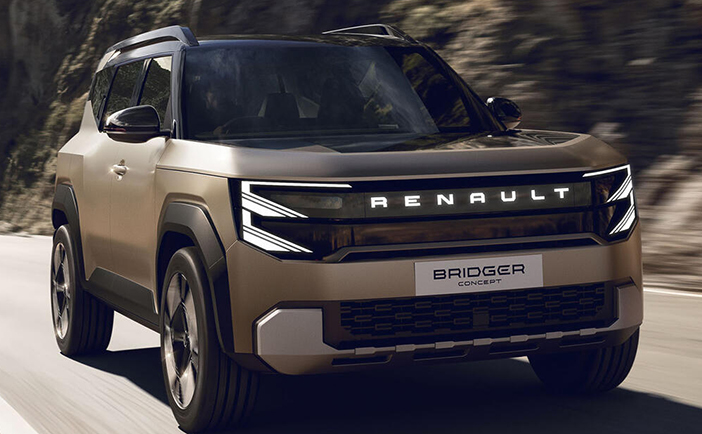
However, with the group’s value-focused Dacia brand needing to electrify its line-up quickly and affordably, and with heavy incentives in place to build its cars locally, company insiders have revealed it could adapt the Bridger for the European market, where it would go up against the similarly conceived Citroën ë-C3 and Fiat Grande Panda Electric. Electrification and reducing CO2 emissions are top priorities for Dacia, with the Romanian firm trailing its Renault Group counterparts on emissions, owing to its limited electric line-up. Dacia is also reviewing its plans in light of proposed rules under the EU’s new Industrial Accelerator Act. This could introduce super-credits for EVs built in Europe, which would be more generous for models that are less than 4.2 meter long. Dacia has announced that it plans to launch 4 EVs by 2030: the Spring, Sandero, Sandero Stepway and a fourth car. That final slot was intended to be an electric version of the new Striker crossover, but plans for that have been cancelled, according to sources, and a European-built version of the Bridger is a contender to replace it. Speaking at the Paris mator show last month, Renault Group CEO François Provost said the Bridger was “created for India but it could one day come to our markets too”. Dacia is also due to add a production version of the Hipster microcar to its European line-up in the coming years, but that will sit outside the main car line-up as a Citroën Ami-sized quadricycle. +++
+++ FIAT is set to gain another car with a bear-themed name. The Panda has been knocking around in one form or another since 1980, and more recently, the Grizzly was revealed as a Dacia Bigster rival due to launch next year. Now, not long after, we should have the Koala. Speaking at the Paris Motor Show, Fiat, Abarth and Lancia boss Arnaud Belloni confirmed that the Fiat brand had registered the Koala name. And yes, we’re aware that the koala is actually a marsupial, and not a bear, despite its nickname… In any case, Belloni, who was appointed in September, seemed to suggest the name isn’t taken too seriously. At the show, he facetiously brought up other names both in and out of the car world, including Apple (“what a silly name”) and Renault’s Arkana (“what does it mean?”). “The names, they are important, but they are not so important. They are what the car is, what the car becomes”, he added. Belloni’s comments about the brand then having “a Koala, a Panda and a Grizzly” suggest the newcomer would be the smallest of the lot, which would make sense given a koala’s size in relation to a panda and a grizzly bear. Panda, of course, does also refer to more than one model, encompassing the Grande Panda and the Pandina (meaning little Panda), a continuation of the previous-shape Panda, sold primarily in Italy. A new car will soon be replacing the Pandina, likely based on the same platform used by the new Citroen 2CV, which also seems a likely starting point for the Koala. That architecture will be built to the incoming European ‘E-Car’ regulations, aimed at creating a new generation of small, light and affordable electric cars that have a maximum length of 4.2 metres.
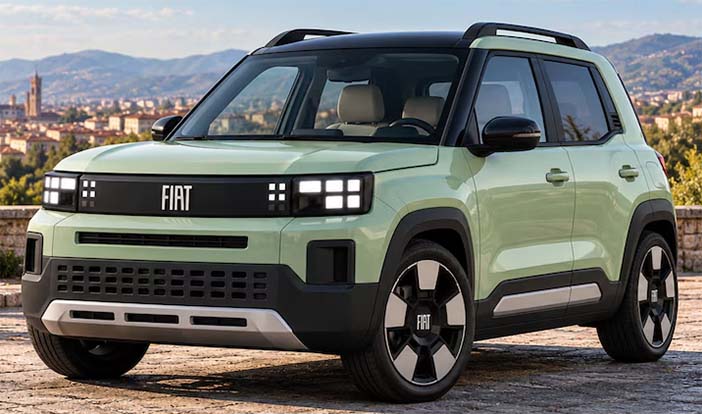
The Citroen 2CV is well within that permitted limit, at 3.76 metres. The new Panda will likely be a similar size, with the Koala coming in a little smaller, potentially even less than the 3.6-metre Fiat 500. Citroen has previously confirmed that it’s aiming for the 2CV to come in at under 1.000 kg; a figure that should be matched by the Koala. This is exceptionally low for an electric car, regardless of size, and will benefit cost, efficiency and handling. While specifics such as battery size and performance are still unknown, in the interest of scale and reducing the development costs, expect a limited number of variants to be available. This will be the result of yet more parts sharing between different Stellantis brands to create this new type of affordable electric car. +++
+++ After decades of making bumper profits in China, GERMANY ’s carmakers have run out of road and sales have slumped dramatically, forcing painful job losses at home. Volkswagen’s woes in China pushed Europe’s largest carmaker to a 5.8 billion euro loss for the 3 months to end-September. The 10-brand group’s declining fortunes in the world’s largest car market are the main reason behind a historic restructuring drive that could see it shed up to 120.000 jobs by the end of the decade. BMW and Mercedes-Benz are also cutting jobs, and all three have issued profit warnings this year. “Nobody was prepared for the swiftness or the violence of the pivot”, Tu Le of Sino Auto Insights said. “The fall for the German automakers has been really abrupt”. The big 3 German carmakers’ annual vehicle deliveries in China fell about a third between 2019 and 2025 to 3.87 million, according to calculations based on company disclosures. Chinese carmakers’ shares of their domestic market meanwhile rose to 65.3 from 37.8 percent, according to the China Passenger Car Association (CPCA). The rapid fall has come as a shock to Germany, a nation that has regarded itself as a key player ever since Carl Benz invented the motor car in 1886. German carmakers’ rich history meant they were long dismissive of Chinese competition and slow to react, said a former Mercedes-Benz strategy expert who later consulted for BMW. “When I was doing analyses of the market in China there was not appreciation, more a sort of confusion”, she told AFP. “It was coming from a place of elitism, a thought of ‘Oh we’re better’. There was disbelief that others could do things differently”. The German brands meanwhile had to compete with the likes of China’s BYD, which started out making batteries for mobile phones, and Xpeng, founded by software entrepreneur He Xiaopeng. The Chinese government stepped up support for electric vehicles with subsidies and charging infrastructure at the same time. That made Germans’ key strength (long experience in improving internal combustion engines) increasingly irrelevant and perhaps soon obsolete. “What the market demanded was not a skillset they had”, Le said. “The legacy automakers in China were bringing analogue toys to a digital party”.
Germany’s carmakers have held up better in China’s combustion-engine segment. Volkswagen is the country’s number-one carmaker for petrol and diesel vehicles. But that is a wasting asset in China, where so-called new energy vehicles made up a record 67.8 percent of sales last month, leaving combustion-engine cars looking tired. “In China people associate brands with specific technologies now. If you think of Volkswagen, you think petrol, not electric”, Ingo Speich of Deka Investment, which holds shares in the German carmakers, said. “It’s like after 2007 when Apple invented the iPhone. Nokia started coming out with good smartphones by 2009, 2010, but it was too late, people just didn’t think of them as smartphone-makers”. Germany’s carmakers are now trying to shift engineering east, both to stay competitive in the Chinese market as well as to integrate technologies developed there into cars sold abroad. Volkswagen said a year ago that it could now design cars from start to finish in China at its centre in Hefei. Both BMW and VW have said they hope to export vehicles from China into other parts of the Asia-Pacific region. The low-cost Volkswagen ID.Up, slated for European launch in 2027, will meanwhile have an electric motor made in China. “You can see us also as a Chinese player”, Volkswagen CEO Oliver Blume said in July. “We can do the same as the Chinese can do”. Speaking in October, Mercedes-Benz CEO Ola Källenius said the company would overhaul its China strategy, adding that giving up on the world’s toughest but largest market was not an option. “We’re not looking at China as something like ‘Oh that’s going away and let’s focus on the other things’ “, he said. “There’s not a play where you put China aside”. +++
+++ HONDA has teased a brand new SUV that won’t be just any new addition to its range. The Avancier will be the first new car with the Japanese company’s next-generation hybrid powertrains, interior technology and design language. The Avancier name has previously been used on a China-only crossover, but soon it will be applied to a brand new 7-seater for the global market. It’ll start production in right-hand-drive form for sales in Japan and Australia next year, and afterwards it could be sold in Europe. This new family-sized model would give Honda a rival to 7-seater SUVs like the Skoda Kodiaq and Hyundai Santa Fe, a growing market it has not had a contender from Honda before. If the Avancier is going to be sold in Europe, it will be priced above the current CR-V. The Avancier will be our first look at Honda’s next-generation styling and technology, which already appears to be a big step on from the models of today. The most striking angle previewed is the rear, which looks dramatically different from any current Honda. Parallels could be drawn with Range Rover due to the two thin upright lighting elements, but it’s clear that the Avancier sits them within a very different body defined by a strong, angular D-pillar and a crisp line running down the car’s side. Another teaser showing some of the car’s front-end lighting previews yet more links to Land Rover products.
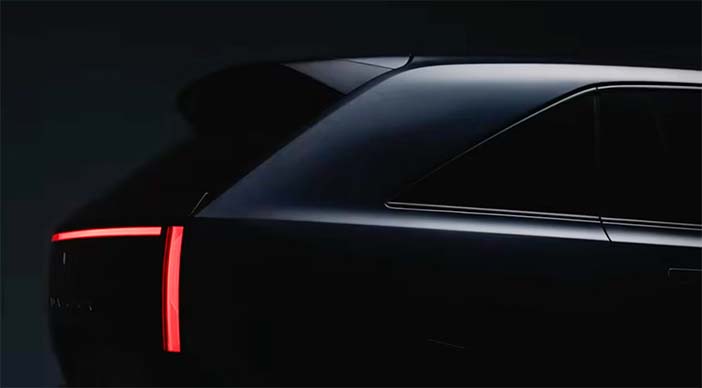
The thin horizontal lighting and defined edges running along the sides of the bonnet suggest a similar sense of solidity; it could even feature a clamshell-style bonnet. While I don’t yet know any official specifications of the car’s powertrain, I do know that it’ll feature a next-generation Honda hybrid system. Building on the company’s current e:HEV technology, this system will work by using a small petrol engine largely as a generator, leaving the bulk of the propulsion to come from a pair of electric motors. One of these will feed the car’s battery pack acting as a small generator, while the second will drive the front wheels directly. In larger and higher-specification models like the Avancier, the number of electric motors could actually increase to 3 with a further e-motor mounted on the rear axle to achieve all-wheel drive. Honda says this new era of powertrains will be the most efficient of its type; a claim that could well be accurate given the already impressive numbers achievable by Honda’s existing e:HEV technology. This new era of Honda models previewed by the Avancier will also incorporate a fundamentally redesigned interior, with the brand’s new Asimo user interface to be rolled out across the range. This was a system developed in tandem with Honda’s ambitious (but now cancelled) 0 Series electric car programme, yet it will still see the light of day in these new hybrid-powered models. As well as offering greater connectivity and new digital features, the new Asimo interface will run on larger, brighter and more responsive displays. In some cases, these will be spread across the entire dash-front in a Mercedes-style panel, but the style of its application in the new Avancier remains to be seen. An ambition of the Honda 0 Series programme was to reach the point of the cars being fully ‘software defined’, meaning that features and capabilities were governed by updatable software rather than fixed hardware. We don’t yet know whether this initial batch of new Hondas will hit this target from the off. Beyond the tech, we also expect to see a sense of simplicity in the overall interior design. Honda is promising the use a smaller range of higher quality materials and fabrics, giving its future models a cleaner, yet still warm and inviting cabin feel. +++
+++ Piped-in engine sounds started out in the 2010s, but has since become the norm for many automakers. Blame it on regulations (yet again) that require cars to be quieter from the outside. Couple that with advances in sound insulation and you don’t get much engine sound from within the car. While that’s fine for, say, a luxury car, but unforgivable in a sports car. Hence, there’s now the ‘need’ for the speakers to let the drivers hear the engine. Then we get to performance EVs. There’s a strange sensation of speed and silence, and while some people like that, others would like to hear something out of it. If anything, sportier EVs are doing everything in their power to simulate internal combuston-powered cars. Just take a look at the Hyundai Ioniq 5 N, going beyond sounds by getting a simulated manual transmission. Many other performance EVs have followed suit, one of them being the new-generation Mercedes-AMG GT 4-DOOR. AMG has shared how it simulated the V8 experience in the electric GT 4-Door. The company revealed that it needed over 1.600 audio files just to get the V8 sound right. While it’s true that the sounds came from the AMG GT R, it wasn’t as simple as recording the car’s engine and slapping the file into the GT 4-Door. Each audio file was spliced and looped into smaller chunks, just so it can accurately capture the exact sound a V8 would make at a certain rpm. On top of that, the sound of the engine upshifting and downshifting was also recorded, and the same process of splicing and looping were applied. Of course, pops and bangs were also thrown in for a more immersive experience. There won’t be flames shooting out the back, but at least it makes you think the car just did so. The V8 sounds are used in the GT63 and GT55 model, but AMG didn’t ignore the GT53, either. But instead of an 8-cylinder soundtrack, the junior GT 4-Door has 6-cylinder sounds pumping through its speakers. It wasn’t mentioned from which model the sound was recorded from, but a safe bet would be from the E53 e-Performance and other AMG models that used the 3.0-liter twin-turbo inline-6 engine. But aside from the aural experience, AMG made the effort to make the car feel like its combustion-powered predecessor. The seats can buzz to give the driver the sensation of engine vibrations, and the 9-speed automatic was simulated in as well. Those paddles aren’t just for brake regeneration, but also for shifting if the car is put in AMGFORCE Sport+ mode. Of course, if things get too loud for your liking, you can revert to the standard driving modes, and the GT 4-Door becomes a quiet electric cruiser. Like the looks or not, there’s a lot of clever stuff going on with the car. +++
+++ New research shows that increased weight and neglected maintenance cause EVs to suffer more tyre defects than combustion-engined cars, but experts say faster TYRE WEAR won’t erase their overall climate advantage. According to a report by analyst New Automotive, for every 1.000 MOT tests on cars 3 to 8 years old, about 26 EVs recorded tread below the legal limit, compared with 18 petrol cars. Cuts reaching the cords were recorded in approximately 30 EV tests, compared with 14 petrol cars. The comparison covered 1.6 million EV tests and 17.9 million ICE car tests. “For a percent extra weight of car, you get a percentage extra in tyre abrasion”, said Nick Molden, founder of Emissions Analytics, calling it “a rough rule of thumb”. He added: “An EV would typically be 20% heavier than an ICE car. Before fitting specialist tyres, you’re looking at 20% or so more wear on an EV”. The British Tyre Manufacturers Association (BTMA) has also found a higher tyre failure rate among EVs. Its latest figures put the failure rate for EVs at 6.0%, compared with 4.7% for diesels and 4.3% for petrol cars. The BTMA points to greater weight and instant torque wearing tyres more quickly. Darren Lindsey, head of the BTMA, said driver behaviour and maintenance are also part of the problem, explaining: “People tend to drive and forget now”. He argued that because EVs need less routine servicing, tyres can be overlooked. Lindsey warned that the higher reported defect figure (roughly 80% higher than for ICE cars) shouldn’t be interpreted as a direct measure of wear. “That’s probably down to how people are treating the vehicle”, he said, pointing out that a defect could be “a cut in the sidewall”, “a small bulge” or another problem that isn’t simply down to tread wear. Maintenance aside, Jon Andersson, Ricardo’s global technical expert on emissions measurement and standards, pointed to several reasons why EV tyres wear more quickly. “Mass is definitely an important factor, perhaps the most significant”, he said. “But speed, braking, tyre characteristics, alignment, maintenance and driving style can all play a part”. Molden said specialist EV tyres are generally “just offsetting the added wear from the extra vehicle weight and torque” but that comes at a price: EV tyres, “in round numbers, are up to 50% more expensive than normal ICE tyres”. Molden said the main problem comes when “these heavy cars with high torque” are fitted with tyres “which are not suitable for that” and that the wrong tyre can double wear rates. While EVs wear out their tyres more quickly, experts say increased degradation does not necessarily mean more pollution, but EV-specific rubber could bring its own set of concerns. Andersson said wear and airborne emissions aren’t equivalent: “A tyre with higher overall wear does not necessarily generate proportionally more airborne particle pollution”. Yet as impending Euro 7 abrasion standards compel manufacturers to create longer-lasting compounds, solving wear may simply shift the hazard. Molden said new compound formulations “will affect the toxicity of the particles”. That chemical profile remains a critical blindspot. University of Surrey professor Prashant Kumar, who studies the impact of air pollution on health, said tyre-wear particles can contain metals and chemicals whose long-term health impact “is not very well understood”. Larger rubber fragments stay on the ground and are washed away by rain but finer particles “could become airborne” and pose a risk. Asked to comment, the BTMA pushed back, saying any changes to materials or product design are subject to “extensive technical evaluation and scrutiny”. If EVs wear through tyres more quickly, another issue is what happens to them once they are spent. Molden said “around 2 billion” end-of-life tyres are discarded globally per year. Manufacturing more tyres would add to CO2 emissions, he said, but that wouldn’t wipe out the overall CO2 advantage of an EV. He put this at “approximately 50% on a life-cycle basis”, not including the impact of the tyres themselves. He added: “Intuitively, the combustion engine produces a lot of CO2. Tyres on average last about 2 years, so there is no way going through tyres faster will negate the benefit of electrification”. +++
+++ The VOLKSWAGEN GROUP is evaluating whether to deploy its China-developed electrical architecture across the majority of its future European core models: a move that could dramatically reshape the German firm’s global engineering strategy as it battles to cut costs. According to internal discussions confirmed by Group board member and Volkswagen brand CEO Thomas Schäfer, up to 75% of the firm’s core models in Europe (spanning the Volkswagen, Cupra and Skoda brands) could eventually use the China Electronic Architecture (CEA). Developed in partnership with Chinese EV maker Xpeng, the CEA is described as “a zonal electronic and electrical architecture with high-performance central computing” that “enables software-driven innovations across all powertrain types”, from combustion to hybrid to electric. The proposal signals a significant shift in Volkswagen’s regional strategy. The firm currently relies on the CEA for the Chinese market and is developing a separate RVT electrical architecture with American EV maker Rivian for the western hemisphere. The RVT architecture is set to make its debut on the production version of the ID.Every1, Volkswagen’s upcoming electric successor to the entry-level Up, which is tentatively scheduled to be unveiled at the 2027 Munich motor show and will be called ID.Up. Speaking on the Volkswagen Group’s evolving software strategy at an event in China, Schäfer outlined the complex geopolitical and financial calculations driving the debate. “First of all, it’s clear that we need 2 architectures ultimately. One is CEA and one is RVT for the western hemisphere”, he said. “We are at the moment looking at the most cost-efficient way of making it ready for the volume segment and we are investigating if the CEA is indeed the right one for Europe. The minute you start making either software architectures of vehicles ready for Europe, complying with all the European rules and regulations, you make the cars more expensive here in China or you create a variant. So there’s always a debate: do you make the cars here in the most competitive market more uncompetitive in order to have an advantage in Europe or is it better to stay separate?”. While Schäfer cautioned that no final decision has been made, he indicated a strong leaning towards adopting the Chinese technology for the European market. “I believe it will be”, he said, “but we’re not finished yet”. The potential pivot comes as Europe’s largest car maker faces intense pressure to lower EV development costs and fend off fierce competition from Chinese rivals. +++