
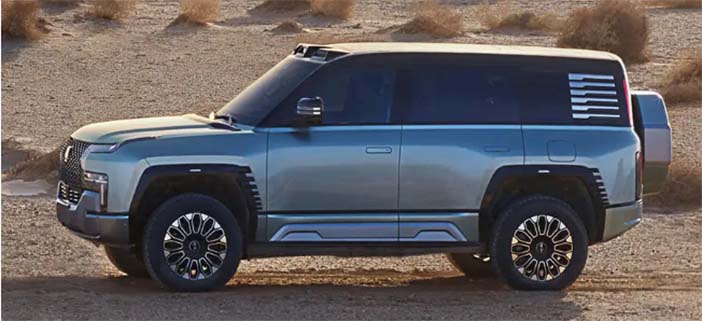
+++ BYD will gauge European public appetite for its new ultra-luxurious Land Rover Defender rival at the Geneva motor show later this month. The Chinese company last year revealed the U8 4×4 as the spearhead of its new Yangwang luxury brand, envisioned as a rival to the likes of Audi, Mercedes-Benz and BMW. It was shown alongside the U9, a Rimac Nevera-style electric supercar. BYD had given no explicit indication that it planned to take the Yangwang brand to Europe, but has now confirmed it will be “teasing public reaction” for the U8 at the Geneva show, where it is 1 of just 5 mainstream car brands exhibiting this year. Notably, BYD boss Wang Chuanfu has previously spoken of his ambition to “reshape the contours of the global luxury car market” with the Yangwang brand, suggesting it was never envisioned as solely a domestic offering. It will be the first time BYD has shown a Yangwang model in Europe and the brand is keen to impress upon showgoers the “exceptional capabilities” of the new e4 platform, which underpins the U8 and is not shared with any of the 5 electric cars BYD currently sells in Europe. The most notable of the new platform’s attributes is a 1.100+ hp quad-motor powertrain (1 motor on each wheel) which allows for 360 degree ’tank turns’ on the spot and boosts the U8’s dynamic stability and agility in normal driving situations. The forthcoming Mercedes EQG (an electric version of the G-Class) has a similar set-up. The motors are powered normally by a 49 kWh battery, but a 2.0-litre turbo petrol engine (unconnected to the wheels) functions as a range-extender. The U8 is also equipped with an ‘intelligent’ hydraulic suspension system that is said to minimise the risk of rollover and keeps the car body flat in extreme manoeuvres to stop the occupants moving around the cabin. It also allows the car to be driven on 3 wheels in the event of a puncture. The U8, measuring a substantial 5.300 mm long and with a wheelbase of 3.500 mm, would naturally contend with range-topping versions of the Land Rover Defender and Mercedes G-Class if it were exported to Europe, but the firm has not said which markets specifically it could be sold in, nor given an idea of volumes or local pricing. It costs roughly €140.000 in its home market. BYD will also display the new Denza D7 in Geneva; an Audi Q8 e-Tron rivalling electric crossover from the new premium brand it has established as a joint venture with Mercedes-Benz. It has not said when or where the N7 will launch but has confirmed the Denza D9 (a Lexus LM-style luxury MPV) will go on sale in Europe this year. The 2 new brands will be on display alongside the new BYD Seal U and a new version of the Tang 7-seat SUV. +++
+++ ELECTRIC CARS accounted for 9.3 percent of newly purchased cars in South Korea last year, hovering above that of other major counterparts, including the United States and Japan. The electric vehicles (EVs) took up 162.507 of 1.74 million cars sold in Korea in 2023, according to the data compiled by the Ministry of Land, Infrastructure and Transport. The ratio marked a significant rise from just 1.9 percent tallied in 2019. The figure, however, fell slightly from 9.7 percent posted in 2022, apparently reflecting the growing concerns over the lack of charging infrastructure and higher costs. Last year, EVs accounted for 22.2 percent of around 30 million cars sold in China, on the back of Beijing’s aggressive move to bolster the sales by providing tax cuts and other discounts. The United States, meanwhile, saw EVs take up 7.2 percent of its domestic automobile sales, trailed by Japan with 2.9 percent and India with 2.1 percent. +++
+++ EURO NCAP has blamed a significant reduction in the number of cars that it evaluated last year partly on manufacturers rushing to beat the introduction of tougher tests. The European vehicle safety testing agency, whose 5-star safety rating is keenly sought by manufacturers the world over, rated 73 cars in 2022, making it the organisation’s busiest year ever. However, in 2023, it rated just 18 cars. Explaining the reduction, a Euro NCAP spokesman said: “Manufacturers were eager to get their cars rated in 2022, demonstrating that they met the original design targets, before the rating scheme changed in 2023 with the introduction of new, challenging test scenarios”. Such is the power of Euro NCAP’s rating system to influence not only how well a new car sells but also the insurance group it occupies that, claimed the organisation, new test scenarios now define product cycles and launch dates, with car makers establishing at the outset what their target star rating is against which version of the protocols. Having decided this, there is, it said, pressure on them to put the car into production in time to meet those targets. Euro NCAP added that for this reason it was unsurprised by the reduction in ratings that it awarded in 2023. The spokesman said: “It isn’t uncommon that manufacturers need a bit more time to understand what requirements must be met for five stars. We have seen these fluctuations [in our testing numbers]occur over the last decade”. However, changes to the tests weren’t the only reason why fewer cars were rated in 2023. Manufacturers are in a process of transition, extending the life of some long-running, combustion-engined cars while giving themselves breathing space to continue their work developing all-new electric cars. As a result, and especially in recent years, Euro NCAP has rated a lot of powertrain variants of ICE models; a trend that is beginning to slow as new electric cars come on stream. Additionally, the difference in the number of cars that Euro NCAP rated in 2022 compared with 2023 was amplified not only by car makers rushing to beat the introduction of new test protocols but also by the Covid pandemic, which caused chip shortages and created a backlog of new model launches. The spokesman said: “The test requirements for 2022 had been in place since January 2020; 1 year longer than was originally planned, due to the impact of the pandemic. Many manufacturers were forced to postpone new car introductions and were plagued by the chip shortages, causing cuts in production volumes and delays”. With the pandemic now a distant memory and its new tests established, Euro NCAP expects to rate at least 40 cars in 2024 and possibly more in 2025 ahead of the introduction of further new tests in 2026. +++
+++ A 28% rise in electric car sales boosted EUROPE ’s new car market to its strongest year since the Covid pandemic, according to industry analyst Jato Dynamics. A total of 12.792.151 cars were sold across Europe in 2023; up 22% on 2022 and a 7% increase over 2020. Jato analyst Felipe Munoz hailed the increase as a normalisation of the market, with supply chain disruption from the pandemic largely resolved. “Despite this, it’s unlikely we will see volumes surpass the 15 million units recorded in 2019”, added Munoz, who cited changing attitudes to car ownership and the increased cost of buying a new car. The Tesla Model Y was Europe’s best-selling car in 2023, becoming the first ever EV to top the chart and the first car from outside of Europe to do so. On sale since 2020 and built in the United States, China and Germany, the crossover finished the year with 251.604 units sold, according to figures from industry analyst Jato Dynamics; a rise of 84% over 2022. Tesla sold some 17.000 more examples of the Model Y than any other car, beating the likes of the Dacia Sandero (234.715) and the Volkswagen T-Roc (204.610). It was also the only electric-only model to appear in the top 30, as the second-best selling EV, the Tesla Model 3, finished 32nd overall with 100.883 sales. “The soaring popularity of the Model Y and price cuts across its range helped Tesla record its largest market share since arriving in Europe. Tesla has the right product in the right place at the right time”, said Jato global analyst Felipe Munoz. It didn’t end there for the American EV brand: it’s now the 16th most-registered brand in Europe, having surpassed Volvo and Nissan. Meanwhile, Volkswagen finished the year once again as Europe’s favorite brand, with 1.343.740 cars sold, followed by Toyota with 819.544 and Audi with 730.690. Apart from the Tesla Model Y, the Dacia Sandero and the Volkswagen T-Roc, the best-selling cars in Europe in 2023 were: 4. Renault Clio (201.604 sales, +42% YoY), 5. Peugeot 208 (193.679 sales, -6% YoY), 6. Opel/Vauxhall Corsa (188.154 sales, +15% YoY), 7. Volkswagen Golf (183.716 sales, +4% YoY), 8. Toyota Yaris Cross (176.285 sales, +29% YoY), 9. Fiat 500 (173.187 sales, -3% YoY) and 10. Skoda Octavia (160.662 sales, +43 YoY). +++
+++ Last fall’s contentious United Auto Workers’ strike changed FORD ’s relationship with the union to the point where it will “think carefully” about where it builds future vehicles, Ford’s top executive said Thursday. CEO Jim Farley told that the company always took pride in its relationship with the UAW, having avoided strikes since the 1970s. But last year, Ford’s highly profitable factory in Kentucky was the first truck plant that the UAW shut down with a strike. Farley said as the company looks at the transition from internal combustion to electric vehicles, “we have to think carefully about our manufacturing footprint”. Ford, Farley said, decided to build all of its highly profitable big pickup trucks in the U.S. and by far has the most union members (57.000) of any Detroit automaker. This came at a higher cost than competitors, who went through bankruptcy and built truck plants in Mexico, he said. But Ford thought it was the “right kind of cost”, Farley said. “Our reliance on the UAW turned out to be we were the first truck plant to be shut down”, Farley told. “Really our relationship has changed. It’s been a watershed moment for the company. Does this have business impact? Yes”. The UAW made strong wage gains after a 6-week strike at selected plants run by Ford, General Motors and Jeep maker Stellantis. Top-scale factory workers won 33% raises in a contract that runs through April of 2028, taking their top wage to around $42 per hour. High manufacturing costs are among the reasons why Ford has a $7 billion annual cost disadvantage to competitors, Farley has said. He told that Ford is making progress on cutting those costs with cultural and structural changes at the company. It expects to take out $2 billion worth of costs this year, and Farley said he thinks cuts in manufacturing costs will “fully offset” the cost of the UAW contract. Ford has said the contract would add $900 to the cost of a vehicle by the time it reaches full effect. Ford has shifted its electric vehicle strategy so it concentrates on smaller, lower priced EVs and electric work vehicles such as pickup trucks and full-size vans, Farley said. Any EV larger than a Kuga “better be really functional or a work vehicle”. A small team within the company is developing the underpinnings of a less costly smaller vehicle, which Farley said would be profitable because of U.S. federal tax credits as high as $7.500 per vehicle. He gave no time frame for the small EV to come out, but said Ford’s next generation of electric vehicles would come in the 2025 through 2027 time frame. His comments about the union raise questions about whether the new small EV would be built in Mexico, which has lower labor costs. Vehicles built in North America are still eligible for the U.S. tax credit. Farley also said he sees EV battery prices coming down with more competition. The company, he said, may go with a common cylinder-shaped battery cell to leverage purchasing and get better prices. He also said Ford might do that with another automaker. Ford’s Model e, the electric vehicle unit, lost nearly $5 billion before taxes last year. Farley wouldn’t give a date for it to break even, but said any new EV built by the company has to make money within 12 months of its release. The company still posted net income of $4.3 billion due largely to big profits from its Pro commercial vehicle unit and Ford Blue, the internal combustion division. Farley said Ford and others will have trouble competing on EVs with Chinese automakers, which are likely to sell 10 million of them this year. It’s a big reason why Ford has recruited management talent to focus on lean operations, he said. Automakers from China, he said, went from selling no EVs in Europe 2 years ago to 10 percent of the market now. Chinese auto giant BYD ’s Seagull small electric vehicle, he said, has about $9,000 in material costs, and it will probably cost the company another $2,000 to meet crash test standards, for a total cost of around $11.000. It has a range of about 240 km in cold weather, “not a fantastic vehicle, but pretty damn good”. +++
+++ The HYUNDAI MOTOR GROUP is highly likely to surpass the 100-million-vehicle sales mark this year, 56 years after it started selling cars in Korea in 1968. It has sold close to 97 million vehicles around the world as of last year. Of these, about 24 million were sold on the domestic Korean market, accounting for approximately 25 percent of total sales, while the remaining 73 million, or 75 percent, were sold internationally. To achieve the 100 million milestone, Hyundai requires the sale of about 3 million additional units. Given its annual sales target of slightly over 4.2 million units, surpassing the 100 million mark within the year appears likely. Hyundai’s sales goal, which aims for an average monthly sales rate of 353.000, suggests the company could reach this target by September, especially considering the 316.000 units already sold globally in January. Hyundai’s journey to this point began with its entry into the automotive market in 1968, followed by its expansion into international markets in 1976. The company’s growth has been marked by several milestones, reaching 1 million in sales by 1986, which rose to 10 million by 1996, 50 million by 2013 and soaring past 90 million by 2022. Among Hyundai’s product lineup, the Avante, known as the Elantra in international markets, stands out as the company’s best-selling model, with cumulative sales exceeding 15 million units. This model leads Hyundai’s portfolio, followed by other popular models like the Accent, the Sonata, the Tucson and the Santa Fe. Hyundai’s global automotive industry ranking has improved significantly over the years. The company was ranked 10th in 2000 and broke into the top-5 by surpassing Ford in 2010. Despite dropping a bit in 2021, Hyundai made a strong comeback in 2022 as the world’s third-largest automaker. It managed to secure the third spot last year. Japan’s Toyota, the world’s largest carmaker by unit sales, reached the same 100 million milestone in 1997, 59 years since its founding in 1937. +++
+++ In Thailand, the new car market share hold by companies from JAPAN , has been plummeting. The downfall in the market is due to the rapid spread of electric vehicles as a result of the Thai government’s tax break policies and the rise of Chinese automakers focusing on EVs. Automakers that sign an agreement with the Thai government are required to build factory bases in the country. As a result, Chinese firms such as BYD Co. are building plants in Thailand, once regarded as a stronghold of Japanese cars. Since Thailand is Southeast Asia’s largest automobile production base, Japanese automakers may face a predicament in the entire regional market, too. The market share of 9 major Japanese automakers in Thailand totaled 77.8% in 2023, according to figures compiled by Toyota’s Thai subsidiary. This was a decrease of 7.6 percentage points from the previous year, with only Honda increasing its sales. “The appeal of Japanese cars is falling”, said a Japanese automaker executive. Companies importing EVs to Thailand can receive subsidies, while tariffs can be reduced by up to 40% if firms sign a memorandum of understanding with the government. More than 10 firms, including Chinese EV giant BYD, have signed the memorandum to reduce sales prices. Last year, 73.568 EVs were sold in Thailand, according to the Federation of Thai Industries, marking a sevenfold increase from the previous year. The new car market share of EVs also jumped from 1.2% to 9.5%, demonstrating that the government’s policies produced a tangible impact. With BYD’s sales volume increasing 98-fold to 30.432 units, the market share of Chinese companies, which had been around 5%, reached about 11%. The main goal of the Thai government’s tax break policies is to attract EV makers to establish their production bases in the country. Companies that sign a memorandum of understanding with Thailand are expected to produce more EVs in the country than they export from 2024 onward. Under this system, Chinese firms such as BYD and Changan Automobile are building factories, while such movements in the Japanese industry have been limited at best. In December, Honda announced that it had begun EV production in Thailand, but has not unveiled a detailed production plan. Toyota, the only Japanese automaker to have concluded a memorandum with the Thai government, began small-scale EV production at the end of last year but has not yet decided when it will begin full-scale production. In an interview with the Japanese media in December, Thai prime minister Srettha Thavisin said that Japanese carmakers are lagging. He urged Japanese carmakers to shift to EVs, saying that if Japan does not do so, it will be left behind in the industry. His remarks are believed to reflect that the Thai government is becoming increasingly frustrated with the reluctance of Japanese automakers. “Thailand has become an export base to neighboring countries. If no measures are taken, the power relationships in Southeast Asian countries, where Japanese carmakers have been strong, could be transformed”, said Sanshiro Fukao, a senior research fellow at Itochu Research Institute. +++
+++ RENAULT on Wednesday said it had bounced back into profit in 2023 as sales rose due to new models and price increases that helped it attain a record margin. The company, whose stable includes the low-cost Dacia and sporty Alpine brands, earned a net profit of 2.2 billion euros last year after suffering heavy losses in 2022 due to writing off its Russian assets. Renault also turned around 4 years of declining sales volumes, managing a 9 percent increase to 2.2 million. Sales revenue rose by 13 percent to 52.4 billion euros as the company was able to raise prices and sold more high-end vehicles. Its operating margin, which compares operating profit to sales revenue, struck a record 7.9 percent. “This is a day to be immensely proud, with historic results for our group”, chief financial officer Thierry Pieton told a news conference. “It demonstrates the success of our new model line-up”, he added. The automaker plans to launch 10 new vehicles this year and maintain its operating margin at above 7.5 percent, thanks in part to cost reductions. “Our fundamentals have never been so solid and there is no question of stopping here”, said chief executive Luca de Meo. The 2023 result includes the contribution of 797 million euros from its partnership with Nissan. The sale of part of its stake in the Japanese automaker brought in 764 million euros alone. +++