+++ The BMW GROUP Group and Tata Technologies, the Indian engineering and digital services company, announced recently that they have signed an agreement to form a joint venture with the aim of setting up several new software and IT development centres in India. The new facilities will be built in Pune, Bangalore and Chennai with the main research and development activities for cars taking place in the first two locations, while the third will concentrate the company’s IT solutions. The new joint venture between the BMW Group and the Tata Group will leverage the Indian company’s vast experience in digital engineering to contribute to the German company’s global strategic expansion. In particular, the aim of the agreement will be to develop new systems for autonomous driving, new software for infotainment systems and new digital services. The engineers will therefore be tasked with focusing on software coding capabilities, the strategic development of software to implement new functions in the cars of the future, and the study of solutions for software-defined vehicles (SDVs), i.e. all those cars of the future that will have all electrical components managed by a single operating system that can be continuously updated. The new joint venture will employ around 100 professionals from Tata Technologies in this first phase, with the aim of further growth in the coming years. Christoph Grote, senior vice president of Software and E/E Architecture at the BMW Group said: “Our collaboration with Tata Technologies will accelerate our progress in the field of Software Defined Vehicle (SDV). In international comparison, India boasts a large number of talents with exceptional software skills, who can contribute to our software expertise. Developing vehicle software for BMW Group means working with world-class processes and tools, which in turn give Indian software engineers the ability to model cutting-edge, premium automotive experiences in future fields such as highly automated driving and artificial intelligence”. Nachiket Paranjpe, president of automotive sales at Tata Technologies, commented: “In the evolving automotive landscape, the journey towards a software-defined vehicle represents a fundamental shift in automotive software and vehicle development methodologies. We will leverage our deep domain knowledge and SDV expertise to collaborate with the BMW Group towards vehicles that are not only technologically advanced, but can also deliver exceptional experiences to consumers around the world”. +++
+++ When the automotive industry started looking toward an ELECTRIFIED FUTURE , Detroit automakers decided to throw their hat in the ring with what they do best: pickup trucks. The first entrants to the electric-pickup market enjoyed some early success, particularly in the Ford F-150 Lightning. But sudden changes to the electric car shopper demographic mean that for the second time in the last 20 years, Detroit finds itself selling big, expensive cars nobody really wants. Behemoths like the GMC Hummer EV and Ford F-150 Lightning, with price tags that can reach 6 figures, aren’t resonating with the current EV shopper, who prioritizes value and practicality. Where the Lightning is concerned, the truck’s early success doesn’t appear to be carrying over past the first round of reservations when the truck first went on sale in 2022. Ford dealers have started warning that the trucks are piling up on their lots. Starting Monday, Ford will dramatically reduce the workforce at the factory that builds the Lightning, according to the Associated Press, in a sign that demand for the truck may be slowing, Expensive pickup trucks aren’t just a Detroit problem. Electric pickup truck pioneer Rivian has also warned of slowing growth, and Elon Musk’s Tesla already appears to be offering some purchase incentives for the Cybertruck. A recent study from car-shopping website Edmunds shows that interest in electric pickup trucks only accounts for only 10% of current EV demand, while demand for electric sedans, hatchbacks and wagons accounts for 43% and demand for SUVs and crossovers comes in second at 42%. This preference for smaller EVs aligns with the price point most EV customers are shopping in right now, according to the Edmunds data. The most desired price range for an EV right now is between $30.000 and $40.000, with a quarter of customers surveyed by Edmunds looking in that range. “The electric vehicle market is growing, but consumers have enough reservations about the current options and charging infrastructure challenges to limit more significant growth in the short term”, Edmunds analyst Jessica Caldwell wrote in the report. Only 4 EVs sell in that range at the moment, according to Edmunds, and none of them are sold by Detroit automakers. The 4 models under $40.000 are the Mini Hatch Electric, the Nissan Leaf, the Fiat 500e and the Hyundai Kona Electric. Electric cars tend to be significantly more expensive than their petrol-powered counterparts. On average, EVs sold for around $61.700 last year, $14.250 more expensive than the typical price paid for non-electric vehicles, Edmunds said. A turn away from big, expensive EVs is a real problem for Detroit, which was hoping to lean on its long-popular and lucrative pickup truck segment to usher in profitability for its electric lineups. For every electric vehicle sold at a $50,000 price tag, car companies are losing $6.000, according to a recent study from Boston Consulting Group. While BCG estimates that car companies will be able to close half of this gap by making changes in technology choices and production efficiencies, they won’t be able to make up the difference before cheap Chinese imports threaten to squeeze prices even further. “At some point, it will become untenable for OEMs to lose money on every vehicle they sell”, BCG wrote in its report. Detroit auto execs are scrambling to revise their electric portfolios to match up with the change in demand. Ford CEO Jim Farley said last month the company would be spending more money on mass-market electric vehicles, and a recent report from Bloomberg said the automaker recently delayed an upcoming 3-row EV to focus on a trio of $25.000 electric vehicles. GM is taking another approach, pulling back on EV production as the company plans to bring more hybrids (a segment that has seen demand increase while EV demand wanes) to the North American market later this year. +++
+++ The best-selling car in EUROPE in 2023, the Tesla Model Y, is losing ground at the first light of 2024. Jato Dynamics, the market research company, provides a snapshot of the market with its ranking of February registrations on the Old Continent. The Dacia Sandero remains at the top of the overall rankings, while the Model Y takes the lead, far ahead of other fully electric vehicles. With 20.797 deliveries, the sceptre of European cars goes to the Dacia Sandero, protagonist for over a year in a head-to-head with the Tesla Model Y in second place with 19.760 sales. This ranking follows that of the previous month. The Romanian manufacturer’s car recorded 25.038 registrations in January, while the Model Y slipped to 20th place with 11.441 deliveries. These figures underline the contraction in demand for all-electric cars. Today, the Tesla is doing better, thanks to 8.319 more sales than in January. But the top step of the podium is still at 1.037 units. The Model Y has no choice but to settle for the title of best-selling electric car. In the BEV rankings alone, the Model Y is up by 8%, ahead of its sister Model 3, which has won the hearts of 7.912 drivers, recording a handsome 71% increase. They are followed by the Peugeot e-208, the MG 4, the Volvo EX40, the BMW i4, the Volvo EX30, the BMW iX 1, the Skoda Enyaq and the Fiat/Abarth 500e; the only cars in the top 10 to show a minus sign. The total number of fully electric cars delivered was 130,672 (+10%). Tesla Model Y sold 19.940 times (+8%). Next came the Tesla Model 3: 7.912 (+71%), the Peugeot e-208: 5.322 (+31%), the MG 4: 5.231 (+93%), the Volvo EX40: 4.604 (+6%), the BMW i4: 3.748 (+120%), the Volvo EX30: 3.670 (new), the BMW iX1: 3.545 (+121%), the Skoda Enyaq: 3.252 (+1%) and the Fiat/Abarth 500e: 3.045 (-37%). Notice that there is no Volkswagen in the top-10. +++
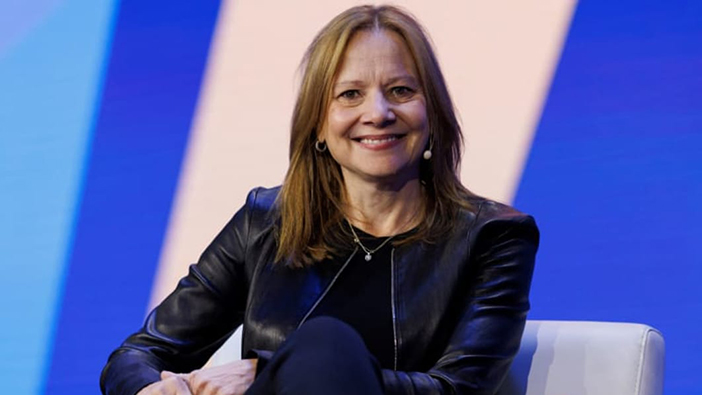
+++ Decades of climbing the ladder while challenging conventional thinking have brought Mary Barra to the present: the year of delivering on ambitious EV goals at storied automaker GENERAL MOTORS (GM). “I think in 2024, this is a year of of execution”, GM’s longtime chair and CEO said. “I think it’s a big year”. It certainly feels like it on a rainy day in late January, just miles outside of Detroit. Barra spent half the day with me touring a new Warren, Michigan, production facility that’s hand-making $300.000-plus Cadillac Celestiq EVs, which can be customized down to the stitching on the seats. These are some of the most expensive automobiles GM has ever made, and they don’t even have a petrol tank. The operation is impressively detailed from start to finish, as is the futuristic take on GM’s famed luxury brand Cadillac. As for the other part of the day, Barra took me for a spin in the new Corvette E-ray Hybrid; the American icon’s first hybrid. The supercar features an electric motor paired with a rear-mounted V8, giving it over 650 horsepower. Barra signed off on moving the engine from the front to rear several years back to better compete on performance with the likes of Ferrari and Lamborghini. It was a classic play from the Barra leadership playbook: bold but respectful of GM’s history. “I can’t take all the credit for the engine move”, Barra said from behind the wheel of the E-ray, heaping praise on the veteran gearheads in Corvette’s development team. Following in her father’s footsteps (he was a die maker at GM’s now-defunct Pontiac badge), Barra (62) began her journey inspecting fenders at a Pontiac plant at age 18. She went onto graduate from the General Motors Institute in 1985, where she obtained a Bachelor of Science in electrical engineering. From there, her career path was as curvy as a country road, with stints in communications, marketing and manufacturing. It’s these connections to the company’s history and operations that have given Barra a lot of credibility among the rank and file; something easily seen during our factory walk in Warren. Auto industry experts say Barra’s intricate knowledge of GM’s business has helped develop a balanced, gaffe-free leader that’s widely respected. “She’s got a style of leadership that’s a little bit maybe steadier and less prone to controversy than some of the others”, Sean Tucker, senior news editor at Cox Automotive, told. Altogether, Barra has drawn upon her rich experience to navigate a host of tricky situations since she was announced as CEO on December 10, 2013: the first woman to hold the top spot at a Big Three automaker. They have ranged from apologizing to victims of a faulty ignition switch early on in her tenure to contending with a prickly president Trump tweeting about the company during Covid to more recently dealing with UAW negotiations and an autonomous Cruise vehicle that fatally injured a pedestrian. Equally as tricky: pivoting GM to electric vehicles against a backdrop of range anxiety, fierce competition and still relatively high prices for the technology. Between 2020 and 2025, GM plans to invest $35 billion in electric vehicle and autonomous vehicle product development, exceeding its gas and diesel spend. The company plans to introduce the Silverado EV, GMC Sierra EV, Equinox EV, Escalade IQ and Celestiq in 2024 alone, pushing to the forefront of the EV revolution. They join an EV lineup headlined currently by the Lyriq and Hummer. Barra had sought to be all-electric by 2035 but has since softened the stance amid industry-wide weakness in EV sales. The company will lean into the rising popularity of hybrids as a means to bridge the gap. GM is still targeting $280 billion in total sales by 2030 (more than double that of 2021 sales) in part due to expectations around EVs. “We still believe in an all-electric future”, Barra said. Until recently, the heavy belief and investment in electric has weighed on GM’s stock price. “I believe Mary has done a commendable job of laying the yellow brick road to growth, but execution has been choppy. This has been like pushing a boulder uphill, but the tide is starting to turn for GM in our view”, Wedbush analyst Dan Ives told. “They are going to be successful in EVs, I am fairly confident in that”, Cox Automotive’s Tucker says. Whatever ends up happening, one thing can’t be denied: Barra’s place in the auto leadership history books. But ask Barra if she views herself as an iconic figure: “No. I feel very fortunate to be leading this team”. +++
+++ The ranks of would-be Tesla buyers in the United States are shrinking, according to a survey by market intelligence firm Caliber, which attributed the drop in part to CEO Elon MUSK ’s polarizing persona. While Tesla continued to post strong sales growth last year, helped by aggressive price cuts, the electric-vehicle maker is expected to report weak quarterly sales. Caliber’s “consideration score” for Tesla fell to 31% in February, less than half its high of 70% in November 2021 when it started tracking consumer interest in the brand. Tesla’s consideration score fell 8 percentage points from January alone even as Caliber’s scores for Mercedes, BMW and Audi, which produce gas as well as EV models, inched up during that same period, reaching 44-47%. Musk in the past has blamed high-interest rates for curbing consumer demand for big ticket items like cars. Caliber cited strong associations between Tesla’s reputation and that of Musk for the scores. “It’s very likely that Musk himself is contributing to the reputational downfall”, Caliber CEO Shahar Silbershatz told, saying his company’s survey shows 83% of Americans connect Musk with Tesla. Reuters spoke to 5 marketing, polling and car experts who said controversies surrounding Musk’s increasingly right-wing politics and public statements are weighing on Tesla’s brand and demand. “It is hard enough to win sales without getting into politics”, said Tim Calkins, a marketing professor at Northwestern University’s Kellogg School of Management. Economic fears, the lack of affordable new models and rising competition from cheaper rivals like China’s BYD have also been cited by Wall Street analysts as putting pressure on Tesla. Overall electric vehicle sales in the U.S. are forecast to increase 15% in the first quarter of this year, according to estimates by researcher Cox Automotive. Tesla sales are projected to increase by 3%. “The EV slowdown is shaping up to be a Tesla slowdown”, Cox analyst Stephanie Valdez Streaty said during a conference call. New car registrations for Teslas in California (their biggest market in the U.S.) posted their first drop in over 3 years in the 4th quarter of 2023 even as EV sales rose overall. At least 5 analysts cut Tesla’s target price last month, saying the automaker could post disappointing first-quarter delivery results. Tesla shares are down nearly 30% year to date. Musk’s outsized personality benefited Tesla as he promoted tackling climate change by reimagining cars as stylish, electric computers on wheels that could beat gasoline guzzlers in looks, performance and handling. Tesla achieved breakneck annual sales growth for more than a decade. In recent years, the billionaire courted controversy with comments and actions including his embrace of the Republican party and endorsement of anti-semitic comments on X. Musk has denied being anti-semitic. When asked by an investor during a January 2023 conference call if his political comments were hurting Tesla’s brand and sales, Musk said he was “reasonably popular”, referring to his then 127 million followers on X, formerly known as Twitter. “Whether you hate me, like me or are indifferent, do you want the best car, or do you not want the best car?”, Musk said at another event in November. Brand valuation consultancy Brand Finance found Tesla’s reputation fell in 2023 in the United States, the Netherlands, France, United Kingdom, and Australia. Tesla’s reputation did not suffer in China, where access to news on the company and its CEO may have been limited, and Germany. In the U.S., a survey by consumer analytics firm CivicScience shown exclusively to Reuters found that 42% of respondents had an unfavorable view of Musk in February, up from 34% in April 2022 when Musk disclosed his stake in Twitter. “A modest but growing number of EV shoppers are increasingly put off by Elon Musk’s behavior and politics and are now finding viable alternatives to Tesla in the marketplace”, Ed Kim, president of California-based consultancy AutoPacific said. That group includes Jonny Page, a London-based consultant who works with climate-focused startups and will purchase an EV this summer. It will not be a Tesla. Page, 36, said his decision is partly because of concerns over Tesla safety but mostly about Musk’s “unhinged” behavior. “I don’t want to put a single penny in that man’s pockets”, Page said. Tesla’s reputation is still sterling with many. Market researcher S&P Mobility shows Tesla has the highest loyalty among major car brands, with 68% of owners choosing another Tesla when they bought a new car last year. Christian Cook, a Tesla Model 3 owner in Texas who identified as leaning right, said Musk’s actions made no difference and that he was “becoming numb to the shenanigans”. Kat Beyer, a climate activist in Wisconsin, said she wanted to avoid Tesla because of Musk’s support for Republicans, but wound up buying a Model Y last year because of a lack of EVs with reliable charging infrastructure. “It’s hard to drive the car associated with him”, Beyer said. “But I can’t go back to gas”. +++
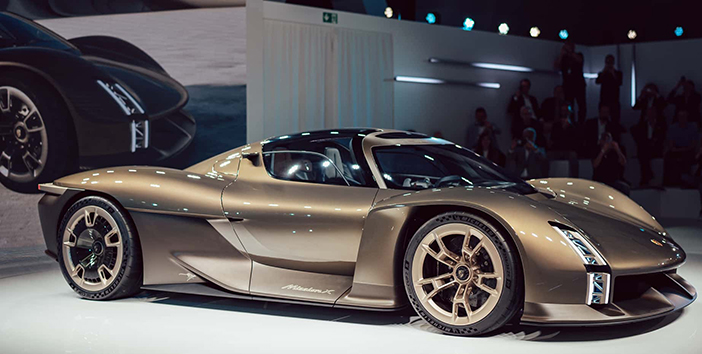
+++ PORSCHE hypercars have been few and far between. The 918 Spyder came out in 2013 while the Carrera GT launched in 2004. Even further back, the 959 debuted in 1986. In 2023, Mission X previewed a potential flagship model from Zuffenhausen. Later this year, a decision will be made whether to put the concept into production. If green-lighted, there’s going to be a major hardware change.
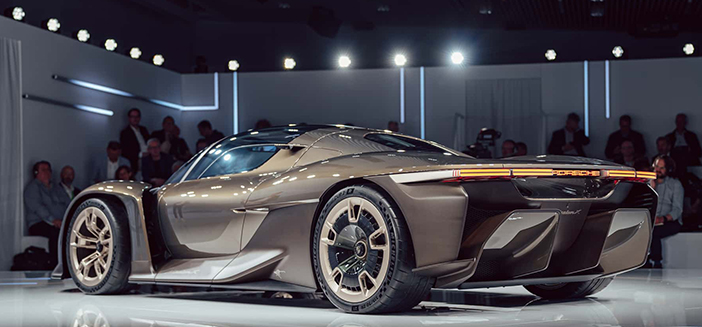
When the all-electric Mission X debuted in June 2023 to celebrate Porsche’s 75th anniversary, the concept had a rear-wheel-drive layout. However, a subsequent road-legal car would switch to an all-wheel-drive setup. Not to unlock extra performance, but to improve efficiency. As weird as that might sound when talking about a hypercar, it makes sense. An AWD setup would significantly increase energy recovery to put more juice back into the battery and help extend the range. Mission X project manager Michael Behr explained why AWD would be adopted: “It’s an electric car and you need a 4-wheeldriven car to recuperate a lot of energy for the battery to have a bigger range on the Nordschleife, not just for 1 lap, maybe for 3 laps”. That’s still an extremely low range considering the track is just under 13 miles long, so 3 laps would be 39 miles. However, Behr was talking about 3 laps performed by a driver who knows what they’re doing and can extract every drop of performance from the Mission X. Driven at a regular pace, the electric hypercar would likely have a significantly higher range. That said, it’s obvious Porsche doesn’t want to cram in a huge battery to extend range since that would add weight. It would be difficult to install a supersized battery anyway since the concept was only 4,5 meter long, so there would be packaging constraints. Behr mentioned the wheelbase would be altered for a production version compared to the concept, which measured 2,73 meter between the axles. In the concept, the battery was mounted centrally behind the seats and featured direct oil cooling. Porsche developed the Mission X with a 900 volt system architecture to enable charging speeds about twice as quickly as the pre-facelift Taycan Turbo S. The updated electric sedan now supports 320 kW charging power instead of 270 kW and can replenish the battery from 10 to 80 percent in 18 minutes. During the same interview, Behr suggested the production version is likely to be sold strictly with a left-hand-drive layout to reduce complexity. He added it would have more headroom than the 918 Spyder, enabling drivers to comfortably use a helmet. This will be possible by fitting doors that open upwards and forward in the same vein as on the 917 Le Mans racer, which also had the curved glass extending onto the roof. Porsche has previously said it will approve the Mission X for production only if it meets certain criteria. It must generate more downforce than the 911 GT3 RS and feature a power-to-weight ratio of 1 to 1. In addition, it must double the charging speed of a Taycan Turbo S. Most importantly, it must set a record for a street-legal production car around the Nürburgring. The title currently belongs to the Mercedes-AMG One with a lap time of 6 minutes and 35.18 seconds. Porsche holds the outright record around the Green Hell with the track-only 919 Hybrid Evo and an incredible 5:19.55 lap. +++
+++ RENAULT is set to launch an electric version of the next-generation Clio to sit above the reborn 5 as a slightly larger and more family-focused supermini. As previously reported by Autointernationaal.nl, Renault will introduce a new-generation Clio in 2026. In line with its commitment to provide small, affordable cars as it electrifies its line-up, the new Clio will continue to be offered with a full-hybrid petrol powertrain, but the flexibility of its architecture means an EV is possible too. The electric Clio will sit on a variation of the new Ampère Small platform, which underpins the new Renault 5, while the combustion version will continue to use the CMF-B architecture that is underneath today’s car. Ampère Small will be produced in 3 sizes: one for the 4 and 5 superminis, a smaller version for the reborn Twingo E-Tech and a larger version that can be used for an electric Clio to directly rival the Peugeot e-208 and MG 4 EV. While notionally separate architectures, Renault’s 2 B-segment platforms are closely related (with roughly 60% carry-over from CMF-B to its electric-only equivalent) so they share key mounting points, suspension structures and dimensions. This means they can accommodate the same body (or ‘top hat’) and thus the petrol and electric Clio models can be fundamentally identical. The new Clio will look substantially different from the current car, which itself bears a strong visual resemblance to the previous generation, launched in 2012. Renault design director Gilles Vidal is expected to bring the new Clio into line with the Mégane and Scenic E-Techs while drawing influence from the range-topping Austral and Rafale, leaving the retro cues to its smaller 4 and 5 platform-mates. It will be around 20 mm longer than the 5, putting it roughly in line with the current Clio, which measures 4.053 mm bumper to bumper. That small increase will not be obvious externally, but should allow for a tangible increase in load capacity and rear leg room. Ultimately, sources suggest, offering an electric Clio alongside the 5 is more about providing customers with greater choice than filling every gap in the line-up. In any case, Renault bosses do not see the 5 as a replacement for the Clio. Indeed, product performance boss Bruno Vanel has previously told that “Clio is a brand in itself”, hinting at the importance of retaining the well-known name for another generation. Renault is committed to keeping costs down for its small electric cars, so any electric Clio would no doubt command just a small premium over the 5 E-Tech, which is being launched at around €29.000 in the Netherlands. A starting price of just under €35.000 would neatly fill the gap between the 5 E-Tech and the Mégane E-Tech, which is currently available in the Netherlands from €36.370 euro. However, Renault engineering boss Gilles Le Borgne suggested offering an electric Clio is not an immediate priority for the new-generation car’s launch in 2026 because, in theory, “you can have a whole life of ICE, hybrid Clio before the ICE ban” in 2035. Nonetheless, he remains a vocal proponent of offering ‘multi-energy’ powertrain options on the same platform, so long as it is affordable (and profitable) to do so. “It’s like religion. We always fight over multi-energy. Perhaps you know my background”, said Le Borgne, referring to a 30-year tenure at the PSA Group, during which he oversaw the development of electrified powertrains for Peugeot, Citroën, DS and Opel. “I was the one fighting for multi-energy on the other side of the river, and I have no religion. I’m very practical. When I can use multi-energy, I do”. +++
+++ TESLA has a plan to fend off cheaper competition from China with a €33.000 electric car. But first it has to overhaul a 100-year-old manufacturing process pioneered by Henry Ford. The company is moving to what it calls an “unboxed” approach, which is more like building Legos than a traditional production line. Instead of a large, rectangular car moving along a linear conveyer belt, parts are assembled simultaneously in dedicated areas and then the subassemblies are all put together at the end. Tesla says the change could reduce manufacturing footprints by more than 40%, allowing the carmaker to build future plants far faster and at less expense. If the new assembly process is successful, Tesla says it can slash production costs in half. That will be key to delivering a cheap enough car to stoke demand that’s slowed of late and pressured the electric-car maker’s stock price. Tesla shares are down 29% so far this year, compared to a 10% increase in the S&P 500 during the same period. “If we’re going to scale the way we want to do, we have to rethink manufacturing again”, Lars Moravy, Tesla’s vice president of vehicle engineering, said during the company’s March 2023 investor day. The problem is that investors haven’t heard many details about how Tesla has progressed with the idea since then, even as Chinese automakers have slashed costs and Detroit carmakers have refocused their efforts on cheaper models, as well. On the company’s most recent earnings call in January, chief executive officer Elon Musk stuck to generalities, saying only that Tesla was “very far along” on making a cheaper car, which is slated to start production at the end of next year. While he mentioned the new “revolutionary manufacturing system,” calling it “far more advanced than any automotive manufacturing system in the world, by a significant margin”, he didn’t elaborate. Musk is notorious for missing deadlines, and some on Wall Street are dubious that Musk can meet his already-delayed timeline (he first teased a €33.000 EV way back in 2020) much less the savings targets. Tesla’s method is unproven, and may come with its own inefficiencies and risks. A recent analysis estimated that the new modular manufacturing process would cut costs by 33%, not half. In the absence of details, some people are taking it upon themselves to figure out how well the system might work. Mathew Vachaparampil, CEO of Caresoft, an engineering and automotive benchmarking firm, said his company’s engineers spent 200,000 hours building a digital replica of Tesla’s unboxed platform. They found that Musk’s ambitions are technically possible, and Vachaparampil said they would make “huge financial sense”, if achieved. The old ‘Ford manufacturing’ process, Tesla executives say, is rife with inefficiencies. Moving a car-sized “box” through a factory takes up a lot of space. Painting an entire machine, instead of just the panels that need it, takes time and wastes energy. And working off of a hulking frame means only a few people can assemble their parts at a given time. The unboxed method doesn’t require a big skeleton of a machine to move through a factory. Instead, splitting off into small groups, workers labor on various components of a vehicle simultaneously before it comes together at a single point in final assembly. The potential cost savings are substantial, according to Vachaparampil. Caresoft sees at least a 50% reduction in paint-shop investment in new factories alone. Paint has long been the most expensive part of any auto plant: The high heat required for automotive paint is energy intensive, and there are strict emissions requirements. The throughput of the paint shop largely determines a plant’s total output, according to auto plant experts. A typical car body is 1.8 meters wide and 4.5 meters long. Instead of sending the entire rectangular body through a paint shop, Tesla’s unboxed process will paint the individual panels before the car is assembled. The unboxed method has plenty of risks of its own, mainly that it’s unproven and requires shifting to a new assembly process, which could lead to production delays. But it’s not the first time Tesla has made significant changes to improve long-held manufacturing practices. With its Model Y, instead of stamping various pieces of the car, Tesla turned to die-casting machine presses to ‘gigacast’ (or create giant molds) of the front and rear of the vehicle. That eliminated the need for hundreds of parts and welds. Other U.S. automakers are also working to fend off the competitive threat posed by Chinese cars. Ford, for example, is exploring a compact EV that would use a cheaper battery. “The concern is that the lower end of the automotive market isn’t currently being served by electric vehicles, but they will be served by China if U.S.. companies can’t cut costs”, said Susan Helper, a professor of economics at Case Western University, who recently served as a senior adviser for industrial strategy at the White House Office of Management and Budget. But Musk’s company has an edge over longtime automakers in adapting to novel, potentially cheaper manufacturing techniques. Tesla’s factories are newer than most, and some aren’t even under construction yet, so it can more easily and cheaply tailor its facilities to run on cutting-edge manufacturing methods. That doesn’t mean it’s easy. The company has warned investors that it’s “between two major growth waves” as demand for the Model 3 and Model Y (both of which have been out for years) tops out. Tesla delivered 1.8 million cars last year, but aims to deliver 20 million cars by 2030. To do that, it will need much cheaper cars. +++
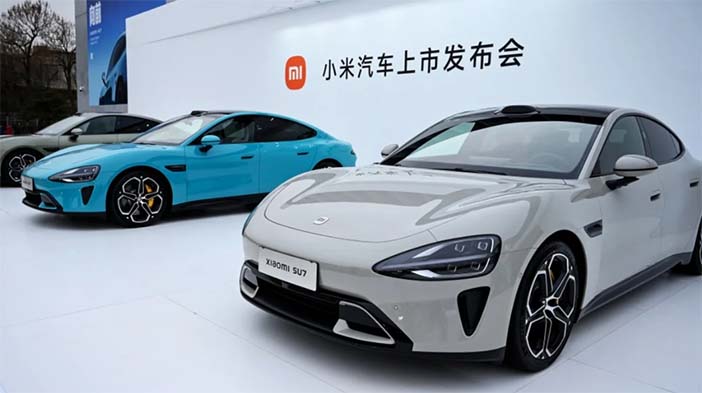
+++ Customers wishing to purchase one of Chinese smartphone maker XIAOMI ’s new electric vehicles could be kept waiting for up to 7 months. The company advised potential buyers that wait times for its SU7 electric sedan could range from 4 to 7 months, Xiaomi’s car app said. Last week, Xiaomi launched its first line of EVs, the Speed Ultra 7 (SU7), at a lavish event in Beijing. Within 24 hours of the launch, pre-orders for the vehicle had hit 88.898. It comes just over a month after Apple abandoned its own decadelong EV dream following a string of design issues and leadership changes. While the delays may be a promising sign of strong demand for the SU7, the Beijing-based tech giant has entered the EV market at a precarious time. The market for electric vehicles has generally been on the decline, and the company faces steep competition in China. Leading EV companies, including Tesla and BYD, have been slashing prices in a price war aimed at winning over consumers. Xiaomi is also aiming for the upper end of the Chinese auto market. Xiaomi’s standard SU7 costs 215.900 yuan, which is around €40.000 in Dutch pricing. That’s roughly €4.000 less than Tesla’s Model 3 in the Netherlands. Analysts said Xiaomi may benefit from its smartphone expertise, as it could help the company design smart dashboards. Xiaomi also has much larger cash reserves to fall back on than smaller EV startups, meaning it could be well-placed to navigate China’s crowded market. +++