
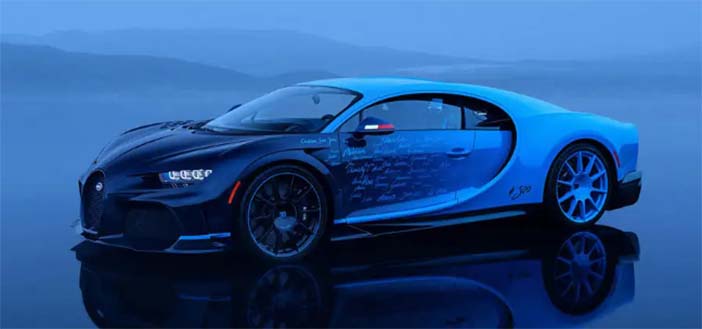
+++ Production of the BUGATTI CHIRON has come to an end, a month before its successor is due to be revealed. Finishing its 8-year lineage with the Super Sport l’Ultime, the special edition (limited to just 1 car) pairs a bespoke exterior paint with commemorative badging. This final model also marks the end of the French brand’s famed W16 engine, which is set to be replaced in the Chiron’s successor by a 1000bhp hybridised naturally aspirated V16. Bugatti recently revealed the shape and layout of that engine, as well as its screaming soundtrack, and CEO Mate Rimac gave extra details in an interview. While keeping most cards close to his chest, Rimac revealed that the colossal engine goes without forced induction, unlike its W16 predecessor, which inhaled through 4 turbochargers. The engine itself, he added, will measure a whopping 1-metre long in its own right: 400 mm longer than the 4-bank unit from the Chiron. Despite that, though (and the integration of a substantial electric drivetrain element), the car will be a similar shape to its predecessor, Rimac suggested. He said: “The exterior is an evolution. You can still see the very distinct Bugatti design”. Certainly, spy shots circulating the internet in recent weeks indicate that it will have a familiar silhouette, but be somewhat lower and sleeker than the Chiron it replaces. Rimac, despite being best known for his pioneering work creating electric hypercars and supplying battery tech to a number of global car manufacturers, said he was a driving force behind bringing the V16 to fruition. Before his eponymous firm took over Bugatti from the Volkswagen Group, he said: “The business plan was to make an electric coupé-SUV type of thing”. “Management was saying the next car has to be electric”, he added, acknowledging that a rebadged and restyled version of the Rimac Nevera would have theoretically made a logical electric replacement for the Chiron. But maintaining differentiation between the 2 hypercar brands, while honouring the heritage of Bugatti, was essential. Rimac said: “You could very easily and convincingly make a Bugatti out of the Nevera (just make a different design and call it a day), but I thought that was absolutely wrong for the brand. “Luckily, I won that argument 3 years ago when electrification was all the rage, which it isn’t any more”. Rimac was referring to the perceived decline in demand for electric hypercars, acknowledging that his firm has still not sold all 150 units of the Nevera. In addition, Rimac said, any Bugatti powerplant should be “as emotional as possible”. Referencing founder Ettore Bugatti’s famous slogan, he said: “You can achieve the power figures we have with the V16 from a very highly turbocharged V8, but we wanted to have it very emotional. It has to feel special, because ‘if it is comparable, it is no longer Bugatti'”. As for that power figure, while refusing to be drawn into giving a specific number, he suggested the next Bugatti will have comfortably more than 1.000 hp. Given the size of the engine and the introduction of a hybrid element, it seems likely the new car will comfortably eclipse the W16’s 1.600 hp maximum. It will be the first production car in decades to use such an engine, the last having been the ultra-rare Cizeta-Moroder V16T in 1991. Bugatti has not given any more details about the engine, such as its capacity. Various reports say it is 8.3 litres in capacity, and has been developed by Cosworth, though neither Bugatti nor the British firm have confirmed these details. The firm describes its first hybrid powertrain as “incomparable in every detail, it is a pure embodiment of Bugatti’s DNA, created not just for the present, or even the future, but ‘Pour l’éternité’ “: for eternity. Previously, it was thought that Bugatti would downsize its engine in light of the potential electric power boost provided by a hybrid drivetrain, and the need to accommodate a battery and electric motors, but clearly the firm has found a means to stay true its 16-cylinder lineage as it embraces electrification. The firm had already told that the new powertrain would be “unlike anything else on sale” but had stopped short of revealing any technical details. The design of the car itself was signed off early last year, with designer Achim Anscheidt (who stepped down as Bugatti’s design chief recently) telling that it will “bring forward” Bugatti into a new era while retaining signature cues such as the horseshoe grille and crescent-shaped belt line. Frank Heyl, his replacement, promised the new car will be “even more amazing” than the Chiron: “It’s going to be amazing. Proportionally, technologically, in terms of innovation and in terms of unexpectedness. It’s going to blow people out of the water completely, and it’s a true joy to work on this”. It is not yet confirmed whether the hybrid drivetrain will allow for engine-off running, or whether the 2 propulsion systems will work in tandem for maximum power output. +++
+++ HUAWEI ’s 4th joint venture with a Chinese automaker may not have an official name yet, but the tech giant’s CEO has made some pretty bold statements about its future products. Yu Chengdong, the head of Huawei’s Smart Car Solutions, stated that their partnership with JAC aims to surpass Maybach and Rolls-Royce in terms of luxury and comfort. More specifically, Chengdong stated, “Yes, the name of Huawei-JAC has not been decided yet. This may be a million-level car, very high-end. Our benchmark far exceeds the level of Maybach and Rolls-Royce Phantom. It is more luxurious, higher-end, and more comfortable than them”. A Chinese electric car priced around ¥1 million (about $140,000 at current exchange rates) challenging established titans like the Rolls-Royce Phantom and Mercedes-Maybach S-Class in refinement? It sounds ambitious. But that’s exactly the target Huawei’s CEO has set for their new co-branded venture, aiming to disrupt the ultra-luxury car market. The first model from the new joint venture is rumoured to be a spacious sedan featuring a fully electric powertrain. This ultra-luxurious EV is expected to make its debut in the fourth quarter of 2024, positioning itself as a direct competitor to flagship models like the BMW i7 and the Mercedes-Benz EQS. The new automotive brand being created by Huawei and JAC will represent the “fourth realm” of the Hima project. This ultra-luxury offering will sit above existing Huawei partnerships like the high-end Stelato (BAIC), midrange Luxeed (Chery) and SUV-focused Aito (Seres). All 4 brands cater to young demographics, emphasizing high-tech features and practicality in their marketing. During the same interview, Yu Chengdong revealed that he alternates between driving the Luxeed S7 sedan and the Aito M9 SUV as his daily rides. He praised both vehicles as excellent products, highlighting their Lidar technology and safety features as “truly ahead of the entire industry”. Additionally, he expressed pride in the impressive driving range of Huawei-backed models, ranging between 705-855 km, which surpasses offerings from rival manufacturers. Yu Chengdong was also questioned about the principles from the mobile phone industry that could be adapted to the automotive sector. According to the CEO, these principles encompass the user experience, user satisfaction, product quality, and customer service. +++
+++ When HYUNDAI revealed the Ioniq 6 in 2022, Porsche fans were quick to point out the visual similarities between it and their favourite brand’s vehicles. But Hyundai’s latest hire could mean an Ioniq 6 successor won’t only look like a Porsche, but also drive like one. The Hyundai Motor Group has signed up Manfred Harrer, a 51-year-old German engineer who spent 14 years at Porsche, where he worked on vehicles like the Cayenne and also the Taycan, for which he was vice-president of chassis development. Harrer’s resume also includes stints at BMW and Audi, but by far the most intriguing bit of his work history includes the time he spent working on the iCar, following his move to Apple in the spring of 2021. But Apple killed the iCar (codenamed Project Titan) in February of this year. No doubt his new Korean co-workers will be fascinated to hear what went down there, but Harrer’s number-1 priority is to make sure the Hyundai Group’s various performance and luxury products drive like true enthusiast cars. As executive vice-president and head of the new Genesis & Performance Development tech unit, he’ll work under the umbrella of the Hyundai-Kia Research and Development operation on upcoming cars from both Genesis and Hyundai’s sporty N sub-brand. Hyundai-Kia R&D boss Yang Heui-won seems as keen on the clout Harrer’s name brings within the industry as he does his expertise, stating that his appointment enhances “the image and reputation of our mobility brands”, though he’s no doubt hoping there’s more to Harrer than a nice set of antique business cards. “My commitment to Hyundai is driven by a profound belief in their visionary approach to advanced mobility solutions”, said the press officer who wrote these words we’re meant to believe Harrer spoke himself. “With my extensive experience in the automotive and tech industry, I am dedicated to playing a pivotal role in the future evolution of Genesis and high-performance vehicles within the Group”. +++
+++ LUCID chief executive Peter Rawlinson has suggested that Tesla has become “distracted” and no longer has the “sense of purpose” that it used to. During a recent interview, Rawlinson said it’s now up to Lucid to push electric vehicle technologies to new heights. Rawlinson, who once served as the chief engineer for the Model S, didn’t directly mention Elon Musk in the interview but made statements that seem related to him. “Tesla was truly at the cutting edge developing the most advanced technology with a clarity of vision and purpose and an absolute singularity of mindset”, he said. “And what I’m seeing now is a worrying trend towards a sort of distraction”. “There’s an interest in social media, even politics, and it’s kind of losing its way”, he added, seemingly referencing Musk’s purchase of Twitter and recent reports he could become a policy advisor if Donald Trump wins this year’s U.S. election. “I don’t see it having that singular sense of purpose, and I think it really falls to Lucid to take the technology to a whole new level now”. Rawlinson believes Lucid’s technology is “many years ahead” of other car manufacturers, including Tesla. Last year, the firm entered into a long-term strategic partnership to share its advanced electric powertrain technology with Aston Martin. Genesis could also use Lucid motors in the future. While Lucid has the technology nailed, it still needs to ramp up deliveries. In 2023, it delivered just 6.001 vehicles and produced 8.428. Production is expected to grow slightly to 9.000 this year, but that’s still not enough to make it a volume player in the EV market. +++
+++ Rich people don’t need to worry about depreciation the same way us regular folk do, but they might be worried about the shame of being seen in outdated cars, so ROLLS-ROYCE ’s strategy of making only minimal changes at facelift time is sure to keep existing owners happy. In the last couple of years the Phantom and, more recently, the Cullinan, have received mid-life makeovers that are so discrete the updates can be hard to spot. And it looks like smaller Ghost will be following suit later this year. I last spotted the revised Ghost undergoing winter tests in a snowy Sweden, but latest images that the bikini disguise is only covering the nose. This tells us not to expect anything new from the profile view or at the rear, except a redesigned taillight graphic. But the front led lights will definitely be slimmer and it looks like they might be less rectangular than the current lamps. The lights themselves appear more eye-shaped, with a narrower section near the grille that will help create more visual differentiation between the Ghost and Rolls’ other models. The lower bumper will also be new; its horizontal slats emphasizing the car’s width, and the ADAS sensor at the center, below the license plate, will be reshaped, and presumably brings more sophisticated driver assistance features. One thing about the current Ghost that should be staying put is its 6.75-liter V12. The twin-turbo motor makes 570 hp in standard tune and 600 hp / 900 Nm of torque in Black Badge guise, and since those outputs exactly match those of the facelifted Cullinan, I’m not expecting the Ghost to gain any additional horses when it arrives, probably later this year. +++
+++ TESLA has aggressively cut production of the Model Y at its Shanghai factory in recent months due to slowing demand for the EV, but it’s unclear if similar cuts are planned at its factories in the U.S. and Germany. Information from the China Association of Automobile Manufacturers (CAAM) reveals that the Shanghai site built 49.498 Model Ys in March and 36.610 units in April; a significant decline of 17.7% and 33% from the same months in 2023. An unnamed source has told that Tesla planned to cut Model Y output by at least 20% from March to June. Both the Model 3 and Model Y are manufactured at the Chinese factory. The carmaker built 287.359 vehicles at the Shanghai site in the first 4 months of the year. Interestingly, while this is 5% lower than the same period in 2023, production of the Model 3 has increased by 10%. Tesla reportedly aims to sell between 600.000 and 700.000 vehicles in China this year, of the roughly 2 million cars it intends to sell globally. By comparison: it sold 603.664 cars in the country in 2023. The manufacturer’s share of China’s battery-electric and plug-in hybrid market slipped to 6.8% through the first 4 months of this year, down from 7.8% a year ago. Tesla is developing new affordable models to slot below the Model 3 and Model Y in its line-up. These models were initially expected to be all-new cars built from the ground up but a report last month asserted they will be stripped-down versions of the Model 3 and Model Y. Tesla is remaining tight-lipped about its entry-level models and has said they will use existing platforms and be built on current production lines. +++
+++ Future GR-branded models from TOYOTA GAZOO RACING (GR) will retain internal combustion engines, despite the industry’s ongoing shift towards battery-electric vehicles. Fully-fledged performance models like the GR Corolla, GR Yaris, GR Supra and GR 86, have put Toyota back on the sports car map and in the case of the Corolla and Yaris, have added new spice to the hot hatch market. During a recent interview, Toyota Gazoo Racing president Tomoya Takahashi offered assurances that GR-branded models will retain combustion engines. “We want to use internal combustion engines as much as possible”, he told. “There may be a time in the future when engines are banned, but internal combustion engines aren’t bad, the enemy is carbon. We are investing in future engines”. While many car manufacturers plan to shift to all-electric models, Toyota is adopting a “multi-pathway” approach to reducing emissions. Takahashi noted that the GR division can use hybrid powertrains to cut its emissions and is also open to using carbon-neutral fuels. “By using hybrid technology, we can reduce carbon emissions, and we can also use carbon neutral fuels”, he said. “We’re not sure about electrification and when it’s happening. Globally, there are discussions that cars won’t all be electric. Nobody can see ten years into the future. Our direction is multi-pathway, not only EV”. During his interview, Takahashi added that Gazoo Racing isn’t interested in making fast cars, like some of the quick electric vehicles on the market, but wants to make fun cars. “There is a difference between a fast car and a good car. We want to make better cars”, he said. Last week, Gazoo Racing’s boss suggested the company’s next model could be a performance-focused SUV. Possible candidates for the GR treatment could be the C-HR and Yaris Cross, but Toyota could pull something out of left field and make a hotted-up Corolla Cross or RAV4. +++