
+++ AUDI is partnering with SAIC to develop a new China-specific architecture known as the ‘Advanced Digitized Platform’ for its next generation of electric vehicles. The 2 manufacturers first joined forces last year as Audi attempts to expand its presence in the world’s largest car market. The collaboration will initially result in 3 new battery-electric vehicles in the B and C segments, allowing Audi to reduce its time-to-market by more than 30%. Its first new BEV created with SAIC will be launched next year. “The deepened cooperation marks a significant milestone in Audi’s China strategy and further strengthens our local partnership with SAIC”, Audi chief executive Gernot Döllner said. “We have a clear and common goal: to combine the best of our 2 companies to the full advantage of our Chinese customers with Audi’s premium experience and SAIC’s innovation speed in China. Through the partnership with SAIC, we will significantly accelerate our local electrification strategy and deliver smart BEV products catering to Chinese customers’ needs. Audi’s unmistakable aesthetics and engineering together with the innovation speed of SAIC will offer Chinese customers intuitive and smart digital premium experiences, as well as automated driving features”. Fermin Soneira from Audi has been named chief executive of the joint project. He has previously served as the head of Product Line for Electric Models from the A to C Segment at Audi and has more than 25 years of experience within the Volkswagen Group. When the first models underpinned by the new Advanced Digitized Platform launch, Audi will be selling BEVs in China based on three distinct architectures. The MEB platform underpins the existing Q4 e-Tron and Q5 e-Tron, and Audi will also introduce a BEV in China with FAW based on its Premium Platform Electric (PPE) architecture. +++
+++ CHEVROLET ’s new lineup of electric vehicles is arguably showing up at the worst possible time. After a few years of rapid growth, EV sales are hitting a plateau. This has led to massive changes in EV strategies at most major automakers, with many now pivoting to hybrids. And yet, Chevrolet chief marketing officer Steve Majoros doesn’t seem worried about the company’s chances in this new EV market. “I think it actually benefits Chevrolet”, Majoros says of the changing EV market, which is now dominated by more frugal and practical customers; Chevrolet’s bread and butter. Given that, he says, Chevrolet is pressing forward with EVs in hopes that their offerings can break through. This lean-in approach is a classic strategy for a mass-market brand like Chevrolet. For years, Chevrolet has offered a wide range of pickup trucks, SUVs and crossovers to meet demand for a huge swath of customers. Simply by slotting vehicles in a segment and at a certain price point, Chevrolet, typically the third-largest brand in the United States after Ford and Toyota, is able to siphon off market share from competitors and grow its volume. It appears the brand is taking the same approach with its EVs, but it could turn out to be a risky move. Chevrolet’s first attempt at electrifying an existing nameplate, the Blazer EV, got off to a rocky start with a stop-sale related to software issues. Majoros insisted Blazer EV is recovering and notched impressive monthly sales, but didn’t provide specifics since GM no longer shares monthly sales numbers. Chevrolet is banking on the conventional wisdom in the automotive industry that half the battle of converting a customer to an EV is getting them in front of the vehicle. Majoros offers a point of proof that a flood-the-zone approach might be working: Dealers and their employees, often the first to experience these electric cars, are also among Chevrolet’s most reliable early EV adopters. “We’re talking to a lot of first-time EV buyers with the Blazer EV, and a lot of them are dealership employees”, Majoros said. “They get the first look at these cars, they test drive them and realize, ‘This thing’s pretty damn good’ “. Dealers and their employees buying up their own EV supply isn’t necessarily a new phenomenon. Many of them see EV ownership as a requirement for selling these high-tech cars in order to speak with authority about the experience of driving, charging, and daily maintenance. Dealers who own EVs are often enthusiastic about their battery-powered cars, but the trouble comes when trying to convince their customers. Factors like steep upfront costs, quirks of ownership, and overall lifestyle changes required to replace a gas-powered car with an EV keeps an entire swath of customers out of the battery-electric segment, dealers say. Majoros concedes those points but thinks Chevy is poised to change a lot of minds with its new mass-market line-up of EVs. The Equinox, in particular, slots into the current EV market well, with a starting price of $43.295 and an estimated range of 510 km. “We’re on the precipice of this click for a lot of customers”, Majoros said. “Every year, or even every month, more people own EVs, talk about them with their friends or coworkers: all those factors add up for a brand like Chevrolet”. While Chevrolet waits for this “click” to happen, Majoros points out that the brand still has plenty of gas-powered cars to keep dealer lots humming. He also pointed to GM’s plans to integrate hybrids into the U.S. market but didn’t offer a timeline for those releases. GM isn’t the only automaker relying on its gas-powered profits to shepherd it through this EV slowdown. Other legacy car companies are pulling back on EV goals, leaning harder into hybrids, and relying on the success of traditional gas guzzlers to offset losses in the still unprofitable EV business. Chevrolet’s dealers “have that reassurance of a pretty good and steady base of internal combustion engine product”, Majoros told a group of journalists. “We are going nowhere in that space”. +++
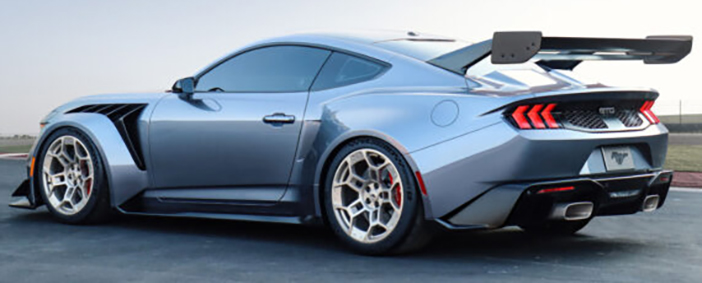
+++ The new Mustang GTD was forged to be the weapon with which FORD intends to conquer international road racing. On the quest to elevate its high-performance pony car, Ford is taking the GTD on a European tour to coincide with its debut at the 24 Hours of Le Mans on June 21. To commemorate it all, Ford is kicking off a new digital series that documents the GTD’s development. “These images and videos show high-performance equipment in ways that match the high-performance nature of the Mustang GTD”, Ford’s announcement said. They will be released via various social media channels, including YouTube and TikTok, suggesting that the campaign will likely progress beyond still CGI images to video content. “We’ve tested the Mustang GTD in North America extensively, including laps at Sebring International Raceway and Virginia International Raceway. This has all been in service of engineering a car that can lap the Nürburgring in under seven minutes”, said Mustang GTD chief program engineer Greg Goodall. “Moving onto European roads and dedicated test sessions at the Nürburgring is the next step, ahead of a timed run later this year”. And by later this year, Goodall means Q4, following the GTD’s appearances at the 24 Hours of Spa and the Goodwood Festival of Speed. Ford’s hype engine is coming online just in time for European customers to start requesting reservations for the GTD; details of that are to follow in June. More than 7,500 customers raised their hands for allocations of 2025 and 2026 GTDs; how European enthusiasts will respond to the opportunity remains to be seen. +++
+++ PEDESTRIAN DEATHS in the United States have climbed dramatically over the past 5 years, likely due to an increase in distracted driving and other factors. Whatever the cause, it’s become clear that hybrids and electric vehicles are more dangerous to pedestrians. A recent study in the United Kingdom showed that they’re twice as likely to strike pedestrians than vehicles with combustion engines and up to three times more likely to do so in urban areas. Before going too far, this isn’t an EV hit piece, and it’s not intended to say that electrified vehicles are bad. They are, however, quieter than gas cars, making it more difficult to hear one approaching, despite being required to generate a sound at lower speeds. They also tend to be driven by younger drivers with less experience. While this study took place in the United Kingdom, a 2017 study from the American Department of Transportation showed that EVs and hybrids present a 20 percent higher risk than internal combustion-powered cars, a risk that rises to 50 percent during low speed maneuvers. One of the study’s authors, Phil Edwards, said, “Electric cars are a hazard to pedestrians because they are less likely to be heard than petrol or diesel cars. The government needs to mitigate these risks if they are going to phase out the sale of petrol and diesel cars. If you’re moving to an electric car, remember that it’s a new kind of vehicle. They are much quieter than the old-fashioned cars, and pedestrians have learned to navigate roads by listening for traffic. Drivers of these vehicles need to be extra cautious”. Edwards also cited EVs’ stronger acceleration and greater weight as problems that can extend their stopping distances. His view is that if the government is going to promote electrification, it also needs to step in with more robust requirements to make pedestrians safer. +++
+++ In February, Volvo made the decision to stop providing funding to POLESTAR and off-loaded its stake to Geely. This took much of the car industry by surprise, but according to Polestar chief executive Thomas Ingenlath, it was always part of the plan. Polestar was formed as a standalone electric vehicle brand in 2017 and for the first five years, relied largely on funding from Volvo and Geely. In mid-2022, it went public on the Nasdaq and in the middle of February this year, raised $950 million in private funding from 12 international banks. Ingenlath said Polestar could no longer rely on internal financing: “It was always clear the money we needed should not come out of the pockets of our owners”, he said. “We had to find financing that wasn’t simply going to Volvo and Geely saying: ‘Mummy, Daddy, we need more money’. That was always the point, and we talked about the financing and equity required to cover this €1.2 billion. At the end of 2023 we were well progressed but we couldn’t at that stage say more. Then of course, when we were finally able to announce we’d raised €950 million (from 12 international banks, announced in late February) it was 2 weeks too late to counterstrike the headlines that came when Volvo announced they would reduce ownership, and everybody thought like, ‘Oh, this is a big crisis situation!’ For us, it was a non-dramatic situation”. Ingenlath added “the plan was always for Volvo to let off ownership” but said it will remain a partner “with whom we need synergies with manufacturing, the service network, and so on”. The company’s reduced reliance on Volvo and Geely is visible in its current range and future products. Whereas the Polestar 2 shares its CMA platform with the XC40 and uses many Volvo parts, as does the Polestar 3, the new Polestar 4 uses more Geely parts while the forthcoming Polestar 5 and Polestar 6 are underpinned by the firm’s own bonded aluminium chassis technology. “Our segment is very premium, expensive cars, and that’s where we want to convince”, he added. “We are definitely not just building computers on wheels. We are building cars that are amazing to drive. We acknowledge that driving can be a very physical, emotional experience, and it needs a lot of craftsmanship and knowledge to tune these cars so that they are not just a piece of software but actually a really nicely performing physical thing”. +++
+++ The TOYOTA Gazoo Racing division is on a roll lately, offering a series of well-received sports cars (GR 86 and GR Supra) and hot hatches (GR Yaris and GR Corolla). But its boss thinks they need to be joined by (what else, in this day and age) a performance SUV. Gazoo Racing president Tomoya Takahashi believes that the company should cater to customers who seek a spacious and practical vehicle without sacrificing performance. In some markets, Toyota already offers GR Sport versions for most of its SUVs, which include styling and suspension upgrades. However, these are far milder compared to the full-fledged GR products, which feature increased power levels and more aggressive aesthetics. Speaking to Australian media, Tomoya Takahashi said: “In the future, from my point of view we need a GR SUV. Some people can only use SUVs because they have a family or need space. To expand our brand, maybe an SUV is needed”. However, the Gazoo Racing boss also said that the firm has limited resources when it comes to developing new products, so they need to prioritize. Takahashi didn’t specify which model will come first, but Toyota has plenty of SUVs to choose from, depending on the market. The most road-focused offerings that would be fitting candidates for the Gazoo Racing treatment are the Yaris Cross, C-HR and Corolla Cross, with the larger and quite popular RAV4 also being a global contender. On the other hand, ladder-frame SUVs like the Land Cruiser 250 and 300 Series are are more challenging to tune for improved on-road handling, as doing so could compromise their off-road capabilities. This is why Toyota prioritized ruggedness over sportiness in the Land Cruiser GR Sport, making it more capable than the standard version. A potential GR C-HR could feature lower suspension, new wheels, upgraded brakes and a sportier body kit. Built on the TNGA-C architecture, it should be compatible with the 1.6-liter 3-cylinder turbo-powertrain from the GR Yaris and the GR Corolla, capable of producing up to 304 hp. It’s worth noting that the C-HR already incorporates Toyota’s E-Four AWD system, which sounds like a no-brainer for a performance model. A few years ago, Toyota denied rumours about a potential GR Yaris Cross, but this could change in the future. I say that because a performance-focused version of the closely-related Lexus LBX is deemed highly likely following the debut of the LBX Morizo RR concept that uses many GR parts. Toyota wouldn’t be the first to offer a performance-focused SUV in this segment. Over the years we’ve seen products like the Volkswagen T-Roc R, Cupra Formentor VZ5, Mini Countryman JCW and the discontinued Hyundai Kona N. The situation is similar with sporty divisions of more premium automakers including BMW M, Mercedes-AMG, and Audi Sport, which offer a wide range of SUVs in different shapes and sizes. +++
+++ VOLKSWAGEN just announced it is delaying the North American market launch of its electric flagship ID.7. The ID.7 was originally slated to go on sale there at some point in the 2024 calendar year. Now, Volkswagen’s official line is that “as market dynamics continue to change, Volkswagen is delaying the introduction of the ID.7 in the U.S. and Canada”. Of course, I asked VW what the new timing will be for the ID.7 launch, and a spokesperson told me that “we do not have a targeted date”. As for the reasoning, VW’s statement points to unexpected demand in Europe, specifically for the wagon variant, the ID.7 Tourer. “After the introduction of the ID.7 Tourer, customer demand for the models is higher than expected, especially in Germany”, VW’s statement reads. A spokesperson told us that deliveries will continue uninterrupted in Europe and China, pointing out that “along with the rest of the industry, we are observing market trends and looking for the right moments to bring the right vehicles to the North American region”. The company also pointed out a 27.5% increase in American SUV sales in the first quarter, almost hinting that an electric liftback might not be what the market is demanding at the moment. Without a target date in mind, I really don’t know when the ID.7 will eventually land in the United States. For the time being, that’s all we have to go on. VW reaffirmed its intention to launch the ID. Buzz in the 4th quarter of 2024 and also remains committed to the ID.4 in the United States. +++