
+++ HYUNDAI will launch its hotly anticipated 3-row Ioniq 7 SUV later this year. The production version of 2021’s Seven Concept is Hyundai’s answer to sister company Kia’s EV9 and rides on the same E-GMP platform. It’s also likely to be offered with a very similar selection of motor configurations, and if it mirror’s the Kia’s exactly that would mean starting with a single-motor, RWD model making 218 hp, graduating to an all-wheel-drive version with 385 hp and topping out with a high-performance variant boasting 585 hp. Hyundai could also offer two different battery options, the first measuring 76.1 kW and offering around 410 km of driving range, and a larger 99.8 kWh pack pushing the touring capability to 530 km. +++
+++ ITALY and Stellantis aren’t exactly seeing eye-to-eye these days, but the situation could be heating up. In particular, a report suggests the government could be looking to take some defunct brands away from the automaker. The story is complex and hazy, but Il Sole 24 Ore suggested the government could be looking to seize the Autobianchi and Innocenti brands that are owned by Stellantis. If everything pans out, they could potentially be given to Chinese automakers willing to setup shop in Italy. While few people outside of Europe likely remember the brands, Autobianchi was founded in 1955 and folded in 1995. Innocenti’s history is more complex and includes everything from British Leyland to De Tomaso, Daihatsu and the Chrysler TC by Maserati. Regardless, the brand also faded away in the 90’s. According to the paper, new regulations could allow the government to obtain historic brands that are “unused for at least 5 years or those subject to a cessation process by the owner company”. More interestingly, the publication says the “Ministry of Business and Made in Italy has applied for and obtained registration” for the Autobianchi and Innocenti trademarks. However, these are said to use different graphics than the ones owned by Stellantis. It remains unclear if anything will actually come to fruition, but it sounds like the government is at least laying the groundwork for that possibility. That being said, there’s no shortage of Chinese brands in existence today and neither the Autobianchi nor Innocenti names are particularly coveted. However, the government has been trying to boost automotive production in Italy and going after automakers who try to play up ‘questionable’ Italian roots. The most notable incident occurred earlier this year when Alfa Romeo decided to rename the Milano as the Junior after a minister suggested using the original name was illegal because the crossover would be made in Poland. More recently, the government took aim at DR Automobiles for passing off Chinese cars as Italian. In that case, the government showed photos of “finished” vehicles being imported for what was supposed to be final assembly. +++
+++ Just a few weeks after the official confirmation of an upcoming facelift for the JEEP Grand Cherokee, prototypes of the SUV made their first appearance on public roads. Visual updates at the front will primarily focus on this area, while the remainder of the bodywork is expected to remain unchanged. Expect a new pair of vertical DRLs, hints of the redesigned intakes, and relocated ADAS sensors. The headlights seem to retain their shape but may feature updated led graphics. Similar updates could be anticipated for the taillights, along with potential mild tweaks to the rear bumper in subsequent prototypes. Inside the cabin, there will be upgrades to the infotainment system. The relocated sensors on the exterior indicate Jeep’s potential enhancements to the Grand Cherokee’s active safety features, which already include limited hands-free driving capabilities in select trims. At the moment, official information about any mechanical upgrades is not available. It is rumoured that the 4xe (PHEV) variant could be supplemented by a turbocharged ICE option, potentially the Hurricane 3.0-liter inline-6. The facelifted version will be launched next year. The updates will coincide with new generations of the Compass and Cherokee. +++
+++ MCLAREN ’s recently discontinued “Sport Series” encompassing models like the 540C, 570GT, 570S and 600LT in coupe and spider variants, won’t be making a comeback. Instead, the company is pivoting its focus towards supercars, hyper cars, and yes, “Shared Performance” SUVs. I recently sat down for a chat with Jamie Corstorphine, McLaren’s Director of Product Planning. Corstorphine confirmed that there are no plans for another entry-level supercar below the Artura, meaning that the GTS (successor of the GT) will remain McLaren’s sole “affordable” 2-seater offering with the McLaren badge. Since the launch of the Artura, McLaren has been calling it their first “High-Performance Hybrid Supercar”, distancing itself from the discontinued 570S. Unlike the V8-powered also-rans of yesterday, the Artura boasts a cutting-edge hybrid powertrain. This new twin-turbo V6 and electric motor combo punches harder than any Sport Series offering, propelling the Artura into a higher echelon of supercar performance. According to Corstorphine, McLaren recognized from customer and media feedback that the 570S didn’t fit the definition of a “sports car”. Consequently, the Artura represents the company’s “next step,” firmly establishing itself within the supercar segment alongside the larger 750S. Essentially, the Artura is the 570S’s more muscular successor, boasting across-the-board upgrades that position it to compete head-on with popular supercars from other manufacturers. Speaking of rivals and market positioning, McLaren clearly has its sights set on the Ferrari 296 GTB/GTS. They readily admit to benchmarking this specific Ferrari during the Artura’s development. The not-so-subtle jab continues when they highlight the Artura’s weight advantage: a full 83 kg lighter than its closest competitor. Despite both being electrified “entry-level” (air quotes for emphasis) supercars, Ferrari charges a hefty premium for the 296 GTB/GTS. The Ferrari’s true rival, the 750S successor, is still in the pipeline, packing a hybrid V8. Until then, the Artura will have to flex its lighter weight and lower price tag to steal some thunder from Ferrari’s electrified stallion. Corstorphine declined to comment on future products when asked about the market positioning of the 750S’s successor. However, drawing from the lineage of the 570S and the Artura, one could speculate that the new supercar will edge closer to the Ultimate series in terms of power and performance, while maintaining a prudent distance from the forthcoming flagship. +++
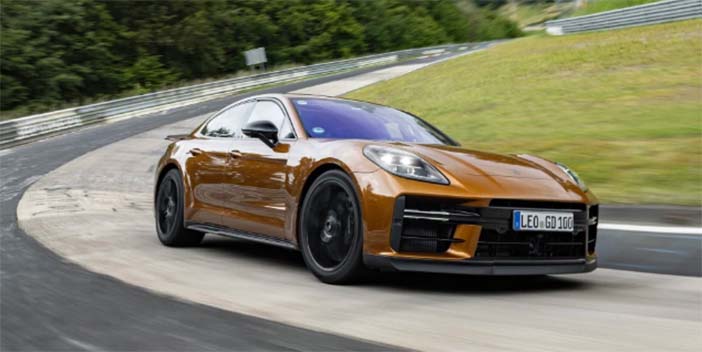
+++ PORSCHE has claimed another record on Germany’s gruelling Nürburgring track. Lars Kern, one of the company’s official test drivers, lapped the Green Hell in 7:24.17 behind the wheel of an upcoming, range-topping Panamera variant that hasn’t been presented to the public yet. Kern’s time pegs the Panamera in what was considered supercar territory until not too long ago. For context, the Maserati MC12 set a time of 7:24.29 in 2008 and Porsche’s own 997-generation 911 GT2 RS lapped the ‘Ring in 7:24 two years later. Porsche notes that the new model is precisely 5.64 seconds faster than “the comparable model of the previous generation”. The old record for the “luxury-class cars with combustion engines and hybrids” category belonged to the Mercedes-AMG GT63 S, which set a time of 7:27.80 in November 2020. The record-setting car was stock with the exception of a roll cage, which is mandatory, and a racing seat for the driver. It rode on Michelin Pilot Sport Cup 2 tires, and it was equipped with the optional Carbon Aerokit body kit developed to keep front-axle lift in check. But while Porsche is keeping the model’s identity under wraps, it all but confirmed we’re looking at the next-generation Panamera Turbo S E-Hybrid. Adding 7:24.17, the car’s time, to 5.64, the time improvement, gets you 7:29.81. That’s exactly the time set by the last-generation Turbo S. We’ll need to be patient to learn more about what’s under the hood, though Porsche confirmed that the V8 engine is coming back. Expect the S to pack a more powerful drivetrain than the new-for-2024 Turbo E-Hybrid, which is rated at 670 hp and 900 Nm. “The powertrain, the aerodynamics, the chassis, the new ultra-high performance tires from Michelin: many aspects have contributed to this best time”, Kern said. “The new Porsche Active Ride chassis has made a particularly big contribution”. More details about the new Panamera’s range-topping model will emerge in the coming weeks. +++
+++ Buyers show their preference in hybrids, prompting automakers to step up their game. STELLANTIS follows the trend by offering as many as 30 hybrid models in Europe within 2024 and promising 6 more launches through 2026 for its 14-brand portfolio. All of Stellantis’ hybrid offerings come equipped with the electrified dual-clutch transmission (eDCT) integrating a 29 hp electric motor. Energy is stored in a 48 Volt battery pack with a capacity of 0.9 kWh, allowing up to 1 km of electric-only range. Though not as efficient as a full-hybrid solution, the mild-hybrid system uses regenerative braking and coasting to reduce fuel consumption and emissions by up to 20 percent, depending on the model. Besides being cleaner and more frugal than their gasoline-only equivalents, mild-hybrids are more affordable than PHEVs and BEVs, making them a sweet spot for customers, given that Stellantis doesn’t have full-hybrid offerings like Toyota or Nissan. Furthermore, the eDCT can also be compatible with plug-in hybrids, by changing only the electric drive module and inverter. Sébastien Jacquet, Stellantis Deputy Chief Engineering Officer, said: “We have a very competitive hybrid solution that we are now ramping up with our new eDCT technology and we are rolling it out across a wide range of models, making it accessible to many customers”. According to the company, sales of the EU30 hybrid models increased by 41 percent year-to-date in 2024 compared to last year. Stellantis hopes this number will increase further, following the expansion of its mild-hybrid lineup. The company produces eDCT gearboxes in Metz (France), and Turin (Italy), with a combined capacity of over 1.2 million units per year, supplying 11 vehicle production plants. Stellantis didn’t provide information on the six upcoming launches. Still, it is safe to assume that two of the future offerings will be the Fiat 500 Hybrid and the Fiat Grande Panda Hybrid, which have been officially confirmed. Below, you can see the list of mild-hybrid models that will be on sale in Europe by the end of the year: Alfa Romeo Junior / Tonale, Citroën New C3 / New C3 AirCross / C4 / C4X / C5 AirCross / C5X, DS 3 / DS 4, Fiat Panda / 600, Jeep Avenger / Renegade / Compass, Lancia Ypsilon, Maserati Grecale, Opel Corsa / Astra / Astra SportsTourer / Mokka / Frontera / New Grandland, Peugeot 208 / 308 / 308 SW / 408 / 2008 / New 3008 / New 5008. Stellantis invests more than €50 billion for its worldwide electrification program over the decade, as part of the Dare Forward 2030 plan. The ambition goal of an EV-only passenger lineup in Europe by 2030 remains, with a 50% BEV sales mix (passenger vehicles and light-duty trucks) in the US market by the same year. The long-term goal is for Stellantis to become a carbon net zero corporation by 2038. +++
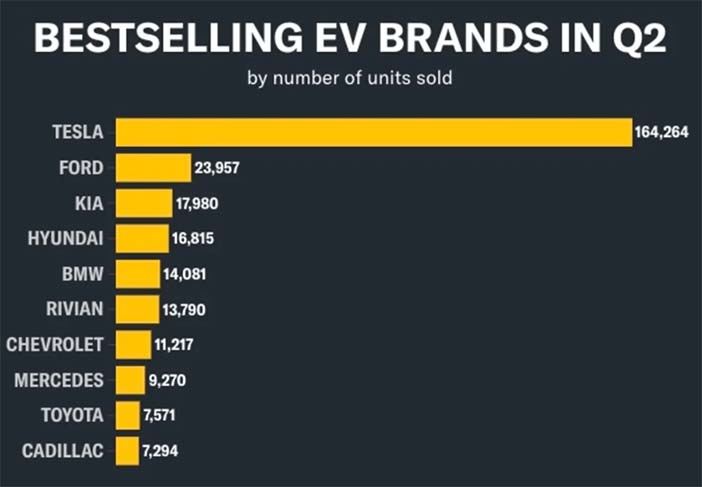
+++ As electric vehicle sales continue to grow in the U.S., albeit at a slower pace than expected, TESLA ’s share of the market dipped below a key level as improved competitor EV offerings hit showroom floors. Cox Automotive’s latest EV sales report found that Tesla’s share of EV sales in the United States fell below 50% for the first time, to 49.7%. This comes as overall EV sales grew to approximately 8% of the total market, up from the 7.2% seen in Q2 last year, in what it calls a “record-breaking” quarter. “Despite Tesla’s declining sales, with its EV sales share now below 50% for the first time, the overall competitive landscape for electric vehicles is intensifying”, Stephanie Valdez Streaty, industry insights director at Cox Automotive, said in the report. Looking over Cox’s dataset starting in 2019, Tesla’s market share hit a high of 82.5% in Q3 of 2019 and has been steadily declining ever since. The steepest drop has occurred in recent quarters, starting in Q4 2021, when Tesla’s market share stood at 77.5%. It fell to 50.2% in less than two years (Q2 2023) as new brands and EVs from legacy automakers hit the market. Tesla’s slide in market shares coincides with a dip in Q2 deliveries. Tesla said it delivered 443,956 vehicles during the second quarter, higher than the 386,810 vehicles globally delivered in the first quarter but lower than the approximate 466,140 delivered a year ago. With Tesla now sitting at 49.7% of the market, Cox found that Ford’s Mustang Mach-E, Ford Lightning EV pickup, and E-Transit cargo vans have put it in second place with a 7.2% share. Kia, its sister brand Hyundai, and BMW rounded out the top-5. Digging deeper into the fastest-growing brands in Q2, GM’s Cadillac took top honours with EV sales growth of over 440%, powered by its Lyriq. Though Cadillac’s Lyriq saw its initial rollout delayed as GM worked out kinks in its Ultium EV platform, sales momentum has been growing since the start of the year. Toyota has seen its lone EV (the BZ4X) grow sales to over 7.000 units in Q2 (from 2.000 a year ago), though reportedly with big discounts. “This increased competition is leading to continued price pressure, gradually boosting EV adoption, Cox’s Valdez Streaty said. “Automakers that deliver the right product at the right price and offer an excellent consumer experience will lead the way in EV adoption”. Greater affordability could be spurring sales at Ford, Kia, and Hyundai. Kia’s moderately priced EV6, EV9 and Niro EV are reaching larger segments of the market, along with Hyundai’s similarly priced Ioniq 5 and Ioniq 6. Luxury brands like BMW and Cadillac are likely excelling in the customer service arena, Valdez Streaty noted, with higher-income buyers valuing dealer experience alongside product mix in their buying decisions. BMW EVs like the iX, i4 and i7 have buoyed sales. Conversely, BMW rival Mercedes, which leaned heavily into luxury, high-priced EVs, has seen EV sales fall in Q2 (down 22.3%), as its offerings at lofty prices have not hit home with consumers. Mercedes has now pivoted back to gas-powered vehicles and no longer sees itself going fully electric by 2030. +++
+++ VINFAST had a disastrous launch in the United States and things haven’t gotten much better as electric vehicle adoption is slowing. Given these developments, the company has announced a “strategic decision” to hit the brakes on their North Carolina manufacturing facility. Originally announced in March of 2022, the plant was full of promise as vehicles were slated to roll off the assembly line in July of 2024. The facility was supposed to build up to 150.000 VF 8s and VF 9s annually. Needless to say, those plans didn’t pan out despite a $1.2 billion incentive package from the state of North Carolina. However, a ground breaking ceremony was eventually held in the summer of 2023 and the company announced the plant would also build the VF 7. At the time, VinFast said production was expected to begin in 2025. However, as local publications have reported, VinFast has drastically reduced the size of the plant and not much has occurred since the original ground breaking ceremony. As a result, the site was little more than a patch of dirt when WRAL visited earlier this year. Fast forward to today and VinFast is now saying production is expected to begin in 2028; a full 4 years behind schedule. The company didn’t say much about the delay, but claimed the move would enable them to “optimize its capital allocation and manage its short-term spending more effectively, focusing more resources on supporting near-term growth targets and strengthening existing operations”. Chairwoman Madam Thuy Le went into a little more detail by saying, “We have adopted a more prudent outlook that is carefully calibrated to near-term headwinds, taking into full consideration the realities of market volatility and potential challenges”. Despite the setback, she claimed “Our robust long-term strategy and proven execution capabilities position us well to meet the evolving needs of the dynamic global EV market”. Besides hitting the brakes on U.S. production, VinFast revealed they delivered 12.058 vehicles in the second quarter which was a 26% improvement from a year ago. The company went on to say they’re expecting to sell approximately 80.000 vehicles globally, which would be a huge jump from the 34.855 vehicles delivered in 2023. That number might be optimistic as VinFast only delivered 21.747 vehicles in the first half of the year. As a result, the company would have to nearly triple their rate of sales to hit their year-end goal. +++