
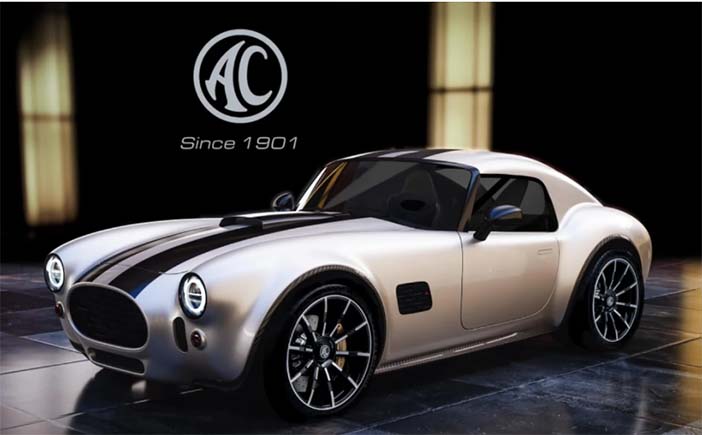
+++ AC CARS , known to automotive enthusiasts as the British automaker that spawned the vehicle that would later become the all-conquering Shelby Cobra in the United States, has unveiled renderings and specifications of something that’s quite interesting. The AC Cobra GT Coupe, as its name implies, boasts a hardtop. But unlike the famous Cobra Daytona Coupe, this one looks a whole lot like the bug-eye Roadster. According to AC Cars (which claims to be the Britain’s oldest active vehicle manufacturer, though we’d add the current company has only a tenuous connection to the original AC that was founded in 1901) this new Cobra GT Coupe will debut as a Clubsport Edition toward the end of 2025 with a 799 hp V8 engine. Assuming it’s mechanically similar to the Cobra Roadster that we first saw in spring 2023, that V8 will likely be sourced from Ford, displace 5.0 liters and be topped by a large supercharger. Only 99 Clubsport Edition models are planned, to be followed by versions powered by either a 450 hp naturally aspirated or 720 hp supercharged engine. With around 1.440 kilos to move, courtesy of an aluminium chassis and carbon fiber bodywork, I expect impressive performance. History tells us that this isn’t AC’s first Cobra-based coupe. The one-of-one A98 Coupe, which was sadly involved in an tragic accident during competition, is said to have served as inspiration for this new GT Coupe, and indeed the distinctive Kammtail rear end is shared between the 2 cars. +++
+++ A colourful parade of amphibious cars glided through AMSTERDAM ’s canals on Thursday, but it was the last time the event will be held in the city, at least until EV batteries become lighter. Starting in 2025, access to the city’s waterways will be restricted to emission-free vessels and vehicles, a standard too high for amphibious cars due to the weight of electric batteries. “This year is the last time because Amsterdam will introduce some new rules”, said Dutchman Roy Bolks, organizer of the annual amphibious cars parade that moves countries every year. The multi-day event started on Monday in Amsterdam and took the amphibious cars to the cities of Monnickendam and Utrecht before finishing in Amsterdam on Thursday. “Everybody has to think about the environment and we understand it but it’s a pity we can’t easily turn these cars electric. … So we’re going to enjoy this last time”, said Dutch participant Onno den Boer. Typically, the event attracts around 80 participants, but this year 100 amphibious car enthusiasts joined the parade. “And that’s only because we set a limit. We created a waiting list”, Bolks said. Electric amphibious vehicles are rare but Bolks said he knew of two, adding, “They’re not easy to navigate as the battery is too big. The vehicle becomes too heavy”. He added that the unusual cars could return to Amsterdam if technology improves for them, although he’s not aware of such research. The parade first took place in 1987 and has been hosted by Amsterdam 4 times. The new legislation doesn’t apply to the whole country, so the parade can still be held in the Netherlands. “It will take place in Friesland in a few years. It’s pretty there”, said Bolks. Next year the parade will take place in Belgium, close to Ghent. +++

+++ As July wrapped up for 2024, automakers from CHINA are releasing their sales “report card”. Today, we’ll be focusing on the sales performance of the emerging New Energy Vehicle (NEV) automakers. The term “emerging NEV automakers”, frequently mentioned in Chinese media reports, refers to the newer automakers specializing in the production of electric and plug-in hybrid vehicles that had sprouted in recent years, in contrast to the traditional automakers that previously focused on diesel or gasoline-engine cars. In China, the leading emerging automakers often referenced are Nio, Li Auto and Xpeng. In July, Li Auto sold 51.000 NEVs. Next came Aito (41.535), Leapmotor (22.093), Nio (20.498), Deepal (16.721), Geely Galaxy (16.704), Zeekr (15.655), Xpeng (11.145), Neta (11.015), Denza (10.340) and Xiaomi (10.000). In July 2024, Li Auto delivered 51.000 new vehicles; up 49.4% year-on-year and 6.8% month-on-month. From January to July 2024, a total of 239.981 vehicles were delivered. As of July 31, Li Auto had delivered a total of 873.345 vehicles. For Aito, which is part of the Harmony Intelligent Mobility Alliance (HIMA) along with Luxeed and Stelato, the brand delivered 18.047 M9s, 16.562 M7s and 6.926 M5s in July, bringing its cumulative sales for the first 7 months of 2024 to 222.679 vehicles. Earlier on July 29, Aito’s 400.000th vehicle rolled off the production line. At the same time, it is worth pointing out that HIMA’s July cumulative sales volume was 44.090 vehicles, a year-on-year increase of 942% and a month-on-month increase of 2.2%. In July, Leapmotor returned to the top three in the sales of emerging Chinese NEV automakers, selling 22.093 vehicles, a year-on-year increase of 54.1% and a month-on-month increase of 9.8%. In the first 7 months of this year, Leapmotor’s cumulative sales volume reached 108.789 vehicles. As for Xiaomi, the official has not revealed the exact sales number but only shared a poster that the delivery volume in July exceeded 10.000 vehicles and that the delivery volume in August will continue to exceed 10.000 units. Furthermore, according to the forecast data previously released by the China Passenger Car Association (CPCA), preliminary estimates show that the sales volume of the Chinese domestic passenger car retail market (i.e. sedans, MPVs, SUVs) in July was about 1.73 million units, a slight decrease of 2.0% year-on-year and month-on-month. More specifically, the retail sales volume of new energy vehicles in the Chinese domestic market is expected to reach 860.000 units, basically the same as in June, a year-on-year increase of 34.1%, and the penetration rate is expected to further increase to 49.7%. +++
+++ Hybrid Electric Vehicle (HEV) sales ratio of the HYUNDAI MOTOR GROUP surpassed double digits for the first time in the first half of this year. According to Hyundai and Kia, the 2 companies sold a total of 3.619.631 vehicles from January to June this year, with HEVs accounting for 11.3% (408.799 units) of the total. This is the first time that HEVs have accounted for more than 10% of Hyundai and Kia’s overall sales and exceeded 400.000 units in a half-year period. During this period, Hyundai sold a total of 2.063.934 units across all models, while Kia sold 1.555.697 units, marking a 1.0% decrease compared to the same period last year. However, combined HEV sales for the 2 companies surged by 21.2% year-over-year. Hyundai sold 220.155 HEVs; an increase of 21.8% year-over-year, and Kia sold 188.644 HEVs; up 20.4%. The strong performance in HEV sales in the first half of this year was driven by mid-sized SUVs. Hyundai’s Tucson Hybrid saw sales more than double to 85.000 units in the first half compared to 42.000 units in the same period last year. The Santa Fe Hybrid also saw an 80.0% increase in sales to 45.100 units during this period. For Kia, the Sportage Hybrid’s sales increased by 14.0% to 67.600 units and the Sorento HEV’s sales rose by 14.2% to 45.300 units. Industry insiders explained that the increase in HEV sales is due to Hyundai and Kia’s strategic focus on hybrid vehicles as an alternative in the market. This shift occurred while electric vehicles (EVs) faced a temporary stagnation, known as the ‘chasm’, over the past 2 to 3 years. During this period, Hyundai and Kia expanded their HEV offerings across most of their line-up, including compact to mid-sized recreational vehicles (RVs) and passenger models like the Avante Hybrid and the Grandeur Hybrid. Currently, Hyundai and Kia are selling 16 HEV models and have recently added HEV versions to minivan models such as the Carnival and the Staria. Additionally, Hyundai’s luxury brand, Genesis, is also developing HEV models. Meanwhile, Hyundai and Kia’s EV sales for the first half of this year decreased by 17.0% compared to the same period last year, totalling 200.932 units. +++
+++ LAMBORGHINI ’s first 6 months of 2024 show record results in terms of deliveries, revenues and operating income, thanks to the commercial success of the 3 models currently produced at the Sant’Agata Bolognese plant: Revuelto, Urus and Huracán. In detail, 5.558 cars were delivered, generating revenues of €1.621 million; an increase of 14.1% over the same period of 2023 with operating profit rising to a record €458 million. Stephan Winkelmann, chairman and CEO of Lamborghini, remarked: “We are extremely proud of the results we achieved in the first half of 2024. We are going through a pivotal phase, supported by the largest investment in the company’s history, with the main objective of expanding our product offering. This process demands significant resources, yet these efforts are essential to sustain our growth and ensure that Automobili Lamborghini continues to innovate and lead in the luxury super sports car sector”. Profitability reached 28.2%, demonstrating the success of the company’s strategy and the better balance between deliveries and financial parameters. Paolo Poma, managing director and CFO of Lamborghini, commented: “We are pleased that our growth path has been consolidated once again. The positive trend and strong order bank bolster confidence so that, even in a year marked by the transition to hybrid, we can confirm growth of the key financial and business metrics, reflecting the brand’s strength in the luxury and super sports segment”. In terms of deliveries, distribution of cars across the 3 macro-areas continues to be evenly balanced, with EMEA, Americas and APAC registering 2.498, 1.849 and 1.211 vehicles delivered, respectively. Regarding the individual markets, the United States remains in the lead (1.621 cars delivered), followed by Germany (595), the United Kingdom (514), Japan (354), China (Mainland, Hong Kong and Macao; 337) and Italy (268). The order bank remains solid, with the Revuelto projecting a wait of more than 2 years. For the Huracán, orders cover the entire production run until the expected line closure in December. The Urus SE, unveiled at the end of April at the Beijing International Automotive Exhibition, has also been met with a widespread positive response from customers, with orders covering around one-year’s production. These results testify to the success of the strategy outlined by Lamborghini’s Direzione Cor Tauri program, which encapsulates the company’s commitment to continuous decarbonization, and which is undergoing one of its most important phases in 2024. Another milestone will soon be reached with the unveiling of the successor to the Huracán on August 16 at Monterey Car Week: the same venue that last year saw the debut of the Lanzador concept car, a preview of the first full-electric model. This new HPEV (High Performance Electrified Vehicle) super sports car will mark the completion of the hybridization process of the Lamborghini range, featuring an all-new twin-turbo V8 engine paired with a hybrid system for best-in-class performance and driving experience. +++
+++ LEAPMOTOR INTERNATIONAL , a 51/49 Stellantis-led company between Stellantis and Leapmotor, has shipped the first batch of electric vehicles (the C10 SUV and the T03 citycar) from Shanghai to European ports this month, marking a significant milestone in the partnership. Leapmotor was the 4th largest Chinese new energy vehicle (NEV) startup in China by sales in June. “The shipment of the C10 and T03 to Europe this month is a landmark moment in the partnership between Stellantis and Leapmotor”, said Stellantis CEO Carlos Tavares. “This demonstrates our commitment to providing innovative, affordable and sustainable mobility solutions to our customers. Relying on Stellantis’ strong business assets in Europe and the hard work of our companies’ teams on guaranteeing product innovation and quality, I strongly believe that Leapmotor’s electric vehicles will be widely accepted by European customers. We are excited about the opportunities this partnership brings and look forward to a successful journey together”. “As of the first half of July, Leapmotor has accumulatively sold over 400.000 EVs in China since the company’s first sale”, said Leapmotor CEO, founder and chairman Zhu Jiangming. “China is the biggest and most competitive EV market in the world and our products have proved their value by being acclaimed by the local customers. Since the very beginning, the C10 and T03 models are designed to meet the high standards of global customers and we are confident that the collaboration between Stellantis and Leapmotor will drive significant growth for both companies”. Leveraging the Stellantis distribution channels, the Leapmotor International JV plans to increase sales points for Leapmotor vehicles in Europe to 500 by 2026, from 200 at the end of 2024, to ensure a high level of service for customers. As the C10 and T03 vehicles embark on their journey to Europe, Stellantis and Leapmotor remain dedicated to pushing the boundaries of innovation and sustainability in the automotive industry. The shipment this month is just the beginning of a long-term collaboration aimed at transforming the landscape of electric mobility in Europe and beyond. There is at least one model planned to go on sale every year in the next 3 years. The C10 is Leapmotor’s first global product, built according to global design and safety standards. The car is based on self-developed 3.0 technology architecture. It is a fully equipped, family-centric D-segment vehicle with 420 km WLTP range. The T03 is a small 5-door A-segment urban boutique commuter car. It features 265 km WLTP range. +++
+++ An electric MERCEDES C-Class will arrive in 2 years, company CEO Ola Källenius has said. Speaking on Mercedes’ earnings call for the second quarter of 2024, he confirmed the new EV will arrive alongside a new electric GLC, with both models pushing further upmarket. The siblings, based on the new MB.EA platform, will be placed in what Mercedes dubs the ‘core luxury’ segment, currently occupied by the likes of the CLE and E-Class. Meanwhile, the brand’s range of ‘entry-level’ cars will be shrunk to comprise the CLA, GLA and GLB, with these 3 models moving to the new MMA platform. Källenius confirmed the new CLA will come first in 2025, having been previewed by a concept at last year’s Munich motor show. Mercedes will raise the prices of these entry-level models “significantly” as it aims to improve their profitability. It will also look to grow the share of its ‘top-end’ luxury cars, such as AMG performance models and the G-Class, by 60%. Källenius added that MB.EA will no longer replace the EVA2 platform used for the EQS and EQE, suggesting the mooted ‘large’ variant of the new platform has been scrapped. Despite its growing assault on the EV market, Mercedes remains committed to offering combustion-engined cars. It has reported a 25% slump in EV sales year on year, from 61.211 to 45.843. Meanwhile, it sold 27% more plug-in-hybrids, making 44.120 deliveries. “We are unsure about the speed of the transition. It’s almost impossible to foresee how long it will take”, said Källenius. “We are one of those few companies that are well positioned to play the flexibility card until the 2030s”, he added. +++
+++ TOYOTA reported a modest rise in first-quarter net profits on Thursday as a weak yen and cost cuts helped the Japanese auto giant overcome a drop in production and sales in its home market. The firm said net income rose 1.7 percent to 1.33 trillion yen ($8.9 billion) and operating profit jumped 16.7 percent to 1.31 trillion yen. Revenues climbed 12.2 percent to 11.8 trillion yen. The world’s largest automaker by sales also kept unchanged its full-year forecasts, predicting net profit of 3.57 trillion yen, marking a drop of 27.8 percent, on sales of 46 trillion yen, which would be a gain of 2.0 percent. “Our operating income was 1.3 trillion yen despite a decrease in production and sales volume in Japan, due to the effects of foreign exchange rates and cost reduction efforts”, Toyota said in a statement. “Despite the inability to maintain stable production in Japan due to factors such as certification issues and recalls, we achieved an increase in profit, thanks to the support of all our stakeholders, including suppliers and dealers”, it said. In June, the Japanse government instructed 4 firms (Toyota, Honda, Mazda and Suzuki) to stop delivering certain vehicle models on the home-market because of certification issues. This week Toyota was also slapped with a correction order by the transport ministry over a failure to comply fully with national vehicle inspection standards. That followed inspections in June by officials at its headquarters in Aichi Prefecture to probe breaches declared by the company related to domestic shipment certifications. Toyota last year reported record bumper results, with net profit doubling to 4.94 trillion yen and revenues soaring by a fifth to 45.1 trillion yen, helped by strong sales of hybrid vehicles. The company pioneered hybrid cars (combining internal combustion engines and batteries) with its popular Prius model. But it has been criticized along with other Japanese automakers for being slow to embrace purely battery-powered vehicles, allowing firms like Tesla and China’s BYD to steal a march and gain market share. However, there are signs consumers are going cold on pure EVs because of high prices and worries about reliability, range and a lack of charging points. Toyota aims to sell 1.5 million pure EVs annually by 2026 and 3.5 million by 2030. Last year it sold 10.3 million vehicles. The firm is also hoping to mass-produce solid-state batteries, a potential game-changing technological breakthrough that could mean faster charging times and greater range. +++
+++ Recently pictures have emerged of the XIAOMI SU7 on the streets of Paris, France. It is there as part of Xiaomi’s special exhibition entitled “People, Cars and Homes Full Ecology” and, thanks to the Paris Olympics, is attracting attention from visitors from across the world. The appearance of the Xiaomi SU7 in Paris has led to a lot of speculation that Xiaomi was about to enter the European market.
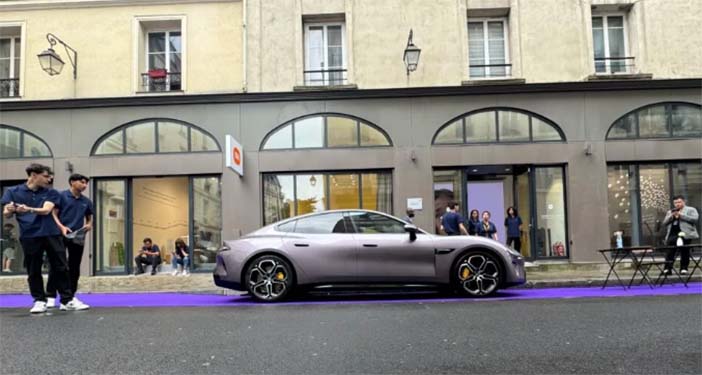
Lei Jun, Xiaomi’s CEO, responded in a live broadcast, saying that Xiaomi would strive to sell cars in Europe before 2030. However, while Xiaomi might not officially be selling the SU7 overseas, that has not stopped gray channels in various countries across the world where dealers can make large profits due to the interest in the Xiaomi car. Lei Jun said that regarding the car business, “We’re aiming for the top five in the world, so we’re going global when the time is right”. In the first quarter of 2024, overseas revenue accounted for more than 50% of the total, of which smartphone sales were more than 70%.
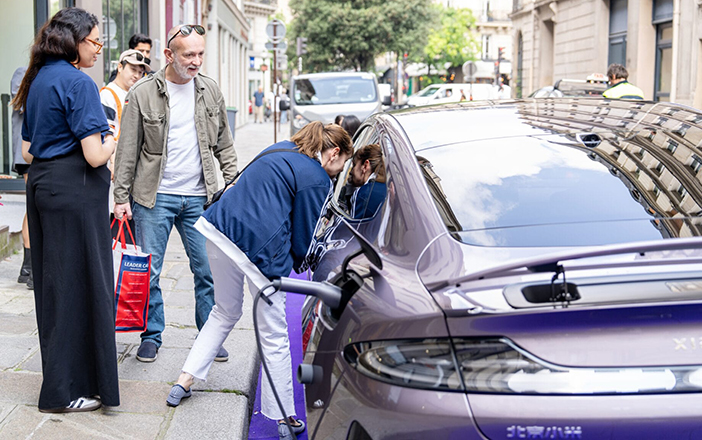
In a sign that Xiaomi SU7 mania is a global phenomenon, the car has been attracting a large amount of attention in the display at the Pompidou Museum Block in Paris. The car made it overseas debut earlier this year at MWC 2024, a mobile systems industry event, held in Barcelona. Spain. While Xiaomi might not officially export the Xiaomi SU7, that has not stopped parallel export companies from spotting a good business opportunity and making big profits.
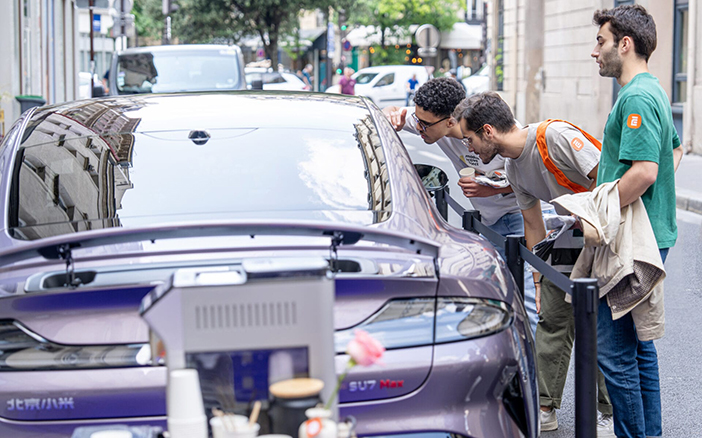
A week ago, I reported that second-hand the Xiaomi SU7 could fetch more than the price paid new. With parallel exports, dealers are buying the car and then exporting it as a second-hand car. Profits are reported to range between 10.000 and even as much as 60.000 yuan ($1.400 – $8.250) per car. Russia accounts for about 50% of the export market, while the Middle East accounts for another 30%. Through various optimizations of the factory Xiaomi has managed to increase production and thereby shorten waiting times which are now said to be a maximum of 5 weeks after locking in the order. During June Xiaomi delivered over 10.000 cars for the first time. Furthermore, the annual delivery target of 100,000 cars is expected to be reached in November. +++