
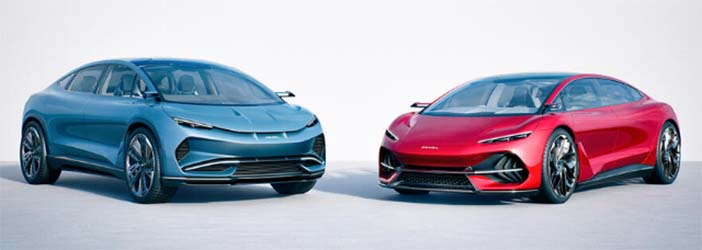
+++ Italian electric vehicle start-up AEHRA has named its first 2 cars the Impeto (a SUV) and Estasi (a saloon) as it ramps up its efforts to begin production. It has submitted a business plan to Italy’s Ministry of Industry concerning a factory at Mosciano Sant’Angelo, in the north-eastern Abruzzo region. The company said it chose the location for its proximity to Italy’s carbonfibre industry and the expertise offered by the nearby University of L’Aquila. Aehra founder and CEO Hazim Nada said: “This factor will prove critical to the creation of the carbonfibre monocoque that sits at the heart of the Aehra saloon and SUV models and represents a world-first for mainstream production vehicles. As an area of regional development, Abruzzo unlocks further fiscal advantages. Aehra has also established a strategic relationship with the University of L’Aquila. Home to one of the world’s most advanced engineering centers, the university will prove key to the development of Aehra’s advanced 800 km range electric powertrain and all future technology. We also have a similar partnership with the Polytechnic of Milan”. Aehra plans to break ground on the €1.2 billion site later this year. It added that the plant could create 540 jobs locally and an extra 110 positions at the company’s headquarters in Milan. The company’s bid for government investment comes as Italian authorities aim to shore up the country’s automotive industry. The Ministry of Industry previously forced Alfa Romeo to rename the Milano to Junior because it was built in Poland and seized a shipment of Moroccan-built Fiat Topolinos because they were emblazoned with the Italian flag. The Italian Competition and Markets Authority also recently fined Italian sibling brands DR and Evo €6 million for marketing Chinese-built cars as being made in Italy. +++
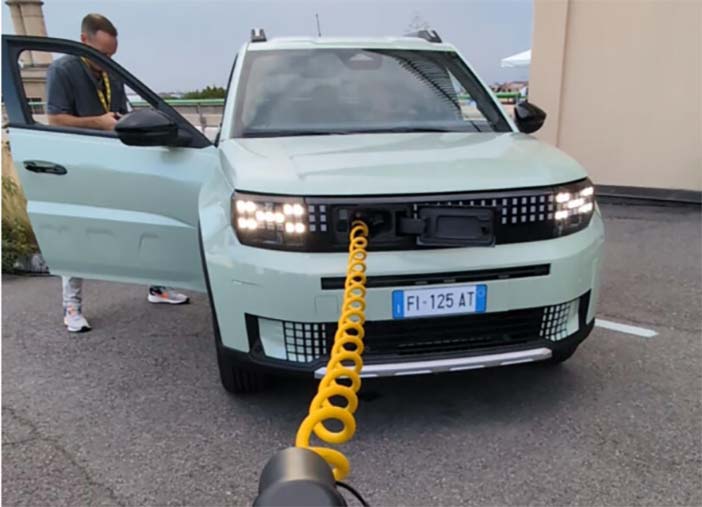
+++ FIAT will integrate charging cables into the bodywork of its next generation electric vehicles, beginning with the new Grande Panda next year. In that car, it will be stored behind a panel on the front fascia, featuring a sprung cable in what Fiat describes as its novel way of “reinventing” charging. Integrating retractable cables into a car’s bodywork could play an important role in boosting the perceived user-friendliness of electric vehicles, Carlos Tavares, CEO of Fiat parent Stellantis, said: “We are coming up with a solution not to put the charging cable in the mud. You have these fantastic cars (full of technology, great materials, nice trims) and the first thing you do is you put the cable on the ground, and it’s dirty and you throw it back in your trunk. That’s not very high technology. If you look at vacuum cleaners, they found a better solution”. In the Grande Panda, due to hit Dutch roads early next year, the integrated AC cable can charge at speeds of up to 7.4 kW, meaning it can add some 200 km to the Panda’s 44 kWh battery in 4 hours and 10 minutes. It is understood that the front-mounted charging cable will not be capable of rapid-charging because of the cooling requirement this would incur. A separate DC charging port is positioned on the side of the car for faster charging speeds of up to 100 kW. When it hits roads next year, the Smart Car platform-based Panda will be one of the cheapest electric cars on the market with pricing said to start at “less than €25.000”. +++
+++ The Ioniq 6 may still look like one of the most futuristic shapes on the road, but HYUNDAI is in the midst of testing the facelifted variant, which could be revealed by the end of 2024. Thanks to the recent facelift of the Ioniq 5, with which the Ioniq 6 shares its platform, we already have a good idea of what to expect from the new all-electric saloon. Arriving in 2022, one year after the Ioniq 5, a facelift for the Ioniq 6 seems right on cue. These latest spy shots give us our first glimpse of the updated car so we don’t expect it to go on sale until 2025, though. There’s plenty of camouflage surrounding the test car, but it looks like the headlight shape could be tweaked for the mid-life refresh and, if the new Ioniq 5 is anything to go by, we should expect reshaped bumpers front and rear. The Ioniq 6 sits on the same E-GMP architecture as the Ioniq 5 and we expect it to receive the same upgrades as its hatchback sibling. That means the current 77.4 kWh battery should be swapped to an 84 kWh unit, which is likely to boost the Ioniq 6’s range up from 540 km miles, possibly over the less aerodynamically-efficient Ioniq 5’s 560 km maximum. A dual-motor option is expected to sit alongside the rear-wheel drive model, but with a new 84 kWh battery we could finally see the Ioniq 6 N; especially considering the Ioniq 5 N uses that same 84kWh battery. We caught the Ioniq 6 N out testing earlier this year so we suspect the reveal could sit close to the updated Ioniq 6. The Ioniq 6 should also feature Hyundai’s new pre-conditioning system with the facelift. It allows the battery to be prepared for charge with a heat pump to make the maximum 350 kW charging speed more reliable all year round. A new entry-level Ioniq 6 could be on the cards too with the Ioniq 5 replacing its 58 kWh battery option with a new 63 kWh unit. The smaller battery was never offered on the Ioniq 6, but if the new battery was added to the range it would surely undercut the car’s current €45.895 starting price tag on the Dutch market. +++
+++ INEOS is planning a significant shift upmarket, with a focus on boutique off-roaders to rival the Mercedes-Benz G-Class, instead of trying to grow both its line-up and sales. By pivoting to focus on its new Arcane Works programme (Ineos’s take on Land Rover SV and Bentley Mulliner), the brand will be able to target similar margins while making fewer vehicles as it looks to battle against increasingly stringent emissions regulations in the United Kingdom and across Europe. “The main feedback from dealers is that the Grenadier is too cheap. It needs to be more expensive for the amount of car you get”, George Ratcliffe, commercial director of Ineos, told. “They want to sell it for more”. This pivot is a far cry from the brand’s initial plan, which, along with the Grenadier and its Arcane Works siblings, originally included a Jeep Avenger-sized small urban model and the electric Fusilier, revealed earlier this year but now indefinitely postponed. “What we wanted to achieve is no longer possible”, said Ratcliffe. “When the Grenadier project started, what we said was: ‘We’re going to build a really affordable, easy-to-fix utilitarian vehicle that will be good for farmers.’ It’s a gap in the market. But with the modern world and what you need (engines, pedestrian protection rules, CO2 emissions, regulation on vehicles) you cannot do that any more”. Ratcliffe also warned that limiting sales in certain markets, such as the United Kingdom, with its strict ZEV mandate, has not been ruled out. That mandate forces car makers to sell an increasing ratio of electric cars each year from 2024 onwards, but it exempts those that sell fewer than 2.500 cars annually. Ineos delivered 146 cars and 178 commercial vehicles in the UK in the first half of this year. Fleet CO2 targets were another reason cited for the Fusilier’s postponement. Ratcliffe said projected sales would have taken the firm over the threshold of being a ‘small’ manufacturer (fewer than 10.000 cars or 22.000 vans sold annually) with the dispensation to propose its own emissions targets. “Without having the Fusilier, we have a bit more flexibility because we have a bit more capacity to sell up to being a small manufacturer and it doesn’t matter if you’re selling a petrol, diesel or electric car”, said Ratcliffe. “By selling fewer electric cars we can sell more Grenadiers and still keep the same CO2 cap. But when we want to punch through that, we have to have something that brings our average down”. +++
+++ British car-manufacturing numbers fell through the floor in the last month or so. In June, the 27 percent plunge (vs June ’23) was debilitating and, frankly, unsustainable for the automotive business. But the disappointing numbers are explained away by the Society of Motor Manufacturers & Traders. All this was “expected” and “caused by multiple model changes” as “factories repurpose”, it stated. Also, don’t forget: “Manufacturers are retooling production lines to make electrified models”. Fair enough. But everything from model changes to retooling and repurposing in the short term aren’t the major, long-term problems. Bigger dilemmas by far go like this: we have to accept and deal with the fact that the usual suspects (Japan, Germany, South Korea, Spain, USA and France, in that order) already build more cars than us and will almost certainly continue to do so. But more importantly, the huge, comparatively new kids on the block (China in particular, but India too) are also giving us a comprehensive kicking on the car-production front. As are Brazil, the Czech Republic, Indonesia and Slovakia. And the unlikeliest of suspects (Iran and Turkey) are beating Blighty, too. Putting China and India aside, I consider Germany, Japan and South Korea among the most respected, successful, established and tried and tested car producers. The priority for their domestic makers is mass production of non-premium and premium cars. Why? Because that’s where hundreds of thousands of jobs, tens of millions of sales, and billions of profits come from. Much, much further down their priority list is making and selling a tiny handful of luxury cars. Why? Because very few of the public can afford such models. True, the high profit margins might be tempting. But as Volkswagen-Audi, Toyota-Lexus and Hyundai-Kia show, it makes far more sense to produce millions of cars that rake in small to medium profits per unit than it does to build a few thousand luxury models that are highly profitable. But instead of following the consistently successful business model adopted by these world-beating duos, the closest thing Britain has to a home-grown pair ( JAGUAR LAND ROVER ) is moving in the opposite direction. Currently, it’s a small outfit on the global stage. A realistic aim would be to crank up production and become medium-sized. Far more ambitious and considerably harder to establish would be to win entry into the sort of ‘large and loud’ territory that the Seoul brothers (Hyundai and Kia) have somehow managed to occupy. But if they can do it, why can’t the Jaguar Land Rover sister act? Instead, the separate but connected Jaguar and Range Rover brands are going further and further down the luxury-car route. Inevitably, this means JLR will build fewer cars, which in turn means that Britain will sink even further down the table of car-producing nations. Last year, we produced around half as many cars as half a decade earlier. By the end of 2024, and despite the alleged ramping up of electric car production, I estimate that annual output here will be lower than in 2023. And we know one of the main reasons, don’t we? +++
+++ JLR has increased its 5-year investment plan from €17 billion to €21 billion after the slower-than-predicted EV take-up forced it to boost spending on platforms that allow combustion engines as well as electric powertrains. The British firm announced the original €17 billion plan last April, detailing spending on new EV platforms, including the mid-sized EMA, which will underpin cars built at its Halewood plant from 2025. However, the sluggish demand for electric cars has forced it top up the spending budget to extend the life of ICE cars. The hike to €21 billionn is “partly because we are having to invest more in keeping the parallel running of BEV vehicles and ICE vehicles going for longer than we anticipated as the industry trend towards BEV globally starts to slow down from previous expectations”, JLR chief financial officer Richard Molyneux told analysts at the company’s investor day in June. +++
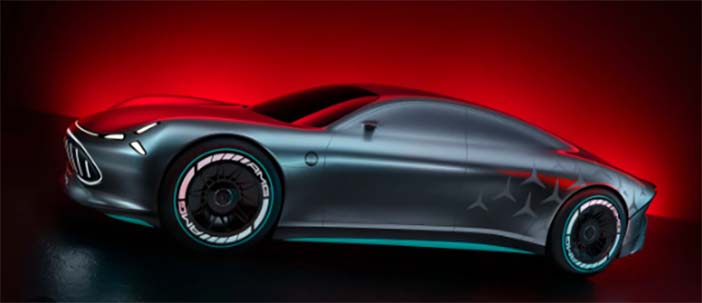
+++ New prototypes of MERCEDES-AMG ’s flagship 4-door electric vehicle have been spied having shed a few layers of their camouflage. The pictures reveal more of the new high-end model’s design and engineering traits. The high-spec Mercedes-AMG electric performance car has already been directly previewed by the AMG Vision Concept from 2022, and when it arrives next year it should rival cars like the Porsche Taycan Turbo S and Audi e-Tron GT RS Performance. it will feature a low-slung sleek design, frameless doors and huge wheels. Unlike previous EQ models including the EQS and EQE, AMG has decided to give the car a more distinct bonnet, plus generous overhangs that will combine to create a more elegant and sophisticated silhouette. The front of the car will be extremely low-slung, something confirmed by how low the bonnet sits over the front wheels. The tail will also feature a Kamm-style design, ditching the more rounded rear that’s been a staple of Merc’s design language since the early 2000s. This new high-end 4-door model will be based on an entirely bespoke architecture called AMG.EA, rather than using tech from Merc’s existing AMG EQ models. AMG.EA utilises several new technologies, including axial flux motors that are lighter and more power dense than the radial motors used in most EVs. This bespoke platform will support the dramatic proportions we can already see, so too the 21-inch wheels and sophisticated chassis technology that we expect will also be in use. Using the AMG Vision Concept as reference we also have some idea about the new car’s detailing, such as the vertical strakes on the nose and Merc’s new three-pointed motif within the headlights. Official teaser images of Mercedes-AMG’s new all-electric super saloon and Porsche Taycan rival have also already been released showing the performance brand’s first bespoke electric vehicle undergoing testing near the Arctic Circle in typical AMG style: sideways. Under the skin, I expect to see a combination of a flat battery pack and a dual-motor layout with up to 1.000 hp. It’ll need that much power to go up against Porsche’s super-high powered Taycan Turbo GT, which produces 1.106 hp and is capable of 0-100 kph in 2.2 seconds. Expect plenty of high-end chassis hardware, too, including elements like rear-wheel steering and other innovative suspension tech like active roll control, or potentially even a fully-active system as you’ll find on the latest Taycan. All this new content won’t come cheap, though. Mercedes’ flagship electric vehicle will most likely rival only the highest spec versions of the Taycan and its twin, the Audi e-Tron GT. This should see pricing start well over six figures. Such is the price of progress, especially when there’s an AMG badge affixed to the bootlid. AMG says the new model and its platform are “still at the beginning of a demanding and comprehensive test plan, which will span multiple proving grounds, continents and climate zones”. Meaning we should start to learn more about it in the coming 12 months, with Mercedes already confirming a market introduction in 2025. +++
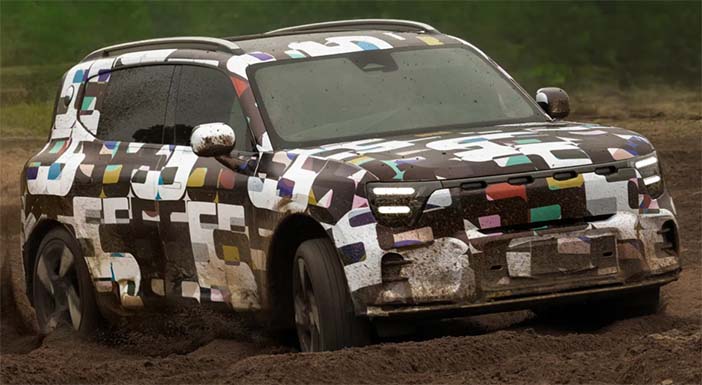
+++ The next new SMART will be unveiled on 28th August; a family-sized SUV called the #5, that’ll look to expand the all-electric brand into new territory. After several leaked images were found on the Chinese Ministry of Information Technology website, Smart has posted more pictures of the #5 showcasing its off-road ability. Having initially revealed the new Smart #5 in concept form at this year’s Beijing motor show it’s not surprising to see Smart is testing its SUV on some pretty rough terrain as it gears up for the reveal event in Australia. The production car will lose the off-road focused #5 Concept’s roof-mounted lightbar, knobbly tyres and bonnet tree cables with Smart now referring to it as a ‘luxury SUV’. As we’ve already seen from the leaked images, the new official test shots show the Smart #5 will gain a more upright body compared to the Smart #1 and Smart #3. There’s a bluff nose, an upright windscreen and a traditional SUV profile for the #5. The front end features a similar face to the concept, those 4 inserts along the faux grille could also light-up like on the concept, although we won’t know until we’ve seen the Smart #5 in the dark. There’s a new alloy wheel design for the #5 with four-spoke rims and on the rear pillar, Smart’s ‘C’ logo appears. Around to the rear we see a full-width light bar which is joined by four individual lights sitting along the bootlid.
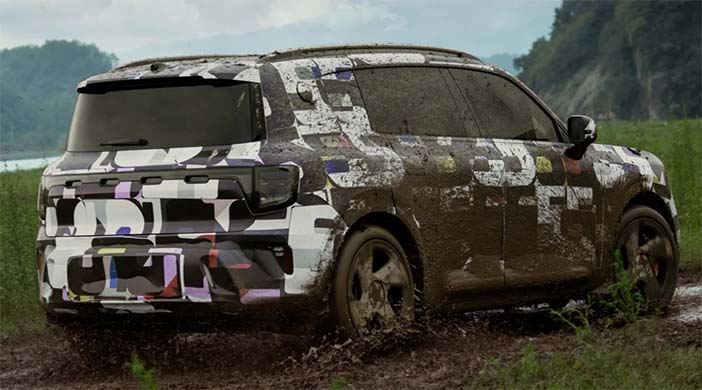
Smart may have made a name for itself with the dinky ForTwo, but the new #5 will be the largest Smart to date. At 4.705 mm long, the #5 is 56 mm longer than the Skoda Enyaq and only 50 mm or so shorter than a Tesla Model Y. This suggests Smart’s new SUV will be a more family-friendly model, with a generous amount of interior space thanks to a 2.900 mm wheelbase. Smart has already confirmed other technical information about its next SUV, including a brand new 800 volt hardware and battery pack of more than 100 kWh. Official figures haven’t been confirmed, but the maker says that should translate to a range of “more than 540 km” and a 10 to 80 percent charge time of “just 15 minutes”. As we’ve seen with the #3 and #1, Smart will offer a range of single and dual-motor powertrains, topped off by a high performance flagship with a combined power rating of up to 648 bhp. This figure is just a sum of the two motors’ peak power rating, though, so it remains to be seen whether the battery pack is capable of feeding that much power to the motors at any one time. Official performance and economy figures are still some way off being released, but for those less interested in straight-line speed, a range of more sensible models will be available. This includes a second dual-motor variant with a combined power figure of 585 hp, plus two single-motor variants with 390 hp or 340 hp. This being a modern EV, the need to fit in such a large battery pack has led to a very short rear overhang, which should not only benefit packaging the powertrain elements, but also unlock lots of rear legroom. As a result, I don’t expect this model to offer a third row of seating, which some potential rivals with similar footprints, like the Peugeot E-5008, offer. No images have been revealed of the Smart #5 interior, so far, but we expect the cabin will contain the new generation of technology and hardware previewed by the Smart #5 Concept. This is likely to include a screen-heavy design, with 2 large touchscreen displays mounted on the dash for the driver and passenger, plus a further driver’s display and minimal physical controls. +++
+++ The car industry in the UNITED KINGDOM has once again called on the government to incentivise private sales of EVs. While almost one in five new cars sold last month were electric, demand still lags behind what is required by the strict ZEV mandate rules. In July, the marketshare for electric vehicles rose by 18.8 percent to an overall share of 18.5 percent. This may seem like good news for the UK’s transition to electric power, but the marketshare still idles at just 16.5 percent year-to-date, which is a long way away from the 19.8 percent that the industry was previously hoping to achieve by the end of 2024 and the 22 percent required for each manufacturer under the new ZEV mandate rules. The drive to increase EV sales isn’t helped by waning support from private buyers; the cost of buying a new electric car remains relatively high compared to the petrol equivalent, despite the arrival of some cheaper new EV models in recent months. Thus, units sold privately account for roughly only 17 per cent of EV registrations, despite the overall volume of sales rising marginally by around 1 percent. Representing the British car industry, the Society of Motor Manufacturers and Traders (SMMT) chief executive, Mike Hawes, said that the muted private demand for electric vehicles is “the over-riding concern”. “More people than ever are buying and driving such cars, but we still need the pace of change to quicken, else the British climate change ambitions are threatened and manufacturers’ ability to hit regulated electric vehicle targets are at risk”. Hawes called for the British government to bring “action on incentives” (the SMMT previously called for VAT to be slashed on EVs bought privately, as well as a tax cut on public charging) ahead of the new 74-registration plate coming in September. It’s not all bad news, though; car sales overall were up by 2.5 per cent last month, marking 2 years of sustained growth since the Covid-19 pandemic and other geopolitical events, took their toll on the industry. Now, the SMMT expects the Bank of England’s recent cut in interest rates to make car finance cheaper and more accessible than it was before, catering to what it calls a “pent-up demand”. Last year was a positive one for the automotive industry, with the United Kingdom experiencing its best year for car sales since the pandemic. More than 1.9 million new cars were registered, but one stood out among the rest. The Ford Puma was the best-selling car in 2023, becoming the first Ford to top the charts since the Ford Fiesta’s 12-year run ended in 2020. It fought off stiff competition from the Nissan Qashqai, the Vauxhall Corsa and Volkswagen T-Roc to reach the summit. 7 months into the new year, the Puma still reigns supreme, topping the list ahead of its rivals, but only just: the Kia Sportage and Nissan Qashqai are hot on its heels. The top-10 bestsellers in the United Kingdom so far this year are 1. Ford Puma – 29.792 units, 2. Kia Sportage – 28.138 units, 3. Nissan Qashqai – 26.514 units, 4. Volkswagen Golf – 22.045 units, 5. Nissan Juke – 19.429 units, 6. Audi A3 – 20.549 units, 7. MG HS – 19.175 units, 8. Hyundai Tucson – 19.099 units, 9. BMW 1 Series – 19.037 units and 10. Volkswagen T-Roc – 18.245 units. +++
+++ The end is nigh for VOLKSWAGEN ’s range of petrol, diesel and plug-in hybrid cars. The maker is winding down the introduction of new combustion-engined models as it looks ahead to an electric car-only future. But before the switch, the German company will manage to sneak in one last all-new petrol model: the next-generation T-Roc. It will follow in the tracks of the new Tiguan, inheriting much of that car’s engine and interior tech, plus an evolutionary design in keeping with the updated family aesthetic. I expect to see the new T-Roc in 2025. The T-Roc will get a recognisable front end, with swept-back headlights and a narrow, filled-in grille lifted almost wholesale from the recently launched third-generation Tiguan. The new T-Roc’s lower bumper will feature L-shaped air intakes, flanking a similarly dark central section that includes more cooling and vents for the car’s extensive range of powertrains. So it’s business as usual from the front, and forward of the A-pillars, there’s not much to tell the T-Roc and Tiguan apart. From here, however, we see the roofline tail away, with a gentler rake to the bootlid giving a more coupé-like appearance for Volkswagen’s sportier, less practicality-focused small SUV. The T-Roc gets smaller rear quarter-lights, too. The back of the new T-Roc is set to be far more distinctive, helping to create greater clear air between the 2 cars. As well as the sloping tailgate, the T-Roc will get a narrower screen and small roof-mounted spoiler. As on the outgoing car, the number plate is fixed to the bumper rather than the bootlid, which itself will likely serve as a placeholder for enlarged ‘T-ROC’ badging, similar to that worn by VW’s latest models. Other notable features, not immediately apparent from the spy pictures, include full-width light bars front and rear. We may also see VW choose to offer the T-Roc with illuminated logos, as seen on the recently introduced facelifted Golf and flagship Touareg. I expect the T-Roc to grow for its second generation, with much of that extra length apparent in the car’s wheelbase. Moving to the same upgraded MQB Evo platform as the latest Golf, the T-Roc will hold its position as the Tiguan’s less-practical sibling, but it will offer more space inside than ever before. The boot is expected to increase in size, although that more rakish rear screen will inevitably have an impact on the car’s ultimate carrying capacity. While we’ve not yet had a look inside, expect the T-Roc’s interior to mix elements from the Golf, Tiguan and latest Passat. Given that it’s an new-generation model, there should, for example, be the budget to integrate VW’s ‘smart dials’ (rotary multifunction controls) into the T-Roc. This would allow VW to avoid installing the controversial touch-slider for volume and climate controls in the new car. At the heart of the fascia, there should be a 12.9-inch screen standing proud of the dashboard, alongside a digital driver interface; most probably without the usual cowling for the instrument binnacle. The T-Roc might also adopt the Tiguan’s space-saving column-mounted gear shifter. In terms of tech buried within, the T-Roc will utilise the new infotainment system. As mentioned, the T-Roc will be one of VW’s final combustion-engined cars to launch in Europe. However, we can expect nothing less than the firm’s latest, cleanest and most refined powerplants with varying degrees of hybrid technology. The base car is likely to feature a 1.5-litre turbo petrol with either 116 hp or 150 hp. Given the T-Roc’s growth spurt, there’s a chance VW may look to ditch the entry-level manual transmission, giving base cars an injection of mild-hybrid assistance by default, There is a chance VW may offer a pair of big-battery PHEVs. If so, it will be the first time the T-Roc will be offered with a plug. Assuming an identical layout to the one found in the latest Golf and Tiguan, a 19.7 kWh (usable) battery should give it a zero-emissions range of more than 115 km. 2 power outputs are likely to be offered, the punchier of them boasting a combined 272 hp. Most versions of the T-Roc will be front-wheel drive, but as before, I expect 4Motion all-wheel drive to be available on selected models; most notably the plug-in hybrids. This is no serious off-roader, although 4×4 editions will benefit from an improved towing capacity, plus a bit of added all-weather capability. It’s too early to say whether the hot T-Roc R edition will return, but given that the 300 hp 2.0-litre TSI range-topper has just been confirmed for the facelifted Golf, there’s no reason why it shouldn’t appear here, too. This will, of course, depend on market demand, and isn’t likely to appear for another 18-24 months. Despite the SUV’s growth in size, plus its revamped interior and more modern engines, the T-Roc will continue to be positioned beneath the Tiguan as a more compact and affordable take on the family- SUV formula. I therefore expect a starting price of around €40.000. That will allow VW to pitch the second-generation T-Roc well shy of established rivals such as the BMW X2 and Mercedes GLA. Without a specific electric variant, the company will continue to direct customers towards the ID.4, which itself is due for a mid-life update in the not-too-distant future. +++