
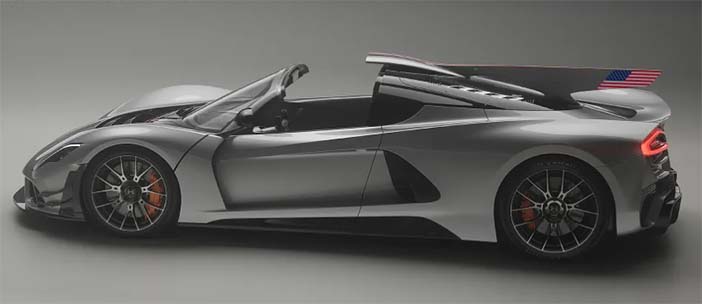
+++ The HENNESSEY Venom F5-M Roadster has been revealed as the most powerful production car ever fitted with a manual gearbox. Based on the semi-automatic Venom F5, just 12 cars will be built, and each one has already been sold at a cost of €3.5 million (Dutch pricing). Texan hypercar builder Hennessey says the “core purpose” of the Venom F5-M is to “amplify the sensation of driving”. Each one gets the standard Roadster’s open-cockpit design, but is marked out by the 1.400 mm dorsal fin that stretches from the roof-mounted air scoop right to the trailing edge of the rear deck. John Hennessey, company founder and CEO said: “We always wanted to build a manual Venom F5 and it’s something our clients have been asking for. It’s old-school, it’s badass and it offers ultimate driving engagement”. Nathan Malinick, Hennessey design director said: “This is a car for bold and brave driving enthusiasts who like their hypercars to thrill with wild power, dramatic design, and an experience behind the wheel that is incomparable to anything else on Earth”. Inside, the F5-M Roadster gets a sawn-off, Formula One-style steering wheel that’s fitted with a plethora of buttons controlling many of the car’s functions. On the centre console sits the all-important (carbon-fibre) gearlever, which Hennessey says is “physically connected” to the gearbox, without any electronic interference. The open-gated 6-speed manual sends 1.817 hp straight to the rear wheels. Performance figures haven’t been revealed, but the F5-M Roadster stands on the shoulders of the world’s fastest-ever convertible road car: the Hennessey Venom GT Spyder. That model, which boasted a relatively restrained 1.451 hp, holds the world record top speed for an open-top car. The 425 kph maximum was set in 2016. Part of a 30-unit total build run of Roadster models, every 12 F5-M model will be unique. Each owner will pick their chosen paint colour before it is deleted from the configurator, ensuring what Hennessey claims is “total exclusivity”. +++
+++ This is our best look yet at the long-awaited HYUNDAI IONIQ 6 N: the lower and sleeker sibling of the award-winning Ioniq 5 N, and a new challenger for the Tesla Model 3 Performance. Hyundai planted the seed for the Ioniq 6 N back in 2022, when it revealed the RN22e concept car. It featured a much more aggressive styling than the standard Ioniq 6 and a massive rear wing which, somewhat surprisingly, appears to have made its way onto the production model. Design changes compared with the regular Ioniq 6 include a redesigned front bumper, with more pronounced air vents on either side and what look to be a large central air intake. This would help cool the battery and motors underneath the car. Meanwhile, the wheels are wider than standard and partially hide a set of big, bright red brake calipers. It appears that the Ioniq 6 N has also received some wheelarch extensions, and the rear bumper has been tweaked to look more aggressive, too. The most noticeable change is, of course, the massive rear wing, below which is the standard car’s ducktail spoiler. The Ioniq 6 N should feature the same 650 hp, dual-motor set-up as the Ioniq 5 N, as well as that car’s 84 kWh battery and 800V charging system. There’s no reason why we couldn’t see an even higher power figure for the sportier bodystyle, but this is only speculation at the moment. I suspect that the Ioniq 6 N will also feature the same novelties and clever driving modes as its award-winning sibling, such as synthesised soundtracks that mimic the exhaust note of a petrol hot hatch and the ‘N e-Shift’ system that’s supposed to simulate gearshifts from an 8-speed dual-clutch transmission. It’s still far too early to speculate about performance figures, but we expect the Ioniq 6 N will at least match the 5 N’s 3.4-second 0-100 kph time, and offer its drift and N Grin Boost modes. In terms of handling, it’ll still run a coil-spring suspension set-up, but given the saloon’s lower centre of gravity, it could be even more engaging to drive than the somewhat more upright 5. Inside, the Hyundai Ioniq 6 N will probably pick up more sporty design elements, such as the 5 N’s new steering wheel and bucket seats. However, the basic interior architecture won’t change too much, and the standard Ioniq 6 already feels quite cosseting, thanks to its large centre console. Hyundai hasn’t confirmed a specific timing for the Ioniq 6 N yet, but it should arrive sometime in 2025. We should learn more when the facelifted version of the regular Hyundai Ioniq 6 is revealed. +++
+++ HYUNDAI-KIA ’s electric powertrains, featured in the Hyundai Ioniq 5 N and Kia EV9 GT-Line, have been recognized by US automotive publication WardsAuto as 2 of the 10 Best Engines & Propulsion Systems for 2024. This also is the third straight year that Hyundai Motor Group’s E-GMP electric vehicle platform, has earned this prestigious recognition. WardsAuto has been holding automotive powertrain awards since 1995. Expanded in 2019 to include electric propulsion systems, the awards spotlight the most innovative, efficient, and high-performing engines and drivetrains in the market. This year’s competition featured 34 new vehicles sold in the US, judged on criteria including performance, efficiency and technological innovation. The Hyundai Ioniq 5 N stood out for its power and driving dynamics, delivering 650 horsepower through its dual-motor, all-wheel-drive system. It is powered by an 84.0 kWh battery and features advanced thermal management systems designed to ensure peak performance under different driving conditions. The Kia EV9 GT-Line was recognized for its balance of range and versatility. It is equipped with a 99.8 kWh battery and can achieve up to 501 kilometers of driving range on a single charge. It also features a 400 to 800-volt multi-speed charging system that allows for faster charging, along with Vehicle-to-Load technology that enables the car to power external devices. The group’s efforts in EV powertrain innovations have been paying off, with Hyundai, Kia, and Genesis capturing a 10 percent share of the American market for electric vehicles from January to July this year, according to Motor Intelligence. This places Hyundai-Kia second only to Tesla, which holds a 50.8 percent market share. Sales of the Ioniq 5 reached 18.728 units in the first half of 2024, making it the 4th best-selling EV in the US. Meanwhile, the Kia EV9 debuted strongly with 9.671 units sold during the same period. With this latest recognition, the Hyundai Motor Group has now won a total of 18 WardsAuto awards since 2008. +++
+++ The reinvention of JAGUAR as a luxury brand is just around the corner, with managing director Rawdon Glover confirming the new, design-led brand will launch 3 cars over the next 3 years, each with an average transaction price of €140.000. The maker is hoping to reveal its first model, a 4-door saloon, before the end of the year, ahead of customer cars arriving towards the end of 2025, possibly early 2026. Following this, we’ll see a Bentley Continental-rivalling coupé and a large SUV. Glover confirmed the brand will not chase volume, “you’ll want a Jaguar, not need one”, he said. As CEO Adrian Mardell previously explained in an interview, there is a very clear desire to take Jaguar in a new direction with a fresh visual identity that expresses the emotion of the brand. To that effect, Jaguar’s team of designers produced a host of different options for consideration by a number of key stakeholders. What we see here is the first interpretation of a new design language that was virtually the unanimous choice of everyone involved, and is described by Mardell as “jaw dropping”. Glover told us the “design inside and out will make you want to buy a Jaguar”. The rapid-fire process was instigated by JLR’s chief creative officer, Gerry McGovern. Called Project Renaissance, it handed 3 teams within JLR’s design studio in Gaydon a common brief to produce a family of three distinct types of vehicles, resulting in 18 clay-model proposals being made in barely 3 months. It’s understood that Jaguar’s plan for 3 new models has changed tack somewhat. The business had previously hinted at 1 sleek saloon, followed by 2 SUVs. The maker’s is now understood to have swapped 1 of those SUVs for a big, 2-door, 4-seat GT; similar in positioning to Bentley’s Continental GT. There will be a common design language shared among the 3 new Jaguars, with Mardell previously insisting it’s “really important that there’s an association; a family look”. The British marque is being fully rebooted as part of JLR’s Reimagine strategy, with no replacements planned for any of the existing models. Instead, Jaguar is being moved upmarket to stand alongside Range Rover, Defender and Discovery as 1 of 4 ‘brand pillars’ of JLR. Indeed, Jaguar will be hoping to replicate some of the success of the latest Defender, which sells 3 times as many models as the old one did, each for around twice the price. The new 3-car line-up will be made at Solihull (the same plant that will also build the all-electric Range Rover) with the GT set to be the most powerful Jaguar production car ever made, and trumping the brand’s existing electric car, the I-Pace, on both range and charging capacity. Jaguar has not released motor outputs or performance figures, but it says the new model will have up to 700 km of range, and will be capable of adding around 320 km of range in 15 minutes of rapid charging. Glover told me that Jaguar will offer owners a charge card that’ll include access to the Tesla Supercharger network. McGovern said: “Jaguar’s founder Sir William Lyons said that it would be a copy of nothing, and that’s what we’re working towards. The brand has to inspire like no other: think exuberance, aspirational, fearless. This is absolutely the right way forward for this business, and I’ve more enthusiasm for it now than I’ve ever had. It’s a real opportunity; big stuff”. All of the new creations will sit on a bespoke platform called Jaguar Electrified Architecture (JEA). Nick Collins, JLR’s executive director of vehicle programmes, said: “JEA is being developed specifically for the exuberant Jaguar brand. There’s not a single vehicle architecture anywhere in the world that could create something as exuberant as what Gerry and the team have created”. As part of JLR’s reorganisation, Jaguars will only be sold alongside Range Rover, Defender and Discovery at selected retailers, although the brand could also be positioned at standalone boutique sales points; a tactic that’s already being employed for the luxury SUV brand. The first model’s price point is around €140.000 and JLR’s chief commercial officer Lennard Hoornik confirmed that this will be the entry point for the brand. “It’s definitely a ‘prices from’ situation”, he said. Hoornik added that the second and third models in the new range would arrive in reasonably short order after 2025. JLR’s overall ambition for Jaguar is to move it upmarket, even if it means reducing its sales volumes (an overall figure of 50,000, matching the Range Rover, is said to be at the higher end of the potential numbers). McGovern said: “It’s not that designs were bad over the past 20 years; it’s more that the strategy was about creating more universal appeal, and competing with mainstream premium products. This made Jaguar more normal. We’ve decided we want to go back to the future, to being a copy of nothing; a complete reimagining”. The only existing car that will stick around into 2025 is the F-Pace; Jaguar’s current top seller. +++
+++ JAPAN will hand out more subsidies for electric-vehicle battery production, pledging as much as $2.4 billion in support for related projects by Toyota and other major companies, as it seeks to strengthen its battery supply chain. The government will support 12 projects for storage batteries or those for their parts, materials or production equipment by up to ¥350 billion ($2.44 billion), Minister of Economy, Trade and Industry Ken Saito told reporters. We hope that these efforts will strengthen Japan’s storage battery supply chain and the storage battery industry’s competitiveness, Saito said. The move will help expand the country’s production capacity for storage batteries by around 50% to 120 gigawatt-hours (GWh), from 80 GWh currently, Japanese media reported earlier. The government backing included support for investments by Toyota, Nissan and joint projects that Panasonic Holdings’ energy unit would run with automakers Subaru and Mazda, respectively, Saito said. The latest support comes after the government pledged nearly $1 billion in subsidies for storage battery production in June last year. Toyota would invest a total of ¥250 billion in 2 subsidiaries to build battery plants in Hyogo and Fukuoka prefectures. However, a Toyota spokesperson said the automaker has not made any announcement regarding such projects, adding it has been making various efforts to increase the production capacity of EV batteries. Nissan said in a statement it had received certification from the government for a plan to produce lithium-iron-phosphate batteries. The automaker aimed to install such batteries in mini-vehicles from the 2028 business year, targeting a domestic production capacity 5 GWh for which it would get up to ¥55.5 billion in support, it said. Panasonic said there was nothing it could say beyond previously-made announcements, while Subaru and Mazda did not reply to comment requests. Panasonic’s energy unit, which also makes batteries for Tesla, previously signed an automotive battery supply agreement with Mazda and another agreement with Subaru. +++
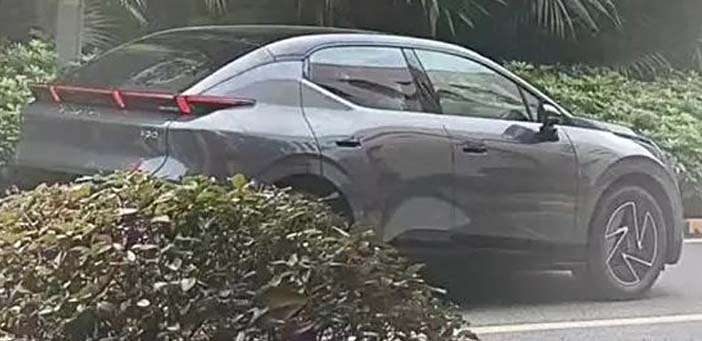
+++ LYNK & CO ’s new fully electric model will be unveiled in October in Europe. Following on from this, the Z20 will then debut in China at the Guangzhou Auto Show in November. It’s believed that the car will be sold in Europe as the Z02 rather than as the Z20, as it will be known in China. An unveiling in Europe in October is certainly in line with previous information given by Alain Visser, former CEO of Lynk & Co International, who said in 2023 that the company would bring an EV to Europe in 2024. Currently, Lynk & Co only offers the 01 PHEV in Europe and changing the car’s name to Z02 may be an effort to make the range look more coherent. Known internally by the code name E335, the car is built on Geely’s SEA2 platform, which is a version of the sustainable experience architecture targeted towards smaller cars. The Z20 can be seen as a Lynk & Co version of the Zeekr X, not only does it share the same platform technology but similarly it is a small SUV. Little concrete is known about the forthcoming Z20, and it seems as if the car may have been largely developed in Europe, with many spy shots so far seen having come from there. Both the cars spotted testing in Europe carried UK number plates. DVLA information showed that both had been registered on July 17 and that the vehicle maker was noted as Zhejiang Geely. Under the camouflage, one car is white, and the other is blue, according to registration information. Design-wise, features should be fairly similar between the recently launched Z10, Lynk & Co’s first all-electric model, and the forthcoming Z20/Z02. Unfortunately, the only shot so far of the front of the car is one from Europe, where it is heavily camouflaged. In the case of the Zeekr X, it has dimensions of 4.450, 1.836, 1.572 mm (l/w/h) and a wheelbase of 2.750 mm. We should expect the Lynk & Co car to be of a similar size, although possibly slightly bigger. A previously published interior spy shot reveals the car has a flat-bottomed steering wheel, dual wireless mobile phone charging pads, and square tandem drink holders. Also visible is a floating infotainment screen. Drive selection is by way of a steering column-mounted stalk. There is often little variation in the key details between brands in the Geely stable and so it is a safe assumption that powertrain information for the new Lynk & Co Z20/Z02 will be mainly in line with that of the Zeekr X. If that is indeed the case then the Lynk & Co will have a rear-mounted 200 kW electric motor which will be supplemented on all-wheel drive versions by a front-mounted 115 kW motor. Acceleration times 0-100 km/h for the Zeekr X are 5.8 and 3.7 seconds, respectively, for the single and dual motor versions. The Lynk & Co may well also inherit the same 66 kWh battery pack, which for the Zeekr gives a range of up to 560 km for the single motor version and 512 km for the all-wheel drive. +++
+++ VOLKSWAGEN has formally terminated a 3 decade-old job security deal with labour on Tuesday, opening the door for compulsory redundancies at the company from July 2025. Volkswagen, Europe’s largest car manufacturer, also cancelled deals guaranteeing employment for trainees and regulating temporary work for the company. Volkswagen had announced last week that it could not rule out potential plant closures or lay-offs because of major challenges currently facing the company. It also said it would scrap the job security deal that had been in place since 1994. The automaker has struggled to manage the shift to electric vehicle production, declining prospects in the important Chinese market and tough new competition from rising Chinese automakers. Volkswagen’s financial performance has lagged behind other brand within the Volkswagen Group, which also includes Škoda, SEAT, Audi and others. The company said it hopes to negotiate new wage agreements and other deals with the trade union and works council to replace the cancelled agreement by the time it lapses next year. Volkswagen has never closed a factory in Germany, and has not shut down a plant anywhere in the world since 1988. “This period now gives us the opportunity to find solutions together with employee representatives on how we can make Volkswagen competitive and fit for the future in the long term”, Volkswagen HR director Gunnar Kilian said in a company statement. “We must put Volkswagen in a position to reduce costs in Germany to a competitive level in order to invest in new technologies and new products from our own resources”, he said. Volkswagen has a total of 120.000 employees in Germany, more than half of them in Wolfsburg. Labour leaders have vowed to put up an intense fight against any plant closures or major cuts to the Volkswagen workforce. Thorsten Gröger, IG Metall district manager for Lower Saxony, spoke of “an unprecedented attack on the joint, historic collective labour agreement”, with which VW is now escalating the situation unnecessarily. “It’s better to solve the problems together and not against each other”. By unilaterally cancelling the job security agreement, “Volkswagen is putting co-determination to one of the biggest tests in the company’s history”, he said. Works Council chairwoman Daniela Cavallo said on Tuesday that workers would “fiercely defend ourselves against this historic attack on our jobs. There will be no compulsory redundancies with us”. +++
+++ The all-new VOLVO EX60 mid-size electric SUV is expected to be launched in 2026, and will serve as the zero-emissions alternative to the best-selling Volvo XC60, and will rival the Audi Q6 e-Tron, Porsche Macan Electric and BMW’s hugely important new Neue Klasse SUV, among others. Volvo has now confirmed the car’s name and revealed this will be the first model built on its next-generation SPA3 platform. This is an evolution of the EV architecture that underpins the Volvo EX90 flagship. Volvo says SPA3 is a far more scalable architecture than its predecessor, which will allow the brand to develop and build cars of all sizes using the same technology. That includes, in theory, smaller models than the 4.2-metre-long EX30 and larger ones than the EX90, which is more than 5 metres in length. Being scalable also means Volvo can create increased synergies and share key components across all cars built on SPA3, which reduces complexity and can help bring down the cost of production. Another advancement that will set the EX60 apart from other electric Volvos will be its “structural” battery pack. This technology has already been adopted by the likes of Tesla and BYD, and in effect bonds the battery pack with the floor of the car. The result, the brand’s head of new car programmes and strategy, Erik Severinson, told is “improved energy density” and, given the extra structural rigidity, “great driveability”. The EX90 uses a huge 107 kWh (usable) battery pack that offers a range of 600 km on a single charge. Given the EX60’s smaller size, I expect to see a slightly more compact, lighter battery fitted to top-spec models. The increased energy density of its structural battery pack could see range figures approaching the 640 km, however. The incorporation of this new kind of cell technology is thanks, in part, to the EX60’s megacasted rear underfloor. Unlike most cars, which have rear undercarriages constructed using a multitude of different parts, the EX60 will instead get a single unit that is cast out of aluminium. The factory in Gothenburg, Sweden, will assemble the EX60’s megacasted floor. Basically following the same manufacturing processes used to build 1:64-scale model cars but greatly enlarged, megacasting is a relatively new concept in the automotive sphere. Tesla is the only other mainstream manufacturer currently adopting the method, along with several Chinese brands such as Nio, Zeekr and XPeng. Volvo says the new rear floor weighs “15-20 percent less” than a traditional stamped equivalent and that it offers “just as good, if not better safety and durability”. There are other incidental benefits from the process, too, including an increased boot capacity and faster production times. A megacasted floor takes 120 seconds to build, compared with 1 hour for a multi-piece stamped floor. Plus, while Volvo’s production process currently uses 20 per cent recycled aluminium, the goal is to increase this figure and fully recycle the megacasted floor at the end of the car’s life. The new Volvo EX60 will either be unveiled at the tail end of 2025, or in 2026 when the car is expected to go on sale. Arriving first is the Volvo ES90 electric saloon, which will make its world debut in March 2025 and should hit the streets later that year. But in the meantime, our exclusive image shows what the new EX60 could look like. It will probably carry over several design elements from both the EX30 and EX90, such as their eight-bit-style Thor’s-hammer LED headlights, flush door handles, a blanked-off grille and aerodynamic alloy wheels. Volvo hasn’t confirmed whether the advanced LiDAR driver-assistance tech found on the EX90 will filter down to ‘lesser’ models, such as the forthcoming EX60, but Severinson did tell us that the brand is experimenting with “different kinds of [safety]sensors going forward”. +++