
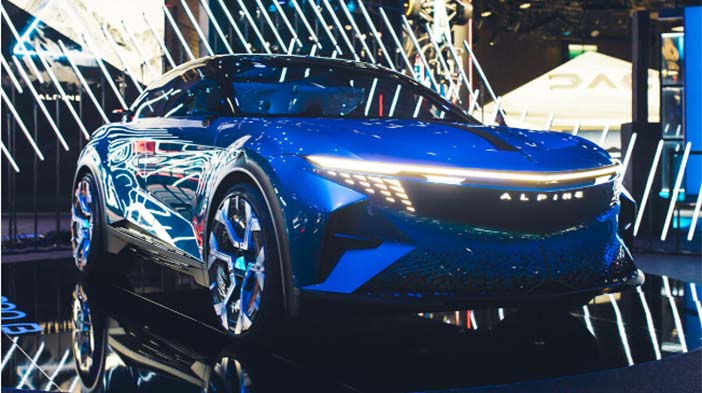
+++ ALPINE will use innovative power management software in its electric cars to ensure that a feeling of perceived lightness counteracts the added bulk of an EV powertrain and enables true sports car handling. The firm’s sole current model, the 1.100 kg A110, is one of the lightest cars in series production; a key component in its acclaimed dynamic agility. But the 7 electric cars the brand plans to launch by 2030 will inevitably be much heavier, which presents a tricky engineering challenge for a brand whose handling prowess is central to its positioning. For reference, even the compact electric A290 hot hatch weighs around 1.500 kg and while the firm has not confirmed a weight for its new A390, the similarly sized Nissan Ariya with which it shares a platform weighs between 2.000 and 2.300 kg. But speaking to journalists at the Paris motor show, Alpine CEO Philippe Krief said the firm will fine-tune its EV powertrains to give the “behaviour” of a light car, in keeping with the spirit of the A110. “It’s perceived lightness that’s coming, not actual lightness”, he said. Crucial to achieving this is Alpine’s bespoke powertrain arrangement (previewed on the A390 concept at Paris) with 2 motors on the front axle and 1 at the rear. By using torque vectoring technology to intricately vary the power delivery to all three motors, said Krief, “you can generate a quite immediate response time; it’s like the behaviour of a light car”. The A390, he acknowledged, is “not a light car, but it seems to be. It’s so quick; it’s so natural and so integrated. When you have professional drivers testing your cars and they tested with the systems on because they wanted it that way, you understand that it’s good. This is the ultimate test”. Even so, Alpine is still “working on the absolute weight of the car”, he said, and it is expected to be lighter than the equivalent Renault and Nissan models. The A390 is currently in the final stages of testing ahead of an official unveiling in 6 months time and will set the tone for the dynamic behaviour of the 5 other EVs that are due to follow it by the end of the decade. Before being installed as Alpine CEO last year, Krief was best known for his work as an engineer on such acclaimed sports cars as the Ferrari 458 and Alfa Romeo Giulia Quadrifoglio. Asked if his experience on those cars can help in the creation of a 5-seat electric SUV, he said: “Yes, it’s different, but what gives you the pleasure when you drive the car is always the same thing. It’s a fact that when you do a sports car, you need to have the car feedback to everything you are doing as quickly and as reliably as possible – as simple as that. The steering, acceleration, braking and gearbox need to be fast and precise, and you have other technologies to do that with electric but you have some degree of freedom as well”. Describing Alpine as a “sports specialty” brand, rather than a pure sports car maker, Krief reiterated the brand’s plan to be selling 100.000 cars a year by 2030, and his ambition to position the brand “kind of between Porsche and Audi”. Asked if Alpine has comparable brand awareness to those 2 German marques, he said “no, absolutely not”, but that expanding the model line-up, Alpine’s dealer network and its motorsport activities will help to build that footprint. +++
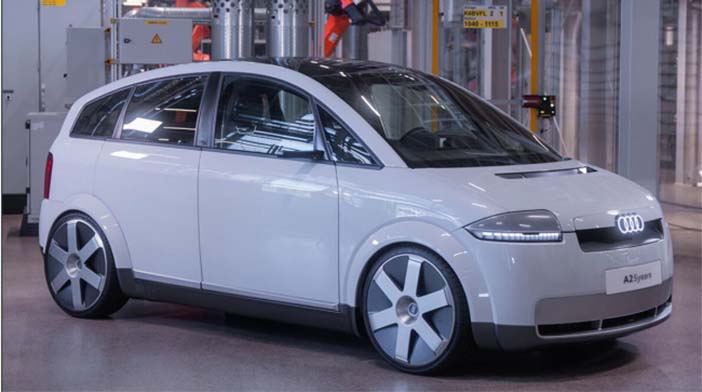
+++ AUDI has reinvented the cult-classic A2 with electric power and a futuristic new look to celebrate its 25th anniversary. The one-off A2 e-Tron is the latest creation to emerge from Audi’s apprenticeship program, which in recent years has given us the outlandish RS6 GTO concept and a 240 hp, race-inspired reworking of the NSU Prinz. Technical details of the electric A2 are thin on the ground, but the innovative MPV-cum-supermini has been subtly redesigned with influence from Audi’s current EVs. The headlights, for example, have been swapped for more modern, slimline led strips, and the badges at each end are now illuminated; like on the new Audi Q6 e-Tron. The conventional door handles have been removed, too, and the original alloy wheels have made way for a more contemporary closed-off design, measures made (no doubt) in pursuit of enhanced aerodynamic efficiency. With a coefficient between 0.25 and 0.29, the efficiency-focused A2 was already one of the slipperiest production cars of its era, but Audi has not confirmed a figure for this electric reworking. Nor has the firm given any indication of how closely the A2 e-Tron is related, technically, to any of Audi’s production cars. At less than 4 metres long and just 1.700 mm wide, the A2 is substantially smaller than Audi’s current entry-level EV, the Q4 e-Tron, but it is possible that the MEB architecture which underpins that crossover could have been adapted for the compact one-off. Audi sparked speculation of an electric A2 revival in 2019 when it revealed the AI:ME concept as a futuristic vision of an MEB-based hatchback to succeed the A3, but has not since alluded to any plans for a production version. A car bearing the A2 e-Tron badge could, however, be in showrooms as soon as 2017: Audi is developing a “wonderful and unique” entry-level EV to sit underneath the A4 and Q4 e-Tron models, and according to the firm’s new naming strategy for EVs, it will have an even-numbered name. The original Audi A2 has come to be regarded as a defining car of its era, with its lightweight aluminium construction, wind-cheating bodywork and ultra-frugal petrol and diesel powertrains helping to cement its legacy as a flagbearer for truly efficient family transport. It was expensive, however, and less practical than the more conventional alternatives that were on sale at the same time, so it sold in low numbers and was not replaced after its retirement in 2005. +++
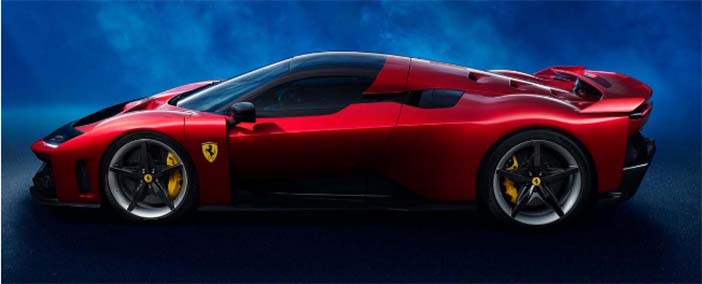
+++ FERRARI ’s long-awaited successor to the LaFerrari is the Italian marque’s most powerful road car to date, drawing 1.200 hp from a wild electrified V6 powertrain that fuses technology from the firm’s Le Mans-winning 499P with that of its Formula 1 racing cars. Named the F80, the new hypercar has been unveiled just weeks after McLaren revealed its own new halo model, the W1. The F80 reignites the 2 manufacturers’ long–standing rivalry and reboots two-thirds of the iconic ‘Holy Trinity’ of hypercars from the early 2010s. The new hypercar is priced from €4 million in the Netherlands and limited to just 799 examples (all sold), and it follows in the footsteps of the F40, F50, Enzo and LaFerrari in rewriting the rulebook for a road-going Ferrari, while also being fitted with a host of tech that makes it a “new benchmark for innovation”. At the heart of the F80’s powertrain is a new version of Ferrari’s 3.0-litre twin-turbo V6. The engine can rev to 9.200 rpm and has been completely overhauled compared with the unit that powers the 296 GTB. Parts from the 499P Le Mans car have been added to give it 900 hp in its own right, making it the most powerful engine Maranello has yet produced but no heavier than the 296’s engine. Working in conjunction with the V6 engine are 3 electric motors: 2 on the front axle and 1 on the rear. Produced in-house (a first for Maranello), the front motors make 140 hp apiece, while the rear motor takes the form of an ‘MGU-K’ energy recovery unit. The latter is similar in design to that found in the brand’s F1 cars and can recover as much as 94bhp through braking to automatically fill power gaps. For the first time in a Ferrari, the F80 features ‘E-turbos’. Connected to an F1-derived ‘MGU-H’ heat recovery device, they have electric motors between the turbine and compressor to reduce lag and enhance throttle response. All in, the powertrain sends a combined 1.200 hp to all 4 wheels for a claimed 0-100 kph in 2.15 seconds. This trumps both the McLaren W1 and the Mercedes-AMG One. Different modes offer varying power levels, with Hybrid, Performance and Qualify selectable via the eManettino switch on the steering wheel. There is no pure-electric mode, as on the 296, because the F80 is not a plug-in hybrid: its 2.3 kWh battery serves to boost power and allows low-speed, short-distance engine-off running. While the default Hybrid mode optimises the powertrain for efficiency, Performance and Qualify modes give access to the F80’s Boost Optimisation function, which records the track during a sighting lap and then delivers power boosts when needed on the next pass, on straights or uphill sections, for example. The F80 draws on the aerodynamic expertise of Ferrari’s top-class motorsport teams to maximise downforce. As Ferrari’s chief product development boss, Gianmaria Fulgenzi, explained, the underbody of the F80 is heavily inspired by the firm’s F1 car, with large barge boards used to channel air underneath the car. Up front, the aggressively styled nose is dominated by a huge ‘S-Duct’, which takes inspiration from the 499P and moves air over the cabin and towards the rear. The black fascia across the nose, which is of a similar vein to that of the new 12Cilindri, features a small lip at the top edge to channel air over the top of the cabin to the rear wing. Endowing the radical F80 with greater visual presence is the active rear wing, which adjusts not only its height but also its angle to optimise downforce and minimise drag. With help from a huge rear diffuser, the rear of the car is able to create up to 590 kg of downforce. All in, the F80 generates up to 1000kg of downforce at 250 kph, which puts it on par with the McLaren W1; Ferrari says the front end alone can generate up to 460 kg of downforce. In comparison, an F1 car generates some 1.200 kg at the same speed. At 4.840 mm long, 2.060 mm wide and 1.130 mm tall, the F80 is marginally bigger than the W1, and it is 125 kg heavier at 1.525 kg (dry). However, the mix of lightweight, race-honed materials (carbonfibre, titanium and aluminium) used in its construction make it 60 kg lighter than its LaFerrari predecessor. The F80’s chassis is also 50% stiffer than its forebear’s. The cell and roof are made from carbonfibre, with the front and rear subframes made from aluminium. Ferrari has also used the front subframe for heat management purposes, with the hollow structure used as cooling ducts for the brakes. Crucial to the F80’s set-up is the active suspension, which is powered by 4 actuators (48v). 3D printing is used to create parts of the double-wishbone set-up employed by the F80. “We developed the system with Multimatic because it helped us with the active suspension on the Purosangue”. said Fulgenzi. “In the F80, the system is totally new. The centre of gravity is naturally lower, with most of the car’s weight in the centre of the car. “Also with the aerodynamics, we need to keep the car stable and balanced through corners, and the active suspension is the perfect system to ensure this”. Draped over the lightweight carbonfibre chassis is a design that is “absolutely new” and avoids “anything nostalgic”, according to designer Flavio Manzoni, who cited spaceships and sci-fi as the inspiration for the car’s outlandish look. The influence of icons from past Ferrari is evident, with the pronounced front wheel arches nodding to the F40 and Enzo, while the rear styling echoes that of the classic 330 P3. Early discussions about making the F80 a single-seater did not come to fruition, but the cabin has been designed primarily for the driver with what Ferrari calls a ‘1+’ configuration. This translates to an asymmetrical layout that gives the driver priority in the cabin, while relegating the passenger to a ‘seat’ that’s offset and carved into the chassis.The majority of the controls and functions on both the new ovoid steering wheel and slim centre console are physical, which Ferrari says are easy to use while driving. “A 0-100 kph time of 2.15 seconds is only a number, but when you experience this kind of driving, people want it more and more everyday”, said Fulgenzi. “That’s what we want to create: for owners to be addicted to driving the car and not just own it”. +++
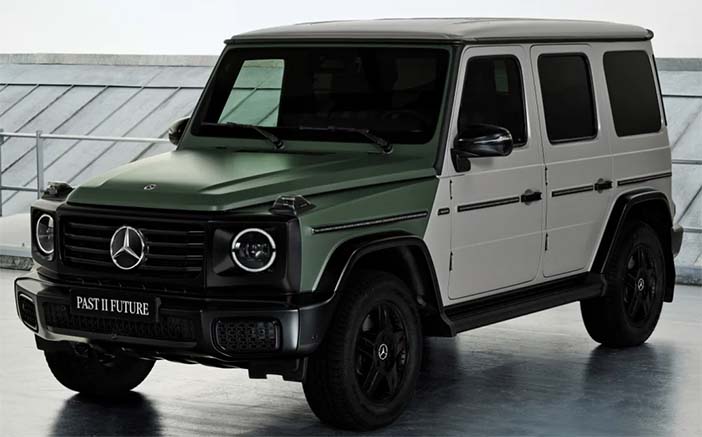
+++ A lot has changed in the 45 years since the original MERCEDES G-CLASS came down from the Schöckl mountain and was introduced to the world, and the new ultra-limited-edition G-Class Past II Future celebrates this timeless quality of the iconic 4×4. The new version comes in a unique olive green and grey 2-tone paint scheme, which is contrasted by the fully black front end, including grille and bumpers, plus black alloy wheels, wheelarch cladding and side steps. Meanwhile the trim running along the length of the car features a special message: “This G-Class is dedicated to those who celebrate invention. The disruptors. The pioneers. The collaborators. To those who explored the past and drive the future with passion, wisdom and vision”. The interior gets chequered seat upholstery, which is a nod to the patterns found in earlier G-Class models. There’s also ‘Past II Future’ lettering on the dashboard’s grab handle, and ‘one of 20’ inscribed on the centre console. Every model gets a 3.0-litre 6-cylinder engine with mild-hybrid assistance, but customers will be able to choose from the diesel G 450d with 367 hp and the petrol G 500 with 449 hp. Both send their power through a 9-speed automatic transmission to all 4 wheels. Only 20 examples of the G-Class Past II Future will be made, and while Mercedes hasn’t announced how much they cost, it’ll start delivering the cars to their owners in April 2025. The design and interior treatment for the limited edition G-Class is inspired by a one-piece ‘art piece’ that Mercedes created with the help of luxury fashion brand Moncler and Japanese designer NIGO. It’s also part of the G-Wagen’s 45th anniversary celebrations, and is based on a fully restored cabriolet model from the ’90s. In place of a fabric roof, the ‘Project G-Class Past II Future’ has a quilted design similar to a Moncler puffer jacket. Other interesting details include black steel wheels in a nineties design, plus a gold-coloured fuel can on the back along with the familiar spare wheel, and a sound system that uses removable boom boxes. +++
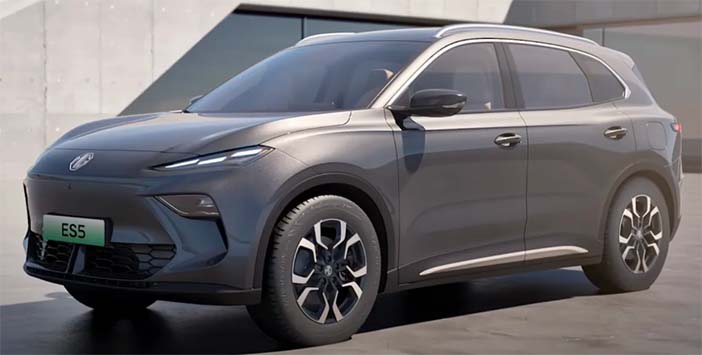
+++ This is the first official look at MG ’s new fully electric SUV, which will launch in the Netherlands next year and serve as the successor to the popular ZS, rivalling small family EVs such as the Skoda Elroq, Kia EV3 and Hyundai Kona Electric. In China it’s called the MG ES5, but Autointernationaal.nl has learned that the brand is still to decide what name the car will use when it comes to our shores. All we know so far is that it will not be badged ZS. The design will be slightly different to the car you see here, but the family resemblance with MG’s other EVs should still be very obvious, particularly the MG4 hatchback on which it’s based. The SUV doesn’t look quite as aggressive, mind you, and features much slimmer headlights, plus there’s more black plastic cladding along the sides and a set of roof rails. But, as with the MG4, there’s a large chrome MG octagon badge on the nose, and at the rear is a full-width light bar with Y-shaped tail-lights. The ES5’s interior has a minimalist feel, and features an enormous touchscreen as its centrepiece. However, the version sold here is expected to have a different cabin design tailored towards the European market, which we think will mirror other models in MG’s Dutch line-up, such as the second-generation ZS and HS that were introduced very recently. In terms of size, the ES5 is longer, wider and lower than the ZS it will replace. In fact, at 4.476 mm from nose to tail, it’s also about 120 mm longer than the latest Kona Electric, and its wheelbase of 2.730 mm is 70 mm longer, too. While certain technical details have yet to be announced, considering that the ES5 sits on the same Modular Scalable Platform (MSP) as the MG 4, it could therefore be offered with the same wide selection of battery/motor combinations as its sibling. If so, the base model will use a 51 kWh battery and offer a range of just over 320 km, while the longest-range version will deliver more than 480 km thanks to a 77 kWh powerpack. So far, MG has only said the ES5 is rear-wheel drive, like most versions of the MG4, which produce between 170 hp and 245 hp depending on the exact model. But we know this platform can accommodate a dual-motor powertrain as we’ve seen in the MG4 XPower, so there’s potential for an all-wheel-drive version as well. The European version of the MG ES5, or whatever it’s eventually called, is set to be revealed in early 2025, so pricing won’t be confirmed for some time. However, Dutch distributor Van Mossel revealed to Autointernationaal.nl earlier this year that he’s hoping to be able to launch with a sub-€34.000 starting point. This would significantly undercut its key rivals. The Skoda Elroq has just gone on sale with a starting price of €34.990, the Kia EV3 starts from nearly €36.995 and the cheapest Hyundai Kona Electric is priced at the same price. The spokesman added: “Inevitably by the time we get to it, there’s probably going to be 2 or 3 other cars that have come out at the same time, maybe from some brands that don’t even exist in this market right now because it’s ever changing, isn’t it? So we’ve just got to keep a very close eye on who’s doing what, how they’re doing it and look to where we can see some opportunities”. MG is also plotting to go after the Skoda Enyaq and Renault Scénic E-Tech next year with a larger, mid-size electric SUV. It will use the same MSP platform as the ES5 and in effect will be a replacement for the Marvel R that’s sold in Europe. The name of MG’s second electric SUV for 2025 also remains under wraps for now. +++
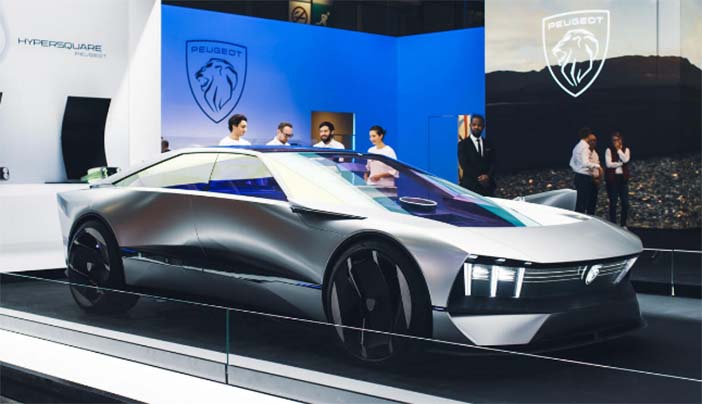
+++ PEUGEOT won’t follow rivals in reviving any historic models for its all-electric era, but will subtly reference its heritage in future cars. The brand’s head of design, Matthias Hossann, told that Peugeot has no plans to adopt a nostalgia-fuelled design approach at the Paris motor show, where Renault showed off the new retro-styled 4 crossover alongside its similarly conceived 5 E-Tech and Twingo E-Tech. His comments would seem to confirm, once and for all, that there is no chance of 2018’s E-Legend concept reaching production in any form, and that its influence on future models will be minimal. Designed to celebrate the 50th anniversary of Peugeot’s brand-defining 504 saloon, the E-Legend was an overtly retro-inspired creation that introduced several definitive styling cues for Peugeot’s current model line-up, but it never made it to showrooms in its own right. While they take some influence from the concept in their light signatures and muscular proportions, Peugeot’s current cars are rather more futuristic in their design than retro, but that’s not to say heritage cannot still play a role in the brand’s future, according to Hossann. He said he is “still super-proud” of the E-Legend, because “it was the perfect balance between reinventing the past without going into pure retro design. I think sometimes it’s good to do retro design when you have to relaunch a brand, because it creates a kind of highlight for the brand at some point. I think that is not really the case, for the moment, at Peugeot”. So while rival brands including Renault, Fiat and Mini take influence from their most recognisable past models for their new-era EVs, there are no grand comebacks for any historic Peugeot models in the cards. Instead, as showcased by the brand’s radical Inception concept (expected to strongly influence the successor to the 508) Peugeot’s future models will be imposing, futuristically styled creations designed to make the marque as recognisable and distinctive as possible, while taking influence from its 214-year history. Hossann said: “What we are showing today, for example, with the Inception is that Peugeot is one of the oldest car brands in the world, in fact, but at the same time, we are really future- and forward-looking. When we design a Peugeot as a team, we say ‘let’s really invent the future’, but at the same time, we have some solid foundations. We have a fantastic history. So I’m not saying that we’ll never look into our history, and the E-Legend is a good example, but at the same time, how can we twist it into something which, in the end, is really futuristic? I think this is the main challenge”. Hossann said exclusively nostalgic design cues can be “a danger for a brand” and that it is important for Peugeot to show it “can always reinvent” itself. “The challengers for the future will be those brands that maybe do not exist today, so can we really reinvent, on a daily basis, our brand, by keeping this strong foundation which is our story? It’s always a nice balance between playing with history but always looking into the future,” he said. Designing cars according to these principles is crucial to cementing and promoting Peugeot’s identity as it faces off with a wave of newcomer brands who don’t have the same heritage and recognisability to lean on. “We have tried, for some years, to make a Peugeot be recognisable from 200 metres away”, said Hossann, who points to the ‘feline attitude’ of Peugeot’s current design language as a key differentiator from its rivals. +++
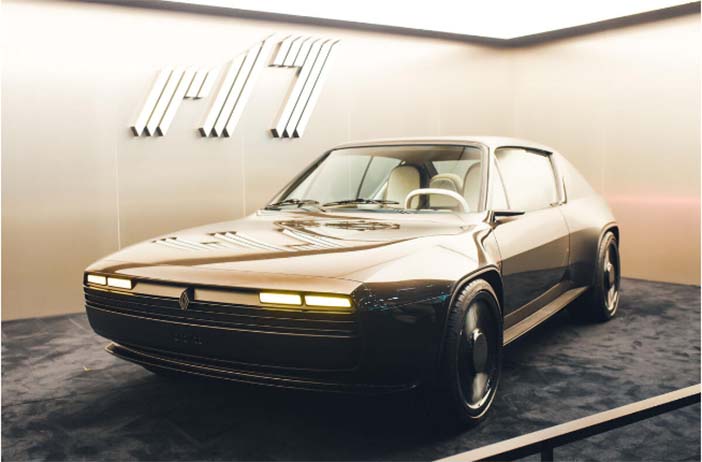
+++ RENAULT has no plans to put its striking 17 concept into production and will start to move away from retro designs now that it has revived some of its most recognisable models. The 17 Electric Restomod was revealed recently as a reinterpretation of a lesser-known coupé from the 1970s, wearing a sleek new look, riding on a new carbonfibre chassis and being powered by a 270 hp rear-mounted electric motor. There was speculation about the possibility of it evolving into a production car, but Renault Group design boss Laurens van den Acker has poured cold water on the prospect. He referred to the 17 concept, created in partnership with designer Ora Ito, as a ‘brand kicker’ designed “just to make noise”, like the Twingo concept that Renault did with Sabine Marcelin last year and the 4 by Matthieu Lehanneur, who designed the 2024 Olympic torch. “These are not for you guys, in a sense”, he told journalists at the Paris motor show. “They’re for people that buy Vogue magazine or read the Monocle”. And in response to calls for Renault to put a version of the 17 in showrooms, Van den Acker suggested that not all historic Renault models have the same popular (and commercial) appeal as the new 4, 5 and Twingo. “You have a selective memory when it comes to the past. Now we look at these cars and we say ‘look at how great they were’, but to be honest they were challenged”, he said, referring to the 17, which had a relatively short life and wasn’t especially popular. The chances of a revival for the likes of the Safrane, then, are minimal, suggested van den Acker, and even though “some people truly, deeply loved” the genre-busting Avantime of the 2000s, the short-lived 2-door MPV won’t be coming back. And while there is an appetite for a resurrection of some of Renault’s more recent and more mundane offerings, it’s not to the extent that the company would consider all options. “People ask me ‘why don’t you do a Modus?’ “, he said. “If you want a Modus, buy yourself a used one. They are still available”. Reviving a historic model is a difficult process, he explained, and to be successful, these retro creations must hold universal appeal, rather than just speaking to enthusiasts. “These are difficult cars in the sense that they are right or wrong: either they hit the bullseye or they don’t. “You need to capture what’s in the collective memory, of what comes up in your mind when you think about the Renault 4 or 5. It’s a tricky job, but ironically and surprisingly, when we tested the cars in market clinics, people looked at the 5 and they said it looked futuristic”. Renault’s aim with the 4, 5 and Twingo is to cultivate appeal even across an audience that doesn’t remember the original models and for whom the names have limited significance. “You can like it even if you don’t know the original car exactly”, he said of the 5. “The way it drives, the big wheels: It’s kind of a concept car made real, let’s be honest. “For those who remember it, we’ve given them all the stuff to love, and for those who couldn’t care less, it’s just a nice car”. +++
+++ Bosch, the world’s largest auto supplier, took RIVIAN to court in July over an ugly dispute concerning the e-motors in the electric vehicle maker’s pickups and SUVs. These kinds of disputes happen often in the supply chain, but rarely lead to litigation because neither side is angry enough to air its dirty laundry in public. This fight is unusual. In most cases, it’s David vs. Goliath. The supplier is David taking on the big mean Goliath automaker who isn’t paying enough for components. But in Bosch vs. Rivian, it’s the other way around. Bosch is a massive corporation with $55 billion in annual worldwide business with automakers. With roots dating back to Germany in 1886, Bosch’s global operations employ about 429.000 people. It reported profits after taxes of $2.8 billion in 2023. Rivian, on the other hand, dates all the way back to 2009 and, if lucky this year, it might generate $5 billion in revenue. It employs an estimated 15.000 people and isn’t close to profitability: it hemorrhaged $2.9 billion in the first half of 2024. Despite the math, Rivian refused to reimburse Bosch $204 million after it ceased using the supplier’s e-motors and brought the work in-house, according to the lawsuit. Rivian countersued, accusing Bosch of “reckless failures” in performing the contract. “At the very heart of Rivian’s vehicle design were 4 electric motors”, the countersuit said. “To supply this mission-critical, custom car part, Rivian turned to the largest and most established supplier of automotive parts in the world: Bosch. That was a mistake”. Perhaps it was a mistake, but when you consider Rivian is the little guy in this fight, is the nascent automaker making a bigger mistake letting it fester into a court fight? We’ll likely find out no later than February 3, when the judge in Wayne County Circuit Court in Detroit has scheduled a status conference. It wouldn’t be a stretch to bet this case settles out of court. +++