+++ The BMW M3 will return for a 7th generation with the choice of either a straight-6 turbo petrol engine or a high-tech EV powertrain with huge power and unprecedented dynamic ability. Due by early 2028, the next M3 is being engineered for both powertrains in a bid to maximise its appeal and in line with BMW’s ongoing commitment to combustion power. The current car’s ‘S58’ twin-turbo 3.0-litre straight-6 has been made compliant with upcoming emissions regulations, meaning the petrol M3 can (for as long as customer demand dictates) remain on sale alongside the all-new electric version, which will be based on BMW’s Neue Klasse platform. In a wide-reaching interview, BMW M CEO Frank van Meel has laid bare his priorities and plans for the electrification of the storied performance division. At the centre of those plans is the new generation of its seminal sports saloon; overhauled from the ground up to take the fight to EV and ICE rivals including the Mercedes-AMG C 63, Porsche Taycan and Hyundai Ioniq 5 N. Asked if the electric and ICE M3s will wear different badges, van Meel said: “Do we need to set them apart? An M3 is a promise, not an engine”. That strongly suggests that electric car will not adopt the iM3 moniker, despite BMW having trademarked it. The EV version will be derived from the next-generation 3 Series, due on sale from next year, while the ICE car is likely to be a heavily updated version of today’s ‘G80’ M3, with Neue Klasse design influence. “We’re also working on the newest emission regulations on combustion engines. We’re planning to keep up our combustion cars as well”, said van Meel, who is adamant that the M3 will retain its signature pace and dynamic agility, irrespective of powertrain. He conceded that the first generation of BMW’s electric performance cars will be heavier than their combustion forebears, because customers want their EVs to have a usable range and that (until solid-state packs arrive) means big, weighty batteries. However, he suggested that with the proliferation of public EV chargers comes the ability to install smaller battery packs and thus reduce weight; important for sports cars, particularly. “It’s the hen and egg principle”, he told. “The way I see it in the end is it’s going to be all-electric. Once you can make high-performance cars (and we will in the future) all-electric, then the next question is what about charging infrastructure. “That is the key question and it’s not a question that a car manufacturer can answer. So in the beginning, the cars will be heavy because they will be equipped with batteries that allow a long range to avoid range anxiety in environments where charging infrastructure is still not widely spread”. As an indication of what an electric BMW super-saloon might weigh, the closest thing to a full-fat M EV currently on sale is the top-rung i5 M60 xDrive which is a heady 2.3 tonnes, compared with 1.930kg for the previous-generation, pure-petrol M5. Van Meel likened this phenomenon to the rise of the iPhone: “When it came out, you just wanted to throw away your old phone. I had a Nokia 6210, the classic one. It had a standby time of 84 hours. Then the iPhone came and didn’t have a standby time of 12 hours. It could do huge things, but actually I went to the Geneva motor show and by 12.30 I ran out of battery. I couldn’t call anyone!” He added: “But the batteries became better, everyone has a charging cable, in every hotel and car there is a plug, so now you’re used to it. You can plug it in everywhere and it’s no hassle any more”. The M division’s priority in the medium term, then, is to ensure its EVs remain as agile and engaging as its current cars in spite of the inevitable extra bulk. Van Meel says the new M5 (now a plug-in hybrid that weighs around half a tonne more than its pure-V8 predecessor) illustrates how the division will use innovative power management technology to mitigate the impact of this added weight. He recalls that when the sports saloon went 4-wheeldrive for its previous generation, there was concern about what that would mean for the model’s trademark rear-biased handling balance, but he had been impressed by prototypes and was confident in the car’s dynamic credentials. He said: “I already knew how it was going to drive, but I couldn’t tell anyone or explain, so I had to just wait until the car came out and everyone could drive it, and then it was fine. And now it’s the best M5 ever”. Van Meel said he feels the same now, having spent time at the wheel of test mules for electric M cars: “I’ve driven our cars and I know what we’re doing, and they’re really cool, but either I don’t want to say right now what we’re doing, or I can’t transfer the message because you come from what you know, and you don’t know what we’re doing”. Crucial to appeasing the keen driver will be the new quad-motor powertrain arrangement that M engineers are testing in prototypes. This allows for full four-wheel torque vectoring that means “you can have a perfect line and the precision you know from an M car”. But, van Meel added, “to get the precision, it does not help only to have four electric motors: you need a central control unit and that’s what we used to call the Hand of God”. This is the central computer BMW M cars use to vary power delivery to each wheel and it has been renamed the Heart of Joy for its electric performance cars. “It seems more complicated, but it’s also more interesting if you control them with one ‘hand’; not only in regards to accelerating or cornering but also braking and stabilising”, he said. “Then you have the possibility to create a new dimension of vehicle dynamics, and then you can counteract the increase in weight”. His comments echo those of Alpine CEO Philippe Krief, who has said torque vectoring between multiple electric motors can create a feeling of “perceived lightness” that masks the true weight of an EV. Importantly, each major component in a BMW M electric drivetrain will be bespoke to the sporting division. Much as it has always used heavily reworked versions of standard BMW engines, it will continue to use parts from its parent company as the basis for higher-output, performance-focused electric systems. Van Meel said: “In the past, we had special engines like the S58. BMW had a B58 and we took the base engine, made modifications (new cylinder head, new production processes) and we can assemble it on the lines where the B 58 engine is assembled, and the same was true with the S and N 63 engines. “We use the same ideas and logic for developing our high-performance engines. We are in close cooperation with BMW to use their bases as a basis for what we are making at M”. +++
+++ BYD South Korea will roll out its electric sedans early next year, aiming to expand its sales portfolio beyond commercial vehicles here, the Chinese carmaker said. The local subsidiary of the global electric vehicle (EV) and battery maker has already operated its business in Korea focusing on selling commercial cars, such as electric trucks and buses, since 2016. However, the company is seeking to widen its revenue stream with its price-competitive electric sedans and SUVs here in a pre-emptive move to attract more customers during this global EV chasm period, before mass adoption of EVs. BYD’s entry into the Korean market may come as a major risk particularly to other global EV makers focused on selling cheap EVs. The carmaker did not unveil what models will be available for sale here, but they will include its mid-size flagship sedan, the Seal, and electric hatchback, the Dolphin. BYD Korea has already completed the registration of trademarks for the models here. The price for the Dolphin starts at less than 20 million won ($14,200) in China. The Chinese carmaker is still lesser known in Korea, as the company has so far sold only commercial vehicles here, but BYD is the world’s top EV maker. According to data from market tracker, SNE Research, BYD sold more than 2.6 million EVs across the globe between January and September, up 31.2 percent from the previous year, achieving the largest global EV market share of 22.3 percent. BYD’s decision to expand its business here is also seen as part of its efforts to increase sales channels in more Asian regions, as it faces strong tariffs from the United States. “We have conducted an in-depth review with our experienced executives and partner firms, so we can meet the sensitive appetite of Korean customers”, Cho In-chul, head of BYD Korea’s passenger car division, said. “BYD Korea will make public details on the schedule for the launch of our passenger cars soon”. However, it remains to be seen whether the Chinese automaker will be able to expand its presence in the passenger EV market, as Korean customers still tend to view Chinese vehicles with low credibility, according to industry officials. “Local customers have a tendency to purchase vehicles manufactured by trustworthy brands, rather than placing a top priority simply on price competitiveness”, an official from the industry said. “The only and most powerful upside of BYD is its price. The Chinese carmaker needs to improve its brand value and awareness here for its smooth landing in the passenger car business here”. Another obstacle is Koreans’ weak reliability on Chinese batteries following a series of EV fires here, according to the official. “Even if BYD and CATL are considered global battery giants, local customers still prefer to purchase EVs equipped with batteries manufactured by Korean companies, after multiple EV fires were reported throughout this year”, the official said. +++
+++ The HYUNDAI MOTOR GROUP has outpaced Volkswagen Group in the third-quarter profit, edging closer to claiming the world’s second-largest carmaker title this year for the first time. From June to September, Hyundai Kia and Genesis posted 69.4 trillion won ($49.7 billion) in sales revenue and 6.5 trillion won in operating profit. Volkswagen Group reported higher sales of 78.5 billion euros ($84.2 billion), but it fell behind in profit with 2.9 billion euros. This marks a significant milestone for the Korean carmaker, which exceeded the German rival in profit for the first time in the January–March period before Volkswagen regained the lead in the second quarter. In terms of operating profit margin, Hyundai reached 9.3 percent, widening the gap with Volkswagen’s 3.6 percent in the third quarter. In the April-June period, Hyundai and Volkswagen reported 10.9 percent and 6.6 percent in profit margin, respectively. Regarding unit sales during the January–September period, Hyundai came in third with 5.5 million units, following Toyota with 7.2 million units and Volkswagen 6.5 million units. Toyota remains the world’s leading automaker, reporting third-quarter sales revenue of 11.4 trillion yen ($74.1 billion) and an operating profit of 1.2 trillion yen with a 10.1 percent profit margin. With Volkswagen’s shrinking presence, industry watchers expect Hyundai is likely to become the second-largest carmaker in terms of profit by year-end, a first-ever in its history. Volkswagen is reportedly reeling from operational inefficiencies and fierce competition in the electric vehicle market. It plans to shut down at least 3 car plants in Germany, lay off tens of thousands of workers and cut wages by 10 percent. Despite its deep commitment to China, a once-lucrative market for foreign car brands, deliveries in China fell 15 percent on-year in the third quarter. This was largely due to Chinese consumers’ opting for more affordable EVs made by homegrown brands including BYD. Hyundai has also suffered sluggish sales in China, but its diversification strategy has helped it maintain profitability even with the global slowdown in car sales overall. “Unlike Volkswagen, which has capitalized on the booming Chinese market, Hyundai avoided aggressive expansion there due to the country’s protectionist measures”, said Lee Hang-koo, head of the Jeonbuk Institute of Automotive Convergence Technology. “Instead, it ventured into emerging countries, such as India, often referred to as the ‘next China’ ”. Hyundai recently made a landmark debut on the Indian stock market, setting a record as the largest initial public offering in the nation’s history. With the capital raised, the carmaker vowed to boost investments in its auto manufacturing plants in India, clean mobility and research and development. According to the Federation of Automobile Dealers Associations based in India, the Korean auto company sold over 270.000 units capturing a 13.8 percent market share in the first half of this year, ranking as the second best-selling brand after Japan’s Maruti Suzuki. +++
+++ INEOS has announced that it will continue building its Grenadier and Quartermaster off-roaders after finding a solution to its ‘critical component shortage’. The resumption comes just as Ineos is looking to expand into the Chinese and Mexican markets. Of the fix, Lynn Calder, CEO of Ineos Automotive said, “Automotive supply chains are extremely complex but we were not willing to compromise on quality, so we are satisfied that we have found the best possible outcome”. The component that caused the problem was not named. The issue not only affected the Grenadier, which has been in showrooms since 2023, but also the Quartermaster pick-up, which went on sale recently. Despite the hiccup, Ineos is on track for a rise in sales. “By this summer we had sold as many Grenadiers as we had for the whole of 2023, and are on track to have over 20.000 Grenadiers on the road before the end of this year”, said Calder. “We now turn our attention to preparing Hambach to restart in early January, and with significant growth in major new markets (including China and Mexico) and substantial expansion in the United States, I believe 2025 is going to be our best year yet”. Ineos’ Hambach facility in France produces the Grenadier, the Quartermaster double-cab pick-up and Quartermaster double-cab chassis models. The all-electric Fusilier will eventually join the range, although this has been pushed back to 2028, with the firm citing slow EV uptake and industry uncertainties for the delay. +++
+++ When an car brand or marque fails to generate sales, the knee-jerk response from anyone involved will inevitably be something like “the marketing was all wrong”. Well, if JAGUAR ’s upcoming relaunch as a sophisticated electric vehicle brand falls flat on its face, it’s a good bet this bizarre rebranding campaign will get the blame. The expert reactions in this story by our affiliate Ad Age are priceless and worth the time to read. To be fair, Jaguar is seen by some as a stodgy, overrated British luxury brand with a legacy of quality problems. How do you rebuild the reputation of a brand with this kind of baggage? You’re looking at it. The wide variety of reactions included Tesla CEO Elon Musk, who wrote on his X platform: “Do you sell cars?” JLR has adapted its 90-year-old Jaguar brand for “the second century”, with 4 new design elements that are called “symbols of change” for the marque. The British car maker last week began testing prototypes of its 4-door GT model on public roads, the first of 3 models to launch in 2026, and plans to reveal a design prototype during December’s Miami Art Week which will set the tone for the brand’s complete electric rebirth. The first is a ‘Device Mark’, in effect a new font (called Exuberant) in which the word ‘Jaguar’ will be displayed. The second is a 16-bar grid of horizontal stripes called a ‘Strike Through’, which will become both a background and a “universally recognised symbol” of the new cars. The third is a new colour palette used on the upcoming concept and intended to “present texture and movement”. And the fourth is the ‘Maker’s Mark’, which has 2 elements. The first is a traditional Jaguar ‘Leaper’, now redesigned. The second is a medallion shaped “monogram” combining ‘j’ and ‘r’ in a circular surround. “This is a reimagining that recaptures the essence of Jaguar, returning it to the values that once made it so loved, but making it relevant for a contemporary audience”, said design boss Gerry McGovern. “We are creating Jaguar for the future, restoring its status as a brand that enriches the lives of our clients and the Jaguar community”. Speaking at an exclusive event earlier this month at the inner sanctum of JLR’s Gaydon design studio, chief commercial officer Lennard Hoornik said that if a company like Jaguar wanted to make radical changes, “first, you have to find the guts to do it”. More generally, CEO Adrian Mardell described Jaguar’s changes as “a complete reset” and asserted that “this time, we’re going to do something spectacular.” Jaguar MD Rawdon reiterated the “fearless” remark, and said the aim was to take Jaguar “back to its natural habitat”, a move that would unashamedly take the cars to an average price point more than double the oe held by the outgoing cars. He promised cars with “a visceral, emotional connection with the driver”. Addressing criticism that the new Jaguars would be EV-only, Glover urged commentators to avoid “thinking 2024” but to recognise that the first car would have a 7 or 8 year life from late 2026, at which stage the world’s 4 million fast chargers would have grown to 15 million. In any case, the first Jaguar (the super-GT) would have a battery range of around 700 km, and would be able to accept 320 km of charge in 15 minutes. +++
+++ KGM ’s compact Tivoli has surpassed 300.000 units sold in South Korea, with its global cumulative sales exceeding 420.000 units since its debut in 2015. The Tivoli has gained traction for its affordability, practical designs and consistent updates, making it a popular choice for first-time SUV buyers and young drivers. In its first year, the car captured 54.7 percent of the domestic compact SUV market, which grew from 28.000 units in 2014 to more than 82.000 units by 2015. As of October this year, the Tivoli has sold 300.186 units in South Korea and 126076 abroad. Exports to Europe made up almost 90 percent of overseas sales. The model is now exported to 35 countries, including markets in Asia, the Middle East and Europe. The Tivoli’s affordability, with a starting price of around 18 million won ($13,500), has been key to its appeal. Over the years, KGM said it has introduced updates such as powertrain diversification, advanced driver assistance systems and a 4WD model to maintain its competitiveness. “The Tivoli has become an icon of compact SUVs thanks to our customers”, a KGM official said. “We will continue innovating to ensure its global appeal and steady market presence”. +++
+++ KIA is reportedly scaling back US production of its ambitious EV9 due to stricter Inflation Reduction Act regulations. According to industry sources, the manufacturing facility in Georgia, which began operation last month, produced 21 units of the EV9 in the third quarter and only 1 was sold in the US. Given that the EV9’s monthly sales volume is approximately 1.800 units, the US production constraints are impacting the sales of the family SUV that made its debut in May this year. Most EV9s sold in the US are imported from Kia’s auto plant in South Korea. Kia’s hesitation to boost EV9 sales comes after more stringent Inflation Reduction Act rules, which now ban batteries produced or assembled by a Foreign Entity of Concern. From 2025, EVs should also avoid battery materials sourced from FEOC countries to receive the full $7.500 subsidy. The battery-powered SUV is equipped with battery cells from Korean supplier SK On, manufactured in China, a country designated as a FEOC. As a result, the EV9 only qualifies for half of the IRA tax credit. “The EV9 is ineligible to benefit from the full IRA benefits due to the battery issue, along with other factors, including price”, said a Kia official. EV9 prices start at $56.395, with the GT line-up estimated to cost around $80.000. The IRA provides incentives for SUVs and pickup trucks priced under $80.000. To accelerate IRA-compliant electric car sales, the Hyundai Motor Group and SK On are constructing a battery cell manufacturing plant in Georgia. Projected to have 35 gigawatts-hour annual capacity (sufficient for over 500.000 EVs), the facility is strategically located 460 kilometers and 189 kilometers from Hyundai’s and Kia’s respectively. The Hyundai Motor Group is also setting up a joint venture for a 30 GWh capacity with LG Energy Solution in Georgia. Despite these production adjustments, reports suggest Donald Trump’s transition team is considering scrapping the EV tax credit. “It might be challenging for the Trump administration to repeal the IRA completely. However, reducing the EV subsidy could effectively end benefits for foreign automakers with US facilities. +++
+++ The facelifted KIA SPORTAGE has made its public debut at the LA Auto show, following its recent unveiling in its native South Korea. Its family SUV’s styling has been revised to more closely match that of the brand’s electric cars, the EV3, EV6 and EV9, with new column-like headlights and a blockier front grille. At the rear, the Sportage gets new lights and a more prominent bumper. Inside, a new 12.3 inch curved infotainment touchscreen runs an updated version of Kia’s ccNC operating system. There is a new 2-spoke steering wheel too and an led mood light that spans the width of the dashboard. The car has also been fitted with more sound-deadening material around the B-pillars and door cards to improve rolling refinement. The new Sportage uses the same turbocharged 1.6-litre petrol engine as the outgoing car, but the mild-hybrid models now get an 8-speed automatic gearbox rather than the current 7-speed dual-clutch unit. The full-hybrid model still uses a 6-speed gearbox, but its electric motor has an extra 5 hp and it is said to provide smoother acceleration. The motor’s regenerative braking can be adjusted using the gearshift paddles behind the steering wheel and there is also an ‘Infant’ driving mode that further smooths power delivery to minimise car sickness for children in the back seats. Specifications have yet to be announced for Europe and Kia has so far not clarified which hybrid versions will remain in the line-up, although it is likely that they will. Pricing is expected to remain broadly the same. +++
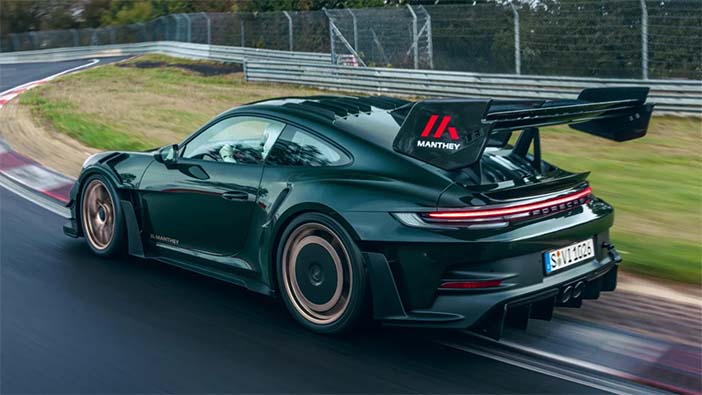
+++ The PORSCHE 911 GT3 is already pretty handy around a race track, and the GT3 RS model is even more so. Yet, Manthey Racing has developed a kit to “further enhance the on-track performance” of the GT3 RS. The company has decades of experience taking Porsches (specifically 911 GT cars) and turning them into track monsters. And this latest example promises to be its quickest iteration of the GT3 RS to date. Porsche owns a majority stake in Manthey Racing, so this new kit comes with the manufacturer’s full approval, having been produced jointly in Germany by Porsche’s development centre in Weissach and Manthey engineers in Meuspath. The Manthey Kit isn’t cheap, especially when you add in the initial price tag of the 911 GT3 RS. However, the upgrades are rather extensive and should see the car climb from its current 4th spot in the Nurburgring lap time table. With winter well and truly here, the firm might have to wait a while for a clear run, though. Nicolas Räder, Managing Director of Manthey Racing, said, “We tested it over several thousand kilometres on European racetracks and on the Nürburgring Nordschleife. Our data promises a significant improvement in lap times compared to the standard 911 GT3 RS. So far, weather conditions have prevented us from achieving an official lap time on the Nordschleife. We want to make up for this at the next possible opportunity”. So what do Manthey’s customers get for their very nearly 6-figure sum? Well, for a start, more than a tonne of downforce (at 290 kph), thanks to a new spoiler lip profile with carbon-fibre elements and redesigned wheel arch ‘Gurney’ flaps with dive planes. Plus the rear window has been deemed superfluous and replaced by a 25 percent lighter carbon-fibre panel, while the rear fin is derived from the 963 race car that won the 2024 World Sportscar Championship. There are also 6 additional roof fins, with all the rear aero designed to divert warm air away from the radiator. That gigantic rear wing also features a Formula One-style DRS (drag reduction system), which works in conjunction with a widened rear diffuser. To the sides of the Porsche, we can see something now synonymous with Manthey’s cars; an ‘aerodisc’ wheel cover to further reduce air resistance. It’s not just the exterior aerodynamics that Manthey Racing has worked on. There’s also ‘semi-active’ coil-over suspension with revised spring rates, designed to work with the extra downforce; the front springs are 30 percent stiffer, and the rears 15 percent stiffer. Plus the kit includes new wheel-acceleration sensors for each wheel to ensure improved damper tuning, and new shock absorbers with two separate valves for the compression and rebound stages of movement. ‘Racing’ brake pads have been fitted, too, and these are optimised for track days. They’re combined with steel-sheathed brake lines to provide “even more direct pedal feel and a faster response time”. Manthey Racing says the pads will offer consistent performance over a wide temperature range. If the big aero changes don’t do it for you, you can also add some more visual tweaks, including illuminated carbon-fibre sill guards with Manthey lettering, more Manthey Racing branding on the LED puddle lights, a towing eye, and decals on the doors and wheels. The 911’s powertrain hasn’t been fiddled with, though. A naturally aspirated, 4.0-litre flat-6 puts out 530 hp and 465 Nm of torque in the GT3 RS, with power going to the rear wheels via a 7-speed dual-clutch automatic transmission. The standard car tops out at 300 kph, but I suspect the additional downforce of the Manthey Kit will limit this car to a ‘mere’ 290 kph. +++