
+++ In the past, if foreign automakers wanted to do business in CHINA , they were effectively forced into a joint venture with a local manufacturer. While this policy has changed over the years, it appears the European Union might try enforcing something similar. Officials in Brussels are planning to introduce new rules that would require Chinese firms to transfer intellectual property to European businesses in exchange for subsidies. This will reportedly go into effect in December and apply to €1 billion worth of battery development incentives. Two senior officials were quoted as saying the scheme could be rolled out to other subsidy programs. However, the exact details aren’t set in stone and may change. While the plan sounds pretty straightforward, it appears to have aspects of a poison pill strategy. In particular, it could make Chinese firms hesitant to go after incentives as it would require them to share technology with European rivals. This could end up helping European companies as there may be less competition for funding. It’s not clear if that’s what officials have in mind, but the EU has to walk a fine line CATL and Envision Energy have invested heavily in European facilities. It also goes without saying that China would likely be angered by the move and this could cause them to retaliate. This wouldn’t be the first time China has fought back as they slapped a hefty tariff on European brandy in an apparent response to Europe’s targeting of Chinese EVs. At the time, China’s Ministry of Commerce suggested they could also target pork and dairy imports as well as “large-displacement fuel vehicles” such as luxury sedans and sports cars. +++
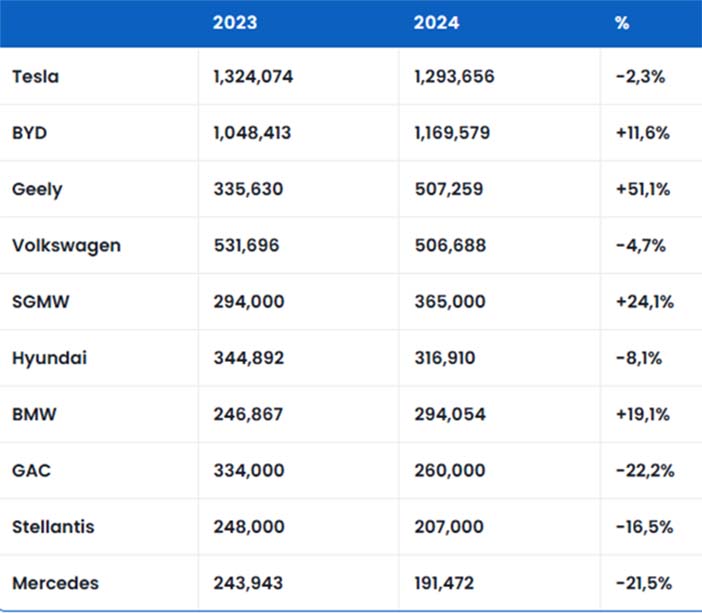
+++ There’s no doubt that China plays a key role in the transition from combustion engine cars to ELECTRIC CARS . It is by far the largest market for these types of vehicles, thanks to a strong push by the government and very competitive models. China’s rapid growth is not only in the domestic market, but also abroad, and today the footprint of its car manufacturers is bigger than ever. The latest official data from 42 carmakers around the world indicates that between January and September 2024, global demand for pure electric cars (excluding plug-in hybrids, extended-range, full-hybrid, mild-hybrid, and fuel-cell) was around 7.2 million units. Despite the difficulties these vehicles are experiencing in the Western world, the total number increased by 8.9 percent on a global scale. Not bad. It’s a fact that the sole driver of growth has been China. Together with its top 20 automakers, Chinese manufacturers sold 20 percent more electric vehicles than in the same period in 2023. This is a rather strong result that reflects the state of the industry there, in contrast to the growing problems of EVs in Europe or North America. The increase in sales allowed Chinese manufacturers to increase their global market share from 45.8 per cent in January-September 2023 to 50.6 per cent one year later. The leading players in the period were BYD, up 12 percent, Geely Group, up 51 percent, and SGMW (SAIC-General Motors-Wuling joint venture), up 24 percent. These 3 groups accounted for 56 percent of all electric vehicles sold by Chinese car manufacturers. However, they were not the only ones with strong growth: Changan increased its sales by 31 percent and, further down the ranking, Nio grew by 36 percent and Chery Group by 66 percent. Leapmotor was the 9th largest Chinese manufacturer with sales more than doubling from 60.000 units in January-September 2023 to 121.000 units in January-September 2024. Xiaomi, which started selling its first model, the SU7, at the beginning of 2024, sold almost 70.000 units until September. On the other side are the non-Chinese manufacturers, i.e. those mainly from Europe, the US, Japan and South Korea. Their combined sales of electric vehicles totalled 3.55 million units, down 0.7 percent. Of this total, Tesla sold 1.29 million units, or slightly more than 1 in 3. Its volume dropped 2.3 per cent from January to September, due to increasingly aggressive competition in China and falling demand in Europe. The Volkswagen Group was the second largest non-Chinese seller of BEVs (battery electric vehicles) with just over half a million units, down 4.7 percent. In fact, it lost 1 position in the global BEV ranking to the Geely Group, which sold almost 1.000 more units. It is clear, then, that the Volkswagen Group’s electric models are struggling to seduce the Chinese consumer. Then there is Hyundai-Kia, which lost one position in the overall BEV ranking to SGMW. The Korean manufacturer sold 8.1 percent fewer electric vehicles than last year, despite the great product offensive of its 3 brands. The third non-Chinese manufacturer was the BMW Group with 294.000 units, up 19 percent, surpassing Stellantis despite its more expensive cars. In general, after Chinese products, American-made electric vehicles ranked second in terms of origin, still outpacing BEVs sold by European companies, down 7 percent. Japanese manufacturers still play a minor role, but their volume increased by 20 percent. +++
+++ EUROPE ’s best-selling car in October was the Dacia Sandero, followed by the Peugeot 208 and Volkswagen Tiguan. The Tesla Model Y is not in the top -25. After a ‘pause’ in September, the Dacia Sandero regained the top spot among the best-selling cars in October, thanks also to the collapse of the Tesla Model Y, which lost 18 percent last month, stopping at just 8.795 registrations, second in the ranking of bestselling electric cars (led by the Skoda Enyaq) and out of the top 25 overall. Behind the Dacia Sandero is the Peugeot 208 with a leap of +40 per cent compared to October 2023, for a total of 20.389 units sold. Closing the podium is the new Volkswagen Tiguan at 17.368 and a growth of 72 per cent compared to last year. A remarkable figure due to the fact that at the end of 2023, the old edition was discontinued while the new one had yet to arrive in dealerships. The top-5 best-selling cars list in Europe in October 2024 is closed with the Renault Clio in 4th position at 16,987 and the Toyota Yaris Cross at 16,542. Also worth noting is the slow but steady rise of the Volkswagen Golf, until a few years ago the undisputed king of the market, which closes in 6th position with +34 per cent compared to 2023, with 16,455 deliveries. Next came the Toyota Yaris (15.977 +46%), the Kia Sportage (14.677 +8%), the Volkswagen T-Roc (14.385 +8%), the 10 Skoda Octavia (14.372 +16%), the Dacia Duster (14,235 +44%), the Opel Corsa (13.905 +1%), the Peugeot 2008 (11.920 -20%), the Renault Captur 11.918 -3%), the Hyundai Tucson (11.807 -9%), the BMW X1 (11.722 +54%), the Toyota C-HR (11.180 +21%), the Ford Puma (11.104 -21%), the Toyota Corolla (10.770 -7%), the Volkswagen Polo (10.658 -23%), the Skoda Enyaq (9.977 +44%), the Ford Kuga (9.654 -8%), the Citroën C3 (9.653 -34%), the Nissan Qashqai (9.620 -9%) and the Peugeot 3008 (9.238 +16%). +++
+++ The ‘right’ size is the most important thing for an touchscreen, rather than making it as big as it can possibly be. That’s according to HYUNDAI design chief SangYup Lee, who confirmed that a next-generation touchscreen was in development and would be bigger than the dual 12 inch displays the brand currently fits in models such as the new Ioniq 9, the launch of which Lee was speaking at. “But the right size is most important, making the screen easy to see and read. Having the right content is also important, as is the right user experience”, said Lee. The size of touchscreens across the car industry is increasing all the time, most notably with the likes of Mercedes’ Hyperscreen, which runs across the full width of a dashboard. Such an expansive approach is not planned by Lee. He added that Hyundai still valued physical buttons and switches for crucial controls, particularly ones that are “safety related or have frequency of use”, such as heater controls and the hazard button. To that end, such switches should be “easy to use and at a natural angle” to allow you to keep your eyes on the road. More broadly on the Ioniq 9, this model is the production version of the Seven Concept, which was revealed 3 years ago at the same LA motor show where the new car makes its world debut. Lee said he still valued concept cars because they allowed Hyundai “to push and show we have a mission”. But most importantly, he said, “the production version must be equally good, or better” and concept cars are “a commitment to deliver, not have you living in la-la land”. The Ioniq 9 is the latest Ioniq model to have little resemblance to the other Ioniq models in the range, but Lee said there were features that linked them, including the pixel light treatments at the front and rear and having the longest wheelbases in their segments for the maximum interior space. Avoiding a cookie-cutter approach is a deliberate strategy, though, with Lee saying “Hyundai is customer centric in its designs” and it was more important that the car was designed to be as good as it possibly can be for the job it’s intended to do rather than look like an upscaled or downscaled version of another model in a range. +++
+++ KIA is preparing electric models for all tastes and the EV2 and EV9 GT will arrive in 2025. Also in development is the EV4 which, like the brand’s other battery-powered vehicles, is expected to adopt the latest version of the Electric Global Modular Platform (E-GMP). A prototype was previewed last year by some spy photos. It is a hatchback, but the EV4 will also be offered as a saloon. The range of the EV4 should consist of several electric motor versions (up to 204 hp) with 2 battery sizes (the most powerful should be close to 82 kWh and guarantee a maximum range of 600 km). Expect proportions comparable to those of the Polestar 2. The design is very similar to that of the EV3 and EV9. +++
+++ In its 110 years of history, MASERATI has passed through various hands, from those of the founder to the Stellantis Group, finding itself in the same deck as Citroen and DS. That’s a correlation that repeats (in part) a story already lived through, the one that from 1968 to 1975 saw the Double Chevron as the owner of the Modenese company. Not all results were exciting, but there was a flagship front-wheel drive model with French styling and an Italian engine. That was the Citroen SM. A flagship that was as fascinating as it was unlucky (just over 10.000 units were sold), but capable of remaining in the hearts of enthusiasts. So much so that it was reborn as a concept (signed by DS) to celebrate the 10th anniversary of the French brand’s birth. A saloon (almost 5 metres long) with sleek forms designed by Thierry Metroz, the brand’s design chief. In an interview, he himself admitted he wanted to see a small production run of the model. This will not be the case, though. Intrigued by the project, I contacted DS directly to ask for clarification, not least because Maserati’s current V6 engine was mentioned: a decidedly interesting (and powerful) detail that would further ennoble the French super saloon. But no, DS is not going for A production VERSION of the concept, even in a very limited number of units. It would’ve been nice to see such a beautiful project come to fruition, but the brand’s priorities lie elsewhere. Some styling details of the SM Tribute could return on the next-gen DS models, though. +++
+++ They may have a lower energy density than their conventional lithium-ion counterparts, but lithium-iron-phosphate (LFP) batteries are less likely to catch fire, have a longer life and, above all, are cheaper. This is why several manufacturers are thinking about it: from Stellantis, which will use this chemistry in the Citroën ë-C3, to Renault, ready to exploit it in the new Twingo. Let’s not forget Volvo, with its highly successful small SUV, the EX30. MERCEDES now joins the list. The German manufacturer’s LFP batteries will make their debut appearance in electric cars on sale from 2025. The debut will be precisely on the new CLA, a saloon offered in both fully electric and hybrid versions. The idea is to offer entry-level luxury vehicles to broaden the range, which has always been concentrated on premium models. The high-end cars will therefore boast 85 kWh capacity, while those with LFP cells will make do with 58 kWh. We also know that the new CLA will be the brand’s first electric car based on the MMA platform, which stands for Mercedes Modular Architecture. It will also form the basis of a future estate and 2 SUVs, initially with rear-wheel drive and 272 hp. The range should reach up to 740 Km. However, it will only take 10 minutes at the filling station to recharge about half of the battery, thanks to an 800 volt architecture. +++
+++ An electric vehicles chimaera until recently, SOLID STATE BATTERIES are getting closer and closer to mass production. So much so that Chinese manufacturer Chery is announcing the creation of the world’s first production line of over 1 GWh. It is located in the Wuhu Economic and Technological Development Zone in the eastern province of Anhui and covers, at the moment, 100.000 square metres of floor space, with the aim of reaching a total volume of 5 GWh. Also home to a research and development centre (R&D) and strong in highly automated technologies, the factory will shorten processes by cutting 6 steps from 11 to 5. Fixed costs (-30 %) and energy consumption (-20 %) will also be lower. The plant is expected to start operation in the coming months, to churn out the first-generation batteries with a record energy density of 280 Wh/kg. It will then be the turn of the second generation, with a capacity of 400 Wh/kg and a third generation, with 500 Wh/kg. The deadline is 2027. “Compared to conventional batteries”, recalls Gao Lixin, general manager of Anhui Anwa New Energy Technology, “solid-state batteries are safer and more environmentally friendly, and have a greatly improved energy density”. +++
+++ TESLA ’s Model Y isn’t just a hit, it’s a phenomenon. Consider that in 2023, it didn’t just dominate the EV segment, it topped global car sales outright, shifting a staggering 1.23 million units, according to JD Power. To put that into perspective, it outsold long-standing juggernauts like Toyota’s RAV4 (1.03 million) and the Corolla (1.01 million), relegating them to second and third place respectively. Not bad for a 5-year-old design that, let’s be honest, is starting to look a bit tired. Enter the Model Y codenamed project Juniper, a long-awaited refresh aimed at keeping Tesla’s golden child ahead of the pack. Launched in 2019 as a slightly taller, longer and more family-friendly sibling to the equally popular Model 3, the Model Y has enjoyed plenty of incremental improvements over the years, but its exterior hasn’t seen any changes. The Juniper update aims to freshen up its looks, bringing sharper styling inspired by last year’s updated Model 3 Highland. Tesla isn’t rocking the boat too much as the familiar egg-like silhouette remains, but spy shots and leaks suggest notable updates to both the front and rear. Camouflaged prototypes and leaked images have offered clues about Tesla’s design direction. Early test cars teased some daring ideas, including split headlights and a Cybertruck-inspired full-width led light bar. However, more recent leaks suggest Tesla is gravitating toward a cleaner, more understated aesthetic. In particular, our exclusive rendering draws on a leaked infotainment display image from a prototype spotted in China. It showcases a redesigned front end with slimmer headlights, a cleaner (albeit more generic) nose, and a sculpted bumper devoid of side intakes, all borrowing heavily from the updated Model 3. If this is indeed the final design (and we strongly suspect it is), it’s a sharper, more refined evolution. That said, it still sticks to the same old “Model 3 after a helium party” aesthetic, complete with its puffer-fish-style greenhouse. Some things, it seems, are just part of the Tesla DNA. Moving to the rear, more changes are expected. A full-width led taillight bar with a frosted finish will replace the existing design, while Tesla’s badge will give way to’TESLA lettering, a trend we’ve seen across other models. The panoramic roof, a signature feature of the Model Y, will be maintained enhancing its light-filled cabin. Spy shots also suggest the rear license plate holder may move to the bumper, streamlining the tailgate for a cleaner overall appearance. Besides its cleaner and sharper styling, the updated design is expected to deliver aerodynamic improvements, boosting efficiency, much like the related Model 3, which saw its drag coefficient drop from 0.225 to 0.219. There’s also speculation about a larger 95 kWh battery pack, which could extend the Model Y’s range beyond the current 81 kWh version. However, even if this rumour proves true (and that’s a big if) it may be limited to certain markets, such as China, while other regions could retain the existing options. Similarly, the electric motors are expected to carry over from the current model, with outputs believed to be around 299 hp for the standard RWD variant and 389 hp for the dual-motor Long Range AWD, though no one really knows for sure as Tesla doesn’t communicate trivial things like specifications. The Long Range variant is also anticipated to offer a paid Acceleration Boost option, a feature Tesla has already begun rolling out for the updated Model 3 in select markets. Again, no official figures but this upgrade usually brings the LR very close to the Performance variant. The Standard and Long Range versions of the Model Y will be joined by a Performance trim, mirroring the line-up of the Model 3. In its current configuration, the Model Y Performance is estimated to deliver 460 hp, but it may adopt the newer dual motors from the Model 3 Performance, which would raise output to 515 hp. With the current Model Y Performance already clocking a 0–100 kph time of 3.7 seconds, the potential upgrade could shave off a few tenths, nudging it closer to the 3.0-second mark. However, as with many Tesla stats, these figures come with an asterisk, namely the inclusion of a rollout. Visually, the Performance variant is likely to distinguish itself with a slightly more aggressive body kit featuring a vented front bumper, rear spoiler, red brake calipers, and unique wheels (hopefully equipped with all-season tires) paired with a lowered stance. An adaptive suspension system and, perhaps, a dedicated track mode could also be part of the package. As for the rumours of an even more powerful Model Y Plaid, I’m not biting. While Tesla could theoretically produce an absurdly fast version of its family-oriented crossover, such a model feels more suited to the Model 3 than the practical, family-focused Model Y. And let’s be totally honest: a 515 hp Performance variant is already more than enough for most of you out there. Interior updates for the Model Y are set to prioritize better materials and improved build quality, addressing criticisms while aiming to rival the increasingly feature-rich Chinese EV competition. Tesla is also expected to refine ride comfort, handling, and NVH (noise, vibration, and harshness) with targeted chassis and suspension adjustments. As usual, the recently refreshed Model 3 provides a solid blueprint for what to expect. Recent spy shots reveal a new design for the steering wheel, an improved infotainment touchscreen display with thinner bezels, and carbon-style trim on the center console, just like on the Model 3 Highland. However, some functional changes will surely prove divisive. Tesla plans to replace the traditional wiper stalk with a fully automatic system, move the turn signal controls to steering wheel buttons, and relocate gear selection to the touchscreen, with additional touch buttons placed behind the rearview mirror on the roof. Other upgrades include multi-color ambient lighting, dual wireless charging pads, and improved front seats with heating and ventilation sourced from the Model 3. Rear passengers will also benefit from a heated bench and an 8-inch touchscreen for climate and media controls. While these changes aren’t ground breaking, they bring the Model Y more in line with competitors that are increasingly offering premium cabin features as standard. A few months ago, reports surfaced that Tesla might be developing a 6-seater Model Y specifically for the Chinese market. This version is said to feature a longer wheelbase and a more spacious cabin compared to the 3-row-spec model, catering to the growing demand for roomier family-oriented vehicles in China. Finally, Tesla may enhance the misleadingly named self-driving capabilities of the Model Y with the Juniper update, potentially incorporating new sensors and more advanced software. According to some sources in China, limited production of the Model Y Juniper has quietly begun at Tesla’s Shanghai Gigafactory, with full-scale manufacturing expected to ramp up soon. The same sources suggest that Tesla has restricted smartphone use within the facility to minimize the risk of early leaks. However, Elon Musk has repeatedly stated that Tesla won’t launch the facelifted Model Y in 2024, hinting at a 2025 debut. It’s possible that Tesla may prioritize the Chinese market initially, with North America, Europe, and other regions following later. Much of the timeline could also depend on Tesla’s ability to clear out existing inventory of the current Model Y before making room for the updated version. In any case, a global market launch is anticipated sometime in the first half of 2025. Key rivals of the Tesla Model Y in the US market include the likes of the Ford Mustang Mach-E, Hyundai Ioniq 5, Kia EV6, Volkswagen ID.4, Nissan Ariya, and in the near-future, the Rivian R2. +++
+++ TOYOTA ’s vice president has confirmed the Japanese brand is readying the next Celica, 18 years after production of the sports car ended. Discussion on reviving the model name has been rife for years and Autointernationaal.nl was told last year that a reborn Celica was being considered as part of a new-era of electric Toyota sports cars, although no executives would go on record to confirm it. However, speaking at this weekend’s Rally Japan, Yuki Nakajima said unambiguously: “We’re making the Celica!” He added: “To be honest, there is no sign of it right now. However, there are many people within the company who are eagerly awaiting the Celica. So… I wonder if it’s okay to say this in a public forum, but we’re doing the Celica!” His announcement follows extra speculation during the past few weeks, with Toyota dropping hints that it was preparing to revive the MR2 and Celica nameplates, while also renewing the GR86 and GR Supra. It also comes after a recent episode of the company’s self-published cartoon, called Grip, briefly showed a whiteboard containing a list of new models: a Supra Mk6, Celica Mk8, MR2 Mk4, GR86 Mk3 and GR GT3. Notably, the whiteboard features alongside character Master Rugu, who guides the show’s protagonists in their battle against autonomous race cars. The new sports cars have yet to be officially confirmed for production by Toyota, but the teaser follows months of reports that the Gazoo Racing line-up is due to be drastically expanded. Toyota chairman Akio Toyoda, who was the driving force behind the creation of GR, has previously spoken of his ambition to revive what he calls the “three brothers”: the Celica, MR2 and Supra. As previously reported by Autocar, Toyota has been debating whether to press a new Celica into production on a new electric car platform that opens up “lots of different possibilities”. Key to this architecture is a low seat height, enabling a more traditional sports cars experience. The FT-Se concept revealed at last year’s Tokyo motor show sits 75 mm lower than the Porsche 718 Cayman. Its design is split into 3 modules, with single-piece front and rear ends. This “allows us to be more extreme”, Shinya Ito, general manager of Lexus Electrified, told last year. The new platform will also be used for a cab-forward 2-seat sports car that channels the spirit of the MR2 and is based on the FT-Se concept. However, it won’t necessarily revive the MR2 name. Japanese magazine Best Car reported earlier this year that the S-FR roadster concept revealed in 2015 has been given the green light for showrooms. Although its engine would be mounted up front rather than amidships, it’s possible that it will still take the MR2’s place as Toyota’s junior sports car, rivalling the Mazda MX-5. Toyota has yet to speak openly about the next-generation Supra, but it’s likely to be due within the next 3 to 4 years, given the current car was launched in 2019. The GR86, meanwhile, is set to be redesigned to meet new crash safety and engine emissions regulations, adopting a hybridised version of the turbocharged 3-pot from the GR Yaris. Toyota tech chief Hiroki Nakajima said such a car was a “good idea”. The GR GT3 supercar was shown in concept form in 2022. +++