
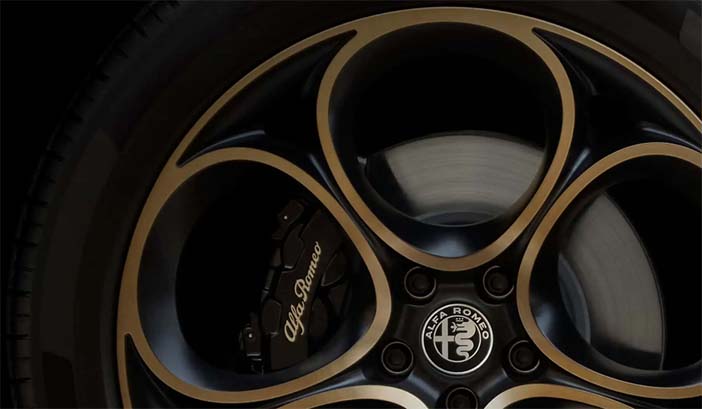
+++ The new ALFA ROMEO special series is called Intensa and will be presented at the Brussels Motor Show, scheduled from 11 to 19 January 2025. It is an exclusive limited edition dedicated to the entire range of the Arese brand and designed to celebrate its history. The set-up includes very rich equipment and, from an aesthetic point of view, unique details in light gold or red. Here is all the information. The Alfa Romeos of the Intensa series are cars with rather rich equipment. Starting with the Giulia, for example, this special series (available on the 280 PS petrol and the 210 PS diesel) includes 19 inch diamond alloy wheels and light gold trim, leather and Alcantara interior with leather stitching, Harman Kardon audio system and 12.3-inch infotainment system. The Stelvio, on the other hand, features 20-inch alloy wheels, black brake callipers and tricolour mirror detailing, all combined with leather and Alcantara interior and, on a mechanical level, SDC adaptive suspension. But that’s not all. This special series also continues on the smaller cars and is in fact also available for Tonale and Junior. On the former, in particular, it includes 2-tone 20-inch rims, black Alcantara interior with leather-coloured details and Level 2 driver assistance systems. On the latter it includes 18-inch diamond wheels and Alcantara interior. At this early stage, the Arese company did not go into detail about prices and availability of the cars on the European market. The Intensa special series will be unveiled at the upcoming Brussels Motor Show scheduled from 11 to 19 January 2025, so it is likely that more information will be released in the days leading up to the event. +++
+++ The first model of the new BMW era will arrive in 2025. Derived from the i Vision Dee concept, the first electric vehicle from the Neue Klasse platform will feature super-efficient batteries and a host of technologies as well as launching the next generation of BMW iDrive. I don’t yet know exactly what the interior will look like, but I imagine there will be customisable ambient lighting, a 3D head-up display and a slim dashboard integrated between the dashboard and the windscreen. Yesterday, BMW announced the date of the official presentation. Visitors to the Consumer Electronics Show (CES) in Las Vegas will be able to discover BMW’s first panoramic iDrive screen from 7 January. BMW could not have chosen a better stage to launch the interiors of its Neue Klasse series vehicles. CES in Las Vegas is one of the most important consumer electronics shows on the planet. BMW’s press conference will take place on 7 January and will be hosted by American comedian Tim Meadows in the Silver Lot (just outside the South Hall of the Las Vegas Convention Center). Frank Weber, Head of Development at BMW, will present the new generation of BMW iDrive together with Adrian van Hooydonk, Group Head of Design, and Stephan Durach, Head of UI/UX Development. After the press conference, CES attendees will be able to visit the BMW Pavilion and see demonstrations by Meadows and BMW experts on the first BMW Panoramic iDrive at scheduled times. +++

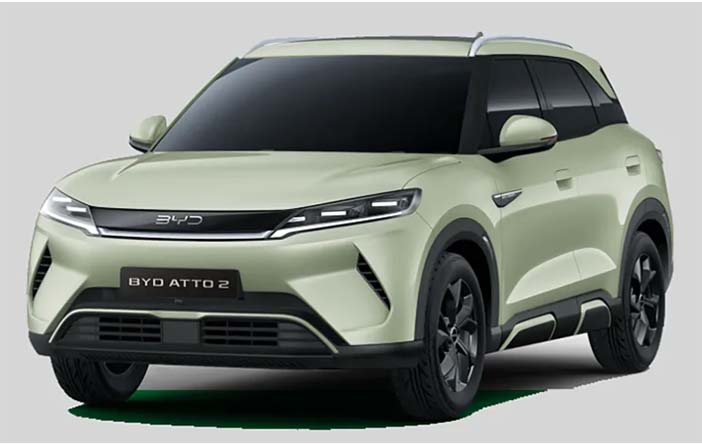
+++ The BYD Atto 2 is officially coming to the Netherlands, with the new small electric SUV likely to arrive on our shores early next year, ready to take on the similarly budget-focused Opel Frontera Electric as well as the forthcoming successor to the MG ZS EV, also due in 2025. The chunky-looking EV was first unveiled back in February, and launched in China as the BYD Yuan Up. As you’ll have guessed by the name, this is the little brother to the Atto 3, and will bridge the gap between that and the Dolphin hatchback in the brand’s line-up. The Atto 2 measures 4.310 mm long, 1.830 mm wide and 1.675 mm tall, and has a 2.620 mm wheelbase, similar dimensions to another possible rival, the Suzuki e Vitara. It uses BYD’s latest electric car architecture, e-Platform 3.0, and its ‘Blade’ battery design, where the cells are integrated into the car’s structure. The first details of the Euro-spec Atto 2 were included in a report by Green NCAP, which assesses how energy efficient and green new cars are. It mentions a 42.4 kWh usable battery that offers an official range of up to 350 km. That’s slightly better than the standard Frontera Electric’s 348 km range, although a Long Range version of the Vauxhall is coming soon that promises 400 km on one charge. The relatively small battery helps keep the Atto 2 under 1.6 tonnes, while the electric motor used to drive its front wheels produces 177 hp and 290 Nm of torque; enough for 0-100 kph in 7.9 seconds. Green NCAP also noted the inclusion of a new heat pump which, along with waste heat from the e-motor, helps to warm the car’s cabin and battery in colder temperatures. The design borrows some elements from its siblings, notably the flowing led headlights and black bar with silver trim at the front, plus the complex, intertwined tail-light arrangement, which is just like the BYD Dolphin’s. The floating roof design, cladding on the side sills and generally boxy shape, meanwhile, give it more than a passing resemblance to the outgoing Citroen C5 Aircross. Inside, the Atto 2 features a large 12.8 inch central touchscreen that can rotate between portrait and landscape orientation (a familiar BYD party trick) while behind the steering wheel is an 8.8 inch digital instrument panel. The centre console has a wireless charging pad, crystal gear selector and what look to be grab handles, a bit like those in a Mercedes G-Class, despite the Atto 2 not showing any obvious off-road inclinations. Overall, the interior is much simpler than those in other BYD models, although this could be geared towards making the Atto 2 as affordable as possible. Dutch pricing for the BYD Atto 2 should start from well under €37.000, although we’ll have to wait to see how close it’s able to get to the Frontera Electric’s hugely impressive starting price of 30.499 euro. The Atto 2 won’t be the only new addition to BYD’s showrooms next year. Due on sale soon is the Seagull supermini is finally coming to Europe to take on the cut-price Dacia Spring and Citroen ë-C3. +++
+++ CITROEN is open to using its new low-cost Smart Car platform for larger models as it seeks to bring down the cost of new cars in a fightback against them being laden with unnecessary technology. CEO Thierry Koskas told in a press conference following the new Citroën C3’s nomination to the Car of the Year 2025 shortlist that the rising costs of new cars would mean buyers of larger models would also look to benefit from cost reductions that the brand is bringing to the supermini segment with the C3’s new Smart Car platform. He said there are “no limits” to scaling up the Smart Car platform to be used in C-segment models (C4-sized) in the future and this is a “direction we would like to explore. What we’ve said about the B-segment (C3-sized) and the need for essential cars with the right level of features, one day there will be a case for in the C-segment. Larger families interested in space but at a reasonable price. There is the opportunity to do bigger cars and this is an option we would like to do”. Koskas said the Smart Car platform and the models based on it, starting with the new C3 and ë-C3, had been designed in a similar way to how Dacia creates its products: by setting the cost first, then allocating a budget to each individual component. He explained: “When we started the development of the car, everybody knew how much they had to spend. Each component had an objective and target, because if you don’t do it globally, that doesn’t work. You need to target everyone and to make everyone accountable in every parameter to meet the target cost”. Pushing this philosophy into bigger cars would also mirror the behaviour of Dacia, which is moving into the C-segment for the first time in 2025 with the Bigster. Koskas said that the level of technology on the C3 was carefully considered to ensure that it wasn’t packed with things customers don’t want or need, which drives up the cost. “When you look at what people expect in this segment, you don’t need to be full of technology”, he said. This pared-back approach was something Citroën would be pursuing for future models, Koskas added; like Dacia, the firm believes there is a market for such cars. Citroën will also look to its Oli concept car for ways of cutting the price of its models by taking a more ‘essential’ approach. “The cost of cars is increasing but the amount of money that people can dedicate to the car is not increasing”, Koskas said. “It’s even worse in the electric world, because you ask people to buy cars that are more expensive. To go back to a well-equipped but still simple and essential product is something we see as absolutely necessary, because the amount of money that people can dedicate to a car is not increasing like the prices of the cars”. Koskas predicted that this will become a trend in the market for a segment of the market over the next few years, adding: “It’s not somewhere where all brands will go, but there will be a place in the market and where we want to be”. Citroën will “comply with all government legislations” concerning the level of active and passive safety equipment and technology needed to sell cars in Europe, but Koskas said “the regulations on safety are getting more and more severe” and hinted at disquiet within the car industry about Euro NCAP trying to add its own requirements on top. The car safety testing body “would like to have more, more and more”, he said. He added: “To meet the safety regulations of the different states or the European Commission is already something where you have to add a lot of features, additions and so on to the car; that is our job and we do that”. Koskas said the UK’s ZEV mandate, which requires manufacturers to sell a set percentage of EVs in increasing numbers each year, ensures that a sharp focus will be maintained on reducing the cost of EVs in order to ensure more widespread adoption. “The mandate is good learning, because, as it’s a step every year. Every year we have to make additional effort, and this will not be done if we are not able to lower the cost. So we need to continue to lower the cost. We have not finished the race for sure”. More generally on EV sales, Koskas acknowledged that EVs need to be pushed at the moment and the reported sales volumes “are not completely natural” when compared with the demand. Still, Citroën won’t look to heavy discounts, as this would hurt residual values and the firm wants to help boost sales in a “clean way”. Citroën’s performance in Europe in 2023 will likely mirror that of 2024, with a market share of around 3.5%. Koskas said “to stabilise is something I’m quite happy with in tough market conditions”, particularly as it has been a changeover year for the C3, with production stopping for around 3 months. With a full year of C3 sales, a facelift for the C4 and a new C5 Aircross SUV coming in 2025, there will be “fireworks for Citroën” and a return to growth, said Koskas, as it looks to push above a 4% market share. Koskas also believes that Citroën can have a cost advantage over rivals with the C5 Aircross and its more sophisticated underpinnings by being clever about where it sources parts; something it has control over, as the car is the only model built at its plant in Rennes, France. +++
+++ A prototype of the HONDA O SERIES SUV will be unveiled next month ahead of production starting in 2026. To be showcased alongside the previously revealed Honda O Series Saloon prototype at CES in Las Vegas, the SUV is the second of 7 planned O Series models that will arrive before the end of the decade. These futuristic-looking new-era Honda EVs will all sit on a new bespoke platform developed from a clean sheet of paper. The first to arrive will be the saloon, which will offer around 490 hp and a range of 500 km. This will be followed in 2026 by the production version of the new SUV prototype, which is expected to be what Honda calls its mid-sized SUV. A smaller entry-level SUV and a larger range-topping SUV will join the line up shortly after. By the end of the decade, a compact SUV, a small SUV and a smaller saloon are also due. The O Series Saloon will be offered with both single- and dual-motor powertrains, featuring newly developed compact e-axles that, Honda claims, can be mounted lower in the car, freeing up space and enabling the vehicle to have a smaller frontal area to improve aerodynamic efficiency. The reduced size of the e-axle motors has been achieved in part by repositioning the inverter to make the units shorter. At least initially, O Series models will feature 2 different e-axle units in 3 different combinations. Entry-level models will have a 245 hp motor on the rear axle and offer rear-wheel drive. There will also be 2 dual-motor, 4-wheeldrive versions. The top-end models will use the same motor on the front axle, giving a system output of 490 hp (although Honda has yet to confirm if this will be the maximum output). There will also be a 4WD version that mates the 245 hp rear motor with a 68 hp unit on the front axle. That smaller e-axle will be shared with Honda’s next-generation hybrid models. The battery pack will fit under the floor as in other electric cars, although Honda said the focus is on making it as thin as possible, claiming it’s around 8 mm thinner than EV batteries from rival firms. As a result, Honda says the platform enables the O Series Saloon to be less than 1.400 mm in height while offering more interior space than current EVs. The key to the thinner battery design will be the use of a new mega-casting tool to produce the battery pack case in 3 parts, rather than around 60 separate pieces as previously. Casting it in 3 sections rather than a single unit will allow 2 different sizes of battery pack (for medium- and large-size models) to be produced on the same production line. While mega-casting will initially be used only for the battery casing, Honda is aiming to eventually use it to produce the front and rear assemblies of the car as single pieces. That is likely to be introduced when a planned new EV-only assembly plant in Canada is opened near the end of the decade. While Honda has yet to give full details, the O Series Saloon and other medium-size models will feature a battery using nickel-manganese-cobalt (NMC) chemistry with a capacity of between 80 kWh and 90 kWh, giving an estimated range of 500 km. Meanwhile, large models will have a pack of around 100 kWh. It’s unclear if different battery options will be offered on each model. As well as extensive use of mega-casting, Honda will use a number of new production techniques designed to increase the platform’s rigidity while reducing weight. That includes expanded use of a system called ‘3D friction stir welding’, which can join metals without melting them, along with ‘constant DC chopping’ (CDC) spot welding, which controls the heat used to weld joints better. The use of both manufacturing techniques is claimed to result in greater rigidity and decreased deformation. In addition, Honda said it has developed the body structure of the O Series platform to disperse the impact of a collision to the side of the structure, which reduces the space at the front and rear required for protection for the battery. Overall, Honda claims the O Series Saloon will weigh around 100 kg less than a current EV of its size, which is also key to the firm’s promise to offer an enjoyable driving experience. The car will feature a steer-by-wire throttle, which suggests that the yoke offered on the concept car could reach production. The control unit for the system will be integrated with those for the suspension, brakes and regen system to aid handling. The O Series Saloon will feature active aerodynamics that can channel air underneath the car via sculpted bodywork, adding up to 10 km of range, as well as creating downforce. 3D gyro sensors, developed for Honda’s humanoid robots, will be used to automatically stabilise the car. Notably, the lightweight aluminium frame has been designed to flex when cornering at speeds, pushing load onto the outside of the wheels to improve cornering balance. All 0 Series models will be software-defined vehicles, able to accept over-the-air software updates to gain new features and upgrades. They will be designed to offer up to level-three (‘eyes-off’) autonomy in certain situations, thanks to a range of camera, radar and lidar sensors. Production of the O Series models will initially begin at Honda’s plant in Ohio, the US, which will be adapted so that ICE and EV cars can be made on the same line. That will be achieved by the use of a new flex cell production system, which makes greater use of decentralised production stations with chassis and parts moved via autonomous robots. This means Honda will be able to constantly adapt ICE and EV output based on demand. A new plant dedicated to EV production, along with a battery plant, will be built in Ontario, Canada by 2028. +++
+++ MERCEDES ‘ range of next-generation cars based on its new MMA platform is starting to take shape, and the latest model we’ve spotted testing is the replacement for the GLB. While the model spied looks to use an internal-combustion engine, the next GLB will be offered as an EV, too, thanks to MMA’s multi-fuel approach. MMA (Mercedes Modular Architecture) will underpin all of the firm’s new compact cars, and will be seen first on the upcoming CLA. Mercedes provided me with a preview to its future MMA-based line-up back in 2023, and we know the CLA will be followed by two SUVs and a Shooting Brake. One of those SUVs is the model spied on test, which we would expect to be fully revealed by the end of 2025 ahead of a probable on-sale date in 2026. Unlike the CLA, which will arrive as an EV in 2025 before a petrol hybrid version comes to the market in 2026, I suspect the GLB successor may come with hybrid and fully electric power from launch. +++
+++ NISSAN has become the latest major company in the United States to retreat from key diversity, equity and inclusion initiatives in the face of mounting pressure and threats from right-wing activists seeking to eradicate such policies. The automaker’s move echoes similar decisions by more than a dozen companies, ranging from rival Toyota to Walmart and Harley-Davidson, in the face of a long-running Republican campaign against positive discrimination of minorities. +++
+++ 2026 will see the renewal of one of the most popular B-segment cars (and one of the best-selling cars in general) in Europe. The arrival of the new RENAULT Clio, whose future generation will evolve stylistically while remaining hybrid, is approaching. The proportions of the new Clio should not deviate too much from the current model. In terms of dimensions, the Renault could approach 4.1 metres in length and be slightly lower to improve aerodynamics and ensure greater efficiency. The front end will be completely revamped, with newly designed slim headlamps and an advanced grille featuring a diamond motif reminiscent of the Renault logo, which could be based on the Rafale grille. At the rear, the rear window will be more sloping, while the lights could be horizontal. As for the cockpit, no detailed information has yet emerged. There will be no shortage of fully digital instrumentation and an updated infotainment system based on the Android Automotive platform. We could find a panel on the Clio similar to the one found on the Austral and Rafale, with instrument cluster and infotainment side-by-side. The new Clio should be based on an evolved version of the current platform and should still be offered with full hybrid and mild hybrid powertrains. Especially in the former case, we expect a powertrain equipped with a more powerful electric motor to improve fuel consumption and further reduce emissions. Unlikely, however, is the adoption of 100 per cent electric motors, which should only be destined for the 5 E-Tech. It remains to be seen whether the non-electrified petrol engines and the diesel will be confirmed in the new generation of Renault. The impression is that the company may forego these engines to comply with new emissions regulations, but we will know more in the coming months. +++
+++ Tarriff talks among import brands are making headlines lately, and SUBARU is no exception. The automaker, warning of a possibly “huge impact” from tariffs, is shoring up its defenses with options including ramping up U.S. production or even adding electric vehicle assembly. Subaru wants to see an increase in U.S. market share to 5 percent, from the roughly 4.2 percent it has today. CEO Atsushi Osaki said he wants to maintain Subaru’s red-hot sales momentum even in the face of impending policy upheaval under the administration of President-elect Donald Trump. Subaru is on pace to notch U.S. sales of nearly 670.000 vehicles this year, a 6 percent increase over 2023. “First, we hope to achieve a big target of 5 percent market share in the U.S.”, Osaki said during a 18 roundtable with reporters at Subaru’s global headquarters in Tokyo. “If the overall demand is 16 million units, 5 percent is 800.000 units. So, that is a big target for us”. +++