
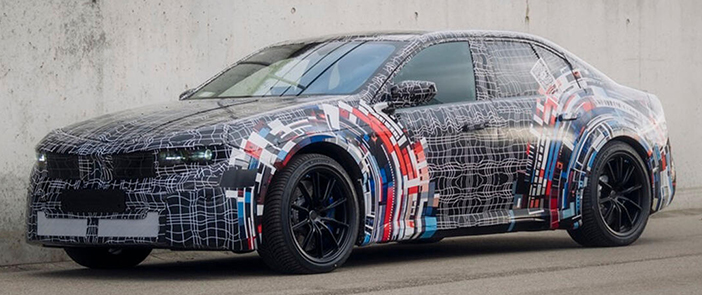
+++ BMW has released the first pictures of the electric M3 and promises it will “set new standards” for the performance saloon. The images of a test mule dubbed the ‘M HP BEV’ reveal several key differences from the Neue Klasse 3 Series on which the car will be based. These include significantly wider wheel arches, chunkier front and rear bumpers, and significantly larger brake discs. The car wears a similar camouflage wrap to the quad-motor, i4-based prototype that the company has previously detailed, suggesting this could be the latest development of that car. The next-generation M3 is due to arrive in showrooms by early 2028, and although BMW is drawing attention to the development of the EV, it will also be available with a turbocharged straight-6 petrol engine. It is being engineered for both powertrains in a bid to maximise its appeal and in line with BMW’s ongoing commitment to combustion power. The current car’s ‘S58’ twin-turbo 3.0-litre straight-6 has been made compliant with upcoming emissions regulations, meaning the petrol M3 can (for as long as customer demand dictates) remain on sale alongside the all-new electric version, which will be based on BMW’s Neue Klasse platform. In a wide-reaching interview, BMW M boss Frank van Meel previously laid bare his plans for the electrification of the performance division. At the centre of those plans is the new generation of its storied sports saloon: overhauled from the ground up to take the fight to EV and ICE rivals including the Mercedes-AMG C63, Porsche Taycan and Hyundai Ioniq 5 N. Asked if the electric and ICE M3s will wear different badges, van Meel said: “Do we need to set them apart? An M3 is a promise, not an engine”. That strongly suggests that electric car will not adopt the iM3 moniker, despite BMW having trademarked it. The EV version will be derived from the next-generation 3 Series, due on sale from next year, while the ICE car is likely to be a heavily updated version of today’s G80-generation M3, with Neue Klasse design influence. +++
+++ DS was split from Citroen in 2014 and has been trying to make headway in the premium car market ever since. A decade ago, success in this hard-fought sector meant beating the Germans, a goal many an upmarket car from France (not to mention the UK, Italy, Sweden, Japan and Korea) had comprehensively failed to achieve down the years. Today, things are a little different and DS has a new grand plan for a fresh, electrically driven appeal to Europe’s badge snob car buyers. Audi, BMW and Mercedes had the European premium car market all but wrapped up for a very long time, but things have changed. The move to electric cars levelled the playing field to an extent and it’s safe to say none of those German giants has managed to navigate the EV transition as effectively as they’d have liked. It’s left the door to the premium car market ajar for the likes of Tesla, Polestar and others at a time when the arrival of new, low-cost competition from China is making the mainstream an increasingly treacherous place to operate. DS, part of the sprawling Stellantis stable of brands along with Citroen, Peugeot, Alfa Romeo, Opel, Jeep and others, probably has its best chance ever of beating the Germans with a high-class product and a convincing brand proposition. The problem is that it’s also got to persuade customers to choose its cars over those from all the other brands being driven in a more premium direction by the fear of having to compete with the Chinese on price. So what is going to set DS apart from the gathering crowd in this increasingly tumultuous premium car space? I’ve just been given a clear glimpse at the brand’s immediate future in the shape of the new (until solid-state packs arrive) Numéro 8. This is an electric coupé-SUV that will serve as a flagship for the DS range. It introduces a new naming strategy, a new design direction and some class-leading EV tech. It’s a statement of intent for DS. For Thierry Métroz, senior vice president of DS Design, the areas the DS brand needs to emphasise in the conversation with customers are clear. He explained: “Our strength over the years is where we are working, because we are Parisian. The original DS was designed in Paris, the 15th District of Paris, and built in the Quai de Javel. It all happened in Paris. It’s a very strong advantage, the link with Paris and its other luxury brands. Our ambition for DS is to be the Louis Vuitton of the automotive industry. It’s a dream, because we can’t decide to be a luxury brand. It takes maybe 10 years, 20 years, 40 years, maybe never, we are working to make it possible”. That link DS is trying to foster to French high fashion brands can also be spotted in the new Numéro 8 naming strategy that will roll out to the Numéro 7 and Numéro 3 in the coming years. There’s some uncertainty over what Chanel would say to any new DS Numéro 5 model, but the delicate whiff of haute couture is exactly what DS is aiming to spread. The cars, of course, need to deliver on all this brand building, and Métroz is in no doubt where DS can make gains. He continued: “The advantage, I think, for DS, is the quality of the interiors. The interior atmosphere, the quality of the lighting, the quality of the material, all the finishes, the prestige and everything. I think it’s our main differentiation with the German brands”. Thomas Bouveret, Head of Interior Design at DS, picks up the thread here: “The main difference from all the other premium cars is to put the emphasis on the material and maybe to design the interior a little bit differently. We try to have another approach, something a little bit less conservative and to bring some kind of new touches to the interior, but taking into account the ergonomic[s]and also the usability”. The DS Numéro 8 cabin does indeed take a different approach on material choices than we’re used to seeing in modern cars at the €55.000 to €85.000 price point the new car is expected to occupy. Leather, aluminium and wood finishes cover the majority of the surfaces you interact with, and the entry-level cars don’t feel noticeably stripped back compared to those higher in the range. DS has even looked at offering bespoke trim packages to customers in the manner of really high-end luxury brands such as Bentley and Rolls-Royce. Many of the trim pieces inside the car can unclip and be swapped for different finishes to change the look and, were the option ever to be made available, this could theoretically be done in dealerships, allowing existing owners to call in and give their car’s cabin a refresh. To showcase what’s possible, DS will follow up the launch of the Numéro 8 in 2025 with a limited-edition model sporting a special interior trim selection based around unique machined aluminium finishes. And DS doesn’t plan to sit back and admire the design it’s created for the Numéro 8, because the plan is for ongoing development. Explained Bouveret: “This is not just the new way of the interior of DS; this is for one, two, maximum three cars… and then after we are working on something different for the future”. We’ll know more about this future later in 2025, when DS reveals a new vehicle interior concept with a focus on the integration of new technology. And the focus going forward seems to be very much on that technological and design progression inside the cars, if not outside. Bouveret continued: “Even if we make some link with the past, I will keep the idea to add some additional points that are new, fresh and unexpected. The link with the past is mainly for the exterior; I would say on the interior, we want to push again to go a little bit further”. DS wants to be premium but Thierry Métroz says that doesn’t have to mean pushing prices up. “It’s not a question of price. The price is important, but the most important for us is to have, always, this sense of refinement: the elegance, the refinement, the quality of the CMF [colour, material and finishing”. Perhaps in recognition of the difficulty there may be in convincing buyers to engage with DS products if they’re on an equal value footing with more established premium brands, DS is aiming to be aggressive right across the range, offering similar standards of design, quality and comfort whatever the model or variant. Said Métroz: “Another point that’s very important for DS… we have the same design philosophy, if it is an ICE car or BEV car. The same design DNA, for all the cars. Whatever the engine.” And the same is true across trim levels in the DS No8 range with the entry models not noticeably inferior in terms of design features and material choices to the cars at the top of the range. DS will also need to be carefully positioned within the mass of brands in the Stellantis group. It forms part of the ‘premium cluster’ with Alfa Romeo and Lancia. Maserati sits above in the luxury segment, while below Peugeot is seen as mainstream, and Citroen is lower mainstream. In that premium segment, Alfa Romeo takes a sportier approach, with DS focusing on comfort and luxury. Alfa Romeo is also in the US market, alongside Stellantis’ US brands Jeep, Dodge, Chrysler and Ram. There are no plans for DS to follow, even though that could change after the departure of Stellantis CEO Carlos Tavares. Métroz said: “No, it’s not planned. I would like to go into the US, but I’m not enough. “Also, we don’t need another brand in the US market but it could change. Maybe the new CEO says: ‘Okay, you can go to the US’ because ..] Maybe we have the potential to develop the brand in the US because we have the Parisian luxury image. It could be good”. While the brand positioning might be clearly defined, like many of its competitors, DS is having a crisis of confidence around the switch to electric cars. Métroz told: “I remember 3 or 4 years ago, Stellantis said ‘only BEV for all the brands’. Now we don’t know. We have BEV, but we are looking to introduce mild hybrid for the next generation of DS”. Could a mild hybrid petrol engine be offered on the currently all-electric Numéro 8? “Not on the Numéro 8. No, but it’s feasible. If we want, we can do it very quickly, without much expense, because of the STLA Medium platform”. So the DS switch to EV could be slower than first indicated and we can expect the next models in the product plan after No8 to feature mild hybrid power as well as electric options. That plan should see a new Numéro 7 (a SUV) revealed towards the end of 2025 and then a Numéro 3 to replace the existing ‘3’. The DS Tribute concept revealed in 2024 previewed a retro-styled luxury saloon evoking the sleek Citroen SM, but any flagship production car along those lines is still some way off. For the foreseeable future, the DS No8 will top the range and spearhead the brand’s renewed tilt at Europe’s premium car market. +++
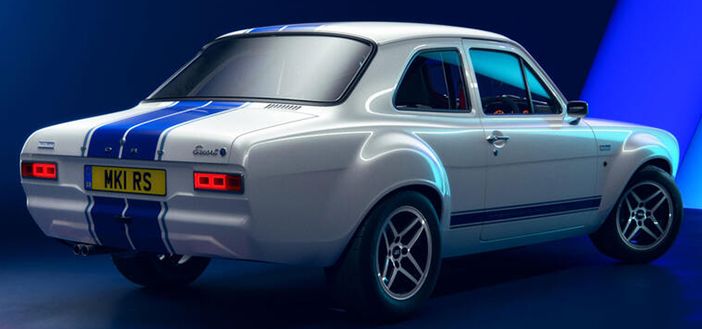
+++ A new UK engineering specialist has revived the original FORD ESCORT RS , with the backing of the car-making giant. It has been developed by Coventry-based Boreham Motorworks and is unique for being allowed to use the Escort name and Ford badges. Unlike many similarly conceived rivals, it is not a restomod based on an existing chassis. Instead, it is an all-new car and each example will be given a chassis number continuing on from the original production run. It is based on the 2-door Escort RS bodies that were produced by Ford’s Advanced Vehicle Operations in Aveley, Essex, before it was shut in 1975. Boreham Motorworks digitally recreated the shell and used computer simulations to re-engineer it for improved handling, adding extra bracing and widening the wheel arches. It also developed a new rear axle made from aluminium and titanium, and moved the rear dampers from their original canted position to a more conventional vertical orientation. 2 engines will be available: a reworking of the storied Twin Cam engine that powered the Escort to competition success, and a powerplant derived from Ford’s current offerings. The Twin Cam has been upsized from 1.558 cc to 1.845 cc and its twin Weber carburettors have been replaced by fuel injection. The changes net an extra 74 hp for 185 hp. This is sent to the rear wheels via the original 4-speed gearbox, with straight-cut, close-ratio gears. The modern alternative is a 2.1-litre 4-pot with forged steel conrods and a billet crankshaft, enabling it to rev to 10.000rpm. It produces 300 hp and is mounted to a 5-speed dog-leg ’box, with ratios aimed at providing usability both on the road and track. Power steering, anti-lock brakes and traction control are omitted to match the driving experience of the original car. It’s also fitted with coilover suspension and an automatic torque-biasing limited-slip differential that’s said to provide “controllable and predictable” oversteer. As well as all the changes under the skin, Boreham employed Wayne Burgess (formerly head of design for Jaguar SVR models, including the XE Project 8) to bring the Escort up to date aesthetically. For example, its chrome bumpers and main indicators were removed to match the look of contemporary race cars, such as the Alan Mann-developed Escort that won the 1968 British Saloon Car Championship. And the new led headlight design mimics the cross-shaped tape that was applied in period to prevent light housings from shattering. Inside, it is a new design but with key references to the original, such as its 6-clock instrument panel and 2 central air vents. It also has modern accoutrements such as climate control dials and switchgear, plus a small Apple CarPlay touchscreen. The Boreham Ford Escort Mk1 RS will make its public debut next summer, ahead of production starting during the third quarter of 2025. Just 150 examples will be built and each will be sold by application only, in a similar fashion to the Ford GT and the new Mustang GTD. Each will be priced from €450.000. Before then, Boreham will also revive the Ford RS200. Like the Escort, this will be built from the ground up as an “entirely new” creation. +++
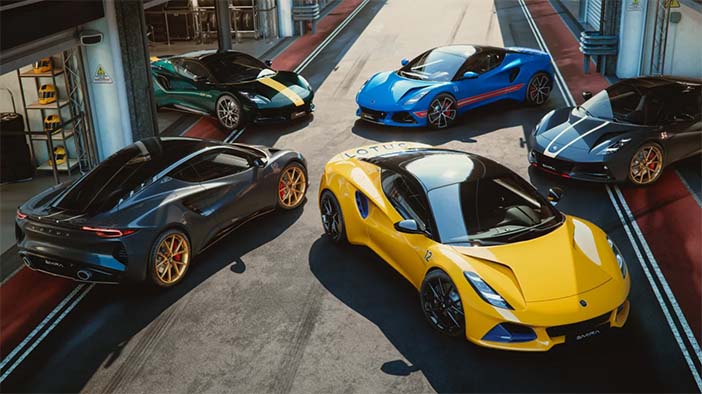
+++ A new collection of LOTUS EMIRA Limited series models has been revealed, each showcasing 1 of 5 liveries inspired by past motorsport success and innovation. Each individual livery will be limited to 12 cars and offered for sale in 12 European markets (referencing the legendary Ayrton Senna’s race number). The liveries are applied to the actual paintwork rather than via decals, and precede the launch of a new personalisation programme that Lotus will offer to all Emira models from 2025 called Chapman Bespoke. This new programme will allow customisation of both the exterior and interior, as seen in the Limited series models. The Type 99T and Type 97T (Formula One cars that were driven to victory by Ayrton Senna) are referenced in 2 of the liveries, while a third is dedicated to the Type 25 that was applied to Jim Clark’s championship winning car. The remaining 2 models (the Type 78 and Type 86) recognise F1 cars that represented a leap in technological innovation: radical aerodynamics and Lotus’ iconic twin-chassis cars. There are no mechanical changes to the Emira Limited series cars, with each running an AMG-sourced 4-cylinder petrol engine paired with a dual-clutch transmission. Power is rated at 360 hp, delivering a 0-100 kph sprint of 4.3 seconds and a 285 kph maximum speed. This powertrain has now finally joined the existing supercharged V6 following delays in homologation. The specials are priced from about €125.000 in the Netherlands. +++
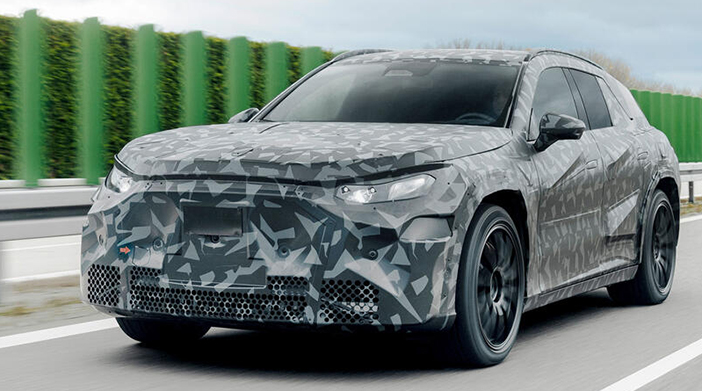
+++ MERCEDES-AMG ’s answer to the Lotus Eletre and upcoming electric Porsche Cayenne will be launched in 2 years and be one of the most powerful cars the brand has ever produced. Currently known as the electric GT SUV (a name it is understood could be carried into production) the super-SUV has hit the road in prototype form for the first time and the production version is set to reach forecourts in 2027. It is the first SUV that AMG has developed independent of parent Mercedes-Benz. The EV will sit on the AMG.EA architecture, which will be used first for a 4-door production version of the Vision AMG concept in 2026. AMG.EA will feature 800 Volt and advanced axial-flux electric motors in both twin and tri set-ups, with outputs well over 1.000 hp expected. Developed by Yasa, the Oxfordshire-based firm owned by Mercedes-Benz, these motors each develop up to 480 hp and 800 Nm and are seen by AMG as a key performance differentiator for its new SUV. Among the performance benchmarks for the new AMG model is the 906 hp Lotus Eletre R. AMG’s dedicated SUV will be heavily focused on road-going performance but insiders have told it will offer variable ride height control to improve ground clearance in off-road use. As for styling, prototypes reveal that its bold-looking design will incorporate elements that provide clear visual connections with its saloon sibling. The front end is also set to feature a new interpretation of AMG’s Panamericana grille, together with distinctive headlights that include the three-pointed star graphics. Flared wheel arches and wide rear haunches dominate the flanks, while retractable door handles (as seen on the EQE SUV and EQS SUV) increase aerodynamic efficiency. Although AMG’s existing combustion-engined GLE-based models come in both SUV and SUV-coupé body styles, its new electric model will be offered solely in SUV form, with a “relatively upright tailgate and angled rear window” providing “the best balance between form and load-carrying space”, insiders have told. Dimensionally, the new model sits between the 4.863 mm-long EQE SUV and 5.125 mm-long EQS SUV. Inside, it adopts a unique design for the dashboard and displays, together with new AMG.OS software. “SUVs have been among our most popular models for many years”, AMG CEO Michael Schiebe told. “We are responding to this by offering customers a high-performance off-roader based on the AMG.EA platform. Our new high-performance architecture follows a clear philosophy: AMG first, EV second”. AMG is remaining tight-lipped about the battery technology. However, Autointernationaal.nl has been told it will introduce a different chemistry combination to offer greater efficiency and a longer range than the existing lithium-nickel-manganese-cobal
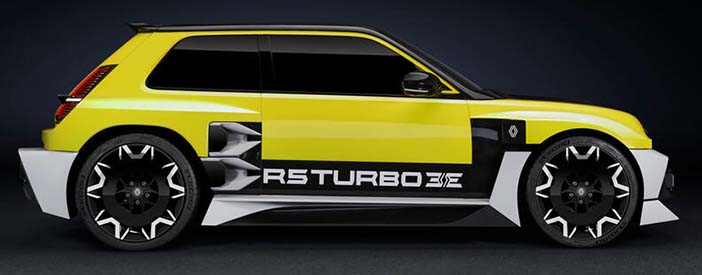
+++ RENAULT ’s striking 5 Turbo 3E concept car will enter production in 2026 as a modern interpretation of the storied Turbo and is said to be the “ultimate hot hatch”. The electric 5 Turbo 3E will be based on a bespoke platform and employ next-generation in-wheel motor technology. That will give it more than triple the power of the original, which went out of production in 1984, and make it the most powerful production car in Renault history. Speaking at an exclusive Car of the Year preview of the new car (yes, the Renault 5 E-Tech is the prima contender for this title …), product boss Bruno Vanel promised the 5 Turbo 3E will deliver an “outstanding driving sensation, something completely unexpected” that is “agile like nothing else” as a result of its innovative drivetrain. The new model was previewed by a 2022 concept that was said to have more than 380 hp, but when it reaches production it will put out in excess of 500 hp, thanks to 2 in-wheel electric motors. These motors enable more precise control of each wheel and the wheels can effectively “do what they want”, said Vanel. In-wheel technology (which has been supplied by British specialist Protean Electric) removes the need for an electronic differential or the type of simulated ‘manual’ gearshift used on the Hyundai Ioniq 5 N. The 0-100 kph time will be less than 3.5 seconds, and Vanel described the performance as “breathtaking”. The electric hot hatch will have a bespoke carbon-composite body. Renault has yet to confirm the car’s dimensions but its proportions are significantly different from those of the standard 5 E-Tech on which it is loosely based. Only the windscreen angle is shared between the 2 cars. A longer dash-to-axle ratio in particular reveals that the production car will follow the concept in using a bespoke architecture. The 2-seat concept used a tubular chassis with a roll-cage in the rear. Its extreme bodywork is created with aerodynamic efficiency and cooling in mind, including a vast rear spoiler and diffuser, flared wheel arches, and side air intakes to cool the motors. One of the key features of the concept version was its three drift modes for different levels of playfulness, including the ability to do doughnuts. The concept also used a manual handbrake and, given how important that is to the ethos of the project, it’s something Renault would want to retain for production. Sandeep Bhambra, Renault’s head of advanced design, said the brief from group CEO Luca de Meo was to “make me a little beast”. Bhambra said the “intention had always been to make it” for production after the concept’s positive reaction. Renault has not revealed production numbers for the car, but it’s likely to be limited and priced at more than €120.000, given the level of bespoke content and its extreme positioning. Given its role within the Renault Group, Alpine is likely to be involved in the car’s development. Producing it at Alpine’s Dieppe factory is also a strong possibility. +++
+++ SEAT will launch hybrid versions of the Ibiza and Arona as part of a significant update in 2025 to meet the strict upcoming Euro 7 emissions regulations. While the role of Seat has long been questioned following the emergence of Cupra as a standalone brand 6 years ago, these significant investments in its two entry-level models now suggest a role for the Spanish brand into the 2030s: as a specialist in smaller and more affordable models in conventional segments. That will allow Cupra to play further upmarket, with a focus on plug-in hybrid and electric cars. Seat and Cupra CEO Wayne Griffiths told that Seat would follow the lead of the Volkswagen Polo, sibling car to the Ibiza, in being updated next year at the same time as EU7 kicks in. This will mean mild-hybrid petrol engines will be offered; a significant investment for smaller and less profitable cars but an important and necessary step for car makers to continue to be able to sell affordable new cars in the mass market where demand for EVs has yet to take off. “We’re going to show you next year the new versions of the Ibiza and Arona”, said Griffiths, speaking at a Car of the Year event off the back of the Cupra Terramar making the 2025 shortlist. “We, like Volkswagen, want to extend the lifecycles of those products, not only with the EU7 but with hybridisation as well, because that’s what’s missing there: hybrid models”. The larger Seat Ateca and Seat Leon are the other models in the brand’s range after the demise of the Tarraco, and both of these are also offered as Cupra models. It’s possible that Seat versions of the Leon and Ateca may ultimately be dropped when they’re given updates of their own, should Seat’s role as a small, affordable hybrid car specialist be solidified off the back of the Ibiza and Arona updates. Griffiths confirmed the Cupra Leon would be updated in its present form, which includes petrol and PHEV versions, to allow for production to be extended “well into the next decade”, alongside the closely related Cupra Formentor. “The Cupra Leon and Cupra Formentor are both based on the same platform”, said Griffiths. “We will extend those well into the next decade. If we want to go into the next decade, then we’re always going to have to take care of those cars and revitalise them. We could expect facelifts or product improvements on both to keep them going as long as we need to. But after that, the next generation of the Leon will definitely be electric”. Griffiths said the investments in the Ibiza and Arona shouldn’t be seen as the Seat group backing away from EVs but representing the reality of a “need to respond to the 90% of the market that is asking for other types of drivetrains: efficient petrol ones, hybrids and plug-in hybrids”. He added: “We’re not going to deviate from electrification as a direction. We don’t question the objective of getting to zero emissions as fast as possible. We have to be flexible on the way and we can’t be dogmatic. We can’t force consumers to drive electric cars”. The arrival of the Cupra Raval at the end of 2025 as a sub-€28.000 electric supermini, along with sibling models in the Volkswagen ID.2 and Skoda Epiq that Cupra is also developing, would help “democratise electromobility”, said Griffiths. “Having smaller urban electric cars under €28.000 (Dutch pricing), I think we’re going to see electric cars taking off. But in the meantime, we have to offer both cars with a combustion engine too. “We’re looking to have 2 brands, Cupra clearly focusing on fully electric and plug-in hybrid, and Seat focusing on petrol engine with self-charging hybrid technique. I think we have the best of both worlds currently”. +++