
+++ The teaser campaign for the BENTLEY TORCAL is kicking into high gear as the company has released a new clip that showcases the interior. The ultra-luxury brand has also released a few new details about their first electric vehicle. Starting outside, the automaker said the crossover will have a “jewel-like floating diamond grille” that “transforms a functional necessity into a captivating design statement, one that is unmistakably Bentley and unlike anything else on the road”. The video doesn’t give us a very good look at it, but the grille is expected to echo the one found on the EXP 15 concept. Bentley also provided a peek at the 3-dimensional taillights, which have a diamond pattern. The pointy shape is a bit of a theme for the Torcal and the company noted the historical design feature has been “reinterpreted for a new era”. The automaker went on to say they teamed up with Cumbria Crystal to commission “bespoke hand-cut crystal objects designed specifically for the project”. Details are limited, but the company suggested the crystals will be illuminated to create a “distinctive visual signature rich in depth, movement and texture”.
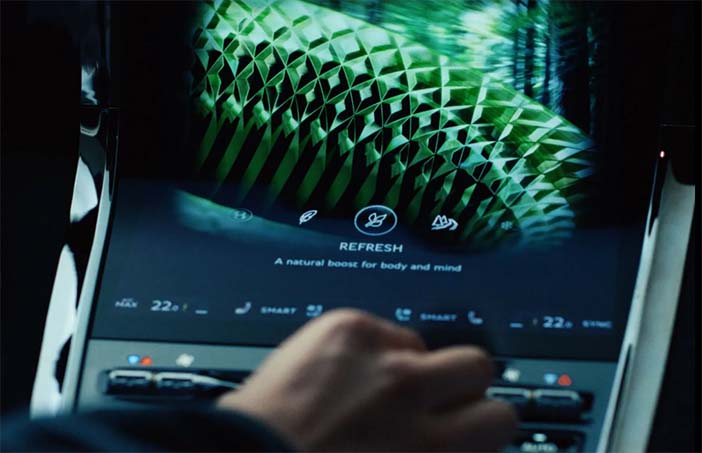
Putting marketing hyperbole aside, we can see the crossover will have sculpted door panels with an interesting ridge-like pattern. Elsewhere, there are knurled climate controls and a rotary dial with a start/stop button. They’re joined by physical buttons as well as dedicated Sport and Comfort modes. The latest pictures also give us another look at the crossover’s curved infotainment system. It features a portrait orientation as well as a lower bar that shows climate and seat information. While there isn’t much else to see, previous spy photos have shown the model will have a 3-spoke steering wheel with wing-like stalks similar to the Audi Q3. The right side has a shifter, while the left side has an assortment of light and wiper controls. Well-heeled customers will also find a curved digital instrument cluster and circular air vents. They’ll be joined by real metal accents and a wide swath of wood trim on the passenger side dashboard. Performance specifications remain mysterious, but the Torcal will ride on the PPE platform that underpins an assortment of models including the Porsche Cayenne Electric. It sports a 113 kWh battery pack, a 390 kW DC fast charging capability and outputs of 441 hp, 666 hp and 1.155 hp. The Bentley will likely fall somewhere in between the latter two numbers and the company has already confirmed the model will be capable of getting 160 km of range in as little as 7 minutes. A debut is scheduled for September 23. +++
+++ BMW has begun testing the 2-door i4 version of the all-electric i3. The i4 name is still being used by the 4-door i4 Gran Coupe, which arrived in 2022 as a rival to the Tesla Model 3 and Polestar 2. The upcoming i3 saloon will soon take over from the i4 Gran Coupe, while the i4 name will be used for 2-door models: an electric coupe and this convertible variant. While the all-electric revolution has reached most areas of the car market, electric convertibles are few and far between. There’s the MG Cyberster, though that’s a 2-seater and the BMW clearly comes with 4 seats. Other 4-seat electric convertibles include the Maserati GranCabrio Folgore and the Mini Electric Convertible, but the upcoming BMW will have precious few direct rivals. This is not only the first time we’ve seen the i4 Convertible (which has a fabric roof like the current 4 Series Convertible rather than a hard-top) testing, but also the first time we’ve seen the i4 in production bodywork. The design of the front end clearly continues the styling of the i3 and iX3 with the ‘Neue Klasse’ layout incorporating the flush-fitting kidney grilles and headlights into one unit. Like the i3, the i4 gets active shutters and functional air curtains lower down on the bumper. The profile of the i4 Convertible reveals the roofline has been kept low and the wheelbase is long considering the total length of the body, all helping to provide the two-door drop-top with a squat, sporty stance. The rear of the i4 in both this convertible and the coupe will likely take on the same lighting signature as the i3 with horizontal LED clusters, though the bootlid will be different and the number plate is positioned further up on this car. The big news in these ‘Neue Klasse’ models is BMW’s Panoramic iDrive system, which replaces a traditional dial pack in front of the driver with a full-width head-up display shown in a black area at the base of the windscreen. Expect a huge 17.9-inch touchscreen in the middle of the dash, taking care of almost every function given that BMW has started to abandon its rotary iDrive controller. A convertible body typically means a reduction in efficiency over the equivalent coupe through a combination of extra weight and less sleek aerodynamics. The standard i3 comes with up to 900 km of range from a huge 112 kWh battery, so even if the i4 Convertible suffers a significant loss of range, it should still easily beat the likes of the MG Cyberster (505 km) and Maserati GranCabrio Folgore (450 km). The i3 has launched in xDrive50 First Edition form with a 470 hp dual-motor powertrain good for 0-100 kph in only 4.7 seconds, and I expect similar numbers for the i4. We can also expect the i4 to arrive sometime in 2027, after the upcoming Touring estate variant of the i3. +++
+++ Days after word that Mercedes-Benz may have paused production of its long-wheelbase electric CLA in CHINA , a fresh forecast spells out just how badly German manufacturers are struggling to keep their Chinese factories busy. The forecast by global research firm Mobility Global found that joint venture plants run by German firms in China, including those for Audi, BMW, Mercedes-Benz, and Volkswagen, operated at less than 50 percent capacity in 2025, with the figure set to fall further. This year it may drop to 46 percent, and slide to 44 percent by 2030. This is dramatically different from 2010, when these joint venture plants were generally operating at full capacity. It shows just how quickly vehicles from German brands have fallen out of favor in China. Most car buyers there now want vehicles from local brands, especially domestic EV makers. Poor utilization rates have also prompted Volkswagen to close its plant in Nanjing, which it had been operating alongside SAIC. Its Urumqi site has also been sold. While BMW and Mercedes have ruled out the possibility of plant closures, sources allege they are considering “operational adjustments”. Admittedly, it’s not just foreign brands that are dealing with poor factory utilization rates. Mobility Global expects average utilization across China’s auto industry to sit near 55 percent in 2026, down from roughly 90 percent in 2010. To help deal with this, exports of Chinese cars continue to rise, up to 10 million units this year, an increase from the seven million reported last year. In addition, while most legacy brands deal with poor utilization rates not only in China but elsewhere, Chinese brands are using strong overseas demand for their models to build new plants outside China, including in Europe. Spain and Hungary are among the locations targeted as manufacturers seek to avoid tariffs, produce closer to customers, and reduce political risk. +++
+++ GENESIS , the premium brand of Hyundai Motor Group, is gradually losing ground in the global completed vehicle market. Hyundai plans to improve sales performance by introducing the GV90, the brand’s first large electric flagship SUV and adding hybrid models in the second half of the year. Genesis’ global sales in the first half of this year amounted to 103.483 units. This marks a 6.1% decrease compared to the same period last year. Particularly in the domestic market, which accounts for half of total sales, sales dropped by 23% year-on-year to 47.024 units. Sales performance improved in the U.S. market. Genesis’ U.S. sales in the first half of the year reached 39.088 units; a 4.5% increase from the same period last year. The GV70, a midsize SUV, recorded the highest sales at 17.324 units. However, Genesis’ market share in the United States remains significantly lower compared to other premium brands. Lexus, Toyota’s luxury brand, sold 169.712 units in the U.S. market in the first half of the year, more than 4 times Genesis’ sales. The RX Hybrid saw a 13.3% increase in sales to 59.904 units. The NX sold 30.763 units, far surpassing the sales of the Genesis GV70, its class competitor. German premium brands also performed well. BMW sold 186.944 units in the U.S. market in the first half of the year. The X3 saw a 29.8% increase in sales to 37.671 units. The X5, which competes with the GV80, recorded sales of 41.554 units, a 23.7% increase from the same period last year. The apparent reason for Genesis’ global sales decline in the first half is production disruptions. A major fire at Anjun Industrial, a parts supplier for Hyundai, in April caused delays in the supply of engine valves and other components. This resulted in an estimated operating profit loss of 200 billion Korean won. Industry experts believe the absence of hybrid models also contributed to Genesis’ poor sales. While electric vehicle popularity has declined in recent years, demand for hybrid vehicles has surged in major markets like the U.S. However, Genesis has only produced gasoline and electric models to date. Hybrid vehicle sales in the U.S. increased by approximately 20% in the first half of the year, accounting for 15.4% of total new vehicle sales; about 3 times the share of electric vehicles. In the European market, hybrid vehicle sales reached 2.198.148 units; a 13.2% increase from the same period last year, accounting for 37.4% of total sales. Genesis plans to launch its first hybrid model, the GV80 Hybrid, in the second half of the year. The G80, a large sedan, is also expected to start selling its hybrid model within the year. There are forecasts that exports of Genesis vehicles will notably increase not only in the domestic market but also in the U.S. The GV90 will make its debut in the third quarter of this year. Although demand for large electric SUVs is limited, analysts predict that the GV90 will enhance Genesis’ brand value in the global market and positively impact overall sales recovery. Genesis plans to introduce a range-extended electric vehicle (EREV) in the second half of next year. Unlike plug-in hybrid vehicles (PHEVs), which use both an engine and a motor for driving, EREVs are driven solely by a motor. The internal combustion engine in an EREV acts as a generator, supplying power to the battery when it is low. An industry official said: “The consecutive launches of hybrid models and the EREV model scheduled for next year will help Genesis rebound in sales”. He added: “The current mainstay models, the G80 and GV80, have been on the market for over six years and are aging. Until fully redesigned models are released, there will be limitations in boosting sales performance”. +++
+++ The European market, which previously favored compact cars, has recently seen a significant rise in preference for LARGE AND MIDSIZE sedans and SUVs. This shift coincides with Chinese companies like Tesla and BYD introducing cost-effective electric vehicles, alongside the emergence of plug-in hybrid (PHEV) large and midsize vehicles with extended electric ranges. Global automakers have responded by strengthening their large and midsize lineups in the European market. According to global market research firm Dataforce on the 20th, sales of large and midsize SUVs in Europe from January to May this year reached 474,553 units, a 27.5% increase compared to the same period last year. This was the highest growth rate among all segments, including SUVs, sedans, and vans. While compact SUVs accounted for the largest portion of the SUV market with 1.208.804 units sold, their growth rate was only 11.9%, less than half that of large and midsize SUVs. Sales of small SUVs (940.230 units) increased by just 7.6%. A clear preference for midsize and large sedans, wagons and hatchbacks is also emerging. Sales of small models, the most in-demand category, totaled 786.303 units, a 1.7% decrease from the same period last year. Sales of compact models (485.999 units) plummeted by 15.2%. In contrast, midsize models recorded a 14.0% increase, the only double-digit growth in the segment, with 154.993 units sold. Previously, Europe had a strong preference for compact and subcompact vehicles. This was due to narrow roads and limited parking spaces, making smaller vehicles more practical for driving and street parking. A utilitarian mindset, viewing cars primarily as transportation tools, also played a role. Tax structures that increased burdens with higher engine displacements further drove demand for compact cars. However, the situation began to change as Tesla and Chinese automakers introduced affordable electric vehicles. The top-selling large and midsize SUV this year was Tesla’s Model Y, with 76.446 units sold; a 67.9% increase from the same period last year. Among the top-5 models by sales volume, BYD’s Seal U (38.822 units) ranked second with a 49.4% growth rate. In the midsize sedan segment, Tesla’s Model 3 led with 38.903 units sold, a 30.9% increase. Volkswagen’s Passat (25.503 units) and ID.7 (25.215 units) took second and third places, respectively, but both saw declines of 19.5% and 22.0%. BYD’s newly released Seal 06 (11.490 units) jumped to fifth place, while the BYD Seal (10.301 units) is poised to enter the top ranks after a 38.9% increase. The expansion of the midsize and larger segments is also driven by rising demand for plug-in hybrids (PHEVs). Recent advancements in PHEV technology have extended pure electric ranges to 70–80 km per charge, maximizing cost savings. Large and midsize SUVs are the second-largest segment for PHEV demand in Europe after compact SUVs. Pure electric vehicles and PHEVs now account for over 70% of the large and midsize SUV market, surpassing the former dominance of diesel vehicles. Brands operating in Europe are expanding their large and midsize vehicle line-ups. Stellantis plans to launch large and midsize models produced by its Chinese partners, Li Auto and Dongfeng, in the European market. Li Auto will manufacture 2 midsize models at Stellantis’ Madrid plant, while Dongfeng will produce a large model in France. Peugeot is set to mass-produce a midsize SUV concept car it unveiled at the Beijing Motor Show in April. Chinese electric vehicle maker Li Auto is scheduled to enter the European market at the Paris Motor Show in October, with its first model being the midsize crossover i6. Industry observers expect it to compete with models like Audi’s Q4 e-Tron, BMW’s iX3 and Polestar’s Polestar 4. The i6 measures 4.950 mm in length; 200–300 mm longer than the Q4 e-Tron and iX3. Hyundai and Kia, however, are struggling to gain traction in the midsize and larger segments. Neither brand appeared in the top 10 for large and midsize SUVs. Hyundai is selling the Ioniq 9, while Kia offers the EV9. In the midsize sedan segment, Kia’s K4 sold 4.141 units from January to May, ranking 8th. Hyundai’s Ioniq 6 sold 2.050 units, placing tenth, but this represented a 3.2% decrease from the same period last year. +++
+++ The MERCEDES-AMG is ready to take its final bow, with a new Final Edition version marking the end of the line for the highly potent but equally pricey hot hatch. The reason for its demise is AMG’s M139 engine. Although it is still the most powerful turbocharged 4-cylinder engine ever put into mass production, it doesn’t meet the latest European emissions standards. And so after 7 years on sale, the A 45 is being axed.
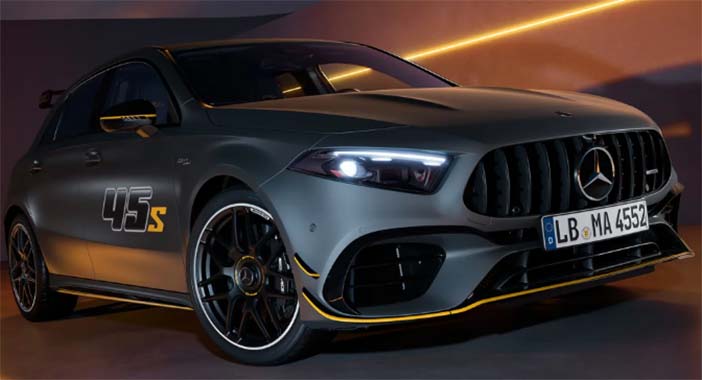
The A 45 S Final Edition costs 23.000 euro more than a Volkswagen Golf R. But for that, buyers will be getting a unique look courtesy of Mountain Grey Magno matte paint with bright yellow accents all around the car and unmissable 45 S graphics on the doors. The black and yellow colour scheme continues inside, too. This special edition also features matte black 19-inch forged wheels with the same eye-catching yellow hue used for centre cabs, the fuel filler cap finished in silver chrome, dark chrome quad exhaust tips plus all the aero elements, including the large roof spoiler, that come as part of the AMG Aerodynamics Package developed to improve stability at high speeds. AMG hasn’t eked any more power out of the M139 engine for the A 45’s final hurrah, but it still spits out 421 hp and a hearty 500 Nm of torque; that’s enough to rocket the car from 0-100 kph in 3.9 seconds and onto a top speed of 270 kph. Once the AMG 35 and 45 retire, the newly unveiled AMG CLA 45 will become the entry point to Mercedes’ performance line-up. Rather than a powerful 4-cylinder engine, it features three cutting-edge e-motors that produce a combined 680 hp. +++
+++ MERCEDES-BENZ is reviving the G-Class Cabriolet almost a decade after the last open-top version of the hardcore off-roader was phased out. New images show the new Cabriolet with its roof down and the folded fabric top occupying the space where the boot is on the regular G-Class.
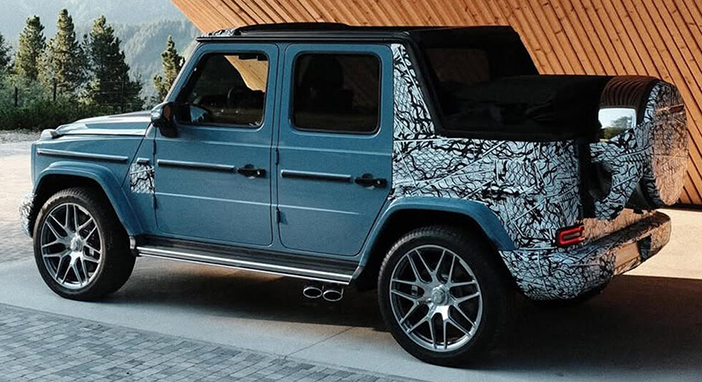
Technical details have yet to be disclosed, though the new images are of an AMG derivative with side-exit exhausts. The regular-bodied AMG G63 is powered by a 585 hp twin-turbocharged petrol V8. No launch date has been revealed yet, but given the drop-top car is already testing and is a variant of a model already on sale, it is likely to arrive in the coming months. The new G-Class Cabriolet is expected to carry a hefty premium over current models. Cabriolets have long been part of the G-Class line-up. The first, a 2-door short-wheelbase model, was introduced as part of the original line-up in 1979 and was produced up until 2013. Later came the ultra-luxury 4-door G-Class Maybach G650 Landaulet, introduced in 2017 with a 621 hp twin-turbocharged 6.0-litre V12 petrol engine and based on the high-riding G63 4×4². Produced in a limited run of just 99 units, it combined a front hard top with a rear folding roof section, individual rear seats set back in the chassis. +++
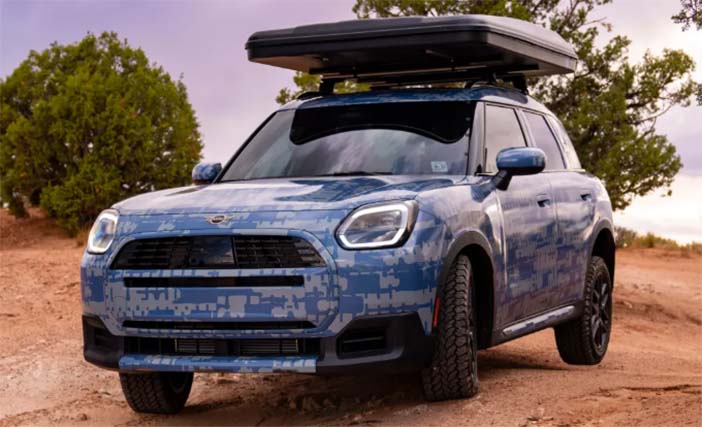
+++ MINI is priming a new off-road version of the Countryman as it looks to broaden the brand’s appeal with a range of individualistic special editions. The company has revealed a new prototype referred to only as “a new Countryman edition”, which brings lifted suspension, chunky off-road tyres and a roof-mounted tent, hinting at its outdoorsy remit. Mini boss Jean-Philippe Parain said the brand is “just one step away” from unwrapping the finished car, which will be unveiled in October. The prototype has been pictured traversing the Rocky Mountain national park in Colorado, in the US, where hardened versions of conventional family SUVs are an emerging trend. The new Countryman reflects Mini’s ambition to keep its line-up fresh with a wide range of new derivatives. Design chief Holger Hampf said: “We’ve witnessed the trend of the outdoor lifestyle and driving out of the city to spend some days in nature. Can our car do this? Certainly, so expect something in that direction”. The finished car will draw on the Vagabund concepts that were unveiled earlier this year. Inspired by festival culture, these exhibited off-road conversions of Mini’s family SUV. Hampf suggested that brand partnerships such as the Vagabund would become more prominent in the years to come, as Mini looks to offer more special editions and greater personalisation. He said Mini had “lost sight of that for a couple of years” as it sought to simplify its range and cut down on option packages, amid a broader drive in the car industry to cut costs. He explained: “We feel Mini is a clean canvas that can be more customised in the way that it takes on different characters. Take, for example, a Paul Smith edition: fashionable and urban. Take a John Cooper Works: racy, sporty and almost track-like for the GP models in the past. Maybe the Deus Ex Machina concepts, more raw, more DIY and so on. We want to make sure that our customisation options allow people to express these different lifestyles. Preference has to become more important to us. This is where we learn from these collaborations, and from past editions”. +++
+++ SUBARU has teased a trio of new high-performance models with combustion engines, reigniting hopes of a fully fledged relaunch of iconic STI models from the Japanese manufacturer’s past. Each will reference Subaru’s enviable motorsport heritage with new high-performance 4-cylinder engines, yet ironically we have BEVs such as the Solterra and Uncharted to thank for them. During a Super Taiku racing event, Subaru produced an image that teases three models that it says will bring the fire back to its line-up. After a high point with the Impreza Turbo and dominating the World Rally Championship, a pivot to more family-friendly models designed chiefly for the American market has generally ignored Subaru’s passionate high-performance fan base.
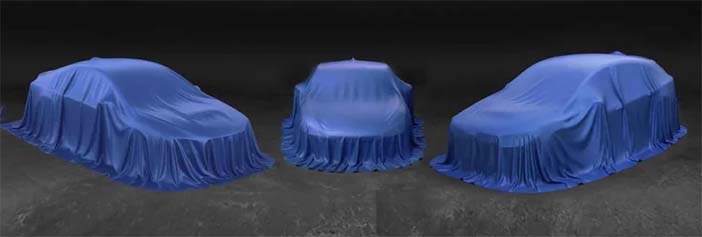
However, a new taskforce has been assembled within Subaru’s Tokyo headquarters and this is all about to change, starting with these 3 new models that could arrive as soon as next year. 2 of these could reimagine the iconic WRX moniker, formerly applied to a high-performance variant of the iconic Impreza but now adorning a distinct, standalone model. It will be available in both saloon and hatchback forms, and both will feature turbocharged ICE powertrains connected to a six-speed manual gearbox and a symmetrical all-wheel drive system. The cars in the photo are hidden under a cloth, but there are still a few key details that give us lots of information about the pair, starting with a tell-tale bonnet scoop. This has been a consistent feature on high-performance Subarus since the late eighties, due to the unusual location of the intercooler on top of the turbocharged flat-four engine. There are other elements to note, too, such as what appear to be substantial styling changes over existing Subaru models. Details such as a solid body crease that runs right up the cars’ flanks, flared wheel arches and a more aggressive nose all suggest the cars could have a boxy, almost retro style. The saloon doesn’t have a high-mounted rear spoiler, suggesting this might not be an all-out STI variant, but this could just be a detail left off to keep us in a little bit of suspense. The second WRX model is a more upright and boxy hatchback or estate, which has its own styling treatment. This also looks to sit a little taller than the saloon, suggesting it could be a more rugged high-performance model – potentially closer in spirit to high-performance Foresters than the original Impreza hatchback. Technically speaking, the WRX has never actually gone off sale, because it’s still available in Japan, Australia and the US. However, its powertrain and performance levels have remained largely stagnant for the last decade, allowing European hot hatchbacks to not simply catch up, but actually surpass it in terms of power and performance. This shouldn’t be the case with these new models, because reports from inside Japan suggest that while the current car’s turbocharged 2.4-litre flat-four engines will be retained, Subaru will be able to tune them to well over 300 hp, and raise torque to over 400 Nm thanks to the re-introduction of a tougher 6-speed manual transmission that was previously discontinued. However, there are also legislative reasons why Subaru is now able to put these high-performance models into production, and they result from rising sales of its all-electric and hybrid models. By selling more ‘low emission’ models, its CAFE (Corporate Average Fuel Economy) standards now sit at a level that will allow the company to build limited numbers of high-performance ICE models without being fined for exceeding the standards. In addition to the two new WRX models is a reimagination of the BRZ. This small 4-seat coupe was developed alongside the Toyota GT86, and while only the first generation was sold in The Netherlands, it too is still available in other markets around the world. This new version will also be co-developed with Toyota, but it is said to have aligned its future GR86 more closely with its GR sports car line-up, suggesting that the Subaru variant could lose its flat-four engine layout. Core values of low weight, rear-wheel drive and a balanced chassis will still apply to the BRZ, however, given that it’s intended to be a purer and more engaging offering alongside its more capable and practical siblings. There’s yet another reason that such high-end halo models will only become more important in future, too. Japanese brands such as Subaru are quickly realising that their global market share is already being threatened by new-age Chinese competition. The ability to capitalise on things including motorsport heritage will become a key element of what keeps brands like Subaru in business. Many buyers, especially in Japan, consider the distinctiveness of cars (driven by legacy) as a key reason to buy, pressuring Subaru to do more with the passion it’s created over decades of motorsport. Of course, the relevance of these models for the UK and Europe is less clear, because emissions regulations here are far tougher than those in other parts of the world. Yet Subaru isn’t leaving Europe behind, because it’ll be a big driver of a BEV program which will also include new high-performance derivatives. David Dello Stritto, Subaru general manager for Europe, told: “We’re pushing as hard as we can to have it as soon as possible and it’s definitely on the map. I can’t say when, and globally we’re assessing our priorities. Customers want it. It’s not just me. And that’s why I don’t want this to be wishful thinking. We’re talking to Japan. There are things in the making”. +++