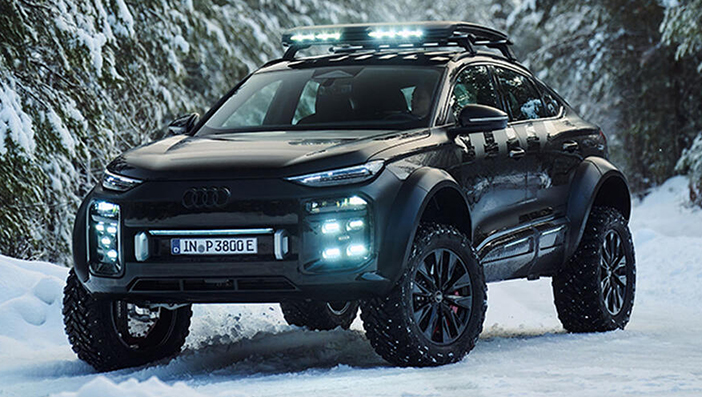
+++ AUDI has revealed the Q6 e-Tron Off-Road concept as a hardcore, go-anywhere version of its latest electric SUV. Described as “Quattro redefined”, the bulked-up Q6 e-tron Sportback has been extensively modified for venturing off the Tarmac, with a heavy visual makeover, a massive suspension lift and chunky all-terrain tyres. Full technical details remain to be revealed, but Audi has confirmed the concept is fitted with portal axles, which boost ground clearance by moving the axle housings above the wheel hubs, with drive delivered via a gearset on each wheel. Portal axles are traditionally the preserve of the most extreme 4x4s and have not yet featured on an Audi model. Mercedes uses them for the Unimog and the hardcore G63 4×4² and Ineos recently deployed them on an ultra-hardcore Grenadier prototype with half a metre of ground clearance. The concept’s heavy chassis overhaul comes with a dramatic new look that emphasises its off-road capabilities, gaining a new set of ultra-bright spotlights, a roof rack, substantially widened wheel arches and chunky lower body cladding. Further details on the Q6 concept’s modifications are likely to be revealed in due course. The studded tyres suggest it’s likely to make its debut at Austria’s Fat Ice Race later this month, in which the Volkswagen Group usually participates. The Q6 off-roader is clearly evolved from 2023’s radical Activesphere concept, a futuristic off-road saloon that previewed what then Audi design boss Marc Lichte called “Audi Allroad 2.0”, hinting at a return for the moniker used for raised, off-road-ready versions of previous-generation A4 and A6 Avant. Heading up Audi design now is former Land Rover designer Massimo Frascella, who was behind the current Defender and Range Rover models, which are among the most capable off-roaders currently in series production. +++
+++ There’s a new V-Series CADILLAC in town, the luxurious land barge that is the Lyriq. Not only is the Lyriq-V the first all-electric Cadillac to wear a V badge, but it will also be the fastest production model the brand has ever made. Its dual motor all-wheel drive configuration puts out 615 hp and 870 Nm. Those figures give it a 0-100 kph time of 3.5 seconds in the performance-focused Velocity Max mode, 0.1 seconds faster than the gas-powered CT5-V Blackwing. The 15.35-inch front Brembo brakes should help slow you down after that run. Despite weighing in at a massive 2.700 kilos, its 102 kWh battery pack can power it for 455 km on a single charge. A DC fast charger can add up to 120 km of range in 10 minutes, while the slowest 240 Volt charger can add 30 km of range in 1 hour. Cadillac includes 3 modes to help you take advantage of the Lyriq-V’s massive power. Competition Mode switches up the traction management software to increase vehicle agility, although the automaker didn’t explain how. V-Mode, on the other hand, allows the driver to customize their performance settings and assign them the steering-wheel-mounted V button. Lastly, there’s launch control, which can be engaged in Velocity Max or V-Mode to enhance your off-the-line acceleration. On the exterior, the Lyriq-V rides on special 22-inch wheels with a model-specific lower front fascia, side rockers, a black-painted roof, and body-coloured lower trim. The body itself can be draped in the exclusive “Magnus Metal Frost” color, and there are plenty of V badges throughout to ensure that passers-by know not to challenge you to a drag race. Enter the cabin, and you’ll be met with a fantastic mix of luxury and racey designs highlighted by V-Series illuminated sill plates. The steering wheel is uniquely styled with a V-Series logo, the aforementioned V-Mode button, “sculpted hand grips”, and an aluminium Regen On Demand paddle. Various interior surfaces are bestowed with paperwood décor, while the seats can be clad in Nappa leather with available embroidery and V-pattern detailing on the seatbacks. Cadillac also mentioned that the existing infotainment system will be complemented by a dual-plane Augmented Reality Head Up Display that will likely display relevant information to the driver. That same infotainment system can also be “updated with specific customization options reflecting the V-Series persona”. This likely means some sort of theme or colour scheme to help you remember you’re driving a Cadillac V. It should also be noted that these V-Series-specific features are included on top of the standard Lyriq’s features, like a panoramic fixed glass roof, a 23-speaker AKG Studio Audio System with Dolby Atmos, and a massive 33-inch-diagonal advanced led display. Such power and luxury will require deep pockets. Cadillac set the price of the Lyriq-V at $79,990, which means it will cost about 107.000 euro on the Dutch market. The Lyriq itself was already an impressive car, with true Cadillac proportions and a design that stands miles apart from any other luxury EV. Having a performance-focused V-Series version just makes it that much more special, and we’re stoked that Cadillac has brought its performance variant to its electric line-up. +++
+++ CHRYSLER is in need of a plan, something resembling anything. News recently broke that Chrysler was putting its immediate EV plans on hold, putting its deadline to go fully electric by 2028 up in the air. A memo to suppliers of the C6X (codename for the Airflow electric SUV) was leaked, stating that “any spending associated with this program should be suspended immediately”. While this is by no means conclusive for Chrysler’s long-term EV plans, it does not look promising because nothing concrete about its future seems to be in sight. Here are 4 reasons why Chrysler’s EV plan would never work if they did end up deciding to pursue it. 1) Chrysler’s only remaining model is a MPV. Yes, MPVs sell because they’re needed, but it’s not a segment anyone would categorize as “hot” the way SUVs are. Sadly, Chrysler now only has 1 model, and there’s nothing concrete in terms of new models on the horizon. Fortunately, the Pacifica sold the most units in the segment in 2024, largely because it offers a plug-in hybrid powertrain, all-wheel drive, and Stow ‘n’ Go seating (for petrol-only models), which allows the second-row seats to fold conveniently into the floor. Those are its bragging rights, and that’s not good. The Pacifica is now the elder statesman in the MPV segment, which isn’t a badge of honour if you consider that it’s been around in the same form since 2017, with only a mild refresh back in 2021. It’s easily upstaged by everyone else in the segment, including the Honda Odyssey, Toyota Sienna, Kia Carnival and now the all-electric Volkswagen ID.Buzz. The last vehicle Chrysler retired was the antiquated 300 sedan that hadn’t been redesigned since 2011, and the one before that was the mediocre 200 sedan that died in 2017. The brand has “added” a second vehicle this year, but it’s not exactly a standalone model. It’s essentially a rebadged base model Pacifica, touted as the Voyager, that costs less and looks the same. This is not big news, folks. As a result, Chrysler isn’t exactly at the forefront of car buyers’ minds. Most thriving brands offer a range of vehicle segments rather than a single model. If you’re going to go all in with electric, but nobody thinks about your brand in the first place, you’ll be hard-pressed to draw in buyers in large volumes. Out of sight, out of mind, as they say. 2) The EV competition is no joke. Even if Chrysler was able to launch a production EV this year, it would be swimming upstream against the likes of Tesla, Ford, General Motors, Hyundai and Honda. The Airflow concept debuted at CES in 2022, and it looked almost production-ready. Part wagon, part SUV and very sleek, the Airflow showed us that Chrysler might be able to redefine itself after a decade of mediocrity. Based on Chrysler’s new STLA Medium EV platform, the Airflow would use new battery tech for a purported 650 km range and come with all-wheel drive, allowing it to compete with the Tesla Model Y and the Ford Mustang Mach-E. Unfortunately, Chrysler put all of its eggs in one basket, and the EV market has cooled, evidenced by numerous automakers making changes to their once tsunami-like EV plans. Moreover, brands like Ford, Hyundai, and Honda have already proven themselves in the EV arena, and those brands are bringing more models into the fray. It’s not only Tesla that would put an electric Chrysler on the ropes, but models like the upcoming Hyundai Ioniq 9, Lincoln Star and the Ford Explorer Electric could prove to be too much competition for a Chrysler electric SUV that the world hasn’t seen yet. That momentum is real, while Chrysler’s mettle in this fight hasn’t even shown itself. 3) Chrysler’s sister brand, Jeep, already has 2 electric SUVs in the works. An upcoming Chrysler electric SUV might end up getting cannibalized by its sister brand, Jeep. You’ve gotta figure that Jeep’s upcoming electric Recon and Wagoneer S will run circles around any potential Chrysler electric SUV in terms of popularity. They will already have a leg up because they’re coming later this year. The Wagoneer S is a done deal, and spy shots of the Recon look pretty promising. We don’t so much as have a whiff of what a future Chrysler electric SUV model looks like. Jeep might be struggling in light of the overall Stellantis sales crisis, but the brand remains at the forefront of buyers’ minds. As they say, there’s no such thing as bad publicity. The worst curse would be not being talked about at all, which is where Chrysler finds themselves these days. 4) There’s nothing significant on the horizon. It appears that Chrysler has nothing truly earth-shattering planned for this year. Yes, the brand has confirmed that a refreshed Pacifica is on the way in 2026, but that’s still a ways off. While the Pacifica is the best-selling minivan, it’s on the decline. The model’s sales dropped about 11 percent in 2024 compared to the previous year, so the trend isn’t positive. Chrysler CEO Christine Feuell confirmed that the brand will introduce a new crossover SUV and a Halcyon concept-based car, but we’re talking a year or more from now to see anything meaningful for a brand that’s fading in sales and the minds of car buyers. The Halcyon is a rakish electric sports coupe that’s too niche to appeal to a wide swath of potential buyers. It might be important as a halo car, but it certainly won’t move the sales needle up very much. Even the niche Halycon-based car would be quite a bit later to the party than the electric Dodge Charger already hitting showrooms. Final thoughts: As much as I would love for Chrysler to not just survive but thrive, my hope isn’t high. Had they introduced even a couple of brand-new or newly redesigned models, they might be able to weather the cooldown of the current EV market. They allowed their models to die, though, and they weren’t great to begin with. The PT Cruiser and the Sebring don’t even elicit good memories, and the 200, 300 and Town & Country weren’t that much better. The brand had better pull off a serious magic trick soon if it’s going to have any chance of success. +++
+++ ELECTRIC CARS are now just as reliable as petrol and diesel cars. That’s the conclusion of an international university study which found that even with intensive usage, EVs on average match the typical lifespan of their ICE counterparts. Researchers from the University of Birmingham, London School of Economics and Political Science, University of California San Diego and Switzerland’s University of Bern analysed more than 300 million test records from between 2005 and 2022. They found that while early electric cars were less reliable, the likelihood of a technological failure fell by an average of 12 percent per year over the above timeframe, compared with 6.7 percent and 1.9 percent for petrol and diesel cars respectively. This now means that the mean projected lifespan of an EV sits at around 18.4 years and up to 200.000 km, with the latter figure surpassing the average for a petrol-powered equivalent. Despite Tesla’s questionable reputation for reliability, the researchers actually found the brand’s cars to be the top-performing EVs in terms of longevity, with models from Audi and Skoda topping the tables for ICE cars. Viet Nguyen-Tien of the London School of Economics and Political Science said the findings provide a “critical insight into the lifespan and environmental impact of electric vehicles”, describing electric cars as “no longer just a niche option”. Professor of Economics at the University of Birmingham, Robert Elliott added that while producing an EV typically generates higher emissions than that of an ICE car, “a long-lasting electric vehicle can quickly offset its carbon footprint, contributing to the fight against climate change, making them a more sustainable long-term option”. Elliott continued: “Our findings offer consumers reliable data to make informed decisions about their vehicle purchases, whilst policymakers can use our insights to shape regulations and incentives that promote the adoption of durable and environmentally friendly vehicles and plan ahead their end-of-life treatment”. +++
+++ The car market in EUROPE barely grew in 2024, with new car registrations rising by just 0.9% to 13 million units. This modest uptick came despite a strong finish in December, where registrations rose 4.1%. While hybrids experienced significant growth (accounting for a third of all December registrations), fully electric vehicles (EVs) struggled, with sales falling by 1.3% over the year. In December alone, EV registrations dropped by 0.2%, signalling consumer reluctance to embrace battery-powered models. This trend has raised concerns about the future of the EV transition, as European automakers face mounting pressure to meet stricter emissions regulations while navigating consumer scepticism and diminishing government support. The collapse of EV sales in markets like Germany, where EV registrations declined by 27% last year, has been particularly stark following the removal of state subsidies. Germany’s VDA car lobby predicts a 30% increase in domestic EV production this year, but without strong consumer demand, these vehicles may struggle to find buyers. Local automakers are calling for renewed government support, with VDA chief Hildegard Müller urging policymakers to establish trade agreements and partnerships to keep the industry competitive. Early elections in Germany could provide an opportunity for policy changes, but uncertainty looms. Complicating matters, Friedrich Merz, the conservative frontrunner for chancellor, has pushed to extend the sale of new combustion-engine vehicles beyond the EU’s planned 2035 ban, while incumbent Olaf Scholz has advocated for continued EV tax incentives. There’s no getting around the fact that EV demand in Europe isn’t as strong as automakers need it to be, but it’s not as bad as it may seem at first glance. As I’ve pointed out before, EV sales in Europe are actually growing, if only slightly, if you remove Tesla from the equation. Last year, Tesla saw its European sales decline by nearly 11%, selling about 40.000 fewer vehicles than in 2023. The release of the updated Model Y Juniper may help sales rebound in 2025, but it’s safe to say that Tesla was lagging behind the rest of the EV pack in 2024. After subtracting Tesla sales, overall EV sales were actually up 0.9% year-over-year in 2024; about the same as the overall market. Still, that’s hardly a reason to celebrate. If generous incentives and government subsidies only managed to keep EV sales at pace with the rest of the market, then automakers could face a very difficult time selling EVs without those aids propping up demand. As EV demand falters, hybrids and PHEVs are gaining traction. In December, hybrid registrations jumped 29.5%, with plug-in hybrids up 2.5%. These models, which combine many of the upsides that ICE and EV vehicles offer, have become a popular choice among consumers hesitant to commit to fully electric cars. The rise of hybrids has muddied automakers’ EV strategies. Many had been banking on a sharp pivot to fully electric vehicles to meet emissions targets and stay competitive globally. However, hybrids’ increasing market share highlights lingering range anxiety and concerns about charging infrastructure as key barriers to EV adoption. Europe’s automakers are not only grappling with domestic struggles but also facing pressure on the global stage. Declining sales in China (the world’s largest car market) are eroding revenue, while heightened competition from Chinese manufacturers is intensifying price pressures. In the U.S., additional tariff risks under president Donald Trump’s administration have further complicated the outlook. Trump’s recent repeal of EV-friendly regulations, referred to as the “EV mandate,” has left automakers uncertain about the future of the American market for battery-powered vehicles. In a note earlier this month, UBS analyst Patrick Hummel described these converging challenges (price pressure, market-share losses in China, tighter emissions regulations, tariff risks, and lackluster demand) as a “perfect storm” for Europe’s manufacturers. Can price cuts and policy changes turn things around? There may be some relief on the horizon. Analysts at Bloomberg Intelligence predict that while European car sales could dip in the first half of 2025, price cuts in the second half might provide a slight rebound. However, the industry remains divided over how to address the challenges. ACEA President and Mercedes-Benz AG CEO Ola Källenius has called for revisions to the EU’s CO2 regulations. He also urged the EU to negotiate a “grand bargain” with the U.S. to avoid escalating trade tensions. Even in a relatively bleak market, automakers like Renault have accomplished significant growth in 2024. Renault’s market share in Europe grew to 11.9% in December, overtaking Stellantis for the first time since the automaker conglomerate was formed in 2021. Hybrid models have been key to Renault’s success, highlighting a potential path forward for companies willing to pivot their strategies. As European carmakers enter 2025, they are confronted by a landscape full of economic uncertainty, evolving consumer preferences, and intensifying regulatory pressures. Meeting stricter emissions targets while navigating weak demand for fully electric vehicles will require some weighty moves—from pricing strategies to government lobbying. The popularity of hybrids offers a glimmer of hope, but it also underscores the complexity of the EV transition. In the face of these challenges, one thing is clear: European automakers must adapt quickly or risk falling further behind in an increasingly competitive car market. +++
+++ In 1965, Carroll Shelby proved what the original FORD MUSTANG could really do when he transformed what he called “a secretary’s car” into the iconic Shelby GT350. Now, 60 years later, there’s a new Shelby GT350 on the block, plus a track-ready GT350R, both offered with an almighty supercharged V8 engine and old-school six-speed manual. Muscle-car fans should remember the last Shelby GT350, which was produced by Ford, because it featured a flat-plane crank V8 that could rev all the way to 8.250 rpm; something no Mustang before could handle. This time, however, the new GT350 models will be built by Shelby American. The more street-focused GT350 is available with either the stock 5.0-litre ‘Coyote’ V8 producing 480 hp, or Shelby can add a Whipple supercharger that takes output to 812 hp; an increase of nearly 70 percent. This figure is when using 93 octane American petrol, though, so the 98 or 99 octane we get here would allow for even more power. Whether you go naturally aspirated or supercharged, the GT350 can be had with a 6-speed manual and a short-throw shifter, or Ford’s latest ten-speed automatic transmission. Other upgrades include a new suspension system that lowers the GT350 by about an inch compared to stock, adjustable front and rear sway bars, a Borla cat-back exhaust system and lightweight 20-inch flow forged alloy wheels wrapped in Michelin Pilot Sport tyres.
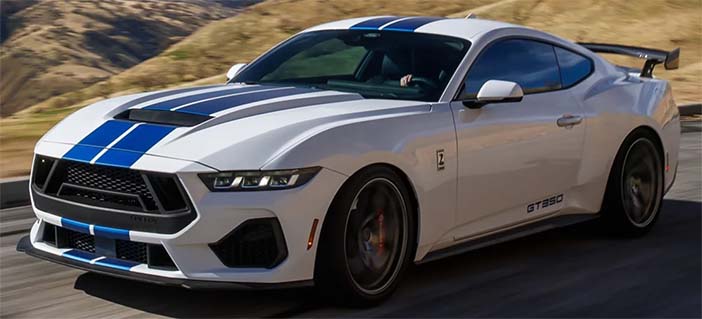
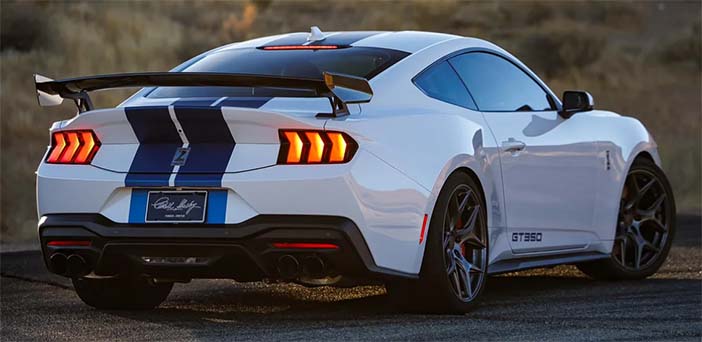
The signature Shelby stripes are present and correct, of course, and go from nose to tail. The bar brawler looks come courtesy of a new front grille design, a much more aggressive bumper with big brake ducts and a 3-piece splitter, plus an aluminium deep draw bonnet with central vent to help extract more heat. Also, at the rear there is a large ducktail spoiler taken from the Shelby Super Snake, although customers will have the option of adding an even bigger spoiler on the boot lid. The GT350R features an even more powerful 819bhp supercharged V8 engine, and is available exclusively with a 6-speed manual. There’s also a suspension package from specialist JRi with fully adjustable shocks, extra chassis stiffening and upgrades from Alcon Racing. Other highlights include a carbon fibre aero package, and lots more carbon fibre inside, plus a half roll cage for safety, extra chassis stiffness, a lap timer and four-point seat harnesses. If that’s not enough, customers can add Sparco carbon fibre racing seats. Shelby made 562 GT350s in 1965, and the company has decided it’ll build the same amount of new models. Just 36 of these will be the hardcore GT350R, also staying true to its ancestor’s production numbers. +++
+++ HONDA just had a record year in 2024, with more than 400.000 sales of the CR-V thanks to the availability of a hybrid model. As the company looks forward to the new year, it has formally announced that the CR-V and the HR-V will undergo some significant changes. Although the HR-V isn’t nearly as popular as the CR-V, it still sold over 151.000 units last year, making it a valuable asset in Honda’s portfolio. Both models last received a new look in 2023. While the exact changes remain uncertain, the 2026 CR-V is confirmed to feature the rugged Trailsport trim. If it’s anything like the Pilot and new Passport, the CR-V Trailsport could receive dedicated off-road features such as higher ground clearance, unique wheels wrapped in all-terrain tires, drive modes tailored to hit the beaten path, and possibly skid plates. Likewise, it could also match the rugged aesthetic of other Trailsports with blackened trim and roof rails. The new CR-V will also likely carry over the current model year’s powertrains. The 2.0-liter hybrid setup comes standard with all-wheel-drive in the Trailsport. Should the Trailsport retain the hybrid setup, it would show a promising step towards Honda’s dedicated EV Hub, which is gearing up to build multiple types of powertrains. “We believe that electrification is best for personal mobility long-term, but how we get to 100% BEV ultimately will be based on customer demand”, said Lance Woelfer, vice president of Honda sales. “That’s why we pursued a smart, flexible strategy with our EV Hub in Ohio, where we will have the ability to produce ICE, Hybrid, and EV on the same line”. Honda said the HR-V will also receive styling and technology enhancements this year. Again, the company is mum on the details, but we imagine the changes will likely be minor. Although the Honda CR-V and HR-V are due for a mid-cycle refresh, the impending tweaks will likely keep the bottom line growing as SUVs continue to sell like hotcakes. The CR-V Trailsport would face stiff competition. If Honda packs it with enough off-road hardware, it may suit the needs of buyers preferring to spend life outdoors. +++
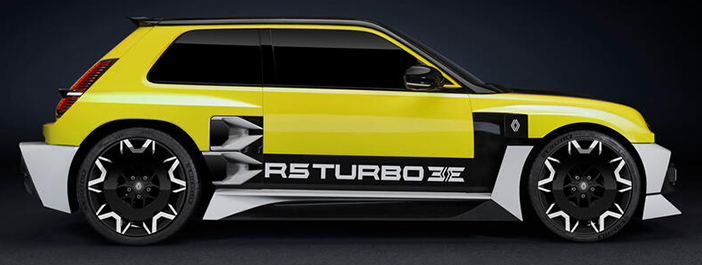
+++ RENAULT will reveal its wild Turbo 3E hyper-hatchback in the coming months before starting production of “much more” than 150 units next year, and there could be more hardcore performance models in the firm’s future. Developed in collaboration with Alpine, the outlandish 3E is the electric reincarnation of the original Renault 5 Turbo. It is loosely based on today’s retro Renault 5 but with bespoke bodywork, its own platform and a pair of in-wheel motors pumping out more than 500 hp. It is far removed in its conception from any Renault model past or present, but CEO Fabrice Cambolive told that it “was a kind of logical consequence when you look at the design of the R5, which already takes some elements from the old Turbo”. He also said it plays an important role as an expansion of the Renault 5 range: “For me, it was very important to be able to have as extensive as possible coverage in terms of customer needs for R5 – beginning with a very interesting price bracket but opening the adoption of this car to people who want extreme sensations. When you have such a car which is such fun to drive, why not push the boundaries?” He hailed the 3E’s ability to “drift permanently” and carry “much more speed” as headline attributes but said these “extreme conditions” were developed with a keen eye on efficiency, so as to ensure the hyper-hatch retained a usable range. “That’s why the idea of having engines on wheels was very interesting for us”, he said, referring to the 3E’s in-wheel EV motors, a technology that is widely touted as bringing dramatic advantages in packaging, efficiency and power delivery compared with conventional ‘e-axles’. Renault will prove the potential of this technology when the 3E makes its dynamic debut, Cambolive said, without naming a date or venue. The original 3E concept was driven in anger for the first time at the 2023 Goodwood Festival of Speed, and sibling brand Alpine hosted the global debut of the R5-based A290 hot hatch there last year – but the company hasn’t confirmed its attendance at the 2025 event. He also wouldn’t give specifics on the 3E’s pricing but said “we will have a fair price linked, of course, with the power of the car” and it will be far below the €200.000-plus commanded by sibling brand Alpine’s similarly extreme A110 R Ultime track car. However, Cambolive did say Renault will build “much more” than 150 units and has been encouraged by early reaction to the car. “A lot of people who know the price already are ready to invest because they think this kind of car will never lose value”, he said, highlighting the collector status that has been achieved by the original Turbo. “If you browse the R5 Turbo 1, you have prices that are quite significant”. Original Turbos are vanishingly rare and prices for the best examples currently push well past €175.000. “I don’t think the price will be a barrier”, said Cambolive. “As long as it’s fair, as long as the car delivers the power, the efficiency, the technology, the innovation and a very high-quality dimension, I think we’ll find our public, especially a public which remembers the ultra-sporty aspects of Renault in the past”. The decision not to revive the dormant Renault Sport moniker used by previous Renault hot hatches is because “we are focusing a lot on product”, Cambolive said, “and speaking about Renault Sport without any products is not essential”. He did suggest, however, that there could be more performance models in the pipeline for Renault after this. “I prefer to speak about Turbo 3E, and after that to see what we can do on top of that if Turbo 3E is a success”, he said. “Let’s build our ‘sportivity’ step by step”. Renault product boss Bruno Vanel recently promised the 5 Turbo 3E will deliver an “outstanding driving sensation, something completely unexpected” that is “agile like nothing else” as a result of its innovative drivetrain. The 2 in-wheel motors enable more precise control of each wheel and the wheels can effectively “do what they want”, said Vanel. In-wheel technology removes the need for an electronic differential or the type of simulated ‘manual’ gearshift used on the Hyundai Ioniq 5 N. The 0-100 ph time will be less than 3.5 seconds, and Vanel described the performance as “breathtaking”. The electric hot hatch will have a bespoke carbon-composite body. Renault has yet to confirm the car’s dimensions but its proportions are significantly different from those of the standard 5 on which it is loosely based. Only the windscreen angle is shared between the 2 cars. A longer dash-to-axle ratio in particular reveals that the production car will follow the concept in using a bespoke architecture. The two-seat concept used a tubular chassis with a roll-cage in the rear. Its extreme bodywork is created with aerodynamic efficiency and cooling in mind, including a vast rear spoiler and diffuser, flared wheel arches, and side air intakes to cool the motors. One of the key features of the concept version was its three drift modes for different levels of playfulness, including the ability to do doughnuts. The concept also used a manual handbrake and, given how important that is to the ethos of the project, it’s something Renault would want to retain for production. Sandeep Bhambra, Renault’s head of advanced design, said the brief from Renault Group CEO Luca de Meo was to “make me a little beast”. Bhambra said the “intention had always been to make it” for production after the positive reaction garnered by the concept that previewed it in 2022. +++