
+++ Most of the recent public discussion about the potential Honda-Nissan COMBINATION seems to be focused on why the value proposition isn’t there. Well, finally, a Honda executive this week touted some potential synergies for the 2 Japanese automakers; at least in the all-important North American market. A merger with Nissan could give Honda access to Nissan’s know-how in big pickups and SUVs, important U.S. segments it has yet to tap, Noriya Kaihara, a Honda executive vice president, told reporters on the sidelines of the CES technology expo in Las Vegas. Sharing those vehicles could help Honda fill gaps in its line-up, he said. “Nissan has a little bit larger class, E-segment vehicles that we don’t have at this moment. So, if we can exchange some of our vehicles, that would be a benefit for us in the short term”, Kaihara said. Nissan’s pickups and SUVs (the Titan full-size pickup, the midsize Frontier and the 3-row body-on-frame Armada SUV) could all be attractive to Honda, which leans on the Pilot crossover and Ridgeline small pickup in North America. Kaihara didn’t address sedans and smaller crossovers, but Honda would likely hold a strong advantage in those segments in North America if the companies combined. Honda could also benefit from Nissan’s excess capacity at its plants on this continent. +++
+++ DACIA will introduce an all-wheel-drive version of the Duster with an electrified back axle by the end of this year. Speaking at Dacia’s press conference at the 2025 Car of the Year final, where the Duster is shortlisted for the award, company CEO Denis Le Vot confirmed a new technological solution for the firm’s all-wheel-drive model. Le Vot said: “By the end of 2025, we will introduce a new hybrid solution for our 4×4 version. We will electrify the rear axle with an e-motor on it. The car will be hybrid and automatic and there will be an LPG version. We will make it available at an affordable price, as is the Dacia way”. This version of the Duster will top a range that includes, from launch, a 100 hp 1.0-litre bi-fuel 3-cylinder engine, a 130 hp 1.2-litre mild hybrid and the top-spec 140 hp 1.6-litre full hybrid from the Jogger. Prices currently top out at just north of €35.000 in the Netherlands, so the new range-topping 4×4 hybrid is expected to nudge that to nearer €40.000. It is highly likely that the powertrain will make its way into the slightly larger Bigster, which is all but technically identical to the Duster. Other cars that also share the CMF-B platform (including the Dacia Jogger, Nissan Juke, Nissan Qashqai and Renault Captur) could be in line for the same treatment. Le Vot added that an electric Duster “would come in time” but the first electric Dacia will be the Sandero, in 2027. The Duster will have to wait until its next generation to receive an electric powertrain and that is likely to be in 2030/31. Le Vot also confirmed that the new Duster was, at the end of November, the number-1 SUV for retail sales in Europe across all different-sized SUVs. +++
+++ The ELECTRIC CAR industry is in the doldrums. Across all brands, no less than 27 percent fewer electric cars were sold in Germany in 2024 than in the previous year. The crisis therefore hit electric cars hard, while the overall market remained virtually constant. This resulted in an electric car share of 13.5 percent. This is according to the registration figures now published by the Federal Motor Transport Authority (KBA). 3 major brands in particular suffered from dwindling electric car sales: Tesla sold 41 percent fewer in 2024, Hyundai including Genesis also had to cope with a drop of 41 percent. Audi also performed worse than the market as a whole with a drop of 29 percent, but this is nothing compared to the other losing brands. Thus, Opel’s BEV sales fell from 27.765 to 7.633 units; a drop of 20.000 or 72 percent. Sales of the Corsa and Mokka Electric, the 2 sales leaders, virtually collapsed as the Corsa is now in 29th place, whereas last year it still made it into the top-10. The electric versions in particular were bought less, while the combustion models still held up quite well. For example, the BEV share of the 2 small Opels fell from 26 and 37 percent to only around 8 percent (for both). Fiat, still in 9th place in 2023 with a respectable 23.180 cars, now finds itself in 14th place because only 8.474 electric cars were sold. The culprit here is the 500 Electric, which is in low demand and plummeted from 4th place among the best-selling electric cars to 17th place. Dacia experienced a similar fate with its Spring, which fell from 14th to 27th place. But back to the positives. VW is still the brand with the most electric car sales (62.108 units; 12 percent less than in 2023), while Tesla (37.574; -41 percent) slipped 1 place and was overtaken by BMW (42.066; +4 percent). No wonder, as BMW even sold slightly more electric cars than in 2023 as a whole. Mercedes (33.991; -7 percent) sold fewer, but was able to maintain 4th place. Next came Skoda (25.308; +8 percent), Audi (21.831; -29 percent), Cupra (18.248; +4 percent), Hyundai / Genesis (16.952; -41 percent), MG (14.370; -18 percent) and Volvo (13.535; +59 percent). All brands sold 380.609 electric cars in Germanu in 2024 (-27 percent). Now let’s take a look at the best-selling models. As it has been the case for what seems like ages, the Model Y is in first place (29.896; -35 percent), but the gap to number 2 has narrowed considerably. The Skoda Enyaq (25.262; +7 percent) is already lurking there waiting for the chance to overtake it. The Volkswagen ID.4 and ID.5, which are always counted together by the KBA, slipped down one place ((21.611; -41 percent). Next came the Volkswagen ID.3 (20.101; -10 percent), the Cupra Born (16.640; -5 percent), the Volkswagen ID.7 (14.554; significantly improved), the Audi Q4 e-Tron (12.871; -29 percent), the BMW iX1 (12.640; -14 percent), the MG 4 (12.004; -9 percent) and the Mercedes EQA (11.476; -17 percent). The BMW i4 and the Volvo EX30 were able to improve on 2023, but are not (yet) among the top-10 best-selling models. +++
+++ MAZDA has just introduced the China-made 6e in Europe, but the Japanese automaker is now stepping up its electrification efforts in a big way. It has announced plans to build a new manufacturing facility in Japan focused exclusively on producing EV batteries that will power its first local model. This move represents a major step forward in its electrification strategy, with the factory set to supply battery modules for the company’s first-ever EV designed on a dedicated electric vehicle platform. The facility will be located in Iwakuni City, within Japan’s Yamaguchi Prefecture, and will feature Panasonic Energy as the primary supplier for its cylindrical battery modules. Once operational, the factory is expected to crank out enough battery packs to achieve an annual production capacity of 10 GWh. The cylindrical batteries will be used in a new model riding on Mazda’s first EV-dedicated architecture. The company didn’t set a date for the debut of the new electric car and hasn’t revealed any technical details. Comments by the CEO, Masahiro Moro, suggest that the in-house development of the architecture will be completed by 2027. Mazda promises this will deliver EVs with “advanced design, superior convenience and extended driving ranges”. Looking ahead, Mazda is diving into a range of battery technologies beyond the Panasonic-sourced modules for its EVs. The automaker is developing high-density lithium-ion batteries in-house, to put them on PHEVs and EVs by 2030. Last but not least, the Mazda CEO has revealed they are also building a “very advanced research base” for solid-state battery technology. +++
+++ The recent demise of the PEUGEOT 508 PSE has left the French firm without a performance-focused model in its line-up. But there is growing hope that the brand could return to its hot-hatch roots with a faster version of the next generation 208. Autointernationaal.nl revealed last year that there will be a hot GSe-badged version of the next Opel Corsa; the sister model to the 208. Both superminis are due to be launched in 2026, and will share parent company Stellantis’s new STLA Small platform. Now, a Stellantis spokesman, suggested the 508 PSE’s retirement doesn’t mean the end of Peugeot’s performance lineage. “There may be other products in the future. Peugeot has always had a penchant for fast, small hatchbacks, as we’ve seen various generations of GTi cars”, he said. “I remember the 205 GTi when I first joined the company. And the 206 GTi thereafter. It would be a sad day for us to declare that we will never go there again. I wouldn’t want to see that sad day coming and I don’t think I will”. Peugeot’s hot hatchback heritage offers plenty of encouragement that the brand may return to this genre for its next performance car, as opposed to a crossover or family SUV. A go-faster version of the next 208 would also give the company a rival to the hotly anticipated Alpine A290 and Mini JCW Electric. I asked whether we could see a tuned version of the 208 further on down the line and he admitted: “I’d love to see it, personally. Peugeot Sport engineers would be the people that would do that sort of thing”. I also asked if the PSE badge (which stands for Peugeot Sport Engineered) could return, or whether GTi would make a comeback, but the spokesman refused to be drawn either way: “The crucial bit for me is the credibility that came from PSE. So, whether we call it PSE or GTi, the truth about it was that Peugeot Sport had engineered the car and there were significant driveability differences between that and a standard car. I think that’s crucial”. He continued: “What we cannot ever do is to put a GTi badge on something that is a conventional car with a slightly bigger e-motor, for example. One of the big things about this future market is that almost every electric car can be a quick car. The beauty comes from being able to make a fast car and a really enjoyable, driveable car as well”. Other brands in the Stellantis family have launched their own small fast EVs recently, with the Abarth 600e, Alfa Romeo Junior Veloce and Lancia Ypsilon HF all based on the same underpinnings as the current 208. They also provide some clues to what kind of performance upgrades a new 208 GTi could receive. Abarth’s souped-up version of the Fiat 600e, for instance, received a sizeable power boost to produce 240 hp in the standard model, and up to 280 hp in the top-spec version. If the 208 GTi were given a similar amount of power, it would hit 100 kph in less than 6 seconds. An even more significant addition to the Abarth model is the Torsen mechanical limited-slip differential that improves the car’s agility, traction and handling. The 600e also benefits from stiffer suspension and anti-roll bars, a wider track, a new braking system and liquid cooling for the battery; something Peugeot would probably look to do with any future 208 GTi. There would be some visual changes too, such as a lower ride height, bigger wheels and a subtle bodykit with a couple of GTi badges. Inside, buyers could expect the car to have contrast stitching and sportier seats, as well as a fresh take on Peugeot’s famous i-Cockpit instrument cluster. There’s a good chance Peugeot will also look to incorporate a version of the Hypersquare steering wheel expected to feature in the standard 208 when it arrives in 2026. +++
+++ PORSCHE is readying another update for the Cayenne, just 1 year after it launched the most recent overhaul of its big-selling SUV. The company last year confirmed that the combustion-engined version of the Cayenne will remain on sale alongside the upcoming electric model into the 2030s. A prototype has now been spotted testing in Germany with a new front grille that resembles the one fitted to the new Porsche 911, as well as prototypes of the electric Cayenne and next-generation Boxster. The test car also sports a set of bulbous foglights, although these are almost certainly not bound for any production car, given they appear to be gaffer-taped onto the vehicle. It’s possible that the prototype previews a minor restyle intended to bring the Cayenne into line with its upcoming stablemates. The prototype may also be testing powertrains revised to meet the Euro 7 emissions regulations that come into force from 1 July this year. When Porsche confirmed the extended lifespan of the petrol Cayenne, it said the model’s twin-turbocharged 4.0-litre V8 (used in the S, GT and Turbo E-Hybrid variants) would remain in development “to comply with future legislative requirements”. Porsche chief Oliver Blume said: “The Cayenne has always defined the sports car in its segment. In the middle of the decade, the fourth generation will set standards in the segment as an electric SUV. At the same time, into the next decade our customers will still be able to choose from a wide range of powerful and efficient combustion and hybrid models”. +++
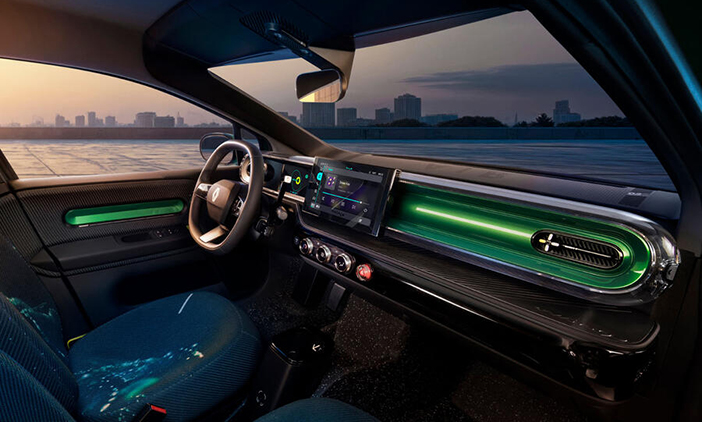
+++ The new RENAULT TWINGO has edged closer to production with the unveiling of a “90%-ready” prototype at the Brussels motor show, complete with running gear and a full, showroom-spec interior. Due in the first half of 2026 with a starting price south of €20.000, the 3.750 mm-long hatchback will be the entry point into Renault’s expanding electric car line-up, sitting beneath the similarly retro-flavoured 4 and 5 hatchbacks, with which it shares the French firm’s Ampr Small platform. Renault aims to take the car from conception to the road in less than 2 years and has partnered with an unnamed Chinese consultancy in a bid to make the engineering and production processes as efficient as possible. In spite of its low projected list price (which puts it in the realm of the petrol-engined Kia Picanto and Hyundai i10) the 4-seat city car features a host of “upper-segment technology” inside and is described as a “joyful, trendy” proposition. The newly revealed interior is clearly related to that of Renault’s larger EVs, dominated as it is by a 7.0 inch digital instrument cluster and a 10.1in infotainment touchscreen, but makes obvious nods to the cabin of the original Twingo from 1992. Renault describes the cockpit as “airy, cylindrical and suspended”, with ovoid air vents and surfaces an obvious homage to the era-defining 1990s supermini. Notably, the seats of this new Twingo prototype are coloured to match the exterior paint, taking inspiration from the lurid upholstery options that were available on the old car. A more subtle nostalgic design cue is the prototype’s prominent red hazard light button, a reference to the similarly conspicuous dome-shaped button on top of the old Twingo’s dash. In another urban-flavoured 1990s throwback, the front seatbacks are adjusted using skateboard wheels. Beyond its retro-modern design, Renault says every aspect of the Twingo’s interior is “designed to make life easier”, highlighting a range of features that boost storage capacity and utility. There are bag storage cubbies under the dashboard, for example, plus a flat, full-width shelf for books or sunglasses. There’s also a split-folding rear bench to increase boot space, plus magnetic phone-mounts on the back of the front headrests and an elasticated bottle holder. Beyond the interior’s retro-modern design, Renault said every aspect had been “designed to make life easier”, highlighted by a range of features that boost storage capacity and utility. The floor of the prototype is finished in cork, chosen for its durability and resistance, but Renault noted that “show cars are an opportunity to explore and test new ideas”, so this material seems unlikely to make it into customer cars. Renault said the new Twingo will be closely related to that used in the 5 E-Tech. +++
+++ VOLKSWAGEN saga: Volkswagen’s management board will take pay cuts adding up to over 300 million euros by 2030, according to comments by VW human resources board member Gunnar Kilian to local paper Braunschweiger Zeitung. +++
+++ Despite the growing uncertainty about EV sales growth, nobody is complaining about EVs at VOLVO , which posted record global deliveries in 2024. The newest battery-powered models in its line-up (the EX30, EX90 and EM90) added 100.768 sales to the automaker’s total volume in 2024. When sales of the EX40 and C40 are added, Volvo’s EV sales reached 175.194 last year; an increase of 54 percent compared with 2023. +++