
+++ AUDI has been in America for over 50 years, officially entering the market in 1970. Compared to BMW and Mercedes-Benz, it’s a relative youngster, and one thing it still hasn’t done is build a plant in the United States. BMW opened its plant in Spartanburg, South Carolina in 1994, while Mercedes followed suit in 1997, building in Vance, Alabama. That’s ironic given that its parent company, Volkswagen, opened its first U.S plant in 1978. It closed in 1988, but resumed local manufacturing in 2011, moving from Westmoreland, Pennsylvania to Chattanooga, Tennessee. Now, Audi is rectifying that by setting its plans in motion to build in the U.S. That said, this wasn’t a decision out of the blue, nor were tariffs the only reason for building it, although it did play a part in it. The thing is, this was decades in the making, and that’s according to retired Volkswagen of America CEO and Audi of America president, Johan de Nysschen. He made that revelation during an interview. Plans for Audi’s American assembly plant go as far back as the 2000s. De Nysschen was there when it all began, and shared some of the several reasons why it kept being pushed back, and why the company is rushing to get the factory completed. As early as 2008, there were already plans to start American assembly. Regional executives were heavily advocating for it at the time. De Nysschen was also on board with the plan, as it should help with the brand’s bottom line. However, executives in Germany ultimately decided on Mexico, mainly to capitalize on the lower labor and manufacturing costs, on top of avoiding import duties. “We were, in my opinion, pretty well down the road to landing it, when somehow at 5 minutes to midnight there was a pivot, and they decided to go to Mexico”, said de Nysschen. He also cited that Germany wanted a return on its investment quicker, stating that the decision to choose Mexico over the U.S was “transactionally driven”. He called that approach short-term focused, and the result now is Audi losing ground to its compatriots in North America in terms of revenue as it’s now forced to pay billions in tariffs. De Nysschen pointed out the consequences of Audi not being able to build stronger roots in America, noting that it had missed out creating a 2-way trade ecosystem. It could’ve followed the same playbook as BMW and Mercedes wherein both made the U.S their major hub for SUV assembly. Just take a look at the X3 and X5, as well as the ML/GLE and GLS, with these SUVs not only being made in America, but also being exported to most markets. “You cannot only produce in the market for the market, and what happens to be able to be exported is the cherry on top. Exports have to be strategically planned as part of the whole equation, so that you have capital tooling only once. You produce for the world in the U.S., and you produce for the world in Germany”, said de Nysschen. Given how successful the Q7 and Q5 had become, Audi could’ve avoided all its current hardships had it planted its flag in America far earlier. Audi could’ve utilized the available VW Group facilities that were already present in America at the time to get things started. That said, the company has chosen to build a plant away from both Volkswagen and Scout Motors, choosing Peach County, Georgia as the site of its first-ever U.S assembly facility. There’s no doubt that sharing lines with VW and Scout would’ve been the more cost-effective solution, but de Nysschen sees the reason behind the decision to go solo. “Ingolstadt does not like to be dictated to Wolfsburg and they want to be masters of their own destiny. So many people who are ignorant say, ‘Oh, Audi is just a luxury Volkswagen’. It’s not true, but if they are built in the same plants, that reinforces that perception”. Pride is a factor, yes, but so is image and perception. There is a risk in doing all of this, though, as explained by de Nysschen. “You are trapped in this sort of vicious cycle. You can’t build volume because you’re too expensive, and because you don’t have volume, you are too expensive”. External pressure, rather than investment, is possibly the biggest reason why Audi had finally decided to build in America, at least in de Nysschen’s opinion. “How should this company survive? Its domestic market has now been eaten up by the Chinese. Fact. The biggest Chinese market has been destroyed by the Chinese. What’s left? United States. They had better make it here. And by making it here also means manufacturing here. It’s fact. It’s given. It’s a requirement. You cannot win without building here”. The Japanese automakers latched on to that way before China joined the auto powerhouse club, and it’s served the likes of Honda and Toyota very well over the decades. BMW and Mercedes also realized that, and both are not suffering as much as Audi in terms of tariffs and penalties. Right now, Audi CEO Gernot Döllner is facing a lot of backlash for appearing in a recent Trump rally. That’s one more thing on his stacked plate right now, and it could turn prospective customers away, especially during these politically-charged times. Still, the plant needs to be done, not just for the sake of circumventing tariffs, but rather, build up long-term investment in the U.S, something its rivals did decades prior. +++
+++ The all-new BMW i3 TOURING is only months away from its official unveiling, when it will join the recently launched Neue Klasse saloon in the German firm’s line-up, which will eventually expand even further to include an i4 Coupé and Convertible. We’ve already seen the i3 Touring testing multiple times and during the saloon’s international reveal earlier this year, BMW even gave us an official teaser of the all-electric estate. Previous spy images have suggested that one key bit of tech we’ve been accustomed to on BMW estates might be removed on the i3 Touring, however. The latch to open up the rear window hasn’t been visible on any models, and with the current 5 Series Touring having already done away with this nifty feature, its future is uncertain. However, all hope is not lost. When the head of BMW’s Neue Klasse division, Dr Mike Reichelt, was asked if we should expect the i3 Touring to get an opening rear window; he simply smiled and nodded, before stating: “We will see”. The i3 in saloon form only gets a 420-litre boot, 30 litres off the petrol-powered 3 Series and a whopping 50 litres down on the Mercedes C-Class Electric saloon. The new Touring version of the i3 will offer a more generous load space and folding rear seats to bump up practicality, without requiring buyers to upsize into the taller iX3. As with its internal-combustion predecessors, I expect the i3 Touring to get the same range of powertrains as the equivalent saloon. For now, there are only 2 versions of the i3: the high-spec 50 xDrive with 2 e-motors producing 469 hp and 645 Nm of torque, and the i3 40 xDrive, also with 2 e-motors but with 380 hp. Single-motor versions are expected to join the line-up soon. The range for the i3 saloon in 50 xDrive guise stands at a whopping 850 km (thanks to a huge 112 kWh battery). Given the extra weight of the Touring’s body, I suspect the range of the equivalent estate will take a slight hit, although like the saloon, it’s still likely to sit at the top of its class. Charging shouldn’t be any different in the Touring: expect as much as 400 kW to add 400 km of range in 10 minutes. As for the new car’s design, we can expect it’ll retain the i3’s rear light design (which hasn’t always been the case with older 3 Series Touring models), plus a window line that lifts up to the rear for a sporty profile. Designers have retained the saloon’s wide and aggressive rear arches, with a deeper piece of rear glass. The announcement of the i3 Touring doesn’t come as too much of a surprise, given that BMW M’s CEO, Frank van Meel, did not deny plans for future M3 Touring models gaining all-electric power when he was interviewed late last year. However, what is new is the fact that BMW will expand the Neue Klasse range to include a new i4 Convertible we’ve already spied, and in all likelihood a 2-door coupe. These will share all of their relevant underpinnings with the i3 and i3 Touring, the open-top variant featuring a fabric roof. The i3 Touring version is likely to incur a premium of around 2.500 euro over the saloon. I expect BMW’s compact electric estate to arrive in early 2027. +++
+++ General Motors has drawn a line on how far the new (C9) CORVETTE can climb upmarket. Corvette chief engineer Tony Roma told the next generation has to beat the C8 on performance without turning into a prestige-priced exotic. Roma has emphasized that stance as the C8 lineup expands. The current car already runs from a relatively attainable base model to a flagship that brushes supercar money, and he wants the next generation to keep the gap between entry-level and halo versions, not bridge it with a single sky-high price. Roma’s comments arrive while GM is still finishing the C8 range, which already spans a wide price ladder. The Corvette Stingray starts at $73,795 including destination, and the lineup tops out with the ZR1X at $227,695. Even with the mid-engine layout, Roma is pushing back on the idea that Chevrolet has to chase Lamborghini and Ferrari sticker for sticker. A Corvette is still meant to be the value play in this space, not a car priced just because the engine moved behind the seats. The 2027 model year already shows where GM’s engineering effort is going. The Grand Sport and Grand Sport X join the range, with the hybrid Grand Sport X replacing the E-Ray. Grand Sport X pairs the 6th generation LS6 small-block V8 with a front-mounted electric motor for all-wheel drive. The layout keeps electrification in the mix while building on GM’s own engine family. The C9 will likely keep the dual-clutch transaxle, even though Roma personally wants something else. “I would love it as a driver, as a customer, I would love it. I just do not know if we can make it make sense”, he said of a manual gearbox. A manual for a mid-engine Corvette is not a parts swap onto an existing case. The C8’s transaxle sits behind the engine, with the clutch pack and gear sets built around dual-clutch operation from the ground up. Retrofitting a clutch pedal, linkage and a new gear case means new tooling, durability validation and emissions certification. It is the same 3-step cost stack that applies to any new driveline, manual or not. Roma noted the old front-engine manual setup took roughly 30 years to develop and refine. That timeline shows how much engineering sits behind what looks like a simple shifter and pedal. “Transmissions are super expensive”, Roma said. He was openly skeptical that an aftermarket solution, like a Tremec gearbox adapted after the fact, could clear production validation. Roma called manual demand part of a cyclical pattern in the industry: real, but not large enough to justify a cost that works against the value positioning he is defending for the C9. +++
+++ The Insurance Institute for Highway Safety (IIHS) in the United States has published its latest crash-safety results, including those for the MAZDA 3 . Despite a relatively low price tag, buyers rightfully expect top-notch safety from this car, which now come equipped with a long list of standard safety technologies. So, how did the Mazda perform? To qualify for an IIHS Top Safety Pick or Top Safety Pick+ award, a vehicle needs to achieve a certain standard across 6 different tests: 1) Small overlap front, 2) Moderate overlap front, 3) Side, 4) Headlights, 5) Front crash prevention (vehicle-to-vehicle) and 6) Front crash prevention (pedestrian). Each test result is rated as Good, Acceptable, Marginal, or Poor. Nothing less than a Good rating in every crash test will do if a vehicle is to qualify for a safety award, and crash-prevention systems require at least an Acceptable rating. Here’s a look at how the Mazda 3 fared: Small Overlap: Good, Moderate Overlap Front: Good, Side: Good, Headlights: Good, Crash Prevention (vehicle-to-vehicle): Acceptable, Crash Prevention (pedestrian): Good. Competitors like the Toyota Corolla did not earn a safety award as it’s score in the moderate overlap front test disqualified it. The Mazda 3 had the best overall results, with no score below an Acceptable rating and the best scores across all 3 crash tests. It was awarded the Top Safety Pick+ award. Also, rear-seat passengers in the Corolla were found to be vulnerable to chest injuries in the moderate front overlap test, which involves a collision at 64 kph covering 40% of the vehicle’s width. Which means only the Mazda continues to meet the strictest IIHS safety standards (a tested Volkswagen Jetta failed too). The Mazda 3 has been on sale since 2019 and has never received a major facelift, making its safety scores that much more impressive. It adds to Mazda’s growing reputation as a safety leader. Other Mazda models to have achieved the Top Safety Pick+ award include the following: Mazda CX-30, Mazda CX-5, Mazda CX-60 and Mazda CX-80. The only current Mazda that hasn’t achieved this distinction (apart from the Mazda 2, which isn’t available in the United States) is the MX-5, but that’s only because it has not been tested by the IIHS. Very few automakers have achieved such consistently strong safety scores. Earlier in 2026, Mazda was also named the top brand in the Consumer Reports Safety Verdict. This assessment also takes into account additional factors like distraction free controls, emergency handling, braking performance and which safety features are equipped as standard. It’s evidence that Mazda’s approach to safety goes well beyond how secure a car is in a crash. This makes it a pity that the China-built 6e and CX-6e score significantly less well on distraction free controls. These results do not mean that European buyers should cross the Corolla off their lists, though. This car still provides a strong level of protection, but as is has aged, the Toyota has fallen behind the best. For anyone searching for a safe compact hatchback or sedan with zero compromises, the Mazda 3 is currently one of the smartest buys. +++
+++ MERCEDES will soon kill the EQE, signalling that the end is nigh for the controversially styled electric sedan. However, the line-up won’t have much of a void, as the 3-pointed-star company is putting the finishing touches on its direct replacement: the first electric E-Class. CEO Ola Källenius discussed the upcoming model during the company’s third quarter-2026 earnings call, revealing that Mercedes has taken a clean-sheet approach to developing its new electric luxury sedan. Although it will share the E-Class name with the combustion-engine model, the new EV will use a dedicated battery-electric platform, with the automaker promising improvements across several key areas. “We will, of course, invite you to the world premiere of the new E-Class, which will happen next year”, Källenius told analysts. He added that Mercedes began developing the car around 3 years ago using what he described as “more or less a white sheet of paper”. Before the wraps come off in 2027, prototypes are undergoing final testing to iron out any potential kinks. Even though the car is still fully cloaked in camouflage, its styling and shape have virtually nothing in common with the outgoing EQE. Instead, it adopts a traditional sedan shape. And while Mercedes stubbornly insists on putting its logo in the headlights, at least it’s gone from the taillights. The electric E-Class is expected to share much of its design with the facelifted combustion-powered E-Class, which is also due next year. Mercedes is therefore taking another step toward merging its petrol/diesel and EV line-ups through a unified design language and shared nameplates. Models such as the CLA, GLA, GLB, GLC and C-Class already follow this approach. During the earnings call, Källenius also discussed the China-specific version, which will be made almost entirely with locally sourced parts: ‘You will see a dedicated battery electric vehicle that in all its features, technology, styling, space, but also the traditional values of Mercedes that are more important than ever, I have to say, especially in China, safety, quality, the ride and drive, those things that make Mercedes-Benz a Mercedes-Benz. Every one of these things have been taken into account in designing that vehicle. We will source almost everything in China for our Chinese production. The first vehicle that is under this new strategy is the electric E-Class that we will launch in the second half of 2027, and then continue like that beyond 2027″. Looking ahead, it’s already pretty much an open secret that AMG is working on a hotter version of the electric E-Class. Mercedes hasn’t officially announced it yet, but a high-performance derivative would make sense to challenge the BMW i5 M60 and Audi S6 e-Tron. Hopefully, Mercedes also has a wagon in the works, although it has already ruled out an electric C-Class Estate to rival the BMW i5 Touring. Designer Robert Lesnik said, “nobody is buying them”, referring to electric wagons. For now, the CLA Shooting Brake remains the only long-roof EV in Mercedes’ line-up. +++
+++ Jaguar Land Rover shocked the automotive world in late July by announcing an all-new model to join the Range Rover line-up, and it’s unlike anything else it’s built. Badged simply as the RANGE ROVER GT , it sits lower than any other Range Rover, and while it may look like a low-riding SUV or crossover, the British brand calls it something else. In a new video detailing the all-electric GT’s development and philosophy, Range Rover repeatedly refers to it as a “car” and a genuine grand tourer. Prototypes were recently driven from the UK into Belgium and on to Germany’s Nürburgring for testing, giving engineers the perfect opportunity to refine the ride and driving experience for long road trips. The GT has the lowest center of gravity of any Range Rover and is also its most aerodynamically efficient, allowing the brand to maximize the EV driving range and reduce wind noise. Recent prototypes provide us with a good idea of how the finished product will look. Beneath the camouflage are familiar Range Rover design elements, including the headlights, taillights, flared arches, and sleek roof. It looks like a Velar that’s been squashed and, at least to my eyes, more like a cross-over than a traditional liftback or SUV. It’s perhaps a little like the Polestar 4 Coupé in that it blurs the line between body types, thanks to the design flexibility an electrified platform enables. Range Rover is eager to point out that despite the sleek design and proportions, the GT will still be “immensely capable off-road” and “class-leading amongst its peers” in this domain. A short clip gives us a quick look at the GT driving on gravel. Inevitably, the relatively low ride height will hinder the vehicle’s off-road credentials, especially compared with vehicles like the Range Rover Sport. JLR has confirmed the Range Rover GT will use its new Electric Modular Architecture (EMA) and initially be sold as an EV. It may use the same 850 volt electrical architecture as the all-new Jaguar Type 01 and perhaps could also borrow that vehicle’s 118 kWh NMC battery. If so, it should support DC fast charging up to 350 kW. A dual-motor powertrain seems most likely, rather than the fancier, more expensive tri-motor setup of the Jaguar. Prospective buyers will be pleased to know that Range Rover won’t only sell the GT as an EV, as a hybrid is also in the works, set to arrive after the EV.
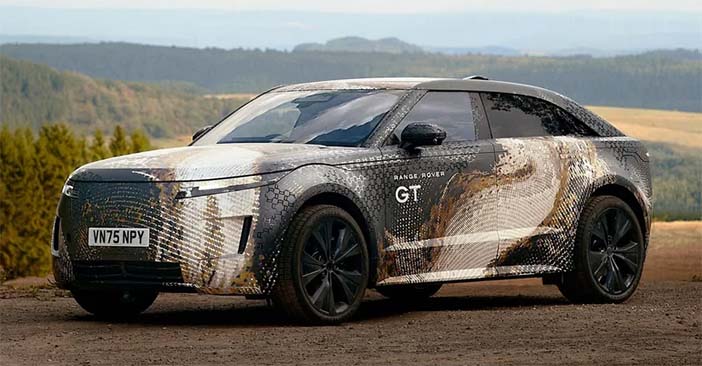
At this stage, we don’t have a clear picture of whether it will borrow its powertrain from another JLR product, or if it will have a distinct engine, electric motor, and battery setup. The GT’s interior will depart dramatically from any other Range Rover model and share elements with the Jaguar Type 01, including a dramatic two-spoke steering wheel, a floating center console, and a large central infotainment display. +++
+++ STELLANTIS has reported its financial results for the third quarter of 2026, with Net revenues increasing 1% year-over-year to €37.6 billion. The improvement was driven by higher volumes in Enlarged Europe and stable volumes and favorable FX in South America, resulting in 3% year-over-year Net revenues increases in both regions. North America Net revenues were down 3% on lower volumes as a consequence of planned production downtime, Middle East & Africa Net revenues were down 19% on lower volumes, and Asia Pacific was down 7% on lower volumes. Net loss was €0.5 billion; a 90% improvement over the prior year which was impacted by significant items. Adjusted operating income improved to €0.3 billion, representing an margin of 0.7%, with North America up 340 bps, Asia Pacific up 480 bps, Middle East & Africa up 140 bps and South America relatively flat, down 30 bps year-over-year, while Enlarged Europe was down 340 bps year-over-year. Industrial free cash flows were negative €4.0 billion; an improvement of €0.3 billion versus the third quarter of 2025, reflecting improved operating performance. In Enlarged Europe, sales increased 1% (or 6% including Leapmotor), driven primarily by models based on the Smart Car platform like the Citroën C3, Fiat Grande Panda and Opel Frontera. Sales of these cars were up 36% year-over-year thanks to growing BEV demand in France, Germany and the United Kingdom. Total BEV sales were up 65% (93% including Leapmotor). Market share in Enlarged Europe was 14.8%, down 60 bps year-over-year or 15.6% including Leapmotor, down 10 bps. Leapmotor continues to build momentum with sales growing nearly 4-fold as compared to the prior year. +++
+++ TOYOTA has been testing a rather mysterious model in Germany, suggesting a new small SUV is being readied for the European market. Wearing the body of a Corolla Cross, the test vehicle looks fairly mundane, but there’s a good chance it’s hiding something more radical underneath. That’s because this is an early development mule, a test vehicle that uses a body from a different (and often completely unrelated) model in place of prototype panels of the car it’ll eventually become. Mules like this are generally created very early in the development cycle, so it’s unusual for Toyota, as a Japanese brand, to have one testing here in Europe. This tells us it could be a primarily Euro-focused project in a similar vein to the C-HR+ and Aygo X. With all this in mind, Toyota could be testing a new B-segment cross-over or SUV to compete against electric models such as the Volkswagen ID.Cross, Hyundai Ioniq 3 and Renault 4. This would give Toyota an electric model underneath the current Urban Cruiser in its range. However, with the firm in the process of creating a new, highly flexible architecture for all its global models, there is also a good chance that what we’re looking at here might feature this radical new tech. From a global perspective, we expect to see the new architecture deployed in the all-new Corolla that’s due to be revealed in the next 12–24 months. This is a model that will support petrol, hybrid, plug-in hybrid and fully electric powertrains, and will underpin other global models such as the next Yaris and Yaris Cross. It comes as a surprise, then, to see this new architecture potentially being tested in the form of a small, electric SUV; a body style that is more important for Europe than just about anywhere else. Regardless of whatever model is being tested here, though, it confirms that Toyota’s electrification plans are now moving ahead at speed. Alongside other legacy brands, Toyota is working quickly to sharpen up its model range in order to compete with the cheaper Chinese competition which has flooded the market. +++