
+++ Since the mid-1990s, AUDI has stood for uncompromising quality in workmanship and materials like no other brand. This laid the foundation for its rise from a somewhat brittle-looking corporate mouse to a premium manufacturer on par with Mercedes and BMW in terms of image. Recently, however, this nimbus has begun to falter. Audi’s recent management chaos resulted in considerable delays in introducing vital new models. But with the backlog of new cars now cleared up: 6 new models debuted last year alone: the A6 e-Tron, the Q6 e-Tron, the A5 sedan, the A5 Avant, the Q5 and the Q5 Sportback. In addition, the important A6 sedan and A6 Avant with combustion engines will be presented in just a few weeks. Audi has certainly closed important gaps in its model portfolio. However, a closer look at the new vehicles immediately reveals the next problem. The quality of the materials used in the interiors of the A6 e-Tron, Q5 and other Audi models is, in some cases, very disappointing, and most regular Audi customers are likely to find it incomprehensible. It’s not so much what you see or touch at first glance: there, almost everything remains in the green zone. But what’s hidden underneath is something that would not have existed in the Audi line-up just a few years ago. The hard plastic on the door panels and glove box is frighteningly simple. And what will those painted parts look like in 4 or 5 years? Those responsible have at least come to a realization. At the drive event for the new Q5, Oscar da Silva Martins, Head of Product and Technology Communication at Audi, was unusually open in his self-criticism and said to journalists present when asked: “We have certainly been better in terms of quality in the past, but we will get there again”. He added that the demands of customers and the media on Audi quality had perhaps been slightly underestimated. In addition, other Audi officials held out the prospect of improvements in this area in the near future. With the facelifts of the latest models, the lesser materials should be a thing of the past. It is possible (hopefully) that they will also react to this in the upcoming new models. In the Ingolstadt-based company’s defense, it should be mentioned that in most cases, the competition with the 3-pointed star is no better. At Mercedes, too, the quality of materials has declined noticeably over the last few years. No vow to improve has yet been heard from them. BMW, on the other hand, bottomed out at the beginning of the 2010s with the then-new 3 Series (F30) and has improved since then. I hear from development circles that constantly tightening standards for emissions, crash safety, cyber security, and homologation are having an extreme impact on development costs and that this has to be compensated for elsewhere. Nevertheless, German premium manufacturers, in particular, should not cut corners when it comes to one of their major hobbyhorses: outstanding quality. I’m curious to see what happens next. +++
+++ We knew BMW ’s upcoming Neue Klasse models would be efficient, we just didn’t know how efficient. However, now the German automaker officially detailed its next-generation EV platform. The numbers are impressive. With BMW’s new Gen6 eDrive electric platform underneath, some Neue Klasse models will be able to travel up to 900 km on a single charge. That is a slight downgrade to the 1.000 km of range initially rumoured, but it’s still an impressive figure nonetheless, and better than every EV currently on the road. Even the least efficient Neue Klasse models (and possibly the sportiest) will still have a minimum of 373 miles of range. The new 800 volt architecture will use cylindrical cells as opposed to standard prismatic cells, which will be integrated directly into the high-voltage battery pack (instead of the modules). These cylindrical cells have an improved energy density of around 20 percent and will help yield a 30 percent increase in range and charging speeds. BMW says most Neue Klasse models will be able to recoup 300 km in just 10 minutes at a DC fast charging station.
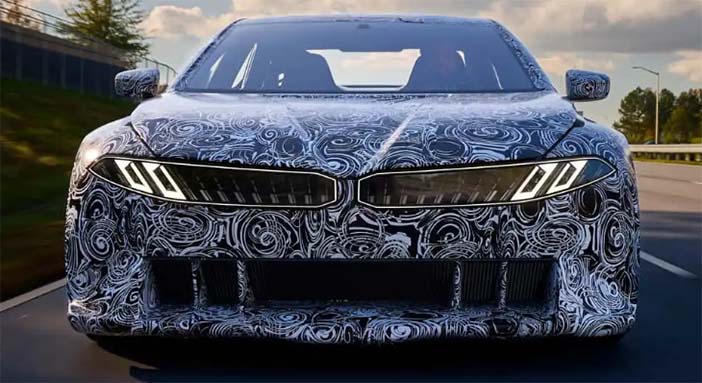
The first of these new Gen6 platforms will be introduced later this year in the iX3. The i3 with the same technology should arrive the following year. BMW plans to introduce at least 4 new EVs with the new technology by 2028. Thanks to the battery tech’s slim and lightweight construction, the Gen6 technology could even make its way to other models within the BMW portfolio, not just Neue Klasse vehicles. Think, M performance, Mini and Rolls-Royce. BMW has already confirmed electric M3 and M4 models. Those electric M models will also use BMW’s recently introduced “Heart of Joy” central computing system. This so-called superbrain seamlessly integrates braking, energy recuperation, charging and steering into one super-fast processor that is supposedly 10 times quicker than the previous setup. We’ll know more about BMW’s next-generation EVs when the iX3 debuts later this year. +++
+++ Having launched the new Omoda and Jaecoo brands in Erope, Chinese company CHERY is now turning its attention to the revival of the MPV. With models such as the Lexus LM and Zeekr 009 showing the potential for funky people carriers, Chery has offered up its own vision of what’s possible in the form of the futuristic New Journeo concept.
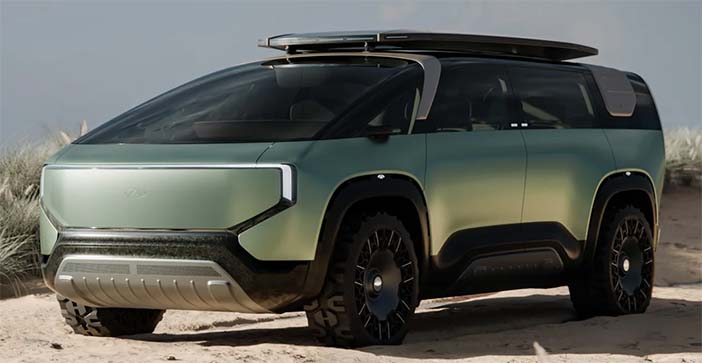
The MPV is claimed to offer a blend of pioneering technologies, sustainable materials and revolutionary design, and there is certainly no disputing that it packs a punch visually, particularly the startling, square rear which may remind some of the Honda Space-hub concept seen at CES in Las Vegas last year. Chery is billing the Journeo as an ‘Adventure Van’ that offers respectable off-road performance, thanks to beefy tyres and height-adjustable suspension, with plenty of luxury, and the ability to transform into a comfortable base camp once its destination has been reached. Inside there’s seating for 4 adults, arranged in 2 rows, with the front pair capable of swivelling 180 degrees. An island between the seating, suede floor covering, mint green colour scheme and panoramic roof ramp up the opulence. As the images released by Chery illustrate, the rear bench can be completely opened out to essentially function as somewhere to lie down and enjoy the view afforded by the 1.3 square metre rear window. A yoke steering wheel, movable instrument panel and door inserts that can be used as cushions are other interior highlights. The Journeo is powered by a hybrid set-up that pairs a 2.0-litre turbocharged petrol engine with an electric motor and a 3-speed transmission, with a promised range of 2.500 kilometres. Although the body has been optimised for aerodynamic efficiency and makes extensive use of aluminium alloy in its construction, the Journeo’s sheer size (at 5.190 mm, it’s 60mm longer than the LM) means it’s unlikely to be especially swift. And its relevance? Well, it’s been designed at the brand’s European advanced design centre in Raunheim near Frankfurt, so don’t be surprised if some elements make it on to production models sold here. Indeed, the MD of Chery Europe, Jochen Tueting, said: “The new Journeo Concept is not just a design study, but a clear indicator of Chery’s future direction. Some of the technologies and design features presented are expected to be integrated into the upcoming series models, including the dual brand Omoda and Jaecoo”. +++
+++ Sony- HONDA Mobility is serious about making an electric vehicle. It has a real product, that I’ve sat in. It has the full might of Honda’s EV hub in Marysville, Ohio behind it. There’s an AI assistant, PlayStation integration and a suite of driver-assistance systems. The Sony-Honda Afeela 1 has everything you’d expect from a modern electric sedan.
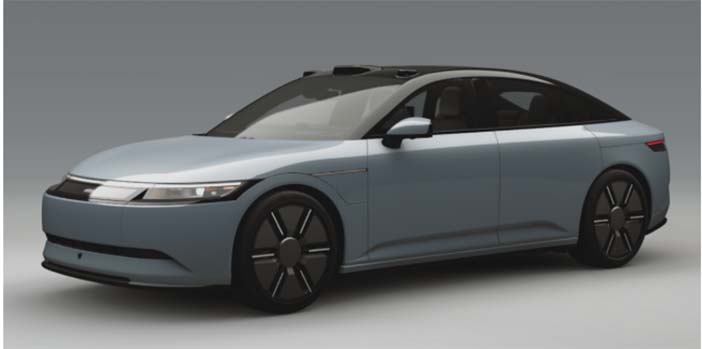
There’s just one thing missing: A reason to buy it. Try as I might, I couldn’t find one. After sitting down for a half-hour virtual interview with Sony-Honda Mobility (SHM) president and COO Izumi Kawanishi, I have more concerns than ever about this project. The luxury EV market is a gunfight these days. Instead of anteing up, Sony-Honda Mobility (SHM) is trying to explain why its pocket knife is the sharpest. “From a strictly business point of view, it would have been a good idea to go with an SUV first”, SHM President Izumi Kawanishi admits via a translator. I agree. The electric luxury full-size sedan segment is tiny in the U.S., and already has a whopping 7 contenders, of which 6 come from household-name brands. The Afeela 1 arrives late to this segment, with specs that put it near the bottom of the class. The Afeela 1 will be powered by two 241 hp electric motors, one at each axle. But since you can’t just combine peak motor outputs to get the combined figure, we expect the final number to be somewhere in the low 400 hp range. It’ll go 480 km on a charge, and fast-charge at up to 150 kW using a Tesla-style North American Charging Standard (NACS) port. Hands-on Level 2 highway-driving assistance will be available, with conditional eyes-off Level 3 autonomy reportedly coming later. But if you want an electric sedan that can go further than 480 km on a charge, offers Level 2 highway driving assistance, over 150 kW of charging power and more than 500 horsepower, take your pick. All 7competitors offer the same. Mercedes even has Level 3 conditional highway autonomy available today on the EQS Sedan (albeit in limited locations), and Lucid will sell you an electric sedan that goes over 800 km on a charge. The Afeela 1 comes from a brand no one knows, without an established distribution network, at a time when sedan sales are cratering and the original hype around EVs has subsided. It arrives long after the legacy automakers and upstarts have already come to market, with middling specs and a higher price tag than the Tesla or Lucid. With all of that working against it, surely the Afeela 1 must have some killer selling point. Some reason that this isn’t a fool’s errand. The company must have some proof that Sony and Honda aren’t spending hundreds of millions of dollars on a road to nowhere. I noted to Kawanashi that the Afeela 1’s competitors are faster, more powerful, with quicker charging, more range and, in some cases, lower prices. When you have no established foothold in the market, that sounds like a losing argument. How do you compete? Kawanishi noted that while the Afeela 1 isn’t cheap, it also includes many features as standard, which is a fair point against German manufacturers that tend to nickel and dime you on options. As for why you’d choose the Afeela, though, the argument was less compelling. “In comparison to Tesla, we did listen to some of our comments from users to get feedback. And one of the things we included in our model is access to Tesla’s charger network. So that does answer some of the criticism about charging speed”, Kawanishi said. “Specifically, one thing that we do provide compared to other rival automakers is the quality of our craftsmanship, specifically within the car”. Given that all competitors should have access to Tesla Superchargers by 2026, and that Sony’s claimed maximum charging speed is at the bottom of its class, I put no stock in that argument. The craftsmanship angle is more compelling but after sitting in the Afeela it’s hard to argue that Sony-Honda has a slam dunk there. It felt well-built, but the sparse interior and screen-heavy design felt like a minimalist redux of, well, every other EV sedan on sale. A BMW, Mercedes, Audi or Porsche feels far nicer inside, and looks more impressive too. It also has to do this without an established retail network, as the Afeela 1 won’t be sold through dealers, at least initially. Sony-Honda will only offer it in California at first, further shrinking the potential buyer pool. It won’t sell on specs, and it won’t sell on availability. So we arrive at Sony-Honda Mobility’s last line of defense: A lead in technology. Which the company may or may not have: Core to Sony-Honda’s argument seems to be a real or perceived lead in automated driver assistance systems. Representatives from the company noted that the car has 40 sensors. It’s the second thing mentioned on the pre-order site, too. I guess 40 is a lot. They tell me one is Lidar, which, as sensors go, is a very good one. Yet SHM’s claimed advantage here seems mostly based on counting sensors. Installing those sensors is easy. Creating a system that can integrate 40 sensors and make safe, confident driving decisions on the fly is much tougher. Multi-billion dollar companies exist to do only that. While no one should discount Honda’s manufacturing expertise when it comes to building the Afeela 1, it’s also no secret that building a great self-driving car is a very elusive proposition for nearly all automakers. Tesla has been promising autonomy “next year” for going on 10 years, three years longer than Sony and Honda have even been working together. China’s automakers are untested but are clearly advancing quickly in this field, and arguably more so than the rest of the world. It’s not clear whether Sony-Honda will get the benefits of Honda’s existing Level 3 experience in Japan—the line between the companies is murky—but even if it does, Honda is far from the top of its class in ADAS. Even Kawanishi can’t explain why Sony-Honda will be able to offer better ADAS than its more experienced competitors. “When it comes to the realm of [this]technology, it’s not something that any manufacturer can just jump in and succeed in”, Kawanishi admitted. He said that it’s true that companies like Tesla, or some Chinese manufacturers may be a little more advanced in terms of actual autonomous driving technology. Still, Sony’s experience gives them one benefit. One part where we have an advantage [over]other manufacturers is that when the driver is not actually handling the steering wheel” and they need something else to do”, he said. “Specifically, entertainment. That’s something where we are very, very strong”. Good news, then. The cart’s all finished. We’ll find a horse later. Perhaps Sony-Honda does not have an advantage in driver assistance, then, or at least not one that will materialize until true autonomous driving is already available in the car. The Afeela’s support for PlayStation games and the Crunchyroll streaming service are certainly nice touches when you’re stuck at a charging spot or, in theory, driving autonomously. Sure, Tesla’s Netflix app may beat Ridevu handily, but PS5 game streaming crushes any glorified mobile game you can play on your Model 3. I’m not convinced, however, that buyers who want to play Playstation 5 games and watch anime in their car and buyers who can spend $90.000 on a car are the same people. And since competitors are beating Sony-Honda to the punch on hands-free and even eyes-free driving, selling on ADAS features and stationary entertainment options alone seems unlikely. Sony’s primary tech advantage, then, can only be explained the way any hungry company in 2025 explains its own credibility: The mystical power of A.I. “Users are able to carry out conversations with the voice agent using AI to customize for the individual user”, Kawanishi said. He added that the AI technology “makes the car more interactive” and reiterated that it could customize the car as you go. It can recommend songs to you, too, he said. Though it will recommend a song to play via your streaming habits on the car’s Amazon Music or Spotify apps, both of which have their own, custom recommendation engines. But Kawanishi’s broad description is essentially what everyone else is promising with in-car AI: Personalized. Custom. Adaptive. But pressed for details, no one seems to have a more compelling use case than suggesting navigation destinations, changing the car’s interior lighting or recommending entertainment. Mercedes has already implemented ChatGPT support, which is silly, given that you can’t exactly code or write while driving. But it’s also launching a Google Gemini-powered “Conversational Navigation”, which can parse complicated routing directives like “Find me an Italian restaurant with gluten-free options and charging nearby”. That sounds quite useful. Volkswagen supports ChatGPT, too. The next generation of BMW iDrive will have similar AI-powered customization as well. Hell, even Honda’s own EV has an AI assistant that is “conversational”, and can, uh, change the lights. In the short demo I got of the Afeela 1’s in-car AI system, the operator said “Hi Afeela”, to which it replied, “Ok, I’ll call you Ophelia.” Sony’s cutting-edge AI failed to recognize its own name, then continued calling the operator “Ophelia” for the rest of the demo. Then the very kind and enthusiastic Sony-Honda employee asked the car to “make the theme more Japanese” and I was professional enough not to laugh. The Afeela 1 took it seriously, too, and set the display background to an image from the PlayStation samurai game Ghost of Tsushima. He then mentioned he was at CES, and the car asked how he was enjoying it. So if you want a car that can make the cabin more Japanese on a whim, and feign interest in your life by asking banal follow-up questions, I suppose you’ve found your match. For the rest of us, Sony-Honda has few answers. The people I talked to at Sony-Honda Mobility were smart, dedicated professionals. Kawanishi is a serious executive with a passion for this, and that came through in our conversation. The company is marketing the car. It’s listening to feedback. It wants to succeed. More importantly, neither company wants to get left behind by China’s automakers, which are absolutely smoking the rest of the world when it comes to EV technology and software integration. This feels like the plan to try and catch up. But launching a whole new car company—even one that takes advantage of Honda’s own factory—is a punishing operation. The game is too crowded and capital-intensive for also-rans to get a foothold. Latecomers best come correct, with new ideas, better execution, lower prices or, ideally, all three. The Sony-Honda Mobility Afeela 1 is not a fresh concept. It does not appear to be better executed than its existing, established, trusted competitors. It does not move the ball forward on EV design, efficiency or value. Its sole raison d’etre seems to be its claimed leads in “craftsmanship” and “technology”, but we haven’t seen compelling evidence of either here. Maybe its assistant will be a decade ahead of others, demonstrating unspeakable competency in a field where neither Sony nor Honda has had a major impact so far. Maybe Sony-Honda will solve autonomy and shock the world. But if the company cannot utterly trounce its competition in either metric, the rest of the Afeela 1 is simply not compelling enough. At least in 2025’s prototype form, the car is good enough in a segment that demands greatness, arriving at a time when the easy money has been swept from the table. +++
+++ Despite the KIA EV3 being on sale only a matter of months, it seems a hotter GT version is nearing production. We’ve known for a while that Kia is planning GT versions of all its EV-badged models. The small SUV will follow in the footsteps of the EV6 GT and EV9 GT; the latter of which was revealed at the LA Auto Show in November. The EV3 GT boasts green brake calipers (as seen on other GT models) hidden behind a set of alloy wheels. The other giveaway design detail is inside the car, where we can expect a set of GT-embossed headrests and contrasting green stitching. They will closely mirror those found on the EV9 GT; the go-faster EV6 gets integrated headrests, which come as part of body-hugging bucket seats. It’s likely that the EV3 GT will get a more aggressive body kit, with chiselled bumpers and side skirts, plus bigger 19 inch wheels. The ride height will be lowered slightly, too, but not enough to detract from the car’s all-important SUV stance. It’s not clear at this stage what powertrain the EV3 GT will use, but it’s almost certain that Kia will choose to add a motor to the rear axle for all-wheel drive. As it stands, the standard EV3 is front-wheel-drive only; an extra motor would not only bump power north of 300 hp, but improve traction for added performance. Expect the 0-100 kph sprint to take less than 6 seconds. Range will probably take a hit, though sticking with the biggest 81.4 kWh battery should allow the quickest EV3 to cover 480 km or more, with 135 kW charging enabling a 10-80 percent top-up in around half an hour. Given how early we’ve caught the EV3 GT in its development cycle, a production model is probably still at least 12 months away. A current, top-spec EV3 costs around €48k in the Netherlands, while the GT will comfortably breach €55k, possibly more. +++
+++ The president of the United States, Donald Trump, is ready to impose a 25 percent tariff on all imported cars and automakers are preparing for the worst. The tax poses a difficult challenge for foreign car companies that want access to the American market while remaining competitive on price. For MERCEDES , that means it could localize C- or E-Class production in the United States. Mercedes CEO Ola Kallenius said during the company’s capital markets day that the automaker wants to “grow in the US”. The company will build either the C-Class or E-Class at its Tuscaloosa, Alabama factory where it assembles the GLE, GLS, EQE SUV and EQS SUV. The move would help Mercedes achieve its goal of localizing 70 percent of production in 2027. The company would like the factory to produce 200.000 cars a year for the US, and the German automaker isn’t alone in re-evaluating where it builds its vehicles. Late last month, before Trump said he would levy a tariff on all imported cars, a report alleged that Porsche and Audi were considering moving some production to America. However, the story failed to provide specific details about the potential models or a timeline for when that could happen. The report did allege that Audi could build its cars at Scout’s new factory, which is under construction in South Carolina. General Motors CFO Paul Jacobson said during an investor conference this week that long-term tariffs could force the automaker to evaluate where it builds certain products. However, he added, “Those are questions that just don’t have an answer today”. Ford CEO Jim Farley said earlier this month tariffs “would have a huge impact on our industry”, adding that “billions of dollars of industry profit wiped out”. He went on to say that tariffs would mean higher prices for consumers. Trump said he could impose his 25 percent tariff as soon as April 2. The president has already issued and paused a tax on imported goods from Canada and Mexico that included cars, adding to the uncertainty. +++
+++ RENAULT is set to go all-in on its three-pronged naming strategy as vice president and head of marketing, Arnaud Belloni, told that the firm “should have revived the R5 much earlier”. According to Belloni, there are “three pillars” to the company’s current strategy. The first covers new names such as Symbioz and Australe; there are also the so-called ‘Saga’ names such as Clio and Mégane, defined as those that have seen at least three generations; and then finally the ‘Icons’, such as R4 and R5, which are just 2 of over 1.000 names that the brand has in its back pocket. Legal issues (with new names) and customer reception (to old ones) have ensured that it’s previously used names which Belloni is looking to focus on. He admitted that the process of gaining approval for car names is “tough”, especially in South America in which an 18-month approval period is standard fare. Belloni said: “We use names that Renault has made from 10, 20 years ago as they are super well protected legally and are generally chosen when we have no time because the deadline is short”. He referred to the example of the Symbioz, which shares its name with a 2017 concept car. Regardless of timescales, Belloni is candid about his support for keeping iconic nameplates within the Renault line-up. He told: “I was at Renault last century in 1989, left and joined again over 20 years ago in 1999. You want my view? Renault should have revived the R5 much earlier! Hopefully we’ve succeeded and it’s an enormous success”. In terms of what’s coming in the future, Belloni told that Renault is leaning heavily on its heritage with the launch of three new LCVs: the Estafette, Goelette and Trafic. The marketing head also hinted that there are some other “secret” names set to be revived in the future, as well; Renault recently revealed the awkwardly named ‘17 electric restomod’, potentially hinting at the 17 nameplate being brought back into production some time in the future. On new names, Belloni told that his policy is that each name should have a meaning. It name needs to describe something. It needs to be tangible. That hasn’t always been the case, as Belloni revealed that previously many new Renault names were actually created by a computer algorithm. He said: “I’ll give you an example; Kadjar means nothing; it’s a name built by a computer. It was AI generated, before the popularisation of AI”. However, one name set to disappear is the E-Tech suffix, which Belloni stated “will not be here in 10 years”. He explained that the E-Tech branding had been designed to “help customers understand the pathway to electrification”. Belloni also hinted that we will eventually see more Saga and Icon models go electric without the E-Tech suffix: “Clio started as petrol, then diesel, then hybrid and perhaps in the future, electric. There is no connection between the car’s name and the powertrain”. For now, anyway, the Clio in particular is set to remain firmly hybrid and petrol-powered; Renault Group’s head of design Laurens van den Acker told that “It wouldn’t make sense to do a full-electric Renault 5 and Clio. We want to be careful not to create vehicles that overlap each other”. +++