
+++ Earlier this month, APPLE CARPLAY ULTRA was revealed as the next major leap for in-car connectivity. Whereas normal CarPlay allows you to handle more basic connectivity and infotainment functions, CarPlay Ultra goes a lot deeper. It offers CarPlay functionality across all display screens, including the gauge cluster area. Although the idea seemed positive at first, a new report suggests that multiple major automakers are rejecting CarPlay Ultra, with no intention of introducing the functionality in new vehicles. So, why is this happening?The report indicates that Audi, Mercedes-Benz, Volvo, Polestar and Renault are among the brands that have decided against introducing CarPlay Ultra. All of these brands were part of a list of automakers Apple originally said would use the new software, back in 2022. More recently, Apple said that Genesis, Hyundai, and Kia also committed to implementing Ultra. Automakers like Renault don’t want CarPlay Ultra in its cars as the tech allows outside companies to access more vehicle data, while replacing automakers’ own controls for features like the climate control. Beyond this apparent intrusion, automakers are also keen to exploit in-car services as a revenue source, offering customers the option of paying for new features, whether long-term or temporarily; that’s despite subscription services being widely shunned by drivers. Still, by handing more control over to CarPlay Ultra, this opportunity could be disrupted for carmakers. Renault seems to feel particularly strongly about not implementing CarPlay Ultra, telling Apple: “Don’t try to invade our own systems”. Automakers like Ford and Nissan have seemingly not yet made up their minds about CarPlay Ultra integration. While CarPlay Ultra has initiated a heated debate, the use of traditional CarPlay will likely remain. Almost 100% of new cars sold in the USA have Apple CarPlay equipped, and the majority of drivers consider it and/or Android Auto to be essential features. Audi and BMW, for instance, have indicated their continued interest in traditional CarPlay, even if neither has committed to CarPlay Ultra. Apple can’t be pleased about this frosty reception to what sounded like a revolutionary in-car experience, but the tech giant remains upbeat. “We’re collaborating closely with automakers to provide the best of iPhone and the best of the car and this work takes time,” said Apple. +++
+++ Vehicles today are far larger than they were before the turn of the century. They’re heavier, too, with tons of engineering designed to protect the driver. But that has come at a cost. Bigger vehicles mean bigger BLIND SPOTS , and a new study reveals just how much less of the road we see today compared to 25 years ago. A new study, highlighted by the Insurance Institute for Highway Safety, found that forward visibility within a 10-meter radius fell by as much as 58 percent on three SUVs it tested. The researchers measured the changes in vehicle blind spots from 1997 to 2023, examining each generation of the Honda Accord, Honda CR-V, Jeep Grand Cherokee and Toyota Camry. The Honda CR-V saw a significant decline in visibility over 25 years. In 1997, drivers could see 68 percent of the area 10 meters in front of the vehicle. Drivers of the 2022 model can now only see 28 percent of that. The Accord and Camry fared much better. Visibility on the Honda declined just 5.0 percent in a quarter century, from 65 to 60. The Camry has barely lost any of its forward visibility over the years, with 57 percent of the 10-meter area visible to drivers today compared to 61 percent in 2007. According to the IIHS, both of those figures are within the margin of error. The IIHS attributed the drop in forward visibility on the CR-V to higher hood and larger mirrors, which can obscure children, pedestrians and cyclists. The deaths of people outside the vehicle have only increased. Pedestrian and bicyclist fatalities in the United States rose 37 and 42 percent, respectively, between 1997 and 2023, according to the safety institute. In 2022, vehicles killed 7,508 pedestrians, and the bigger, boxier vehicles we drive present an even greater risk to people than the smaller sedans people no longer purchase. The study was conducted by researchers from the US Department of Transportation and published in the March 2025 edition of the SAE International Journal of Transportation Safety. +++
+++ GENESIS , the luxury arm of Hyundai which will enter the Dutch market in 2026, will launch a series of hybrids designed to bolster its position in the premium new-car market. It will allow the maker to launch all-new, multi-fuel models, as well as reintroduce cars that have been killed off by increasingly stringent emissions regulations. While the maker hasn’t officially confirmed which models are in line for hybrid drive, UK brand director Jonny Miller told me the company would not retrofit petrol engines to dedicated EVs that currently sit on the E-GMP platform “of which we have one in our range”, he said. This rules out the GV60, but leaves the newly-facelifted GV70 SUV and G80 saloon as possible candidates for this new range of electrically-assisted combustion engines. It’s not clear what form the hybrid tech will take, but the brand’s positioning in the market and Miller’s comments that the implementation would have to “aid performance”, suggests a plug-in setup is likely. The UK boss refused to write anything off, however, insisting “if Genesis has the technology within the Hyundai Group” that anything is possible. Miller hinted that as a collective, Hyundai and Genesis were also working on a range-extender (REx) setup, with the tech proving particularly popular in Asian markets. Volkswagen has recently hinted at plans to bring REx models to Europe, potentially allowing ageing ICE cars (models that would otherwise be axed due to emissions legislation) a stay of execution. Miller also said the move could allow Genesis to “bring back models that were previously offered with a petrol engine”, cars such as the GV80 and possibly even the G70 and G70 Shooting Brake. It may also present the maker with an opportunity to finally sell the GV80 Coupe here; UK buyers have so far been denied the BMW X6 rival due to limited powertrain choice, and the manufacturer’s need to meet ZEV Mandate targets. We could see the first hybrid-powered Genesis variants as soon as this year, alongside the first of the firm’s hot Magma cars, based on Hyundai’s N and Kia’s flagship GT models. Miller said Magma will be the “pinnacle of the range” and “only available with that top spec, top engine”. +++
+++ HYUNDAI ’s N performance brand will not restrict itself exclusively to electric sports cars in the future and could launch hot new petrol powered models alongside the Ioniq 5 N and upcoming Ioniq 6 N. The Korean firm’s sporting division (its answer to the likes of BMW M and Volkswagen R) was launched with the i30 N in 2017. It followed that up with the smaller i20 N in 2021, before revealing the Ioniq 5 N as its first EV in 2023 and taking the two petrol hot hatchbacks off sale shortly afterwards. Following the unveiling of the Ioniq 6 N at Goodwood next month, the performance brand will have a 2-car, exclusively electric, line-up, but N division boss Joon Park has suggested more models will follow, and they won’t necessarily use pure-battery powertrains. Park said the N brand will keep step with its parent company Hyundai in maintaining a diverse powertrain offering over the coming years. “The problem that we have is that there is a perception from the media and our fans that Hyundai N is only focusing on the EV world, which is not true”, he said. “Even though we are going to introduce the Ioniq 6 N at Goodwood Festival of Speed, we are not limiting ourselves to EVs”. He stopped short of confirming any specifics of these new models, but Hyundai has already confirmed it will respond to slower-than-expected global uptake of EVs with a significantly expanded line-up of hybrid models and it will also launch its first range-extender EV in the US next year. Park suggested that no specific technology is off the table for N, saying: “We’re going forward with EVs, of course, as well as all the other proposals we could do. Because for N, imagination and courage are the words we need to remember”. The performance brand has previously experimented with hydrogen fuel cell power, revealing the striking Vision N 74 concept in 2022 as a fully functional rolling laboratory with 670 hp at the rear axle and a total range of more than 580 km supplied by its 95 kW fuel cell. That car has often been reported to have been green-lit for production over the past 3 years, but Hyundai has never officially confirmed plans to put it in showrooms, and its subsequent performance car concepts have been battery-powered, rather than FCEVs. +++
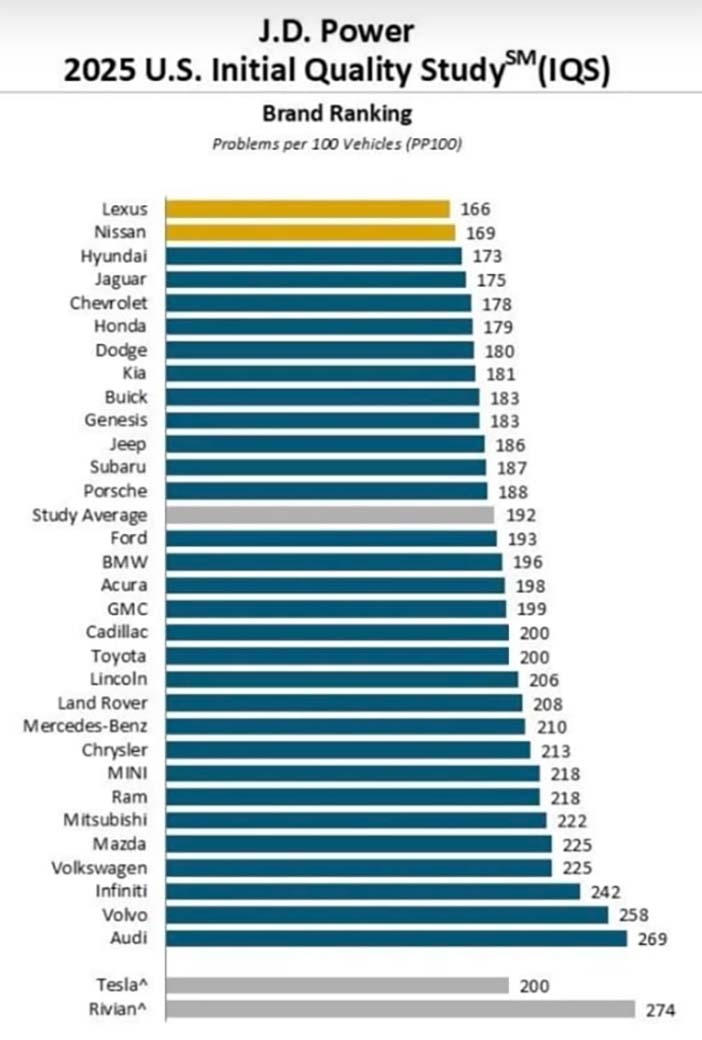
+++ J.D. Power has just released the results of its annual U.S. INITIAL QUALITY Study, which specifically assesses brands on how many problems customers experience with new cars in the first 90 days of ownership. Brands are ranked on the number of problems per 100 vehicles, with a lower score an indication of better vehicle quality. While brands like Lexus, Nissan and Hyundai continued to perform above the industry average, what jumped out to us between this year’s study and last year’s one is the dramatic decline in initial quality for Ram. Let’s take a closer look at the numbers. In last year’s Initial Quality Study, Ram led all automakers with 148 problems per 100 vehicles. It was better by a fair margin, too, since second-placed Chevrolet registered 159 problems per 100 vehicles. This result saw new Ram vehicles register fewer issues than the likes of Lexus, Honda, and Toyota. In 2025, the picture couldn’t be more different. Ram is now way below the industry average with 218 problems per 100 vehicles. It’s near the bottom of the list, in fact, with 23 other brands ranked above it. The study takes into account problems consumers have with infotainment, powertrains, driver-assistance features, controls and displays, and the driving experience. Over 92.694 purchasers and lessees of new 2025 vehicles were surveyed. +++
+++ The MERCEDES EQS arrived “10 years too early” for its radical styling to be accepted by buyers, according to its designer. The electric saloon was launched in 2021 as the flagship in a new line of Mercedes EVs but has failed to generate as many sales as its combustion-engined counterpart, the S-Class. A significant reason for this struggle has been its progressive design, such that Mercedes introduced a more traditional-looking grille as part of the car’s 2024 update, to appeal to the more conservative buyer. “I think the EQS is probably 10 years too early”, Mercedes-Benz design chief Gorden Wagener told. He suggested that the car had perhaps been doomed by comparison to the combustion-powered S-Class, despite having been developed to a different brief. Wagener said: “It’s a very, very progressive car and, of course, it was not originally designed as a chauffeur limousine. That was not the intention. Many people in this class expect a long bonnet and status from a chauffeur car, but the EQS is different. It’s a completely different car. Maybe we should have marketed it differently, more like a futuristic CLS, S-Class Coupé or something like that”. As previously reported by Autointernationaal.nl , the EQS’s struggles have prompted Mercedes to unify the model and the S-Class for their next generation: both will be replaced by a pair of ICE and EV models badged and styled as S-Classes. +++
+++ Despite being revered as a symbol of a new direction for the automaker, newly appointed NISSAN boss Ivan Espinosa didn’t exactly get a warm welcome at his first annual shareholder meeting since taking the position. He found himself at the center of a three-hour public cross-examination at the company’s headquarters in Yokohama, as frustrated investors didn’t hold back their feelings of disappointment in front of the automaker’s top brass. In Japan, annual shareholder meetings are events, as they are a semi-public opportunity for investors to trade words face-to-face with executives. However, Nissan’s was expected to be twice as lively. As Makoto Uchida’s successor, Espinosa faces a massive challenge in front of him. Previously, Nissan reported a massive loss of $4.6 billion for the 2024-2025 fiscal year, which ended in March. To make matters worse, the automaker announced during the meeting that it anticipates an additional loss of $1.38 billion for the first quarter of the 2025-2026 fiscal year, which raised numerous questions and demands for answers from shareholders. The meeting quickly turned into a forum on Nissan’s past mistakes and future direction, as every topic from failed partnerships to job cuts was on the table. Many shareholders grilled the top brass about the abrupt breakdown of Nissan’s merger talks with Honda, a potentially game-changing move that fell apart. To add a cherry on top, Uchida sat alongside Nissan brass at the meeting, which made him a target for angry shareholders who demanded answers about the lack of dividends in contrast to the departed exec’s massive pay-outs, of which Uchida declined to respond. Others expressed their anger about the board’s lack of accountability, especially after news broke that former executives, including former CEO Uchida, received large ‘gold parachute’ pay-outs despite the company’s dismal performance. In total, Uchida and four other executives who departed in the March management shuffle that installed Espinosa as new CEO, received a combined payout of $4.3 million for leaving the company. “Many demanded answers from Uchida and asked what the point of his attendance was if he was refusing to answer any questions”, said Tsuyoshi Maruki, CEO of Strategic Capital, an activist investor, told. However, he praised Espinosa, noting that he had a calm demeanor amidst the rowdiness, adding, “We’ll just have to anticipate good results from now on”. +++
+++ SKODA is planning an onslaught of hot hatchbacks and SUVs led by the recently launched Elroq RS and Enyaq RS, but soon to be bolstered by a go-faster Epiq and flagship Eviatiq. With almost half-a-million RS-badged models now on the road, Skoda is soon set to fully exploit the potential of its sporty sub-brand with a host of new variants that span all body styles from B-segment hatchbacks to 7-seaters. Speaking from the dynamic launch of the Elroq vRS recently, Bjorn Kroll, Skoda’s head of product marketing, told us: “The cars we are launching, very likely, will also have a RS version; people like it”. The deluge of hot products began with the Elroq RS and facelifted Enyaq RS, but will continue with a racier version of the Epiq small SUV, itself due in 2026. The Epiq has been designed alongside the forthcoming Volkswagen ID.2, meaning the RS model will likely share much of its battery and motor tech with the hotly anticipated ID.2 GTI. While production specifications are yet to be announced, I expect the Epiq RS to boast at least 225 hp from a single, front-mounted electric motor, ensuring the downsized performance car is good for 0-100 kph in less than 7 seconds. Skoda’s engineers will no doubt be keeping a close eye on the newly revealed Peugeot E-208 GTi, which was shown at the 24 Hours of Le Mans race earlier this month. Following close behind will be Skoda’s future flagship, thought to be called Eviatiq. We know much less about this model, but given its size and weight, any RS version is all but certain to boast dual motors producing more than 350 hp combined, plus bespoke, lowered suspension and bigger brakes. Such a model is at least 2 years away, however. While the majority of Skoda’s new RS models will be electric, we’re still holding out hope for a hot version of the firm’s range-topping Superb saloon and Estate model. When asked whether such a car was in the plan (as I’ve reported previously) Kroll’s excitable smile spoke a thousand words: “You are not the only one”, he said. “I can only tell you this”. Future RS models should turn the performance dial up a notch, too. Previous examples have often been criticised for their occasionally lukewarm demeanour, but Kroll referenced the Enyaq RS Race concept as a testbed for future technologies including sound generators and software that can mimic a combustion car’s automatic transmission. “Everything that is missing in terms of old emotions”, Kroll admitted, “what we are used to from the good old days, it’s in the Enyaq RS Race concept. You see it, and you hear it. We will use this kind of recipe. “We have to bring more emotion to it. Here you have the torque (that gives a certain amount of emotion) but the rest is what’s missing. Then you have to add, you know, the sound, and the changing of the gears… That kind of thing. “What you see on electric cars today, on RS, is just the beginning”, Kroll insisted. “We will, for sure, try to push even more: going in the direction of what we are used to from the petrol cars”. Whatever happens, RS is set to remain a Skoda staple. Previously, CEO Klaus Zellmer, told us: “RS is absolutely part of our future. If you look at what we’ve done with Enyaq, it’s a fabulous top-of-the-line vehicle; arguably the most aspirational car in our line-up, with 4-wheel drive, around 300 hp. The price is higher, but it’s still a value proposition in terms of performance for the money. “People are more proud of their cars than ever these days, and yes, they’re willing to spend more”, Zellmer added. “Which means a good profit margin, from our perspective. So I think we have to continue along the RS path as we move towards an electrified future”. +++
+++ It’s been over a year since TOYOTA announced a new family of 4-cylinder combustion engines, to be offered in both naturally aspirated and turbocharged flavours. These upcoming gas engines, planned with displacements of 1.5 liters and 2.0 liters, are said to be smaller and lighter. While efficiency is the primary goal, performance won’t be overlooked. The larger of the 2 engines is getting the Gazoo Racing treatment, already previewed in the GR Yaris M concept. The wild mid-engine hot hatch took us by surprise when it debuted as a concept at the Tokyo Auto Salon in January. Sporting the new “G20E” engine mounted above the rear axle, the pocket rocket featured an IHI turbocharger, pushing output to around 400-450 hp. However, there’s potential for much more: “With a larger turbocharger, more than 600 hp is easily possible”. That would be more than double what the “G16E-GTS” produces in the GR Yaris, GR Corolla and Lexus LBX Morizo RR with their turbocharged 1.6-liter 3-cylinder engine. However, while 600+ hp is technically achievable with a larger turbo, Toyota will likely run into a major obstacle: stricter regulations. It may and probably will be forced to detune the “G20E” to reduce CO₂ emissions. However, even an output starting with a “4”, let alone a “5”, would be impressive. In race car applications, an uncorked version could fully exploit the engine’s potential. The most powerful four-cylinder engine installed in a series-production car is Mercedes-AMG’s M139l with 477 hp available in the much-criticized C63 plug-in hybrid. An honourable mention goes to the lesser-known Mitsubishi Lancer Evolution X FQ-440 MR, which produced 440 hp. However, it was essentially a tuned car, and just 40 units were ever sold. Expect to see Toyota’s new 4-cylinder engine to power many performance cars, as the 2.0-liter is being engineered for both longitudinal and transverse installations. It can sit at the front or rear, making it a possible backbone for Gazoo Racing’s future line-up. Toyota has teased a potential return of the Celica and/or MR2, while also promising that the Supra will live on beyond the current generation. A next-gen GR86 could also be a natural fit, assuming it’s in development. Toyota told that it’s been testing the “G20E” in the GR Yaris M for some time. However, we recall sharing a video featuring a Lexus IS prototype over a year ago. The stripped-down sedan was fitted with one of the new engines and sounded highly promising, possibly featuring the most exciting member of the new four-cylinder line-up. At the time, Toyota’s engine boss Takashi Uehara hyped the “totally new engine” as being intended for “car lovers who expect a little something extra”. Interestingly, one Toyota engineer strongly suggested the “G20E” will be highly tuneable: “We left enough space between the cylinders so that the engine can be bored out considerably”. Another engineer claimed the Yaris M’s “performance is incredible”, adding that the hot hatch’s wheelbase had to be slightly extended to accommodate the engine mounted behind the driver. It’s worth noting that Toyota’s new 4-cylinder family is part of a broader initiative alongside 2 other Japanese automakers to extend the life of combustion engines. Mazda is developing rotary engines as range extenders, while Subaru continues refining its boxer engine. Hybridization is a shared objective, but the trio is also exploring carbon-neutral fuels like liquid hydrogen, biofuel and synthetic fuel. Beating a dead horse? Toyota doesn’t think so. In early 2024, Chairman Akio Toyoda said he doesn’t believe EVs will ever exceed a 30% market share. However, a recent International Energy Agency (IEA) study found that over 20% of new cars sold last year worldwide didn’t have a combustion engine. Additionally, BloombergNEF projects EV sales will increase by 25% in 2025. That report also predicts nearly two-thirds of global EV demand this year will come from China, followed by Europe at 17% and the United States at 7%. +++
+++ VOLKSWAGEN interiors reached their peak in the 2010s, when the cars had just the right blend of buttons and screens. At the turn of the decade, minimalism reared its ugly head as Wolfsburg decided it was a good idea to integrate access to most functions into the screen. The dreaded touch slider, which wasn’t even illuminated at first, certainly didn’t help either. Still, we’re willing to give VW a pass if it stays true to its pledge to bring back physical controls. The company’s Head of Technical Development told that a new dashboard design is in the works to rectify past mistakes. Kai Grünitz explained that upcoming updates for the ID.3 and ID.4 will introduce a revamped interior with a focus on traditional switchgear. The ID.2all concept previewed VW’s new approach, and while it’s a step in the right direction, we’re still craving for the layout used in the Golf Mk7. Grünitz isn’t the first high-ranking VW official to promise a return to old-school controls. Not long ago, design boss Andreas Mindt shared details about the future interior direction: “Starting with the ID.2all, every model will have physical buttons for the five most important functions: volume, heating for both sides, fan control, and the hazard lights, positioned beneath the screen. These will be standard across all future VW vehicles”. Mindt even went so far as to say VW will “never, ever make this mistake anymore. On the steering wheel, we will have physical buttons. No guessing anymore. There’s feedback, it’s real, and people love this. Honestly, it’s a car. It’s not a phone”. An insider has confirmed that a rotary knob for volume control will return in future models. That same source indirectly admitted that eliminating conventional switchgear had been a misstep: “If you develop something that works, and it has worked for years, there’s no reason to replace it”. Yet VW did just that by attempting to fix what wasn’t broken. While EVs will lead the charge, combustion-engine cars are also expected to reintroduce physical buttons. Realistically, though, future VWs probably won’t offer as many tactile controls as a previous-generation Golf. Still, there’s reason for optimism: the facelifted Golf VIII already features real buttons on the steering wheel for the GTI and R. In Europe, the R-Line trim also ditched capacitive-touch keys with the arrival of the facelifted version. Hopefully, this long-overdue return to traditional controls will also rub off onto sister models from Skoda, Audi and the rest of the VW gang. The first 3 models with the updated interior are set to land in 2026: the production-ready ID.2 and facelifted versions of the ID.3 and ID.4. +++