
+++ Accidents happen all across the globe every single day at every single hour. Decades ago, marking the “distracted by device” box wasn’t an option for police because DEVICES didn’t exist. Today, those same devices are all too often the issue, and a new study reveals something even more worrying. Police don’t realize just how often those devices might play a role. But in a potentially sticky manner, your insurance provider might. A new Insurance Institute for Highway Safety study compared police reports with anonymized data collected through safe-driving apps powered by Cambridge Mobile Telematics (CMT). The difference was enormous. Researchers linked nearly 17.000 crashes in 4 states between 2021 and 2024. Police reports identified cellphone use in less than 1 percent of them. Telematics showed phone activity within 30 seconds of impact in 7 percent of single-vehicle crashes and 8 percent of two-vehicle crashes. That’s at least 7 times what police recorded. First, let’s acknowledge what the data does and doesn’t say. This is nearly 17.000 crashes over several years, not every crash nationwide. And considering how much attention distracted driving gets today, perhaps the surprising thing is that the telematics figure is still only 7-8 percent. Then there’s what counts as “phone activity. CMT’s system can distinguish between handheld calls, hands-free calls and physical manipulation such as tapping or swiping. It can also determine whether a phone’s screen was unlocked, although that could mean anything from running navigation to watching YouTube. More importantly, researchers couldn’t determine whether phone use actually caused any particular crash. That’s where things get interesting. The drivers voluntarily enrolled in programs using CMT technology and IIHS analyzed anonymized data. CMT also says it doesn’t sell driving data. Nevertheless, consider what the underlying technology knows. It can record location and movement, detect a crash and determine whether you were handling your phone, making a call, or simply had the screen unlocked beforehand. In insurance programs, CMT says the insurer offering the program is generally the controller of that data. Its privacy policy also allows disclosure of personal information when required by law or legal process. None of that means police can simply request your driving history without the appropriate legal authority. But this study inadvertently demonstrates something beyond the shortcomings of crash reports. Telematics could give researchers a far better picture of distracted driving. It also creates an extraordinarily detailed record of what drivers were doing before something went wrong. Whether the insurance discount is worth creating that record is something drivers might want to consider before tapping “agree”. +++
+++ To become big again, FIAT had to embrace being small. That might sound counterintuitive but, after decades of struggle since its heyday as Italy’s national car brand, Fiat has finally found a path back to success by doing what it has always done best: making small cars. Think of any great Fiat and chances are it’s small. Whenever the firm has tried bigger cars lately, it simply hasn’t worked. So in recent years, revitalised as part of the Stellantis empire, it has leaned into what it does well. The 500e and Panda have been joined by the 500 Hybrid and Grande Panda, and even the Topolino quadricycle is selling well. Fiat’s mantra now is “big in small”. That revival has been led by long-time CEO Olivier François, who earlier this week announced his departure from the role after 15 years. But the firm’s Europe boss, Gaetano Thorel, has also played a key role. While François was about big ideas and marketing wizardry, Thorel’s attention to detail and sales acumen shouldn’t be underestimated. That might make him sound dry, but he speaks with passion, as evidenced by his often theatrical gestures. This distinctly Italian spirit seems a spiritual match for Fiat. Yet despite that, Thorel actually spent more than 2 decades at Ford, joining what was then Fiat Chrysler Automobiles only a decade ago and taking up his current role in 2021. Still, he’s clearly also proud of working for Fiat and his role in its recent revival. “We’ve crossed the desert and we survived”, says Thorel. “Now we want to put the Fiat brand where it deserves. It’s a journey, but I’m extremely happy with where we’re going. Fiat is the engine of Stellantis growth in Europe now. We’re consistently selling more than 100.000 units a month”. That success is being driven by the Grande Panda and Thorel notes the share of sales that are direct to consumers, rather than fleets. “If you want to measure the strength of a brand, you look at the business-to-consumer (B2C) share, because those are the customers who choose a brand”, he says. So far this year Fiat is the fifth-best-selling brand in the European B2C rankings, up from 13th last year. But there’s still room to improve. “Are we perfect? No. I have higher expectations for the 500 Hybrid than we’re delivering, but when you take a car out of the market for 2 years, it’s more difficult to reinstate it”, he says. The 500 Hybrid shows how Fiat has flexed in recent years; the plan was for this generation of the city car to go electric-only and its petrol predecessor was discontinued. But when demand for the 500e didn’t pick up as expected, Fiat reverse-engineered its platform to take a small petrol engine and a manual transmission. The 500 has been such a success story for Fiat since its revival in 2007 that its popularity has overshadowed that of the brand itself. So the Grande Panda, built on Stellantis’s cost-conscious Smart Car platform and reviving the spirit of another classic small Fiat model, is what has really driven the wider brand revival, and affirmed Fiat’s small car specialism. “We have 2 territories: small cars and light commercial vehicles”, says Thorel. “For cars, the Fiat rules are clear: we go from 2.0 to 4.5 metres in length”. The Topolino sits at one end of that territory and this year Fiat has revealed the car that will sit at the other end: the Grizzly, a new C-segment SUV that will rival the likes of the Dacia Bigster. Notably, the Grizzly wasn’t initially developed with Europe in mind, but that changed during development as Fiat evaluated the market. “Grizzly is the typical example of a project that Fiat can afford, because it’s global and designed to compete in Turkey and Latin America, but it also has a space here in Europe to offer family transportation with a different formula”, says Thorel. Despite being close to 4.5 metres in length, the Grizzly uses the same Smart Car platform as the Grande Panda and Thorel insists that “we will shock the market when we reveal the price”. The Grizzly will be followed by a fastback variant, both of which will be offered with electric and hybrid powertrains. Beyond that, the big challenge for Thorel is the successor to the Panda. It was launched way back in 2012, but it remains Italy’s best-selling vehicle (where it’s now marketed as the Pandina). bThorel talks of his commitment to the “Panda population” to develop an affordable successor to keep buyers who are unwilling to go electric happy. It’s no easy task: there has always been demand for small cars but their profit margins are tight. That’s why so many rivals have given up on them. “It comes to the social role of a brand”, he says. “We have a social responsibility in Italy, for sure, and Italy is the land of the small car”. That goes as far as pushing for any future Panda to be built in Italy, which Thorel notes “is probably not the best economic decision, but to me this goes beyond economic factors”. Those challenges in Europe are ones Fiat and Thorel face with purpose and a clear strategy: embracing the small to become big again. “When you know what you stand for, everything is much easier”, says Thorel. “We don’t feel the need to do a D-segment car or the like, because Stellantis has sister brands for that. “Fiat is not for everybody: we don’t pretend to be. But we are the brand recognised for small cars, and that’s enough”. Grizzly bears famously are not cute and huggable: they’re carnivorous and maul things, so you probably wouldn’t want to annoy a hungry one. It is, as Fiat Europe boss Gaetano Thorel acknowledges, “technically an aggressive animal”. That has given Fiat a bit of a self-inflicted challenge: to make an SUV named after a pretty fearsome animal fit into a family of small, lovable cars. So why the name at all? “It’s the biggest member of the Panda family”, explains Thorel. “We’ve got the Panda and the Grande Panda. What’s the biggest bear above a panda? The grizzly. “Now the challenge is to make the Grizzly a Fiat animal and sympathetic and smiling. But, trust me, you will see how we do that with our advertising”. +++
+++ HYUNDAI is planning a hot range-topping variant of the next-generation Tucson, using hybrid assistance to give the otherwise family-friendly SUV some added bite. As one of the key new models in the brand’s ambitious plan to expand its N sub-brand, the Tucson N will feature a raft of new technologies to attract customers currently driving everything from premium mid-size SUVs to hot hatchbacks. At the heart of the product plan will be a new hybrid powertrain that will add significant performance to the Tucson without destroying its fuel economy or emissions figures. This will help in the ongoing drive to cut emissions in Europe, but also in markets such as the United States and Korea, where keeping emissions low is less of a priority, but rising fuel prices are increasing the appeal of hybridisation. Joon Park, Hyundai’s vice president of the N Management Group, previously told about its plan to expand beyond just BEVs and the existing pure ICE powertrains, saying: “We’re not limiting ourselves to EVs. We will go further with the ICE-based cars as well; this is not the end of our journey. I cannot tell you exactly, but lighter, more agile, nimble, and exciting. These are the key elements that we are heading to”. The form of this new powertrain is also coming into focus, with Hyundai already revealing its clever new system that uses electric motors predominantly to drive the wheels. However, for its application in these new N models, I suspect the e-motors and batteries will be configured to ‘boost’ the turbocharged petrol engine, particularly in sportier ‘N’ modes. Park said: “One thing I can tell you is that if we have hybrid systems, the characteristics of our hybrid systems will be different. “We have 2 different strategies for our hybrid systems: one for efficiency and one for neutral efficiency. If we have a hybrid system in our N cars, the strategy will be different; to have more power intensely”. It’s difficult to ascertain a potential output for the Tucson N, but I suspect it could be somewhere close to 350 hp, with power sent to all 4 wheels. Adaptive suspension and large wheels, tyres and brakes will also help keep body control in check, with Hyundai ensuring the SUV does not become too uncomfortable or compromised for everyday driving. To date, the N division has showcased its creativity with technologies such as aggressive exhaust notes or augmented engine noises in its BEV models. We expect more innovations in the Tucson N, although what specifically Hyundai has in store remains a mystery. The Tucson is just the starting point for N’s transition to hybrid tech, too, with Park hinting that these downsized powertrains make good sense in a variety of smaller models. The could tee up faster versions of the next generation Kona, plus future versions of the i20 and Korean-market Avante, which will be sold in Europe as an i30 saloon from 2027. +++
+++ JAGUAR LAND ROVER is to cut 4.000 jobs as it reels from the impact of Donald Trump’s tariffs and a major cyber attack. The British car manufacturer will carry out the redundancies over the next 2 years in an effort to save around 2 billion euro. It marks a major escalation of JLR’s cost-cutting efforts after the company said in July it would axe around 300 roles. The carmaker, which is owned by India’s Tata Motors, employs more than 30.000 people in the United Kingdom. JLR is under pressure to shore up its finances amid rising costs and a slump in sales. Revenues fell by almost 10 percent in the first quarter, while pre-tax profits dropped by two thirds to 125 million euro. The manufacturer, whose largest market is North America, has been rocked by Mr Trump’s 10 percent tariff on vehicle imports. It is also still reeling from a crippling cyber attack that shut down production for more than a month and is estimated to have cost the company 2,2 billion euro. Supply chain disruption and tough competition from cut-price Chinese rivals have taken a further toll. The cuts represent a major setback to Andy Burnham’s pledge to re-industrialise Britain. JLR’s global headquarters are in Coventry, while it operates major factories in manufacturing sites in Solihull, Wolverhampton and Merseyside. Jonathan Reynolds, the Business Secretary, said he would meet with JLR’s chief executive this week to discuss job cuts. He told the BBC that while he wanted to mitigate job losses, the business environment for carmakers was “challenging” in the UK and across Europe. “If this is about making sure over time that workforce is right to make the business as competitive as possible, that’s the conversation we need to have”, Mr Reynolds said. He ruled out a bailout to support JLR. Asked if there could be financial support to protect jobs, he said: “Not if it’s to bail people out. If it’s about long-term investment in the future, we do invest alongside industry on that”. Sharon Graham, the general secretary of the Unite union, said there had been a “perfect storm” hanging over the UK’s automotive industry. She added: “Death by a thousand cuts has been going on under the nose of successive governments”. The union boss said she would meet Mr Reynolds and JLR chief executive PB Balaji next week. A spokesman for the Government said that “significant action” had been taken to support carmakers, including lowering electricity bills and creating subsidies for the manufacturing and sale of zero-emission vehicles. It comes after JLR last month delayed the rollout of its all-electric Defender model, which had been expected after a full redesign of the standard model. The redesign has been paused for 2 years, meaning the brand’s best-selling off-roader will not go all-electric until the 2030s. JLR is not the only major car manufacturer rolling out sweeping cuts amid a slowdown in sales and growing competition from China. A JLR spokesman said: “As we deliver the next phase of our strategy we need to adapt to evolving global market conditions while targeting approximately 2 billion of savings over the next 2 years and reduce break-evens to 300.000 vehicles. To achieve this, we must further simplify our organisation, improve efficiency and build greater resilience. “Today, we informed our colleagues and trade union partners that JLR is opening a voluntary redundancy programme offering salaried and management team members the opportunity to leave the business. We will share further information with our colleagues first”. +++
+++ If Ferrari is the benchmark for supercars, then ROLLS-ROYCE is the ultimate symbol of luxury automobiles, and that didn’t happen by accident. It’s the result of years of careful brand-building and, perhaps more importantly, remarkable consistency. Even as technology has changed and competition from China has grown, Rolls-Royce has managed to maintain its position at the very top of the market. BMW’s acquisition of Rolls-Royce in 2003 only strengthened that position, giving the British marque access to the resources of one of the world’s largest automakers. Bentley took a different path. 5 years earlier, in 1998, Volkswagen Group acquired Rolls-Royce’s former partner, giving Bentley the resources to become a truly global luxury automaker in its own right. More than 2 decades later, the 2 brands still share plenty of history. But they’ve ended up in very different places. One of the biggest factors shaping the future of the 2 brands is that Rolls-Royce and Bentley are no longer true rivals.
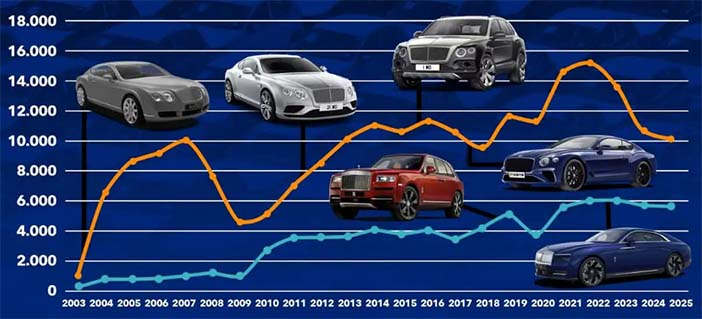
While both are luxury automakers and some of their models compete in the same broad segments, Rolls-Royce has increasingly positioned itself a step above Bentley in terms of exclusivity and price. The Cullinan and Phantom are perhaps the clearest examples. That positioning also helps explain the difference in sales volumes. In 2003, Bentley sold 1.017 cars worldwide, about 3.4 times as many as Rolls-Royce. At the time, the ultra-luxury market was still a relatively small niche, particularly in Europe, and was dominated by large sedans. Both brands, however, began growing rapidly as they turned more of their attention toward the US market. By 2007, both companies had set new sales records. Rolls-Royce surpassed 1.000 deliveries for the first time, while Bentley broke the 10.000-unit mark. The growth continued through the end of the decade. In 2010, Rolls-Royce sold nearly 9 times as many cars worldwide as it had in 2003. Bentley, meanwhile, had grown its sales by roughly 5 times over the same period. The difference in scale remained significant, though. In 2011, Bentley sold 7.003 cars worldwide, roughly twice the 3.538 Rolls-Royces delivered that year. That was hardly a surprise. Bentley’s lineup was broader and generally more accessible, while Rolls-Royce remained focused on the very top end of the luxury market. The next major shift came as both brands expanded beyond traditional luxury sedans. Bentley had an early advantage with the Continental family, while Rolls-Royce brought the Ghost into its lineup as a somewhat more accessible alternative to the Phantom. Those models helped both brands attract new customers without abandoning their luxury positioning. Then came the SUV boom. Bentley launched the Bentayga in 2015, while Rolls-Royce followed with the Cullinan in 2018. Both proved to be hugely important, but the Cullinan had an especially dramatic impact on Rolls-Royce’s business. By 2019, just before the pandemic disrupted the global auto industry, Bentley sold 2.3 cars for every Rolls-Royce. Both brands also ended the year with record sales. But the gap would continue to close. Last year, the ratio fell to an all-time low of just 1.8 Bentleys for every Rolls-Royce. That’s a remarkable change from where the two brands stood in 2003. Bentley still sells more cars overall, but Rolls-Royce has grown considerably faster over the past decade. The Cullinan deserves much of the credit. Luxury buyers have embraced high-end SUVs, and Rolls-Royce was able to turn that demand into one of the most successful models in its history. The Spectre has also played a role. As Rolls-Royce’s first fully electric model, it gives the brand a way to move into the EV era without compromising its ultra-luxury positioning. Bentley, meanwhile, faces a challenge that has little to do with the strength of its products. The brand is part of Volkswagen Group, which means it has to navigate the same financial pressures, electrification costs, regulatory changes, and broader market challenges affecting its parent company. That doesn’t necessarily mean Bentley is in trouble. But its position within the Volkswagen empire gives it a very different set of priorities from Rolls-Royce, which operates under BMW. And that may be the biggest reason the two brands have continued to move apart despite sharing so much history. Bentley has become a successful global luxury automaker, selling significantly more cars than Rolls-Royce. But Rolls-Royce has gone even further upmarket, turning scarcity and exclusivity into the core of its business. For now, that strategy appears to be working. The fact that Rolls-Royce is steadily closing the sales gap with Bentley despite selling substantially more expensive cars may be the clearest indication yet that the 2 British marques are no longer playing quite the same game. +++
+++ I’m wary of self-proclaimed automotive ‘experts’, especially those who’ve insisted for years that motor shows, SMALL CARS , petrol and diesel are all dead. Such events, products and fuels are very much alive. And will be for years, if not decades. Last week’s British Motor Show (BMS) helped prove the point, as if proof is needed, that car exhibitions, preferably those with accompanying side shows and test drive facilities for real-world buyers, can still be a huge hit with forward-thinking vehicle makers, hard-working dealers and the great motoring public. Scores of thousands of car drivers (plus their adult and child passengers) rocked up at BMS and seemed to love it. I know because I spent most of that week living close to the venue in Farnborough, Hants, where I played a modest part in its build-up, prior to attending all 3 public days as an exhibitor, observer and occasional speaker. It was a long, indulgent weekend for diesel diehards, EVangelists, hybrid and hydrogen heroes, LPG lovers, petrolheads and solar supporters. We all unashamedly celebrated cars, car culture, some of the world’s bravest drivers, live music, you name it. Untold millions of pounds’ worth of ancient and modern vehicles were observed, warmly received and appreciated. Among them were a few all-new cars that I persuaded young, hungry manufacturers such as BYD, Chery and Aion to deliver to my little stand at the show. Not sure what impressed me most: the almost premium feel and look of the Chinese cars, or the fact that senior people from each of the 3 firms bothered to turn up and get stuck in. But it was a trio of modest sub-4-metre cars that attracted most of the attention on the stand, and possibly in the entire Hall 1 ‘showroom’ where all the factory-fresh cars were parked up. Most photographed by far of the fleet I ordered in was the Fiat Topolino quadricycle with a glorious paint job (Verde Vita) and a ridiculously reasonable price; not much more than an all-new bicycle launched a few days ago. Honest. Teenagers and young adults swarmed around the funky, little but loveable, €22.000 euro Honda Super-N. If there’s any justice in the automotive world, this boxy ‘city car’ that also happens to happily and legally trundle along at 110 kph on motorways will provide my favourite Japanese manufacturer with the sales boost it needs. Surprisingly, its slightly larger, similarly priced arch-rival, the Renault Twingo, attracted more of a 30-something to middle/old-age crowd. Had there been a Renault sales exec nearby, I’m sure that they could have taken firm orders. Motor shows, petrol and diesel, small cars finished? Nothing could be further from the truth. +++
++ VOLKSWAGEN hasn’t exactly been riding high lately, and everyone knows it. The German giant has been knee-deep in one of its biggest shakeups in years: think factory shutdowns in Germany, slashing costs left and right, and even rumours swirling about the fate of the Seat brand. VW keeps saying it needs to slim down and toughen up, especially with EV sales cooling off in some places and Chinese rivals breathing down its neck. Now, that whole turnaround effort is crossing the Atlantic. Alongside a leadership shuffle from Brand Group Core, Volkswagen just dropped a new playbook for the US, Canada, and Mexico. The big idea? Start making decisions that actually make sense for North American buyers. But forget the executive musical chairs for a second. The real headline is that Volkswagen is finally talking about bringing pickup trucks back to North America. It was a rumor before, but now it’s official. That’s a big deal for a brand that hasn’t had a pickup in the US since the Rabbit (Golf) Pickup vanished ages ago. Tucked away in Volkswagen’s announcement is the line that will have truck fans perking up. “Going forward, Volkswagen in North America will focus on those segments that show the strongest market demand and best meet the needs of customers and dealers in the region. Successful models will be further strengthened, the portfolio expanded and Volkswagen’s presence in the growing HEV (Hybrid Electric Vehicle) segment accelerated. As part of this approach, the brand will explore opportunities in the highly popular body-on-frame B-segment, including robust SUVs and pick-up trucks, as a potential component of Volkswagen’s future product portfolio”, the company said in a statement. The pickup part makes sense. The “body-on-frame B-segment” part is where things get weird. In North America, B-segment typically refers to subcompact vehicles. That’s not exactly where body-on-frame trucks live. If Volkswagen literally means a B-segment pickup, it would be targeting something closer in size to the Ford Maverick, which currently has the small truck market almost entirely to itself. That would be a bold move, especially since compact pickups are suddenly hot with folks who want a truck but don’t need a rolling toolbox. Still, odds are this is just a translation hiccup. Segment names get weird across borders, and Volkswagen probably meant the much bigger midsize truck class instead. That space is packed, with heavy hitters like the Toyota Tacoma, Chevrolet Colorado, GMC Canyon, Nissan Frontier, Jeep Gladiator and Ford Ranger all fighting for attention. If Volkswagen wants to move serious metal here, ‘small’ is probably the smarter bet, especially since new players such as Hyundai and Mitsubishi have also announced their intention to enter. For now, Volkswagen’s keeping quiet about what kind of truck it’s cooking up, or when we might actually see it. But Pickups aren’t the only thing on Volkswagen’s mind. The brand also says it’s hitting the gas on hybrid electric vehicles in North America, making the booming HEV segment a top priority. That lines up with what Volkswagen has been signaling over the past several months. The company has already said hybrids are finally coming to some of its biggest SUVs sold in the US, acknowledging that many American buyers still want the efficiency benefits of electrification without making the jump to a fully electric vehicle. Volkswagen boss Thomas Schäfer says they’re not after quick wins here. The plan is to play the long game and focus on cars and trucks that people and dealers actually want. So, bigger SUVs, hybrids and now (officially) pickup trucks are all in play. The only thing left to guess is what kind of truck Volkswagen will actually roll out, and whether it’ll take on the Maverick, the Tacoma or land somewhere in the middle. +++