
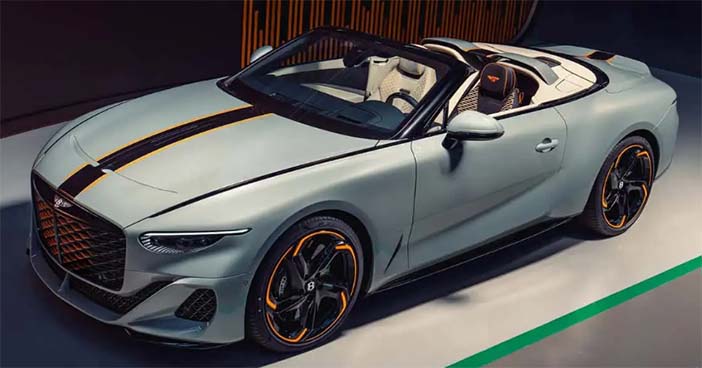
+++ BENTLEY ’s iconic W12 engine is heading to the big junkyard in the sky after more than 20 years in production and over 100.000 12-cylinder vehicles produced. But it’s not going out on a whimper. During Monterey Car Week, Bentley will introduce its new Batur Convertible by Mulliner. The new Batur is an even more stylish take on the automaker’s already pretty and powerful droptop. Packing Bentley’s ubiquitous twin-turbocharged 6.0-liter W12 engine, the Batur Convertible by Mulliner makes a whopping 740 hp; the same amount as the standard convertible and coupe. In this case, though, those 740 horses pair with a one-of-one design created in collaboration with one of Bentley’s clients. The exterior of this Batur Convertible wears an Opalite paint job with Beluga and Mandarin accents, including a central racing stripe with two smaller accent lines on either side. The interior features a ‘one plus one’ design with Beluga black leather and Alcantara on the driver’s side, and Linen white with Alcantara on the passenger side. A rear luggage department features similar Beluga black and Mandarin orange accents, complete with a 2-piece luggage set designed specifically for this vehicle. Just like the seats, even the luggage wears Beluga black and Linen white: 1 for the driver, 1 for the passenger. The Batur Convertible by Mulliner debuts next week in California during Monterey Car Week. Naturally, Bentley doesn’t have a price tag for its newest Batur, which it dubs a “true one-off”. That said, this Batur Convertible is likely one of the last Bentleys ever produced with the automaker’s iconic 12-cylinder engine. For that alone, I’d say it’s pretty priceless. +++
+++ BMW ’s Neue Klasse era officially kicks off next month with the debut of the iX3. Soon, every BMW will look like and have similar features to the automaker’s bold new electric SUV, including performance cars. Thankfully, though, most of them should retain their iconic names. BMW won’t add the letter “i” to the front of its new performance models. Instead, the performance variant of the iX3, for example, will continue to be called the X3 M. M Performance models, though, will supposedly retain the letter “i” at the front of their nameplates; iX3 M60 xDrive. Production of those performance models won’t kick off until sometime in 2027. The standard iX3, meanwhile, debuts next month in Munich. This coincides with reports from 2023, in which BMW M boss Frank van Meel said that the company would never use “i” and “M” letters together on the same vehicle. “We would never use an i on an M, even though it would be electric”, Van Meel told. BMW did trademark the name “iM3” in 2023, but that nameplate will likely never see the light of day. Electric M cars aren’t the only performance vehicles on the horizon. BMW recently confirmed that the inline-6 and V8 engines in its M cars aren’t going anywhere. The company recently updated those engines to meet stricter Euro 7 regulations, and it promises to continue using them in M performance cars in the future. +++
+++ As with many other car manufacturers, HONDA has scaled back its EV ambitions. Last year, it allocated 10 trillion yen ($68 billion) for electrification, only to cut that by 30 percent a few months ago. The company had also aimed for purely electric cars to account for 30 percent of annual sales by the end of the decade, but that target is no longer in place. In a new statement, Honda makes it clear it doesn’t see EVs as the only route to carbon neutrality. To be clear, Honda still stands by its goal to “achieve carbon neutrality for all products and corporate activities” by 2050. But as the old saying goes, it believes there’s more than one way to skin a cat. The head of the company’s Australian arm suggested EVs aren’t the only solution to reducing carbon emissions. Recently appointed Honda Australia CEO Jay Joseph explained: “A point I want to make with that is that EVs are not the goal. Battery-electric vehicles are a pathway to achieving carbon neutral; not necessarily the only pathway. EVs will continue to improve (we’re working on solid-state batteries) but our goal is carbon neutral, not battery-electric vehicles. That’s just the obvious pathway in the near to mid-term, but we’ll develop other technologies that help achieve that as well. We would like that to include electrified fuel cell vehicles when the infrastructure is there”. While the Clarity has come and gone, Honda hasn’t abandoned hydrogen. The CR-V e:FCEV is a fuel cell vehicle with a twist, doubling as a plug-in hybrid thanks to a rechargeable 17.7 kWh battery pack offering 45 km of electric range. Toyota and Hyundai also remain committed to hydrogen, and even BMW plans to launch a fuel cell vehicle in 2028 with help from Toyota. By contrast, Stellantis recently abandoned all hydrogen efforts, calling it a “niche segment”. Fellow Japanese brand Toyota believes there’s room for even more powertrain diversity. The world’s largest automaker is convinced hydrogen-burning combustion engines could serve as an alternative to going all-in on battery EVs. Together with domestic partners Mazda and Subaru, it’s developing carbon-neutral engines capable of running on liquid hydrogen, biofuel and synthetic fuel. That said, the elephant in the room remains infrastructure, or the lack thereof. Any type of hydrogen-powered vehicle would be difficult to own given how underdeveloped the fuelling network is. According to H2stations.org, only about 1,160 refuelling stations were operational globally at the end of last year. Infrastructure for synthetic fuels is practically non-existent, with only a few exceptions, such as Porsche’s pilot plant in Chile. Some would argue automakers are beating a dead horse with hydrogen and synthetic fuels, but others remain sceptical that battery EVs are the ultimate answer. One of the most controversial claims comes from Toyota chairman Akio Toyoda. In early 2024, he predicted that traditional EVs would never exceed a 30 percent market share. But all signs suggest he may be proven wrong in the not-too-distant future, as battery EVs continue to gain traction. The International Energy Agency (IEA) reports that conventional electric cars made up over 20 percent of global sales in 2024 and are on track to surpass 25 percent this year. While China largely drives demand, Europe is also making substantial gains. According to the European Automobile Manufacturers’ Association, EVs accounted for 17.5 percent of new car sales in the first half of 2025, up from 13.9 percent in the same period last year. +++
+++ JAGUAR LAND ROVER saw its profits knocked back by half in the 3 months ending in June as US tariffs, warranty costs and a weak dollar took their toll. The Tata Motors-owned company posted profits before tax of £351 million for the first quarter in its financial year, which runs from April to March. Its profit margin fell to 4.0%, down more than half from 8.9% during the same quarter a year before. +++
+++ MERCEDES is planning the “biggest product launch program in history”, with 18 cars set to debut next year and another 14 models in 2027. Most will be next-generation vehicles or facelifts of existing models, but a few all-new additions are also in the pipeline. All told, the Stuttgart-based luxury automaker “runs about 40 body variants”, according to CEO Ola Källenius. Despite the already complex line-up, the head of the company isn’t ruling out even more models. Källenius rhetorically asked: “Could there be more niches still? I’m not going to exclude that. If we believe there is a market need, we will go for it. At Mercedes we eat, sleep and drink cars”. However, don’t expect the company to take wild risks. The days when automakers could afford to experiment with unconventional, potentially slow-selling models are over: “We also run a business. There needs to be a business case”. The CEO’s comments about a possible lineup expansion might seem surprising, especially since Mercedes has been trimming its portfolio. The SLC, CLS and AMG GT Convertible are already gone, while the T-Class/Citan is being phased out. Additionally, the C-Class Coupe/Convertible and E-Class Coupe/Convertible have been consolidated into the CLE line-up. The B-Class minivan is also expected to bow out sometime next year. Mercedes had initially planned to discontinue the A-Class by 2026, but it’s sticking around. Mercedes’ head of production, Jörg Burzer, told the “compact sedan continues to be very popular with our customers, especially in Europe”. The 5-door hatchback has also earned a reprieve, meaning the existing A-Class will continue to be sold alongside the new CLA sedan and wagon, both of which will be offered with gasoline and electric drivetrains. Last year, Handelsblatt reported that Mercedes could discontinue the GLC Coupe and GLE Coupe. A more radical claim came from Automobilwoche in 2022, which suggested the brand’s stationwagons would be phased out entirely by the end of the decade. But that seems unlikely, considering even the entry-level CLA has just received a wagon version for the third time. Further simplification of the line-up will come by unifying EQ models with their internal combustion counterparts. Mercedes has already confirmed the EQS, described by design boss Gorden Wagener as a car that came out “10 years too early”, will be dropped. It will make way for a next-generation S-Class that will be offered in both ICE and EV versions. Confirmed additions to the line-up include electric versions of the C-Class and GLC, as well as an electric AMG sedan and SUV duo. Looking further ahead, Mercedes is working on a downsized G-Class, nicknamed the “Little G”, which is expected to be available with both gasoline and electric powertrains. Speaking of multi-drivetrain strategies, Mercedes plans to continue this approach for the foreseeable future. Källenius recently said the company has made a “course correction” to extend the life of combustion engines into the 2030s and possibly beyond, given slower-than-expected EV adoption: “Electrified high-tech combustion engines will run longer than we originally expected. In the current situation, I think the most rational approach is for an established manufacturer to do both and not neglect either technology”. +++
+++ A mechanic is offering advice to CVT transmission owners that will keep their NISSAN cars running as long as possible. He posted a video that includes a tip for owners of Nissan’s continuously variable transmission, better known as CVT: “This is a 2016 Nissan X-Trail transmission that we sold”, the person behind the camera says. “And we like to make fun of these Nissan transmissions because they all blow up because of the poor CVT. But Juan over here wants to give all of you CVT owners some advice”. Juan explains that Nissan CVT transmissions include two filters. “One in the pan itself, in the bottom”, Juan says. “And this small one is an external filter for the transmission. Now, you’re supposed to replace your transmission fluid every 50.000-60.000 km, in order for this transmission to last you over 300.000 km”. According to Juan, a lot of people overlook replacing the second external filter to the detriment of their vehicle. “If you change your oil on your CVT every 50.000-60.000 km, change this filter, and the pan filter, your transmission will last pretty much the life of the vehicle”, Juan says. The CVT is notorious in the automotive community. Unlike a traditional automatic transmission, the CVT has no gears, and instead uses a 2-pulley system to send energy from the engine to the vehicle’s wheels. CVTs are cheaper to manufacture than traditional transmissions and are also more fuel efficient. Of course, these benefits come with drawbacks, in particular, the sound of the engine and the feel of changing gears. That can be a dealbreaker for more serious automotive enthusiasts and even casual drivers alike. And that’s not even mentioning the class action lawsuit Nissan settled this summer with owners of 2015-2018 Murano and 2016-2018 Maxima. The owners claimed that the CVT transmissions in those model years were defective. Nissan agreed to extend warranties and reimburse owners for prior repairs. Some owners might qualify for a voucher. +++
+++ STELLANTIS is recalling cars as part of a Europe-wide move across 7 of its major brands to correct a problem where loosened nuts on a fuel pipe could cause an engine fire. A total of 28 models built between 2023-2025 fitted with the 1.2-litre turbo petrol engine are affected across Alfa Romeo, Citroen, DS, Fiat, Jeep, Peugeot and Opel/Vauxhall, as well as the Lancia brand in mainland Europe. In France there have been 11 reported cases of cars catching fire in France prompting the recall, and Stellantis is already in the process of contacting owners. The firm is urging drivers to book their cars in for remedial work, which should take around half an hour and will be free of charge, as soon as possible, and warned owners to be aware of any smell of fuel or warning lights popping up on the dashboard as tell-tale signs of an imminent problem. “Our standard recall process is applied and all owners are being promptly informed of this matter”, said a statement from Stellantis. “We urge our customers to immediately make an appointment at their dealer to solve this issue. Vehicles equipped with the 1.2-turbo petrol engine may face a fuel leakage at the high-pressure pipe between the high-pressure pump and the rail due to loosened nuts”, continued the statement. “This can potentially lead to higher fuel consumption and, in a worst-case scenario, to occurrences of fire in the engine”. The recall is the second for Stellantis this summer, after 120.000 Citroën owners were issued with a more serious notice to stop driving their C3 and DS3 models after a potentially lethal fault with the airbag was discovered in the wake of a fatal accident in France. +++