
+++ Let’s say that 2025 has already been your year. Earnings are ridiculous and you’re thinking of getting a shiny new supercar to make sure everyone knows it. Be sure to skip sending an email to your local BUGATTI representative, though, because it’s a waste of time. The brand is fully sold out until 2029. That’s right, there will be a new president in the US before people who put in a Bugatti order tomorrow will actually get it. No, the brand isn’t struggling to keep the doors open and the production line flowing; instead, it’s quite the opposite. Bugatti will only make 250 units of the new V16 Tourbillon. It could add a lot of production capacity and still sell out. Director of Design Frank Heyl says that it’ll be busy building allocated cars until 2029. “So, building 250 Tourbillons. Now delivering the finalist trials. The final Bolide is going to keep us busy with our capacities until 2029 and sold out until 2029. If you have this financial stability as a business owner, it works out very solid. Then you know, you can plan ahead. It’s all set”, he noted. In fact, it has so many interested parties that if 59 people dropped out, it would still be sold out. “I want to make Bugatti into the most successful, most profitable car company in the world”, said Mate Rimac. No doubt, having that many prospective customers, and extremely well-off at that, even at these uncertain times, is proof, if any was needed, that the historic French brand is shining brighter than ever. That’s in stark contrast to the majority of other automakers who are trying to figure out tariffs, product lineups, and just how electrified their future should be. It’s noteworthy that Bugatti is just playing it as old-school as one could in a world full of underwhelming low-production hybrid supercars and wildly impressive everyday supercars that cost way less. +++
+++ The big news from FORD the past week was the announcement of the $30k electric pickup arriving in 2027, an EV that’s just the first of many coming in the next 5 years. But its engineers say the really big story is how they ripped up the rulebook on building EVs to come up with a production process that will leave rivals, and especially newcomers in the industry, floundering in its wake. “I don’t think many legacy car manufacturers could pull off a project like this”, said Doug Field, Ford’s Chief EV, Digital and Design Officer. “And I don’t believe new electric vehicle startups will be able to keep up with our Ford engineers and manufacturing teams making this a reality”. Ford’s Universal Electric Vehicle Platform was conceived by a small skunkworks team headed by former Tesla engineer Alan Clarke, who worked in near secrecy in California with a bunch of brains recruited from inside and outside of the automaker’s ranks. The architecture the team created broke from Ford tradition in key ways. One is the use of unicasting, where large one-piece aluminium castings replace multiple welded panels on a current Ford vehicle. This technology (also being used or developed by other brands, including Tesla and Toyota) allowed the team to eliminate three-quarters of the parts, two-thirds of the welds, and half of the fasteners versus a traditional pickup. Another big leap that saves both time and weight is the removal of almost 1.6 km of wiring versus an older of Blue Oval’s EV. But equally important is how these new-generation EVs will be produced inside Ford plants. Henry Ford is credited with revolutionizing the car industry by introducing a moving production line that ramped up efficiency and drove down cost. Now, though, the company is moving away from the idea of a single production line to what it calls a production tree. Instead of vehicles moving down one track, they’ll start off on three parallel lines, one building the front, one the rear and the other the structural battery core. When each sub-section is complete the three lines converge and the EV is finished off, having spent far less time in build than a conventional car. Ford says these combined efficiencies (the platform and the production process) will help it compete with Chinese automakers. “The Model T was affordable not because it was a thrifted version of other cars, but because brilliant minds took fundamentally new approaches to old problems”, said Doug Field. “That’s exactly what we set out to do in creating the Ford Universal Electric Vehicle Platform”. Ford says the 2027 mid-size electric truck will be as quick as an Ecoboost Mustang and as roomy as a Toyota RAV4. It also promised a 5-year cost of ownership that will be “lower than buying a 3-year-old Tesla Model Y”. Images shown at the pickup’s announcement revealed the same platform could be used to create a diverse range of other vehicles from a 2-door panel van to a 3-row SUV. +++
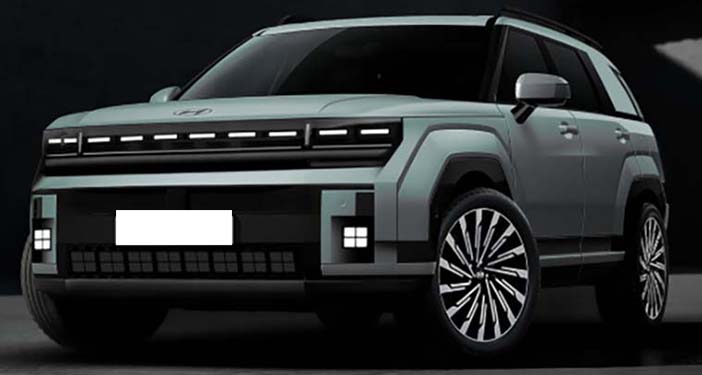
+++ HYUNDAI is preparing to radically reinvent the Tucson, its best-selling model, giving the family SUV a boxy new look inspired by the larger Santa Fe. It’s expected to go on sale in the latter half of next year, with test mules having been spotted on public roads. They reveal it will adopt the brand’s rugged new ‘Art of Steel’ design language, as seen on the Santa Fe and the hydrogen-powered Nexo. While both of those models share that design philosophy, they also have their own unique cues; something Hyundai design chief Simon Loasby has previously said was key to making the range like “chess pieces” rather than “Russian dolls”. The Tucson mules are heavily disguised but it is clear that the new model receives a longer bonnet, chunkier wheel arches and a more upright stance. The change from fourth to fifth generation looks to mirror that of the Nexo, which Loasby said now has a character that is “much more SUV-like” and “capability-driven”. Explaining that car’s upgrade, Loasby said: “We deliberately wanted to turn the volume up on the capability and SUV-ness. Pretty much every region in the world has become more comfortable with SUVs and wants the seating position to be up”. The Tucson’s new shape is likely to result in more interior space, too, and could even improve on the current car’s vast 620-litre boot. It will have the brand’s next-generation interior, which Loasby and Hyundai Group design boss Luc Donckerwolke said could result in a smaller infotainment display and simpler software for the touchscreen (as well as more physical buttons) in an effort to improve safety. Powertrain options are expected to mirror those of the Santa Fe, which is offered with either a 215 hp 1.6-litre turbo petrol hybrid (with front- or four-wheel drive) or a 252bhp plug-in hybrid (four-wheel drive only). The Tucson is a critical model for Hyundai as it targets further growth in Europe. It has been a major catalyst in the brand’s drive to steal sales from established brands such as Volkswagen and BMW, and it last year recorded some 600.000 sales globally. +++
+++ 2 recent facts revealed about Stellantis-backed Chinese electric car maker LEAPMOTOR shouldn’t both be true at the same time but somehow are. The first is that the company’s T03 electric runabout is now one of the cheapest cars on the market. The second is that Leapmotor posted its first-ever half-year net profit, elevating it into the very exclusive club of Chinese electric-focused start-ups to have turned margin positive. The only other member is Li Auto, a premium maker of mainly large range-extender SUVs. +++
+++ MARUTI SUZUKI in India is set to expand its sports utility vehicle (SUV) portfolio with a second mid-sized model, people familiar with the plan said, as the nation’s top carmaker scrambles to counter slowing demand for its bread-and-butter small cars. The Indian unit of Japan’s Suzuki plans to launch the vehicle on September 3 and hopes it will double its sales in the segment, the people said, asking not to be identified discussing business plans. It will be the first new model to roll out of the company’s plant in Kharkhoda in the northern state of Haryana, from where it targets around 10,000 units a month when scaled fully, they said. The launch comes at a critical juncture. Although still the nation’s largest carmaker by sales, the Suzuki unit’s hatchback-heavy line-up has helped give rivals (Mahindra, Hyundai and Tata Motors) a headstart as consumer preference shifted toward SUVs. That, together with shrinking small-car sales, has put Maruti’s goal of grabbing 50% of the domestic market, up from around 40% now, in doubt. While the Grand Vitara has seen volumes plateau in recent months, the new SUV is positioned as a more mass-market version, the people said. That would see the new mid-sized SUV retail through Maruti Suzuki’s Arena outlets, while the Grand Vitara is sold through the Nexa outlets meant for more premium-positioned cars. The new SUV will be only the second product from Suzuki globally in this category, underscoring India’s central role in the company’s growth strategy. The company “is struggling to regain lost market share due to continued weakness in its mainstay mini and compact segments, despite a recovery in output and strengthening of its SUV product portfolio”, Tatsuo Yoshida, a senior autos analyst at Bloomberg Intelligence, wrote in a March report. Accounting for 60% of Suzuki’s global sales, the Indian unit will play a critical role in the success of its parent’s fiscal 2026-31 medium-term plan, Yoshida said, adding that by further strengthening its line-up, particularly in SUVs, Maruti can capture expanding demand in rural areas to boost both sales volume and market share. +++
+++ I had the fortune (some might harshly say misfortune) of driving a 2016 Skoda Fabia recently. It was a fairly humdrum experience with nothing exciting to report, but maybe more importantly there was nothing that was actively frustrating. With today’s new cars required by law to have electronic driver-assistance tech that offers varying degrees of interference and annoyance, the Fabia was refreshingly simple: just turn it on, stick it in gear and off you go. It also had Apple CarPlay, which I was surprised by, so all I had to do was plug my phone into the USB socket and hey presto, there was up-to-date navigation with live traffic information on the touchscreen. That screen was part of Skoda’s Bolero infotainment system, which also featured Bluetooth phone connectivity and a DAB radio (although CarPlay also meant that music streaming was on offer). And while the display was only 6.5 inches (modest by today’s standards) it was big enough and colourful enough to see clearly. A lack of intrusive safety systems, and modern mapping tech via a smartphone made that almost decade-old Fabia much more appealing than it should have been. And it got me thinking: are we PAST THE PEAK of the automobile? If this supermini had all of the convenience features that I wanted, then surely most other cars from a decade ago would be able to meet the needs of the vast majority of buyers for considerably less cash than the latest models? Another piece of tech that makes me think that the 2010s could be the sweet spot of automotive progress is the OBD (on-board diagnostics) port. Before its arrival, a car’s electronic ‘brain’ was a mystery, and before electronics became common, a mechanic would be the best person to help get a sickly car back on the road. But you can get an OBD reader that plugs into the socket that checks the error codes that let you know if something is wrong with a car. Armed with that information, some quick online research will tell you if a problem is fixable, arguably saving you cash on misdiagnosis or repairs that might not be necessary to get a car back to full health. Today’s cars are getting harder to work on due to online connectivity, software updates and plenty of closed systems. If you’re happy behind the wheel of a car that’s a bit older, you could feel the benefit of some pleasingly modern tech, but without the frustrations and expense that might come with a more modern machine. +++
+++ Sometimes the old ways are the best. Case in point, 2 years ago the new (and much improved) TESLA MODEL 3 was launched without an indicator stalk, which caused some backlash to say the least. Thankfully the company has listened to reason and brought back the old fashioned indicators! Unfortunately, for now it’s only customers in China that can get the Model 3 with an indicator stalk. Cars sold in Europe still feature touch-sensitive panels on the steering wheel for the indicators. I’ve found during my testing that these can be irritating to use in certain situations, like on roundabouts or other instances when you’ve turned the steering wheel but need to indicate. What’s more, existing Model 3 owners in China will be able to retrofit an indicator stalk to their car with a kit costing roughly €300. Or a ‘Turn Signal Lever Modification’ as it’s referred to on Tesla’s website. The price includes a new steering wheel without the now redundant indicator buttons, and we’ve been told the original wheel will be recycled by Tesla. There’s no word yet on whether the indicator stalk will be returning to the Model 3 in markets outside of China. Tesla putting the indicator stalk back into the Model 3 is less surprising when you consider that the facelifted Model Y, which arrived last year, did come with one. An incredibly cheap-feeling one mind you. During our testing we found that the stalk doesn’t click into place when you use it, which proved annoying. Regardless, Lars Moravy, Tesla’s vice president of vehicle engineering, explained the decision in an interview earlier this year: “With the indicator stalk, we always say at Tesla if you aren’t deleting so much that you have to put something back in, you haven’t deleted enough. Well, maybe we deleted too much”. In the same interview, head of design, Franz von Holzhausen, discussed Tesla’s obsession with minimalism and removing buttons. “In a world where we’re going to see more and more autonomous vehicles, and full self-driving for Tesla is advancing rapidly, people will be driving less so you need less buttons to interface with”. He added it gives Tesla “the ability for us to consistently make the car better through the UI (User Interface) improvements and hard buttons kind of limit you on that because you’re stuck with them”. +++
+++ Chinese tech giant XIAOMI is planning to start selling its new electric cars in Europe within the next 2 years. Historically best known as a manufacturer of consumer electronics (primarily its hugely popular smartphones), Xiaomi launched the SU7 saloon as its first EV in 2023 and announced plans to become one of the world’s five biggest car makers. With its second EV, the YU7 SUV, now also on sale in China, Xiaomi Auto is one of the fastest-growing car brands in its home market, with more than 80.000 cars delivered in the last quarter alone (a near-200% yearly increase), and is laying the groundwork to soon start exporting cars internationally. In an earnings call this week, company president William Lu told international media that Xiaomi Auto plans to enter the European EV market in 2027, having recently shared a photo of an SU7 on German plates to his Weibo account. Lu is reported as saying the company is in the research and preparation phase of its European rollout and did not give any specific details on timings or model lines. Before sending its cars overseas, however, Xiaomi must contend with severe production bottlenecks at its factory in Beijing. Wait times for the SU7 are currently at 41 weeks and orders placed now for the YU7 won’t be fulfilled for more than a year. Xiaomi reportedly took around 240.000 orders for its YU7 within 18 hours of its unveiling in June; largely attributed to a low starting price, leading to a backlog as the firm ramped up production of its 2 debut models in very short succession. Responding to criticism of the delays on social media, Xiaomi CEO Lei Jun recommended that disappointed customers consider rival products. “If you need to buy a car quickly, other China-produced new energy vehicles are pretty good”, he said, highlighting the Xpeng G7, Li Auto i8 and even the Tesla Model Y, which he called “a great car”. Amid high demand for its first two cars, Xiaomi’s EV business generated revenues of just over £2 billion in the last financial quarter and is expected to achieve monthly or quarterly profitability later this year, Lu said in the earnings call. However, he added that the company is still ultimately operating at a loss following investments of more than £3 billion in the company’s launch and scale-up. Xiaomi’s EVs are likely to be pitched more overtly at the premium end of the market in Europe, given their performance focus and high levels of technology. The SU7 saloon (benchmarked against the Porsche Taycan and Tesla Model S) comes with up to 680 hp in standard form and has a claimed maximum range of nearly 600 km. The YU7 touts a similarly lofty output in top-rung guise and is said to be capable of 620 km per charge. Both cars are available with a choice of rear- or twin-motor powertrains and different battery sizes, though Xiaomi is likely to offer a streamlined international line-up, at least initially. It is possible that the company could launch the warp-speed SU7 Ultra super-saloon as a European halo model, having already built some hype around the 1.550 hp super-saloon by breaking the EV lap record at the Nürburgring twice with it. Xiaomi’s third car will be a larger SUV called the YU9. Positioned more upmarket than its range-mates and equipped with a range-extender powertrain, it seems less likely than its more mainstream, pure-EV range-mates to come to Europe. +++