
+++ AUDI will launch its first cars with a Rivian-developed software stack in 2028, marking a step change in the way it develops its cars and the features they include. The Volkswagen ID.Up, to be launched in 2027, will be the first VW Group production car to use Rivian elements, but Audi will be the first brand from the group to bring a car to market with a complete software architecture developed in partnership with the Californian outfit, with which de German carmanufacturer established a software joint venture last year. That’s because “Audi has the highest requirements when it comes to functionality”, said CEO Gernot Döllner, plus the heightened efficiencies and reduced complexity brought by the new technology will tie into the German brand’s push for clearer and simpler operations. “It’s 2028 where we’ll see it in the market. We are heavily working on it with the Rivian-Volkswagen joint venture, building up mules right now and working intensively together, so the first cars are already on their way”, Döllner told. He revealed that the technology will be introduced in a pair of all-new cars (“if you take a step like that, you do it in a new platform”) which occupy different market segments. Döllner gave no clues to what these first two models will be, but the company is likely to launch its first car on the group’s new ‘SSP’ modular architecture around 2028, so that would seem a likely candidate for the new software stack. He added the stack will have significant implications for the production and capabilities of next-generation Audi models. “It means for us, first of all, reducing complexity. In developing the car, we will have much leaner and faster processes in the way we develop the car. “Over-the-air updates are an integral part of that strategy, so we are more flexible to add functionality or to fix things that are maybe imperfect, and it also helps us to focus our organisation: that software-defined architecture also brings complexity reduction”. Audi’s development of a new software-defined family of vehicles comes as it renews its focus on traditional physical controls in pursuit of greater usability, as demonstrated by the new Concept C show car. The 2 approaches would seem at odds with each other, but Döllner said digital and analogue elements “fit together perfectly”. “You have less virtual buttons in the car and more haptic elements, because that’s definitely the customer requirement we get from the market: customers want to have specific functions and direct access. And it gives us the ability to to bring back materiality to the interior of the car; that real metal feeling, the ‘Audi click’, so also emotion. “But underneath it’s a central computer unit with zonal computers behind, so that’s no contradiction: it fits together”. +++
+++ BMW boss Oliver Zipse has called for a radical overhaul of European regulations to ban the sale of new petrol and diesel cars by 2035, warning that the car industry “will halve in size in Europe” under the current rules. EU regulations feature a firm 2035 cutoff for the sale of all CO2-emitting vehicles. Zipse said the decision to focus CO2 reduction purely on the tailpipe emissions of vehicles, rather than by looking at the whole lifecycle emissions of a manufacturer, along with the manufacturing, use and disposal of its vehicles, risks distorting the market. +++
+++ JLR (Jaguar Land Rover) is working with cybersecurity specialists and the police following a targeted cyber hack which has shut down production until at least Tuesday. The British brand has been rebuilding its internal IT systems since they were breached on Monday, which also caused dealer sales, handovers and parts ordering to stop globally. Autointernationaal.nl understands dealers are now manually registering cars while the systems remain down. Meanwhile, the majority of workers at JLR’s production sites in the West Midlands and Merseyside have been told not to return to work until 9 September. Production is also understood to have stopped at its factories in Slovakia and India. JLR told in a statement on Saturday that “our retail partners remain open”, adding: “We continue to work around the clock to restart our global applications in a controlled and safe manner following the recent cyber incident. We are working with third-party cybersecurity specialists and alongside law enforcement. Last Monday, hackers claimed to have exploited a flaw in the British car maker’s IT system. In an effort to combat the hack, JLR began “shutting down our systems” on Tuesday and is still in the process of rebuilding them. JLR was unable to confirm a timescale for the fix. This caused production to stop at the Halewood technology site as well as the Solihull plant, where the Range Rover and Range Rover Sport are built. The issues are also affecting dealers, who are unable to order parts, can’t code parts they do have to cars, and are unable (in some instances) to complete customer handovers. In addition, they are having to manually register vehicles. This involves phoning the DVLA in each instance. Autointernationaal.nl first reported the issues affecting JLR last week, when British dealers couldn’t register new cars on ‘new plate day’, traditionally one of the year’s busiest for registrations in the United Kingdom. Scattered Spider claimed responsibility for the attack on JLR. Along with fellow hacking group Shiny Hunters, it claims to have obtained customer data after exploiting a similar flaw in JLR’s IT system. The claim was made on a Telegram messenger group, where a user linked to the hackers posted a screenshot of what appeared to show JLR’s internal system. A member of the group told that a well-known flaw in SAP Netweaver (third-party software used by JLR) was exploited to access the data. US cyber agency CISA warned about the flaw earlier this year. An update for the software was released, but whether JLR applied it is unknown. It’s also not known what data was taken or if a ransom demand has been made. JLR told that “there is no evidence any customer data has been stolen”. The hacking groups are believed to be made up of teenagers from English-speaking countries. +++
+++ KIA said Thursday it has surpassed 1 million cumulative sales in Australia, 37 years after entering the Oceanian nation. The milestone was marked with a ceremony held Wednesday (local time) at a dealership in Queensland, according to the company. Kia first entered the country in 1988 and launched a local sales subsidiary in 2006. It reached 500.000 units in cumulative sales in 2018 before doubling the figure in just 7 years. The Cerato, known as K4 in South-Korea, was Kia’s bestselling model in Australia with 200.780 units sold, followed by the Sportage, Rio and Carnival models, with 188.159 units, 166.062 units and 123.854 units, respectively. “Kia has thrived in a competitive and dynamic market, backed by products that have evolved to meet changing expectations and a brand that has earned the trust of Australian customers”, Damien Meredith, chief executive officer (CEO) of Kia Australia, said. “With a fresh wave of innovative models on the horizon, today’s celebration marks an exciting starting point for our next chapter”. +++
+++ The LOTUS Emira has received an indefinite stay of execution. Instead of production coming to an end in 2027, as was originally planned, the troubled British firm’s final petrol-powered sports car will be receiving two new powertrains that should allow it to live beyond the end of the decade. The mid-engined Emira is currently offered with a turbocharged 2.0-litre four-cylinder engine sourced from Mercedes-AMG or a supercharged 3.5-litre Toyota V6. However the 2 engines reportedly fall foul of the new Euro 7 emissions regulations that will come into effect at the end of next year. Instead of letting that be the end of the Emira, Lotus CEO Feng Qingfeng revealed during the company’s Q2 financial results call that the plan is now to give the British-built car a facelift in 2027 and install new powertrains: a plug-in hybrid set-up and an “upgrade” on the V6 engine. However he didn’t disclose any technical details about either. The idea of a hybrid-powered Emira isn’t that surprising to us. Earlier this year, Autointernationaal.nl learned that Lotus was investigating how to electrify its 2-seat sports car. It’s also introducing a new ‘Hyper Hybrid’ set-up that will go into the Eletre luxury SUV and Emeya sports saloon, plus the company’s Porsche Macan rival due to be revealed later this year. However, I don’t think that this will be the hybrid system that makes its way into the Emira. Rather than driving thrills, the Hyper Hybrid system is designed to deliver an “EV-centric driving experience”, lightning-fast charging capabilities and a combined range of more than 1.000km thanks to the assistance of a petrol engine. Given the packaging constraints of the 4.4-metre-long Emira, where every millimetre counts, the sports car is more likely to mirror the Ferrari 296 GTB and McLaren Artura plug-in hybrid supercars. These use electric motor generators that have been shoehorned in between the engine and transmission, boosting power and harvesting some energy for a modest battery. This will still require some significant reengineering of the Emira, which Lotus isn’t in the best position to undertake. For starters, the company has just announced yet another round of job cuts. At least 550 people at its Hethel factory in Norfolk, where the Emira was developed and is built, are being made redundant. The company also recorded a net loss of over £230million in the first half of 2025 alone, and a decline in revenue. Lotus has been using the 3.5-litre V6 engine from Toyota in its sports cars for more than 15 years, since the launch of the Evora in 2009. But as mentioned, this motor won’t comply with Euro 7 emissions standards, meaning Lotus will have to find a replacement. I suspect Lotus will turn to Mercedes-AMG (who already supplies the car’s four-cylinder engine) to provide a new V6 engine for the Emira. During an interview with Auto Express earlier this year, Mercedes’ chief technology officer Markus Schäfer let slip that AMG was working on V6 engines, which is encouraging. +++
+++ LG Energy Solution (LGES) has reaffirmed its status as the main supplier to MERCEDES-BENZ , signing additional deals to provide the German automaker with 107 gigawatt-hours (GWh) of batteries, enough to power 1.5 million electric vehicles (EVs). According to its regulatory filings Wednesday, LGES will provide Mercedes-Benz AG with 32 GWh of batteries in Europe from August 2028 to December 2035 and to the German carmaker’s affiliate in the United States from July 2029 to December 2037. The combined value of the 2 deals is estimated at $10.7 billion, as the batteries are presumed to be 46-series products, which cost $100 per kWh. LGES plans to begin mass production of the next-generation cylindrical batteries next year at its Arizona plant, currently under construction. “In compliance with our agreements with the client, we cannot confirm additional details”, an LGES official said. Last October, LGES signed a separate deal with Mercedes to supply 50.5 GWh of EV batteries in North America and other markets between 2028 and 2038. At the time, industry officials also assumed the Korean firm would provide the German company with its 46-series batteries. Previously, Mercedes relied heavily on batteries from China’s CATL and Farasis Energy to attract European consumers with more affordable EVs. However, the luxury carmaker’s use of lower-cost batteries has been cited as the main reason behind a fire that broke out in an EQE sedan and burned more than 100 vehicles at an underground garage in an Incheon apartment complex last year. The Fair Trade Commission is also set to sanction Mercedes after its Korean subsidiary claimed all its EVs use CATL batteries, despite the EQE sedan’s use of batteries from Farasis. Amid growing concerns over Chinese batteries, Mercedes appears to be shifting its focus from cost to technology and safety. “The latest deal between LGES and Mercedes proves that Korean battery companies outstrip their Chinese rivals in technology”, a battery industry official said. “Korean battery companies are also expected to recover market shares in Europe”. There is also optimism that LGES will increase its U.S. market share after its Arizona plant is completed, especially considering tariffs on Chinese battery imports imposed by the Donald Trump administration. +++
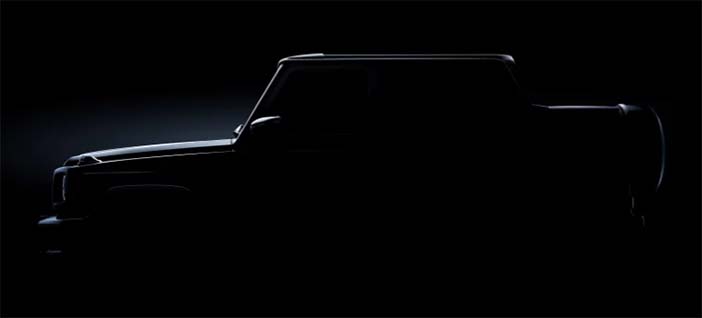
+++ The MERCEDES G-CLASS Convertible is set to return to showrooms, with the brand confirming that an open-top version of its wildly popular SUV will be made available in global markets, including the USA. Mercedes has often sold soft-top G-Class models in the past, but these were typically only available in a short-wheelbase form. When the G was reimagined in the late 2010s, only a long-wheelbase variant was offered, so other than a few extravagant ‘Landaulet’ versions, the model has remained as a hard-top only. That is about to change, though, with Mercedes teasing the silhouette of its new G-Class convertible, which will combine some form of folding roof mechanism with a long-wheelbase five-door bodyshell for the first time in mass production. The teaser is very vague, but we can clearly see a new section at the rear that will fold down to create a semi-open space. How the roof will fold (and where and how it’ll be stored when down) remains to be seen, but we do expect to see some level of compromise to the existing bootspace and the rear seat packaging. We’ll learn more in the coming months, with Mercedes also set to reveal more on a variety of engine options, probably leading with the G 63 AMG’s V8. However, it could also include the G 580 EQ’s electric powertrain, which would create a very specific niche. Prices will exceed those of the current model, and are likely to start from just over €300.000. +++
+++ Electric Vehicles accounted for more than a quarter of all new car registrations last month in the UNITED KINGDOM , according to new data published by the Society of Motor Manufacturers and Traders (SMMT). Of the 82.908 cars registered in the UK during August, 21.969 were battery-electric; an increase of 14.9% for the powertrain compared with the same month last year. That gave EVs a market share of 26.5% for the month, up from 22.9% a year ago. The SMMT attributed the increase in part to the government’s introduction of the Electric Car Grant, with significant discounts on some models boosting interest. As we step closer to the tail end of 2025, one car has stood head and shoulders above the rest. In terms of sales numbers, the Ford Puma still reigns supreme as the most popular car in the United Kingdom. Should it maintain this position until the end of 2025, it will mark its second consecutive year as the top model on the British market. Despite a strong year for the Puma, the broader new car market is experiencing fluctuations, and the industry continues to face unprecedented challenges. In August, 82.908 new cars were registered, representing a drop of 2% year on year. That said, electric car sales continued to rise. That number is expected to grow further in the coming months, as the government’s newly revised EV grant begins to impact more cars, with savings of up to £3.750 on some models. The 10 cars which are currently the most popular in the United Kingdom are: 1. Ford Puma – 33.221 units, 2. Kia Sportage – 29.279 units, 3. Nissan Qashqai – 25.571 units, 4. Vauxhall Corsa – 23.486 units, 5. Nissan Juke – 22.457 units, 6. Volkswagen Golf – 20.016 units, 7. Volkswagen Tiguan – 19.276 units, 8. MG HS – 18.931 units, 9. Peugeot 2008 – 18.662 units and 10. Hyundai Tucson – 18.382 units. +++