
+++ BMW doesn’t fear the incoming wave of aggressive Chinese rivals, its sales boss has said, insisting they will find it very hard to dominate the European market. Firms such as BYD, Chery (which owns Omoda and Jaecoo) and Xpeng have all expanded rapidly in Europe in recent years. But Jochen Goller doesn’t believe they will eat into BMW’s market share. He said: “When Toyota came, afterwards BMW was still selling more cars than before”. +++
+++ Among the enlightening panel discussions and fireside chats at the Automotive News Congress here on Thursday, this one focusing on CHINA ’s automotive ambitions highlighted perhaps the most troubling headwind facing global automakers. Panelists, speaking in the future headquarters of General Motors in Detroit, warned that Chinese automakers pose an existential threat to the rest of the industry. “Think of China in terms of a massive earthquake followed by a devastating tsunami”, said China expert Michael Dunne, CEO of Dunne Insights. During the last 5 years, China’s auto market went from 6 percent electric vehicle penetration to 50 percent. He also said that, inside China, global automakers saw their shares fall from two-thirds of the market to one-third. “The first tsunami is inside China”, Dunne said. “They have a massive price war. No one’s making money inside China, and as a result, everyone’s looking to export”. He added that Chinese automakers are on track to export 9 million vehicles per year, and “they’re going to markets all over the world, except the United States and Canada”. Longtime auto executive Larry Dominique, who operates his own LD Management Consulting business, said auto executives are aware of what’s coming, but they don’t fully appreciate the size and intensity of the threat. “When I look at it today, there is a sense of panic, but I also don’t think there’s enough sense of urgency that goes along”, Dominique said. Dunne said U.S. and foreign automakers are going to be extremely disadvantaged not only on technology and speed, but also on cost containment, Vellequette wrote. “You can’t teach tall in basketball, and it’s really hard to match the Chinese on costs”, Dunne said. +++
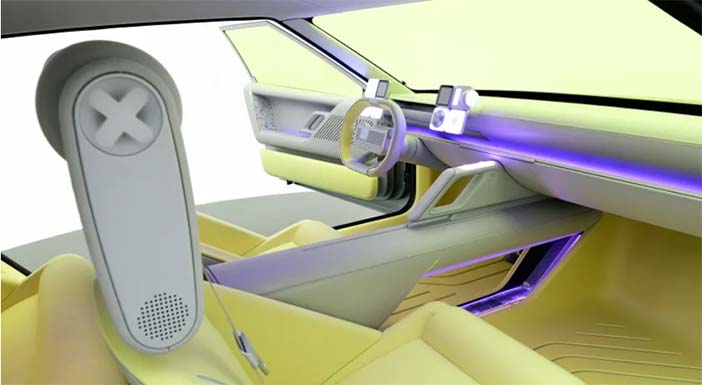
+++ HYUNDAI could be one of the first manufacturers to wean itself off increasing touchscreen dependence, with its latest Concept Three show car signalling its future production car development and a move away from touch and voice-activated core controls. The Concept Three features a number of individually customisable widgets and no central touchscreen, with additional important information positioned on a display at the base of the windscreen to keep as much information as possible in the driver’s eye-line. “A lot of customers are frustrated at having to look and go through layers, so how do we simplify?” head of Hyundai Design Centre Simon Loasby told. “Even on my car you have to go through a couple of layers to get to something like seat heating, so did we get that right?” Loasby pointed out that Hyundai hasn’t abandoned buttons completely in its cabins, unlike some brands that have moved to a combination of only touchscreen and voice activation. But he said that the balance isn’t right at present. “People are prepared to sit and go through menus to play with the high tech stuff, but the instant interaction (temperature, airconditioning, volume, seat heating, skipping tracks) there’s a set which are just so frequently used that actually, then you start questioning, well, why do we need a screen?” he continued. “Not the other way around, not why do we need buttons? Why do we have a screen, and can’t we do that in another way?” The Concept Three’s new direction is something the brand admits it’s working on, with production cars over the next 18 months likely to evolve in a less touchscreen-reliant way, although not completely wiping out the screen on production models. “We’re not there yet, designers always like to challenge and see where the journey could go, which is why we have done what we have with Concept Three”, said Loasby. “And our cars have some very good interactions and functions where screen interaction is required; that’s OK, but we complement that with the frequent-use physical interaction buttons”. +++
+++ JLR is still unable to build any cars at any of its global factories 3 weeks on from a cyber attack that crippled its business, and worries are now growing that those in its supply chain could go bankrupt. The Jaguar and Land Rover maker was targeted by hackers on 1 September and is still in the process of rebuilding its computer systems. The group that hit Marks & Spencer earlier this year has claimed responsibility. This has led to production shutdowns at all of JLR’s global plants, parts ordering issues and retailers being stifled. A timescale for a fix is yet to be announced. The effect could be costing JLR almost €6 million a day, business economics professor David Bailey told. Last Wednesday, JLR confirmed data has been “affected” as a result of the cyber attack, which, while not confirmed, is thought to mean customer details were stolen. JLR told today that it has no official update to give, but reports over the weekend claimed that some of the firm’s suppliers could go bust as a result of the shutdowns. Former Aston Martin CEO Andy Palmer told: “I would not be at all surprised to see bankruptcies”. Palmer added that many suppliers will soon begin to slim their staff count as a result of the shutdown, saying: “You hold back in the first week or so of a shutdown; you bear those losses. But then you go into the second week, more information becomes available, then you cut hard. So layoffs are either already happening or are being planned”. To prevent widespread job losses, the government is facing calls for a furlough scheme to be set up, similar to that used during the Covid pandemic. This would involve the government subsidising workers’ pay packets while they are unable to do their jobs, taking the burden off their employers. One of those making the call is Commons Business and Trade Committee chairman Liam Byrne. The Labour MP said: “What began in some online systems is now rippling through the supply chain, threatening a cashflow crunch that could turn a short-term shock into long-term harm. We cannot afford to see a cornerstone of our advanced manufacturing base weakened by events beyond its control”. The general secretary of trade union Unite, Sharon Graham, has also called for a furlough scheme. “Thousands of these workers in JLR’s supply chain now find their jobs are under an immediate threat because of the cyber attack”, she said. “Ministers need to act fast and introduce a furlough scheme to ensure that vital jobs and skills are not lost while JLR and its supply chain get back on track”. +++
+++ MERCEDES-AMG is exploring an electric version of the AMG GT sports coupé, but it needs to “justify the investment”, said the performance brand’s boss. AMG has already confirmed an electric successor to the GT 4-Door Coupé will arrive next year, previewed by the GT XX concept. It will be the first car to sit on the 800 Volt AMG.EA platform, which will also be used for the brand’s incoming super-SUV due in 2027. Now AMG boss Michael Schiebe has said work is under way to see if a battery-electric version of the 2-door GT is viable. “There is an emotional discussion and a rational discussion”, said Schiebe said at the Munich motor show. ”Emotionally, yes, we should do that. The question is whether there is a market that is big enough to justify the investment that is necessary. At least from a technology point of view, we know how to do that”. A key focus for AMG is which customers the new GT will target. The ICE model is currently bought mainly as a second car for “those who love driving”, so the EV would need to focus on that also, said Schiebe. But, he said, the brand hasn’t put a timeframe on when they would bring it to market and is “flexible” on a launch date. For example, it could accelerate the programme if interest in electric performance cars suddenly rockets over the next few years. He explained: “We are at the moment trying to understand what’s going on in the market. And then we define the target picture of that very specific car”. Mercedes has some form in this space, having previously built an electric version of the old AMG SLS and used it to set an EV lap record at the Nürburgring. However, that EV was only ever sold in extremely low numbers and was retired without a direct successor. If a new EV coupé were green-lit, Scheibe said it would continue to be sold alongside the ICE GT, which the brand will “continue to invest in” well into the next decade. “I would say we are very successful with our combustion-engined GT 2-door”, he said. “So we will focus on that first, and then let’s see when the right point and time is there to launch a two-door EV”. He added: “We want to be in terms of technology and performance successful but also economically successful. We do whatever is, let’s say, worth investing the money. And at the moment, I would say we are more successful investing into our two-door combustion-engine platform than doing this on the electric side. But here we are flexible, so flexible because we are constantly reviewing our portfolio and looking into that”. Ultimately, Schiebe hinted that such a model might be brought to market as a halo car, regardless of its commercial viability: “Sometimes you make a car which is not the most profitable one, but you do it because it’s so important for the brand, and you need to do it because it’s a brand-shaper”. If AMG does build an electric version of the GT, it could serve as the first direct rival to the Maserati Granturismo Folgore, which is currently the only EV super-coupé on sale. Rivals including the Porsche 911, Aston Martin Vantage and Ferrari Amalfi remain exclusively combustion-powered, and will do for several years to come. +++
+++ NISSAN is undergoing a bit of a revolution with its EV range, following the launch of the all-important new Leaf and the return of the Micra, based on the excellent Renault 5. Nissan’s hugely popular Qashqai is going to go pure-electric in the near future, too, though it’ll be sold alongside the hybrid model for a while. In addition, Nissan’s is set to announce an entry-level EV based on the upcoming Renault Twingo, while even the Juke will add to the firm’s electric model range and could get its technology and platform from Nissan’s sister brand and strategic partner, Renault. Renault’s CMF-EV architecture that underpins the all-electric Scenic family SUV did seem like a possible option for the Qashqai EV. However, Renault Group’s Ampere company will soon launch the more sophisticated AmpR Medium platform for C-segment cars (which the Qashqai falls into) and we’ve already seen it used in a fashion on the Renault Embleme concept. Xavier Tesson, Product Planner for Nissan Europe spoke about using Renault’s AmpR Medium platform in future models. “We are open to partnerships, especially in that new world of electric vehicles where the investments are just massive”, he said. “So, here we’ve demonstrated with the Micra, it can be a win-win for both Renault and Nissan. We’re always looking at working with Renault and its platforms to go with what is the best industrial strategy. We’re looking at AmpR platforms; it’s a technical solution on what is the best way and most efficient way to bring a Nissan to market”. While AmpR Medium is able to cater to combustion engine cars (the Emblème concept is a range-extender) the next-generation Qashqai will move to electric power. The current car has electrified tech, with Nissan’s e-Power hybrid systems, but the brand has committed to launching only EVs in Europe from this point on. By definition, it means the 4th-generation model will drop combustion engines entirely. That’s not to say the hybrid Qashqai option will be immediately killed off. Tesson also spoke of Nissan’s all-electric strategy: “We are transitioning to full-electric but we will have an overlap first. There will be an overlap in the Qashqai’s segment and dimension, potentially usage as well.” On electric SUV and hybrid SUV buyers, Tesson added, “they are not the same customers, that double offer is necessary until we see a real transition”. It’s too early to say what kind of technical details the Qashqai EV will provide, though with the similarly-sized Renault Scenic EV on its older CMF-EV platform able to reach 600 km on a charge, I’d expect cars like the Qashqai on AmpR Medium to break the 400 km barrier. As for looks, Nissan has already issued a preview of the Qashqai with the dramatic Hyper Urban concept revealed ahead of the Tokyo Motor Show way back in October 2023. The company even admitted since then the next Qashqai will be “inspired” by the Hyper Urban. The Hyper Urban has only been shown in digital form so far, but I’d expect the new Qashqai to measure around 4.5 metres long, allowing room above for new Leaf (and, potentially, cater to a future seven-seat flagship) while featuring a more practical overall shape than the outgoing car. The Qashqai is one of a trio of models previously confirmed by Nissan for Sunderland, in a package of investment worth up to €2.3 billion. The next Leaf will join the car there, along with the all-electric Juke. +++
+++ RENAULT has issued a recall for several of its popular models due to a potential defect with the electronic parking brake system. The recall affects a number of key vehicles in the brand’s lineup, including the Austral, Captur, Megane E-Tech, Scenic E-Tech and Rafale. The vehicles were all built between April 2024 and January 2025. According to a product recall notice, the issue stems from an incorrectly angled position sensor within the parking brake actuator. This fault can cause the stopping pin to be placed incorrectly, resulting in the parking brake not properly engaging when the P button is pressed on the transmission selector when the engine is switched off, when the driver’s safety-belt is released or when the driver door is opened. While this increases the risk of the vehicle rolling unexpectedly, the Assisted Parking Brake (APB) system is said to remain functional, allowing the car to still be immobilized. While any product recall isn’t great news, it’s worth remembering that the affected Renault models have generally performed extremely well in safety tests, most achieving a top 5-star Euro NCAP rating with only the Captur receiving 4 stars. +++