
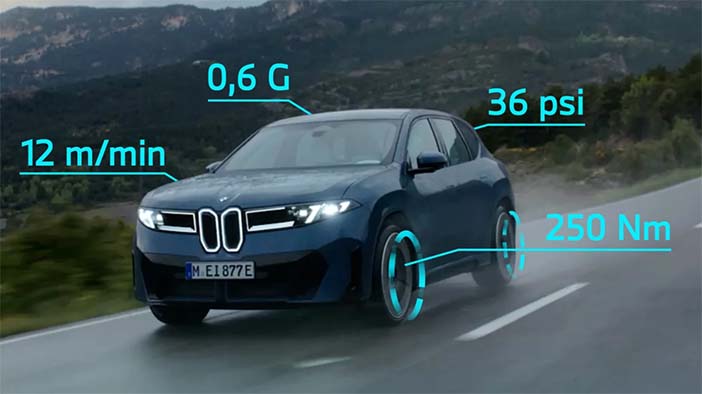
+++ Drivers of hot BMW cars will soon be able to hold their own timed drag races from within their car’s infotainment system. This is thanks to a suite of new BMW M apps designed to enhance and gamify the driving experience. The new M Cockpit, M Drag Meter and M Channel apps are exclusive to M Sport and full-blooded M versions of the new BMW iX3 as well as other forthcoming Neue Klasse models. The apps come as part of a ‘BMW Digital Premium Package’ that costs 350 euro and can be selected as part of the configuration process, or paid for and downloaded over-the-air by owners subsequent to taking delivery. Perhaps the most interesting of the three is the ‘M Drag Meter’ which, as the name suggests, provides a variety of additional data and insights for drag racing. With the iX3 50 xDrive capable of 0-100 kph in a brisk 4.9 seconds, the M Drag Meter app can supply driver reaction, acceleration and quarter-mile times. Plus, it can even display a functioning ‘Christmas tree’ starting light, just like on a real drag strip. If you prefer to drive fast around corners and not just in a straight line, the ‘M Cockpit’ app comprises a multitude of wonderfully nerdy performance gauges. Drivers can use it to keep an eye on their tyre pressures and temperatures, as well as the G-forces they’re generating and their throttle and braking percentages. Conversely, the ‘M Channel’ app is designed for when you’re not driving; it’s packed full of M-branded videos from tutorials to motorsport clips, all to keep the driver and passengers entertained while charging (the iX3 has one of the fastest charging rates on the market, so they won’t be sat watching for that long) or while waiting to pick the kids up from school. As mentioned, the BMW M in-car apps will be available on the iX3 when first deliveries arrive in March 2026. BMW has also expanded its mobile app offerings to now include a specialised ‘M Community’ segment. This acts as a forum for enthusiasts, whilst also showcasing the latest BMW news. Unfortunately, this feature will be exclusive to the German market, meaning BMW’s Dutch fanbase will have to digitally convene elsewhere. +++
+++ BYD will bring PHEV power to the B-segment when it launches the Netherlands’ smallest and cheapest plug-in hybrid next year. The latest addition to BYD’s ranks is described as a hatchback and will effectively serve as a PHEV alternative to the Dolphin Surf, measuring around 4 metres long and roughly 1.5 metres tall. As such, it will be the smallest plug-in hybrid yet available in the Netherlands, with other electrified options of this size (the Toyota Yaris, Renault Clio and MG 3 to name a few) using full hybrid systems which are typically more space- and cost-effective. Technical details are thin on the ground, with the unveiling still some months away, but the Dolphin G’s powertrain is expected to be closely related to that in the new Atto 2 DM-i, which is itself one of the market’s smallest PHEVs. This PHEV version of the Atto 2 EV has a 1.5-litre 4-cylinder petrol engine and an electric motor up front and can operate either as a series hybrid (with the engine working as a generator) or a parallel hybrid (with the 2 power units combining to give maximum shove). In the Atto 2 DM-i, this system produces a combined 262 hp, with the larger of 2 available batteries giving it an electric-only range of 90 km, but it is possible that the packaging restrictions of a smaller supermini means the Dolphin G uses a lower-capacity unit. BYD vice-president Stella Li stopped short of giving away any key details about the Dolphin G but did confirm that it would be the Chinese company’s first car designed for the European market, rather an adapted Chinese-market model, as its existing 9 models are. “There is not any market in China” for PHEV hatchbacks such as the Dolphin G, she said. BYD will start building cars for the European market at its new factory in Hungary next year, beginning with the Dolphin Surf and Atto 2, and it’s possible that the Dolphin G could start following them down the line shortly after. The Dolphin G is one of a wave of PHEVs being added to BYD’s fast-growing European line-up, joining the Seal U DM-i, Seal 6 DM-i and Atto 2 DM-i, as well as the incoming Denza B5 4×4 and Denza Z9 GT. The firm is just weeks away from launching the new Sealion 5 DM-i (a SUV), and a DM-i version of the Atto 3 will follow, likely in 2027. +++
+++ Chinese manufacturer CHANGAN is considering a “dream machine” to help build its brand in Europe. The state-backed firm traces its roots back to arms manufacturing in the 1860s. It began building Jeeps under licence in the 1950s before developing its own models in the 1980s and it has had an R&D centre in the United Kingdom since 2010. It’s currently in the process of launching on the European retail market with the Deepal S07 electric crossover and the smaller Deepal S05. Changan design boss Klaus Zyciora, who at Volkswagen oversaw the creation of the ID 3, ID 4, ID 5 and ID Buzz, said: “Cars are freedom machines and dream machines, and how great is that? Let’s celebrate that”. Asked whether Changan wanted to build a “dream machine” of its own, he replied: “Yes. Wait and see”. Zyciora wouldn’t be drawn on specifics, but it’s possible that the new car could draw on the VIIA concept of 2023.
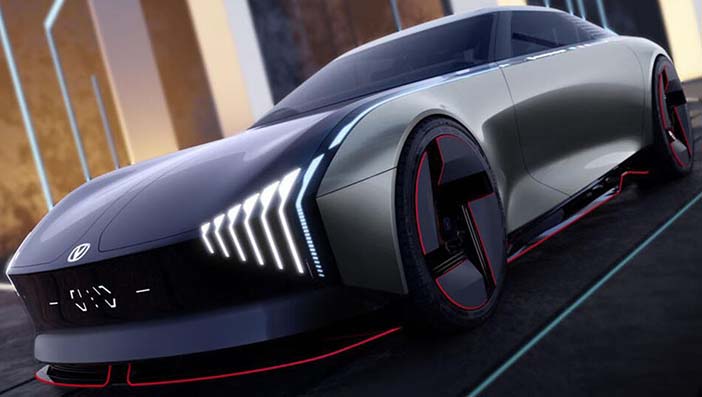
A rakish 3-seat GT, this is the most overtly sporting model yet shown by Changan, and a 2 to 3 year development cycle would roughly align with the pace of development in the Chinese industry. Zyciora also provided several hints about the direction that Changan could follow. Discussing the company’s 3 sub-brands (Avatr, Deepal and Nevo), he highlighted Deepal as “attracting younger customers” with a “performance approach”. These attributes would naturally lend themselves to a brand-builder such as a sports car. Thus far, Deepal has launched 5 models globally: the S05, S07 and S09, which fall in line with European crossover conventions, the L07 saloon and the G318, a more traditional 4×4. “Going forward”, though, said Zycoria, “there’s so much more to come that I think we’re going to find a great community of customers”. He suggested that Changan is looking to “find the balance” between striking, innovative forms and remaining acceptable to global buyers. “If you’re weird, that’s the difference between being unique and attractive or weird and strange; that’s a very narrow thing”, he said. “In the end, it always comes to attractiveness, based on great proportions, on design elements that are seen as beautiful and attractive in the sense that you consider it valuable. If you follow that house rule, you de-risk already. “If you say ‘I want to break every rule, I want to step out of the comfort zone, I want to crush the mould’, you might be very brave. There is a chance that you create an outstanding, iconic product, but the risk is higher, and we have seen that in industry quite a bit”. Referring specifically to “dream machines”, Zycoria added: “In these decisive moments, especially in larger groups, you need to make sure as a designer that you aren’t misguiding a company into oblivion, because in the end it’s all messed up. That shouldn’t happen”. +++
+++ The FORD FIESTA is set to make a comeback worthy of Hollywood or scripture. 2 years after we said goodbye this popular car, a momentous new electric-car platform sharing alliance between Ford and Renault has emerged. This has opened the door for the beloved Fiesta’s return as soon as 2028. The deal, announced in early December 2025, enables Ford to use Renault’s AmpR Small electric-car architecture that already underpins the Renault 5, Renault 4, Alpine A290 and Nissan Micra, as well as serving in the reborn Renault Twingo coming in 2026. It will also allow Ford access to Renault’s battery and motor technology, granting the US brand much-needed scale in the European small-car segment. Ford is set to produce two 2 models: a small hatchback to revive the Fiesta nameplate and a second small EV. Both will be designed by Ford and have unique bodies, rather than being rebadged and lightly restyled versions of the Renault models, like the new Micra. Compared with the Renault 5 E-Tech, the Fiesta is likely to have a sharper, more dynamic look as this suits Ford’s design themes better. The new Fiesta and its SUV sister car will also have their own bespoke chassis-tuning in a bid to deliver the brand’s trademark engaging driving dynamics. Ford has already used this blueprint to differentiate its Explorer and Capri from the Volkswagen ID.4, which is based on the same architecture. “We’re very confident that we can completely differentiate the customer offering”, Ford of Europe president Jim Baumbick told. “Ford will lead on the development of the design and things like the ride, steering, handling and braking to inject the uniquely Ford DNA, to support our brand positioning”. He added that the differentiated designs had already been shared with key dealers and other stakeholders to get their buy-in. Knowing plenty about the AmpR Small platform gives us a good idea of what might power a future Fiesta. The Renault 5 E-Tech, for example, is offered with a choice of 40 kWh and 52 kWh batteries; the latter boosting range to a possible 404 km on the WLTP test cycle. The bigger-battery car gets a more powerful 150 hp motor good for 0-100 kph in less than 8 seconds. The deal is all about economies of scale and getting access to a competitive platform and its manufacturing base: the new Fiesta and its electric sibling will be assembled at Renault’s ‘ElectriCity’ complex in Northern France. It’s also about moving fast: Renault is proud of having set-up a brand-new R&D centre In China which enabled it to develop the 2026 Twingo in under 2 years. Ford will clearly benefit from the French firm’s learning as it’s said the first vehicle from this deal will be on the market in 2028; a similar timeline to the Twingo. Jim Farley, president and CEO of Ford, said: “The strategic partnership with the Renault Group marks an important step for Ford and supports our strategy to build a highly efficient and fit-for-the future business in Europe. We will combine Renault Group’s industrial scale and EV assets with Ford’s iconic design and driving dynamics to create vehicles that are fun, capable, and distinctly Ford in spirit”. François Provost, CEO Renault Group said: “Renault Group is proud to announce a new strategic cooperation with Ford. This shows the strength of our partnership knowhow and competitiveness in Europe. Combining our strengths with Ford will make us more innovative and more responsive in a fast-changing European automotive market”. The deal with Renault is focused on B-segment small cars, said Jim Baumbick, where Ford is already present with the Puma Gen-E model. It’s built in Romania and powered by motors assembled in Ford’s British Halewood plant. The second electric model is therefore unlikely to replace the Puma Gen-E. “I see these 2 vehicles as an augment to Puma”, said Baumbick. So it’s likely Ford plans to push into the affordable EV segment by launching a baby SUV paired with the Dacia Spring replacement, or reviving the Ford Ka using the Renault Twingo as a base. Ford currently partners with Volkswagen for its bigger, ‘C-segment’ cars, the Ford Explorer and Capri electric SUVs. The execution slightly differs from the Renault partnership because Ford has installed Volkswagen’s MEB platform in its Cologne plant, rather than tap into its partner’s industrial base. So don’t expect the larger of the 2 Ampere platforms, known as AmpR Medium, which underpins Renault’s Megane and Scenic, plus the Nissan Ariya and Alpine A390, to revive the recently axed Ford Focus as a Volkswagen ID.3 rival. +++
+++ The courageous new dawn for JAGUAR grows nearer as its groundbreaking 4-door GT will finally be revealed to the world in the summer of 2026. The car has not been revealed in 2025, as was originally intended, but Jaguar’s new beginning continues to rapidly gather pace. The brand is now moving to what managing director Rawdon Glover described as “the end of the beginning, the end of the first phase”. Glover reiterated his belief in the approach of moving Jaguar away from its mainstream position, despite the controversy the Type 00 concept car created around the world when it was unveiled late in 2024. “The irony of the whole furore around the Type 00 is that this car is taking us back into the territory where it has that wow factor like nothing else on the road, rather than very competent saloons and SUVs. We’ve got a history of breaking the mould and starting again, and this is an answer to the question of ‘What should a 21st century Jaguar look like?’. It should look like nothing else on the road, lower slung, dramatic proportions, sense of drama; it is a statement and a car that will not go unnoticed”, Glover continued. “It’s what a Jaguar should look like and this is where Jaguar is at its best: the E-Type, XJ220, XJS, XJC, at the time a Jaguar wasn’t anything that looked like that, and this is why we’re doing the 4-door GT first”. According to the Jaguar chief, the brand is moving to a “centre of gravity” of around 165.000 euro for its new car, which is yet to be named, although it will come with an entry price of around 140.000 euro. Glover insisted that Jaguar has got the ability to work at the higher price, but said it is “conditional”. He continued: “It needs to be executed well, we need to offer an incredible level of service, which is a given, and it’s got to be great. If we execute well, this will work”. Glover said there is a gap between the top premium brands just below that level, and the likes of Rolls-Royce and Bentley, which are at 320.000 euro-plus. “It’s something we have done in the past and when we clinic unbranded, people are thinking uber-luxury, and more than 1.000 hp for the top-end of premium. There is a space for us to be in”. What the 4-door GT won’t do, however, is come with a range of trim levels. There will be a base car, but Glover says bespoke services “are expected at that level”, so a high level of customisation and very limited-run special edition models at much higher price points are on the cards. “Lots of competitors do bespoke personalisation, and then it’s elastic”, he says. “The expectation is that if you are selling a car like that, I want to make it my own, and then there is a much higher level of revenue. Short runs or bespoke cars are part of our product plan”. Jaguar maintains that the car will only ever be electric-only, with the company having no desire or ability to slot in an internal combustion powertrain, and its managing director is adamant that this is still the correct decision. “The most important thing is that it won’t be bought just because it is an electric car”, he said. “People buy these cars because they want to picture themselves getting out of it, want it to look stunning, want it to be a relaxing place to be inside. The powertrain is a long way down the list”. Though engineering specs are light on detail, the 4-door GT will feature a tri-motor layout with total power of around 1.000 hp and a real-world range of around 640 km. Charging capability should see 320 km of range added in around 15 minutes, and rear-wheel steering will mean a turning circle to match a Honda Civic. Orders for the Jaguar GT will open in the second half of 2026, with first cars delivered to customers in just over a year from now. It’s clear that Jaguar is pursuing a different route to other brands with its styling. Glover explained the thinking behind the look of the car in a previous interview earlier in 2025: “We live in a world of small wheels, cars sitting high to package the battery and that look like they were designed in a wind tunnel to maximise the range. We will do the opposite: vehicles that can create an emotional and visceral reaction with the driver. It needs to be a great driver’s car, but one you can drive mile after mile without it being draining, and it must be engaging. The chassis people say they have huge scope to make an engaging drive, but it’s got to drive like a Jaguar”. The British brand’s boss rejected any hint of nervousness about the new direction. “I’m not saying it will be easy – there will be a lot of conquest and we will definitely sell to multi-car Range Rover households”, he replied. “What is the alternative? Look at what is happening elsewhere. Would I want to go into the mid-market or low-end and slug it out?” He said JLR is enjoying success when it comes to making beautiful, desirable vehicles with great design, pushing into higher price points. “We’ve done it with Range Rover and most recently with Defender.” According to Glover, the new Land Rover Defender has doubled in price but tripled in volume compared with the previous long-standing model. “What we did with Defender was that the product transformation came first and the brand after. With Jaguar, we are doing it simultaneously”. He also rejected concerns about moving to an electric vehicle-only plan, commenting that “very few” buyers of 6-figure Jaguars will be single-car households; if 640 km isn’t enough range for them, then they will likely also have access to another car. Visceral and emotional is why people buy cars at this price point, powertrain is way down. It’s about the brand, exterior design, interior design, and how the vehicle handles; people aren’t choosing because of the powertrain”, he said. “This car will be ready in late 2026, so the platform will be used for 7 or 8 years. To liken it to ice hockey, players skate to where the puck is going, not where it is now”. +++
+++KIA ’s sporty new EV5 GT will be unveiled at the Brussels Motor Show, expanding the firm’s range of all-electric, performance-focused GT-branded cars. The EV5 GT won’t be the only new metal on Kia’s Brussels stand. We will also be treated to the global reveal of the new EV2 and GT versions of both the EV3 and EV4 hatchback. Those 2 extra GT models will take Kia’s total to 5 models, following on from the EV6 GT and the EV9 GT. I expect the EV5 GT will go on sale in Europe by summer 2026 and while we’re yet to get any teaser images of the hot SUV, we already know how much power it’ll be packing. The EV5 GT won’t get the wild underpinnings of the EV6 GT (which it shares with the blisteringly quick Hyundai Ioniq 5 N). Instead, it’ll come with a dual-motor set up with 306 hp and 480 Nm. That’ll be enough for a 0-100 kph time of 6.2 seconds. Those numbers are a little way off its rivals from the Volkswagen Group, which include the Skoda Enyaq RS and Volkswagen ID.4 GTX. Both of those have 340 hp and a 5.4 seconds 0-100 kph time. I’m hoping some of the EV6 GT’s (and by proxy) the Ioniq 5 N’s fun-driving dynamics can make their way into the lesser-powered EV5 GT. Range and charging stats have not yet been disclosed, although we know the GT will use the same 81.4 kWh battery as the less potent EV5 Long Range, suggesting a driving range in the region of 480 km should be within reach. A less powerful 265 hp dual motor model will launch at the same time, though again, range figures haven’t been revealed. I don’t know exactly what visual changes will be made to the EV5 GT, although we can expect a fairly subtle makeover judging from the EV6 and EV9 GTs. Expect the usual acid-green accents on the brake calibers and interior, plus Kia has confirmed a “dedicated” GT alloy-wheel design, plus a “matte Magma Red” hero colour for the hot SUV. We’ll have to wait a little longer for prices, but it’ll almost certainly command a premium over the AWD Long Range in GT-Line trim. A price of around 58.000 euro would keep things competitive alongside cars such as the Skoda Enyaq RS and Volkswagen ID.4 GTX. +++
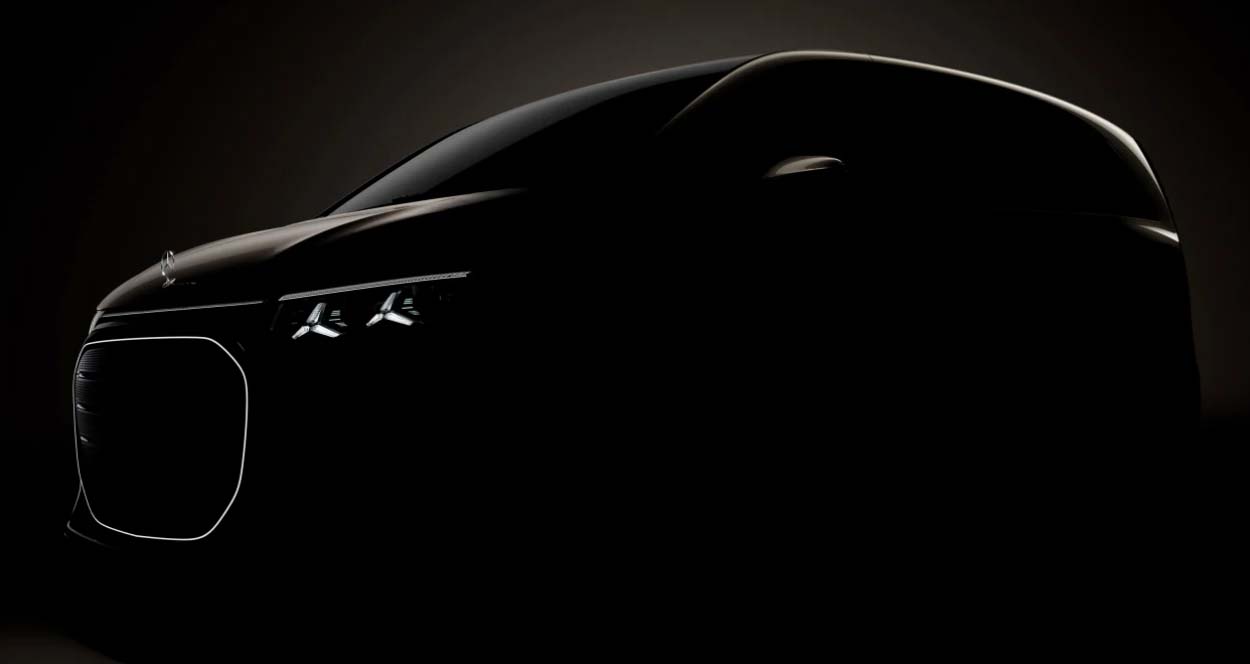
+++ MERCEDES has just given us another teaser of its upcoming VLE minivan which it says will combine “limousine-like ride and handling with MPV-style versatility”. The global reveal of the VLE has also been announced: it’s set for 10 March 2026. We’ve already been given a good look at the new VLE courtesy of the Vision V concept shown earlier in 2025. Like the concept, the VLE production car will come with bold styling cues and brand-new electric architecture to help it succeed in the burgeoning luxury MPV market that includes the Volvo EM90, Lexus LM and Zeekr 009. As for the VLE’s design, the latest teaser image confirms a similar headlight unit to the ones on the new Mercedes GLC and CLA with 3-pointed star daytime running lights. We also know there’ll be a blanked-off ‘panamerica’ style grille taking up much of the VLE’s front end and that’ll be lit-up too. We wouldn’t be too surprised if it gained the same ability as the grille on the new electric GLC, this features 942 illuminated squares that can double as a charging status readout. During the VLE’s development, we saw the VLE testing in a wind tunnel, showing off aerodynamics that the German brand says are “outstanding in terms of efficiency”. There are also new pictures of the VLE at the famed Nardo test track in Italy, fine-tuning its high-speed dynamics and rear-axle steering. The proportions don’t look too dissimilar to the EQV, which the VLE will essentially replace.
What will be significantly different to the EQV is the technical underpinnings. The VLE will be the first model to sit on Mercedes’ VAN.EA platform. During testing, Mercedes revealed the results of long-distance tests of the VLE. The test car’s route went from Stuttgart in Germany to Rome, Italy, covering almost 1.100 km, requiring “2 short charging stops” of 15 minutes each. That suggests a maximum range of around 400 to 500 km; a significant improvement on the current EQV’s range of 360 km. The company hasn’t said what the VLE’s battery capacity will be, however the current EQV comes with a maximum battery size of 90 kWh, and sizes of up to 116 kWh have been used in other Mercedes EVs including the EQS and G-Class. I already know the VAN.EA platform will have a bespoke construction that’s designed to get the most out of an all-electric platform; Mercedes has even gone as far to say it’ll “usher in a completely new era”. This includes a range of cutting-edge technical capability drawn from Merc’s advances in passenger electric cars, including an 800 V electrical system (which could allow for up to 320 kW fast charging) as well as high-end suspension and chassis technology. The new architecture will offer a single-motor layout, plus a dual-motor option with all-wheel drive. The test car was a rear-wheel-drive, single-motor VLE and, according to Mercedes, additional rear-axle steering ensured “easy and agile handling even in tight corners” on the streets of Rome. You can expect to see a similar ability to the EQS SUV, which can turn its rear wheels by up to 10 degrees. The availability of two drivetrains for the VLE will give maximum flexibility when it comes to different applications and requirements. Mercedes previously said the VAN.EA technology will allow for ‘clear differentiation’ between luxury vans and commercial models. The VAN.EA-P platform (the P standing for ‘Premium’) is designed to cater for ‘high-quality family vans’ and everything from ‘exclusive VIP shuttles to spacious limousines’, according to the company. Commercial vans will use the VAN.EA-C set-up – with the C standing for ‘commercial’. Mercedes has also announced that the VLE will be offered with petrol power later on. Details are scarce because it’ll arrive after the electric model, but the combustion-engined VLE will sit on the VAN.CA platform, which Mercedes calls ‘state-of-the-art’. It’ll roll off the same assembly line as the EV in Vitoria, Spain. The VLE will essentially be the mid-size MPV model, akin to an E-Class (hence the ‘E’ part of the name) with seating for up to eight people. A larger VLS will come later and Mercedes claims this will be a “grand limousine” and will “define a unique segment of its own that bestows true greatness to automotive luxury”. The line-up of all-electric vans sitting on this new VAN.EA architecture will be “always on”, meaning they are connected to the internet at all times and able to receive updates. Level 2 automated driving will be available, and there are plans to roll out Level 3 automation by the end of the decade. Judging from the latest electric GLC and CLA, we could see a massive, full-width screen in placement of a traditional dash, utilising the latest MB.OS infotainment system. I’ve only seen a few prototypes running the new set-up under the skin, but when it does arrive on the market, Mercedes will be able to offer more specialised products for all sorts of applications, whether it be as a family car in Europe or high-end business transport in Japan. We’ll have to wait for pricing to be confirmed, but we expect a starting figure close to 110.000 euro, considering that the current, less spacious EQV starts from 89.293 euro in the Netherlands. +++
+++ PEUGEOT is set to channel the spirit of the legendary 205 GTI hot hatch with the range-topping performance version of the next 208. The French manufacturer has already revived the GTI performance sub-brand for a hot new version of its e-208, and now CEO Alain Favey has told that it will add more GTi models as it moves to put “great driving sensations” at the core of its brand positioning, which is likely to apply to the next iteration of the 208 hatch, due in 2028. The e-208 GTI is the latest entrant into the growing field of electric hot hatchbacks and will take on the Alpine A290, Cupra Born VZ and incoming Volkswagen ID.Polo GTI with 280 hp, a 5.7 seconds 0-100 kph time and a mechanical limited-slip differential. It is the first GTi hot hatch that Peugeot has launched since the previous-generation 308 range-topper arrived in 2015. Favey said: “We would not do it if we didn’t think that we want the GTI badge to continue existing in future. So definitely we will make sure that there is a future for GTi which goes beyond just that one”. Favey stopped short of giving any details about the form that these future hot hatchbacks will take but said: “The important thing is to make sure that wherever there is a GTi badge, you get an experience that is one of a kind and absolutely the top in the category”. Peugeot revealed the e-208 GTi in June at the Le Mans 24 Hours and will begin taking orders at the 2026 race before starting deliveries by the year’s end, so there will be almost 18 months between the unveiling and customer deliveries a lengthy lead time that, said Favey, is testament to Peugeot’s lofty ambitions for the GTI. “That’s just the time it takes to get the car ready”, he said. “We want the car to be really top in its category and really a credible hot hatch, and that’s as long as it takes”. Acknowledging Alpine’s A290 as the primary benchmark for Peugeot’s engineers, Favey said the e-208 GTi “will definitely be better than its similarly conceived compatriot, at least, that’s what we hope to be”. “No, but seriously, one of our reference points is to be better than this car, and we think we will be”, he added, calling to mind the fierce historic hot hatch rivalry between the 2 firms, with the original 205 GTI serving as the closest rival for the Renault 5 GT Turbo and later the 2 cars going toe to toe with the 206 GTI and Clio RS. He added that GTi is an important element of Peugeot’s heritage and is being resurrected as part of a drive to “position the brand, to say very clearly that Peugeot stands for great driving sensations. That’s part of what we are”. Peugeot’s desire to emphasise its heritage is evident in the various references made to the hugely popular 205 in the new Polygon concept, which previews the next 208. A performance version, which Favey suggests is likely, would no doubt double down on that retro appeal by reinterpreting some of the 205 GTI’s defining cues, including pepperpot wheels, red pinstriping and prominent GTi badges. The next generation of the larger 308, due in around 2028, would also seem a likely candidate for a GTI version, given that model name has recent performance heritage to leverage. That would enable Peugeot once again to offer a rival to the likes of the VW Golf GTI and Cupra Leon. However the GTi range is expanded, Favey said the badge will not be used again for a petrol hot hatch, because CO2 emissions penalties in Peugeot’s home market would make it too expensive to be viable. He said: “France is a big market for us but unfortunately the rules are such that there are extremely heavy CO₂ penalties up to €70.000, so it would make it just impossible to buy. So we would have a nice car everybody would love, but it would be just impossible to own and that would make it completely impossible. And if we don’t have the French market, it’s difficult for us to justify developing a car like that”. +++