
+++ Thanks to the tangle of modern manufacturing and global supply chains, it’s increasingly difficult to pin down what makes a car genuinely EUROPEAN . Is an American-made Mercedes or a Chinese-built Volkswagen really German? That’s an important distinction, especially in the era of trade wars and tariffs. However, Volkswagen is hoping its European roots will give it the upper hand. This already appears to be working as the European Commission has decided to review tariffs applied to Volkswagen Group vehicles built in China. Instead of a traditional tariff, the automaker is said to be eyeing an “import quota and minimum price mechanism”. The petition was made by Volkswagen Anhui, which is a joint venture with JAC. It builds the Cupra Tavascan, and the automaker has said tariffs are a “serious threat” to its business. If the Commission grants the company’s request, the Tavascan could be exempt from a 20.7% levy. This could occur within a matter a months, although it remains to be seen if officials will be swayed by the company’s arguments. Even if the model were to be exempted from the tariff, the minimum price proposal may not be any better. Officials have “insisted that any minimum prices would need to be as effective and enforceable as the tariffs”. Automakers face steep tariffs when importing vehicles into Europe. The aforementioned 20.7% tariff on Chinese EVs is on top of a 10% baseline tariff. The rates aren’t even the same among automakers, as SAIC reportedly gets hit with a 35.3% tariff, BYD with 17%, and Geely with 18.8%. +++
+++ 2 years on from when FORD stopped producing the Fiesta, Europe’s beloved hatchback is set for a Lazarean comeback … as an electric hatchback. Better a sinner who repents than a proud saint. It’s all thanks to an alliance with Renault, who will provide the platform, battery, motors and factory to build the new EV. Yes, the French car maker that’s generated a huge brand buzz bringing back its chic ‘70s and ‘80s supermini (the Renault 5) will enable Ford to do precisely the same thing and reboot its more recently departed Fiesta. The hatchback that shifted more than 22-million units, will be reborn in 2028. The even bigger story is that Ford is taking a deep breath and committing its deeper pockets to fighting on in Europe, despite shedding 551.000 new car registrations and more than a third of its workforce in the past 6 years. “Today is the first in a number of chapters about how we’re going to compete and win in Europe”, Ford of Europe president Jim Baumbick told on a media call outlining the new Renault partnership. Baumbick has devoted his 32-year Ford career to planning and developing new cars around the world. Question 1. Which new Fords are in the pipeline for Europe? Answer: “There are 2 other new Fords in the pipeline, one being a long-awaited midsize crossover (inspired by the Bronco Sport) to be built in Ford’s Spanish factory. The second is another EV on the Renault electric platform, with the smart money on a small SUV. The platform is suitable for SUV bodystyles: it will underpin next year’s boxy Dacia Spring replacement. A Ford spin-off could provide the opportunity to revive the Ka name and attack the city car segment with Europe’s favourite bodystyle”. Could the Renault 4’s chassis and motors underpin the second-generation Puma Gen-E instead? That EV will be 3-years-old in 2028 and the combustion version even older; it hit the market in 2020. But it’s inconceivable that Ford would pull the Gen-E out of its Romanian factory, and reduce volume from its Halewood electric motor assembly line: every decision Ford takes in Europe is to maximise efficiencies. “I see these 2 electric vehicles as an augment to Puma”, said Baumbick. “On the platforms we make and develop in Europe, our goal is to get to higher levels of scale”, confirms Baumbick. Whether that means sharing the next Puma’s underpinnings more widely across Ford (though it’s too small for North American tastes), or potentially with a third party manufacturer, is still to play out. But converging life cycles with outsiders to co-develop vehicles is challenging”. Question 2. Why is Ford teaming up with other car makers such as Renault? Answer: “Ford’s strategy is wide-open to partnerships; it has to be because the Blue Oval is not part of a big automotive group. So it has alliances with Volkswagen collaborating on both EVs and vans, and the one with Renault may evolve into a second van agreement: talks are underway. While Ford struggles in passenger cars, its van business is hugely profitable and makes Europe hard to walk away from. Partnerships are a critical part of our strategy”, says Baumbick. “In order to compete at the level of cost, we need to ensure that we’re getting scale and getting to new levels of material cost and leveraging the supply chain as well as design efficiency”. This focus has squeezed thousands of dollars out of new model programmes”, he adds. Ford’s midsize electric SUVs, the Explorer and Capri, are based on the MEB platform from Volkswagen, though industrialised in Ford’s Cologne plant at a $2-billion cost. The Fiesta replacement and its sister EV will go a step further and reduce investment by being assembled in Renault’s French ElectriCity manufacturing complex”. Question 3. Why didn’t Ford work with Volkswagen on small EVs?
Answer: “We looked at a wide range of possibilities to compete in the small EV segment and given the speed, agility and competitiveness, the Renault Ampere platform was the right choice for us. Volkswagen is still to get its VW ID.Polo, Cupra Raval and Skoda Epiq into production on the MEB+ platform and is building a new German battery plant to power them; Renault has done the hard yards on all this already. And by setting up an R&D centre in China, the French have slashed vehicle development times: the new Renault Twingo was engineered, admittedly from an existing components set, in fewer than 24 months. Ford is working to a similar timeline to get the Fiesta into production in 2028. If we were to do this on our own, it would take time to develop the platform, a lot of capital to install, and in this marketplace, we need to move with agility and speed”, says Baumbick. “Collaborating with Renault to learn how to compete with the Chinese is a major motivation for Ford. Europe is very important for the overall fitness of the company”, says the regional president. “It’s really a test given the level of competitive activity around EVs and the emergence of the Chinese OEMs as they import into Europe. Such competition isn’t as white-hot in Ford’s domestic market, with tariffs continuing to lock out Chinese car makers and the Trump administration rolling back on electrification demands. But something intrinsically American, the Ford Bronco, is heading the other way, out of the US to Europe”. Question 4: 4. What’s this about a hybrid crossover for Ford’s Spanish plant? Answer: “Continuing Ford’s strategy of mining its famous nameplates and SUV heritage, the Bronco’s less rugged, downsized sister car, the Bronco Sport, is the template for the new model going into the Valencia factory”. The plant currently assembles the Kuga, a 6-year-old crossover, which is based on the same C2 underpinnings as the Bronco Sport. Interestingly, a previous Baumbick European posting was working on the C2 project. The new model, set for launch in 2027, will have a car-like monocoque chassis, rather than the bigger Bronco’s off-road biased ladder-frame. “The new bodystyle we’re developing in Valencia will be multi-energy”, Baumbick told. “We believe that multi-energy, including EV, is critical to advancing both the mission of CO2-reduction and meeting our customers’ needs”. Hybrid powertrains are confirmed but it remains to be seen whether the crossover is available as a pure electric model too. Back in 2022 Ford announced it would install a next-gen EV architecture into the Spanish plant, a plan set back by the Blue Oval pivoting much of its EV engineering and manufacturing back to the States due to policies enacted by the Biden and Trump administrations. Question 5. Where will it all end for Ford in Europe? Answer: “The upshot is that, by 2029, Ford should have key areas of the European passenger car market covered, with the Puma, reborn Fiesta and the other Renault spin-off in the B-segment, while the Bronco Sport, Explorer and Capri attack the midsize market”. That said, Ford vows it has no desire to offer a full vehicle portfolio, turning back the clock to when it offered the Ka city car all the way up to the Mondeo saloon and Galaxy people carrier. “Our orientation is not to play in every segment”, says Baumbick. “Our goal is to win in very specific segments, speaking to enthusiasts and customers that are passionate about their vehicles. That’s where Ford has been at its best. What I’m most excited about is the commitment that Ford is making to really fortify our future in Europe. We are committed to manufacturing and building cars in Europe for Europeans, designed in Europe. This will complement a winning business on the commercial vehicle side”. In 2024, Ford of Europe’s car registrations hit a record low 426.307 units, compared with 1.2-million units 20 years ago. The road to recovery starts here. In an alliance with Renault; a company which has just pulled off its own remarkable salvage job. +++
+++ It’s the end of an era in the automotive corporate world. Audi has offloaded its majority stake in ITALDESIGN to a tech company you’ve likely never heard of. California-based UST is taking control of the iconic design house, which had been part of the Volkswagen Group for well over a decade. In August 2010, Audi acquired 90.1 percent of Italdesign’s shares and, in June 2015, the remaining 9.9 percent, making Italdesign a wholly owned subsidiary. Audi says it will continue to “retain a significant stake” in Italdesign through Lamborghini, which is part of the Audi Group alongside Bentley, Audi Sport and Ducati. Founded in 1968 by the legendary and prolific Giorgetto Giugiaro, the Italian design house worked on a vast array of Volkswagen Group products. In addition to Audi’s own 80 and the mechanically related but lesser-known Asso di Picche concept, Italdesign penned the original Golf, Scirocco and Passat. But Italdesign’s heritage extends far beyond VW and its many brands. It shaped everything from the humble Hyundai Pony to the BMW M1. Numerous Fiat, Alfa Romeo and Maserati models were created in Moncalieri, along with a couple of projects for Renault. The portfolio also includes obscure vehicles such as the Hyundai Stellar, Daewoo Lacetti and the more recent Hongqi HS5. Oh, there were also a handful of Lamborghini tractors. So who is the new owner? According to its website, UST claims to have created over $1 billion in value for more than 140 clients. Its expertise ranges across artificial intelligence, data analytics, cybersecurity and intelligent automation. Beneath the buzzwords, the tech firm, founded in 1999, says it employs more than 30.000 people across over 30 countries. UST plans to “assume operational responsibility while honoring and building on Italdesign’s Italian heritage, design culture, and the talent of its employees”. Details are limited, but the 2 companies say they will complement each other: “The majority takeover of Italdesign by UST creates a strong partnership that combines UST’s expertise in automotive engineering, artificial intelligence, software-defined vehicle development, and digital ecosystem design with Italdesign’s deep knowledge in vehicle and product design, engineering, prototyping, small series production, and automotive electronics. Together, the companies will be able to offer a comprehensive and integrated range of services, from early concept and design to hardware and software development through to production systems. This combined capability is designed to support the development of fully modern, digitally enabled vehicles”. You’ve probably forgotten about it already, but Italdesign’s final project under Audi ownership was a small electric 2+2 coupe. Built on the MEB+ platform destined for the upcoming ID.2 Polo, the EVX concept was a one-off, with no real intention of entering production. In fact, the EVX wasn’t even a physical concept. Beyond a series of renderings, Italdesign presented it only as a hologram at the IAA Mobility show in Munich earlier this year. It’s sad to see Italdesign fade into obscurity, but hopefully it will rise again. As for Giorgetto Giugiaro, the 87-year-old designer is still going strong, having founded the GFG Style studio in 2015 with his son Fabrizio Giugiaro. +++
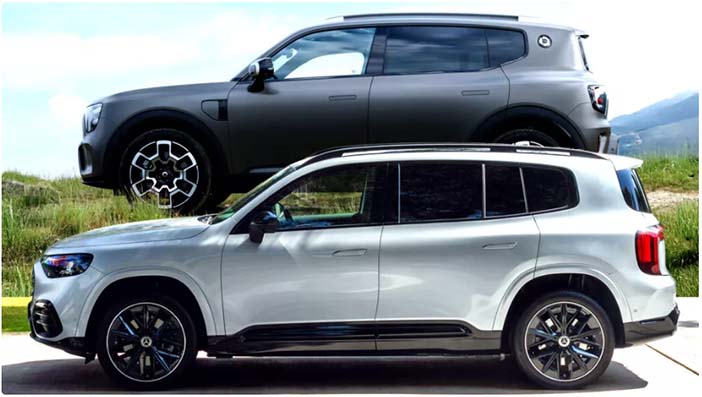
+++ The latest generation of the MERCEDES GLB has arrived, bringing sharper looks, upgraded tech and a new multi-energy platform to the table. At the same time, more than a few of you have noticed something else: the SUV bears more than a passing resemblance to the Smart #5, enough to raise questions about whether these two are more closely related than Mercedes might prefer to acknowledge. That suspicion isn’t entirely unfounded. After all, both models were penned under the same design roof. But beyond the shared styling cues, the connection stops there. They ride on different platforms, have distinct drivetrains, and share no components. Even so, the visual overlap makes a deeper comparison hard to resist. The Smart #5 landed in 2024 as the largest model in the brand’s lineup, a distinction it will soon lose to the upcoming #6 sedan we showed you earlier today. While the exterior design came from Mercedes, which holds a 50% stake in the Smart joint venture, the engineering was handled by Geely, the other half of the partnership. Built on Geely’s SEA platform, the Smart #5 is offered in both fully electric and range-extender versions. The second-gen GLB, on the other hand, sits on Mercedes’ MMA platform, which it shares with the latest CLA. It will be offered in both electric and mild-hybrid forms, reflecting Mercedes’ shift toward more flexible drivetrain options. This divergence in architecture leads to clear differences in powertrain and output. The Smart #5 edges ahead in raw performance, especially in its Brabus trim, which remains the most powerful of the two. Mercedes hasn’t revealed an AMG variant of the new GLB yet, leaving a gap in the performance line-up for now. In terms of footprint, the Mercedes is slightly longer by 37 mm, but its wheelbase is 11 mm shorter. It’s also the only one of the pair to offer 7 seats, while the Smart opts for a 5-seat layout with a focus on maximizing rear legroom and cargo space. Visually, there’s no denying the family resemblance. Common styling cues include the boxy silhouette softened by rounded edges, the similar greenhouse profile, the strong D-pillars, and the upright tail. Even the full-width taillights follow the same outline, though each brand uses its own LED signature. Up front, the Mercedes sets itself apart with a larger grille, which comes across as something of an afterthought, looking disconnected from the rest of the design. The Smart places more visual weight on its lower bumper intake, which also functions as a skid plate. Once again, the headlights follow a similar format with a connecting LED bar, although only one of them gets the signature starry treatment. Other exterior differences emerge on a second pass of the eye. For example, the GLB’s wheel arches are more squared off, and the Smart sports unique mirror housings. Inside, the dashboard follows the same overarching design principles, though the hardware tells a different story. Both models feature a triple-screen layout with a 10.25-inch digital instrument cluster. The infotainment and passenger displays, however, diverge, measuring 14 inches in the Mercedes and 13 inches in the Smart, where they’re housed together in an oval-shaped panel. The climate vents, center console, cup holders, door cards and controls are also different but in reality no one would really notice if you swapped them from one to the other model. Even the steering wheels share a familiar shape, though the Mercedes version features dual spokes that help distinguish it. Seating is one of the few areas where they clearly diverge, with the GLB offering a 3-row layout and the Smart sticking with 2-rows. Much of the resemblance can be traced back to Gorden Wagener, the Chief Design Officer responsible for all Mercedes Group products. With oversight of both Mercedes and Smart styling, his hand in shaping the family look is undeniable. Given the large design teams contributing to both projects, the overlap likely stems from deliberate strategic alignment rather than any shortage of creativity. So, will buyers see them as too similar, or will the distinct badges and mechanical underpinnings be enough to set them apart in the eyes of the market?+++
+++ To say PORSCHE is struggling in China would be an understatement. Sales fell 28 percent to 56.887 cars in 2024. Through September this year, the decline continued, with shipments dropping another 26 percent. Looking ahead, Zuffenhausen has a plan called “Winning Back China”, although it concedes that returning to previous sales volumes is unrealistic. In an interview, Porsche China CEO Alexander Pollich candidly admitted the competition is fierce and that “the pace of innovation in China is breathtaking”. He recalls the Taycan being successful at launch, but now “there is a veritable flood of electric sedans in completely different price segments”. ‘The pace of innovation in China is breathtaking, as is the variety of products on offer, and price and marketing strategies seem to change on a daily basis. Suddenly, you are faced with a multitude of market participants. And the cars appeal to customers’ tastes, let’s be honest. But we are rising to this challenge”. Sales have suffered not only from an influx of lower-priced EVs but also from a lower luxury tax threshold. Since 2016, it stood at 1.3 million yuan ($184,000), but from July 20 this year, it was reduced to 900,000 yuan ($127,000). That change impacted business, making the cars even more expensive and out of reach. The average net list price for a new Porsche in China is under 1 million yuan ($141,000). Consequently, Porsche is scaling back. From 150 sales outlets in 2024, it’s now down to 120. By the end of next year, it’ll have only 80 brick-and-mortar dealerships. The remaining stores are eagerly awaiting the newly announced combustion-engine SUVs. The luxury automaker has confirmed plans to replace the original Macan with a new petrol-fuelled model. In addition, the 3-row SUV, which was supposed to be exclusively electric, will launch first with combustion engines. EVs will still play a role under the “Winning Back China” strategy. The Cayenne Electric will be launched locally. The 718 EV is also coming and is claimed to be “unique in China in terms of its sportiness”. Pollich didn’t elaborate on what that means, but it’s worth noting that the next Boxster and Cayman will still offer gas engines, albeit only for the range-topping versions. Porsche’s head honcho in China warns of a “challenging” 2026, which isn’t surprising. The new petrol-fuelled SUVs mentioned earlier won’t arrive until later this decade. Meanwhile, rejuvenating sales through a spin-off brand, such as Audi’s confusingly named, ringless AUDI, is not in the cards. Pollich didn’t entirely rule it out but clarified there are currently no plans for a second Porsche brand. Citing high costs, the company’s local boss also ruled out shipping semi-knocked-down (SKD) or completely-knocked-down (CKD) kits to China for local assembly. Porsche isn’t an exception, as its main rivals are also struggling in the world’s largest car market. The BMW Group (including Mini) fell 13 percent last year, Mercedes dropped 7 percent and Audi was down 11 percent. It’s the new harsh reality of an intensely competitive market shaped by the rise of local automakers. China has caught up with legacy players, and their pricing is unbeatable, especially in the EV segment. In Porsche’s case, leaning heavily on electric vehicles certainly didn’t help, but renewed interest in combustion engines could work in its favour. +++
+++ RENAULT is eyeing up the return of its Renaultsport sub-brand, admitting that there are “plenty of possibilities with electric” and that “high-power, low-CO2” hybrid engines would suit a new RS-badged Clio hot hatchback. Renault’s global sales and operations director, Bruno Vanel, told that while there is no RS “for now”, if there is enough interest “maybe Renault can reconsider”. He said: “We’ll wait a couple of months, and then we’ll think about it”. Vanel continued: “The good news is that we have the know-how internally to make such a car. We also have hybrid powertrains; solutions to get high power with low CO2 emissions. This is really important now that we are more and more challenged on CO2”. It means that the new Clio could be offered in hot RS guise later down the line. Likely to use an uprated version of the standard car’s 1.8-litre petrol-electric hybrid with more than 200 hp, the race-car inspired dog-clutch layout is already well set up for this kind of model. The last generation of Clio RS used a 197 hp 1.6-litre turbo petrol engine, boosted to 217 hp in Trophy guise. It was one of the first models to use a dual-clutch automatic gearbox, albeit aided by a Race mode and launch control function. While not a stand-out model, RS-badged Renaults through the ages have been among the sharpest and most focused of the breed. In a separate conversation, Vanel admitted it is “more and more difficult to sell hot hatches” these days, but that there are “no preconceptions as to where Renault will go”, hinting that electric RS models could also be under consideration. “Having Alpine helped us to develop the Renault 5 Turbo 3E”, he told. “There are plenty of possibilities with electric; we will see”. +++
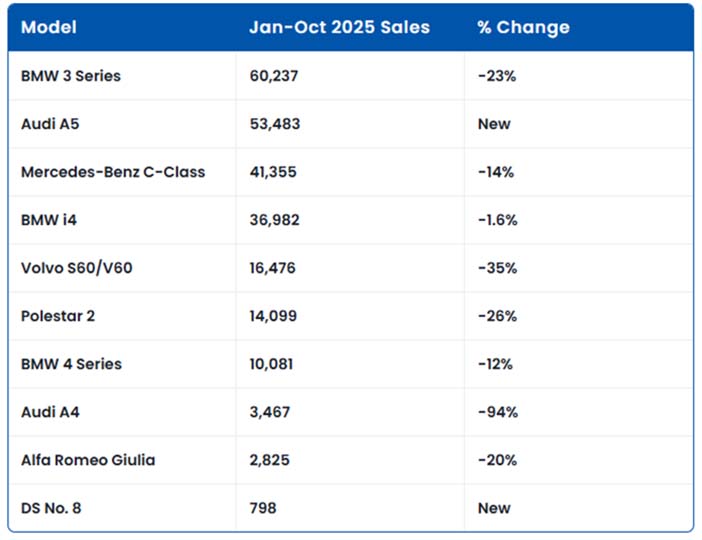
+++ While the selection of mainstream SEDANS has dwindled in recent years in the United States, a handful of premium mid-size options remain. They’re not as popular here as they used to be, and even drivers in Europe are beginning to drift away from luxury sedans in favour of other options. Mid-size premium sedan sales have fallen 19 percent through the first 10 months of the year in Europe. According to Dataforce, sales of the BMW 3 Series were down 23 percent in Europe at the end of October. The Mercedes-Benz C-Class fell 14 percent, and while there was strong demand for the new Audi A5, every other model in the segment saw a sales decline. The all-electric BMW i4 had the smallest slip, falling just 1.6 percent. One reason cited for the decline was a 30 percent drop in fleet sales for the segment, with buyers drifting toward mid-size SUVs instead. Many of those SUVs are more functional than premium sedans and have a broader range of powertrain types available, including plug-ins. But those who bought a mid-size premium sedan most often opted for a gasoline engine, which accounted for 33 percent of sales. Diesel powertrains were second at 27 percent, followed by EVs at around 22 percent. PHEV sales were last at around 19 percent of the midsize premium sedan segment. Most of the cars are ending up in Germany, with the country accounting for 37 percent of the segment’s market share so far. The United Kingdom was second with 16 percent, followed by Italy (6.2 percent), Sweden (4.7 percent), and Poland/France (4.2 percent). The BMW 3 Series, Mercedes C-Class, and Audi A4/A5 have been icons in the luxury space for decades, but even on their home continent, consumers are shunning them, and crossovers and SUVs are winning. +++
+++ The brand-new electric VOLKSWAGEN ID.Polo might just be around the corner, but customers not ready to make the switch to an EV will be thrilled to hear they won’t be left behind. That’s because Volkswagen is planning a substantial update to the existing combustion-powered Polo, bringing more efficient hybrid powertrains and new digital interfaces. Volkswagen’s board member for sales, marketing and aftersales, Martin Sander, told: “There will be an update to the combustion Polo. We can continue to build combustion-powered cars for as long as we need to, there is no limit. The existing MQB-A0 platform is more than capable of that”. The current Volkswagen Polo, plus the Seat Ibiza, Skoda Fabia and their crossover siblings, are built on Volkswagen’s MQB-A0 architecture. It’s a simplified version of the chassis used by the Golf, incorporating simpler rear suspension that’s both cheaper to build and more space efficient. However, although the MQB platform has already been updated to an ‘Evo’ generation to include a new and more powerful electric architecture, only now are the Polo’s A0 underpinnings getting a major upgrade. When asked whether the new-age tech found in the latest MQB-Evo products such as the new T-Roc could be fitted to an updated combustion Polo, Sander said: “Of course. It’s a big job, and expensive, but we need to do it”. This should see the combustion-powered Polo able to adopt VW’s new digital interfaces inside, plus upgraded driver-assistance systems and over-the-air updates. The changes will also bring benefits under the bonnet, because Volkswagen is working on new hybrid powertrains for the Polo. These will include both the mild-hybrid systems seen on the current Golf and T-Roc, and a new-generation full-hybrid unit that will be available from 2026. The ability to house higher-specification engines within the Polo’s smaller footprint has always been a big benefit of its platform, and it’s one the company plans on leveraging to full effect. All of these changes will also be made in line with the brand’s new design philosophies of ‘solid, likeable and secret sauce’. These might sound like little more than marketing spin, but under the leadership of Andy Mindt, the company has already been put on a more stable footing, as we’ve seen through new models such as the upcoming ID.Polo. So expect a doubling-down on higher-quality materials inside and simpler, but more resolved exterior styling to keep the combustion model looking and feeling fresh alongside next year’s electric version. But why is VW going so far with an otherwise ageing platform when its all-new ID. Polo is just on the horizon? According to Martin Sander, “In order to compete in Europe, we have to service the whole of Europe. Norway is 100 percent electric, but the south is very different. Somewhere like Italy is only 10 percent electric. And we still need to offer our customers the sorts of car they want to buy, no matter their region or preference”. Such a significant overhaul of the Polo will also lead to benefits for other models in the range, such as the closely related T-Cross. This SUV model is also sure to pick up a major overhaul considering its impressive market share across most European markets. We might have expected the EU’s tightening emissions regulations and EV mandates to lead to the demise of the petrol-powered European supermini, but this doesn’t appear to be happening. Along with a watering-down of electrification targets and a delay of the banning of combustion-engined new cars to 2040, VW’s decision to update the existing Polo will help the company’s bottom line and its desire to retain market share. +++