+++ The ALPINE A110 is set for a revolution. The replacement for the impressive 2-seat coupe is set to get all-electric power, but will still have “soul” and be a worthy rival to Porsche’s upcoming electric Cayman and Boxster, according to a string of Alpine executives. Alpine’s boss Philippe Krief talked in depth about Alpine’s electric replacement for the A110 coupe, revealing a string of technical headlines. The electric coupe will ride on a dedicated sports car platform, has a target weight of 1.450 kg (close to a Cayman GT4 RS’s), should travel more than 560 km on a charge, and packs 2 in-wheel motors that generate “more than enough power”, vows ex-Ferrari director of engineering Krief. Krief also revealed detailed plans to expand the new A110 range, first with an Alpine A110 Spyder soft-top roadster and then potentially with an all-wheel drive variant, potentially using elements of the tri-motor powertrain developed for the A390. The A110 will be the cornerstone of Renault Group’s attempt to take Alpine’s track pedigree (racing in Formula 1 and the World Endurance Championship) and turn the brand into a thriving, 7-model premium car maker at the cutting edge of new technology. It’s critical, therefore, that the brand’s low-slung A390 is a success, to start generating the cash the company will need to invest in its ambitious product plan. Before leaving, former-CEO Luca de Meo’s vision was to create France’s answer to Porsche. “The A110 is our iconic product, the Porsche 911 of Alpine”, he said. Coincidentally the first A110 coupe (powered by an in-line Renault 4-cylinder engine) made its debut in 1963, the same year the 911 was born. I expect the new A110 to be revealed in 2026, possibly making an appearance at the Paris motor show in October. It will be on sale early in 2027 with the A110 Spyder likely to follow in 2028. The A110 will then be joined by the larger Alpine A310, a 2+2 coupe and convertible using the same platform that will be a more direct rival for the Porsche 911. While the Alpine A390 rides on a painstakingly overhauled version of Renault Group’s AmpR-Medium architecture, the coupe will be the brand’s first model on the Alpine Performance Platform (APP). “Irrationally, we decided to invest in a very modular sports car platform that will underpin the next-generation A110”, explained de Meo. “The APP is the core of Alpine. The priority is to take that platform and develop 3 or 4 models, then we’ll see what happens”. De Meo told that APP is a dedicated sports car platform, made from extruded aluminium sections. It will be manufactured in the Dieppe factory, where workers are used to crafting the lightweight alloy. The material is critical for paring back weight. “We think we can do an electric car that is lighter than a comparable combustion-engine car”, added De Meo. “That will change everything. We’ve invested in the electronic engine architecture, putting the engines in the wheel, [which]lowers the car’s centre of gravity”. The A110 will finesse the in-wheel motor technology powering the Frankenstein’s monster version of the Renault 5, the Turbo 3E. Alpine’s engineers have converted this outrageous, superhatch to rear-wheel drive, with rotors attached to the wheels to spin them. That negates the need for reduction gears and half-shafts, saving weight, and gives huge opportunity to manage torque delivery to individual wheels. While the Turbo 3E will be a drift machine, the new A110 will be set up to carve through corners. “There will be 2 motors on the rear”, says Philippe Krief. “We’ll also have an all-wheel-drive version with 2 rear and 1 different front motor; smaller, lighter”. And how much combined power will there be, in excess of 500 horsepower? “A lot!” he says. “And we are thinking of evolution also to give a range of outputs and models. There will be enough power, I can guarantee!” The motors will be fed by “very high energy density” batteries and an 800-volt electrical architecture, boosting charging capability and enabling thinner wiring and componentry to again reduce weight. “In terms of motors, you optimise them. Integrate all the functions (motor, transmission, inverter, the DC/DC charger) everything in one box. Then in terms of vehicle integration, you fight for every millimeter you can reduce, every kilo on each single part. I’m not saying that it’s easy!” vows Krief. “The weight target of the new A110 is below the best combustion car, a Porsche 718 Cayman”, he confirms. “It’s 1.45 tonnes to be precise”. Today’s entry-level A110 is extremely petite, stretching to just 4.181 mm long and weighing 1.102 kg. That means a relatively modest 252 hp 4-cylinder engine can fire the coupe from standstill to 100 kph in 4.5 seconds. +++
+++ CITROEN could replace the C1 with a new sub-17.000 euro urban electric car if law makers in the European Union sign off the new ‘E-car’ category for small cars, and it would have the spirit, but not the look, of the 2CV. The E-car category is a proposed framework to ease the financial pressures on making small, affordable cars by loosening some of the restrictions they must adhere to. The new category is under consideration by the EU Commission in response to complaints from car makers about the unviability of building true entry-level models. The move is viewed as a crucial step towards a renaissance for cheap, small cars in Europe; a class that has shrunk dramatically in recent years as car makers exited this most unprofitable of segments. Citroën CEO Xavier Chardon is the latest European car company boss to welcome the potential new rules and says their introduction would be likely to pave the way for a return to the A-segment for the French brand. However, Chardon downplayed the notion that this new-era people’s car would be conceived explicitly as a reborn 2CV, as had been earlier suggested. Speaking at the unveiling of Citroën’s radical new ELO concept, Chardon said producing this sort of affordable model remains a possibility for the company and it could be signed off pending the specifics of the new category. Asked whether the ELO concept envisions a potential E-car model, Chardon said: “E-car is opening a different door. For this car, you may not need to have an E-car answer. For us, E-car is more important to define a car that would come below the C3, a car that is more accessible, because this car (the ELO concept) is quite compact, but you can see that with what you have internally (with the modularity, the flexibility) it will never be an entry version of the future line-up. “We are legitimate as the Citroën brand to enter this segment, providing that the European Union is giving some space in terms of future regulations. We don’t know yet. Why are we legitimate? Because this is part of our DNA, and you don’t have to go back so far in history”. Chardon referenced the historical success of previous ‘A-segment’ Citroën models, a lineage that dates right back to the 2CV and includes highly popular superminis like the Saxo and more recently the C1. The C1 was taken off sale in 2020, at the same time as the closely related Peugeot 108, amid a mass exodus of mainstream car makers from the A-segment, with increasing legislation and production costs conspiring to strangle already razor-thin margins. Since then, the C3 has been Citroën’s smallest full-sized car, but at 4.015 mm long and 1.577 mm tall it is substantially larger than the C1, and Chardon says the E-car rules could provide the framework to fill that gap in Citroën’s line-up again. He said: “The C1 was quite a successful car. It was 3.4 metres, so quite compact, but up to 5 seats. Of course, it was not the car that you would use to commute from London to Nice, but it was a car that you could take outside of the city. You had 5 doors, you had an engine where you could go on highways (not as the primary use but giving the flexibility) and we believe that this is important that we find again this logic at a price point that is (at least in Europe) below 15.000 euro. He said the E-car rules are “not the only way” such a model could be brought to fruition” but added: “It’s the most likely way to find an equation that makes this project affordable for customers and also economically viable for us”. Chardon’s comments come shortly after his counterpart at sibling brand Peugeot, Alain Favey, told that his firm was also mulling the prospect of a new entry-level EV supermini in the vein of the 108. Just as the C1 and 108 were twinned in their first 2 generations, so too would their successors be likely to be heavily related, but neither Favey nor Chardon gave any hint as to how advanced the projects are. Other brands including Dacia and BYD have also indicated they could launch new entry models in Europe in a more hospitable regulatory environment. Crucially, any new classification for small cars in Europe would need to ease the sort of safety and technical regulation that has priced such models almost out of existence, because manufacturers need to be able to sell them at a profit, which means they must cost less to build, said Chardon. “And for this you need to change a couple of parameters, especially if you want this car to be fully electrified”, he said. “Having a car at €17.000 electrified without any subsidies is not a walk in the park. And if every time the European Union is asking us for more regulations, this is not supporting us in moving in this direction”. Chardon’s comments clarify Citroën’s position on a spiritual successor to its best-known car, the 2CV, which he said would inspire the conception of any future entry model, but not necessarily the look, contrary to recent suggestions that the iconic 1950s ‘people’s car’ could be revived in the same manner as the Fiat 500 and Renault 5. Asked if the E-car project and mooted ‘reborn’ 2CV were one and the same, Chardon said: “I wouldn’t call it the 2CV project, but I would call it more ‘the E-car’. The 2CV is, for me, an inspiring model. What is interesting is to understand why the 2CV, which was stopped many, many years ago, is still an iconic car and what you can learn from it.“Originally, it was from the time where Citroën was owned by Michelin. It was a very interesting brief. Michelin had said: ‘We need to sell more tyres, so we need to put more cars on the street.’ This was the brief before World War Two, and then after World War Two, it became: ‘We need to offer a car that offers individual mobility to the masses in a period where price was absolutely important’ ”. Chardon noted parallels between consumer demands of the mid-20th century, which ultimately birthed a whole generation of people’s cars including the VW Beetle, Mini, Fiat 500, Morris Minor and Citroën’s own 2CV, and today’s market environment. While the well-known remit of the 2CV (to be able to transport four farmers, a sack of potatoes and a basket of eggs across a field, at a price affordable on minimum wage) may no longer be a core requirement for a cheap car, the need for more affordable mobility is clear, he suggested, and the principles of the 2CV remain highly relevant. He said: “I’m sure that if you translate this brief into a future E-car, it might not be the same as the 2CV, but you have to translate it into 2025, 2026 or the coming years, and this is why the 2CV is a good inspiration. But I would say not the shape or the design. Retro design is a solution. You have also plenty of examples of retro design that were successful, but also retro designs that were not successful, so you need a purpose to make a future icon. So that’s why I wouldn’t call it the 2CV project, but the E-car can be inspired by what the 2CV brought in the past, definitely”. +++
+++ DACIA ’s push into the family car market steps up a gear in 2026 with a bargain-priced, rugged estate. Referred to internally as the Dacia C-Neo, the 5-door wagon will slide into the range alongside the Bigster and 7-seat Jogger. Prototypes are already out testing, revealing the beefy proportions. A long rear overhang will free up plenty of boot space: expect around 600 litres. The rear seats will fold to ensure this is the perfect vehicle for trips to IKEA, supplemented by that Dacia essential: roof bars. Nonetheless, the Dacia C-Neo is far from a utilitarian tank: the arcing roof and slanted rear hatch give it a very different profile to the Jogger’s rigidly straight lines. The wheelbase appears similar to the 2.7 meter-long Bigster’s, and the 2 vehicles will likely share a footprint around 4.5 metres long. Expected to go public in spring 2026, the C-Neo will stay true to Dacia’s tried-and-trusted blueprint of offering excellent value for money, space and hybrid power. Expect the car to cost from around €26.000, which would comfortably undercut its rivals. The C-Neo will boast a mix of sleek profile and a robust body: plastic paint protection is a given. And the surfaces will double down on Dacia’s design philosophy, which was outlined by vice-president of design David Durand. “We try to express our car’s robustness in our formal language. That means clean surfaces, and nice intersections of big blocks that are very pure and simple”, he explained. Under the C-Neo is Dacia’s CMF-B architecture, capable of supporting front and four-wheel drive. This platform unlocks real economies of scale baked in by Dacia’s ‘designed-to-cost’ philosophy. “We’ve been doing this for 20 years or more”, product chief Patrice Lévy-Bencheton told. “When you do essential cars, you make sure that all the features, the parts you are designing and so on, are the most efficient in terms of the cost-to-value ratio”. Minimising weight is critical, because it means the car’s engines can be smaller, as can the brakes, triggering a virtuous circle of cheaper components. One of Lévy-Bencheton’s favourite cost and weight savings is having one strut for the powered tailgate, rather than two. That’s nailed on for this wagon. Another breakthrough could see weight eliminated from the seats, if Dacia can turn the thinking seen on the Hipster concept, where sections were replaced with elasticated mesh, into production reality. All this feeds into Dacia’s laser focus on price. “Offering affordability, whatever the size, whatever the customer need, that’s Dacia’s mission”, said Frank Marotte, vice-president of sales & marketing. “In the family car segment, we see a vast number of customers who are stuck with existing vehicles because they cannot afford to renew. And what we see with Bigster is that we fit a gap where nobody else is, with a car that is roughly 10.000 euro less expensive than rivals”. Marotte added that Dacia has been closely studying the mid-size car market, known as the C-segment, to find untapped demand. “If we come with something different in the C-hatch or the C-wagon, if it fits a need that has been created by other manufacturers moving away from customers, then we have to be there”. It’s all part of a long-term goal for Dacia to sell 1 million vehicles a year, a huge jump over last year’s 676.340 volume. The target is for 20 percent of sales to come from the C-segment, with higher prices boosting revenues. “We’re sticking to the objective to grow”, CEO Katrin Adt told. “We’re bringing new cars in the C-segment but also in the A-segment, trying to broaden our offer”. Dacia has built up a 50.000-strong order bank for the Bigster, and next year will also yield the successor to the Spring. Don’t expect the C-Neo to get pure electric power, although Adt confirmed that “on every car there will be hybrid”. Dacia has re-engineered its hybrid system for the Bigster and next year’s facelifted Jogger, to boost efficiency and performance. Out goes the 1.6-litre 4-cylinder for a less-stressed 1.8-litre, again running the efficient Atkinson cycle. The hybrid system is fed by a bigger, 1.4 kWh battery and includes 2 motors, one powering the wheels during 80 percent of urban driving, Dacia reckons. The other is a starter/generator. Power is sent to the front wheels via an automatic transmission. Expect around 155 hp in total: the Hybrid 155 system’s e-motor produces 50 hp in the facelifted Jogger, boosted by 112 hp from the 1.8-litre. Peak torque is 205 Nm in the Bigster, 170 Nm in the revised Jogger. Hybrid won’t be the only powertrain option: the 1.2-litre TCe, a 3-cylinder turbo engine with 48 volt mild-hybrid assistance, is sure to be offered. In the Bigster it produces 140 hp, or 130 hp coupled with 4-wheel drive and the TCe’s 6-speed manual transmission. +++
+++ HYUNDAI is preparing to resurrect the petrol-powered i30 N hot hatch, filling the gap left by the recent demise of the Ford Focus ST and Honda Civic Type R, a well-placed source has told. The original i30 N was launched in 2017 as the first model from Hyundai’s N performance brand. A close rival to the Volkswagen Golf GTI, it was based on the third-generation i30 but was a highly bespoke proposition under the skin. It featured a stiffer chassis and an electronic limited-slip differential, for example, while its 2.0-litre turbo 4-cylinder was tuned to produce up to 280 hp. The Korean firm axed its flagship hot hatch along with the smaller i20 N in 2024 as part of a move to reposition the N brand “as a pioneer of high-performance EVs” as it began its push to phase out combustion cars in Europe ahead of the 2035 cut-off. Today, Hyundai’s N line-up consists of the Ioniq 5 N and Ioniq 6 N; both pure-EVs with more than 600 hp. However, a source has told Autocar that Hyundai has started work on a new version of the i30 N, which will be powered by a combustion engine; likely to be hybridised. Indeed, N division boss Joon Park told earlier this year that future Hyundai performance cars won’t necessarily use pure-battery powertrains. He added that the N brand will keep step with its parent company in maintaining a diverse powertrain offering over the coming years. The problem that we have is that there is a perception from the media and our fans that Hyundai N is only focusing on the EV world, which is not true”, he said. “We are not limiting ourselves to EVs”. Further details remain to be uncovered, but based on what we know of the N brand’s plans to introduce new hybrid models, the hot new i30 could use an uprated version of an existing electrified drivetrain (possibly the standard i30’s 1.5-litre hybrid, for example) but there is potential for an all-new powertrain entirely. Hyundai recently confirmed that it was using an outlandish Veloster-based prototype to test a new engine for performance cars, which engineers described as high revving, high performance and combustion powered. In the test mule, it’s mounted in the middle of the chassis, but other orientations are possible. Toyota has similarly used a mid-engined prototype to test its new 2.0-litre 4-cylinder engine for upcoming GR sports cars, for instance. Hyundai said it wants to “develop an engine that meets the performance requirements of the market and to mass produce it without any problems”; hinting at plans to introduce a new ICE-powered sports car in relatively high volumes. Spy photographers recently caught Hyundai readying a third facelift for the third-generation i30, which is likely to be due next year. This suggests the performance variant will be based on that facelifted version so it may arrive before the end of 2026 or at the start of 2027. In response to the story, a Hyundai spokesperson told: “Hyundai is committed to introducing 7 new N models by 2030, with plans that include exploring a broad range of powertrains such as internal combustion engines, hybrid and electric vehicles. Future product plans will be announced at a later date as part of our ongoing effort to deliver product strategies that align with our customer lifestyles and government regulations”. +++
+++ Technical specifications for the new plug-in-hybrid LOTUS ELETRE have been revealed in a Chinese government filing. The electric SUV swaps its 108 kWh battery for the smaller 70 kWh unit from Geely sibling brand Zeekr’s 9X luxury SUV. This yields an electric-only range of up to 100 km between charges. In the 9X, this battery can be charged from 20-80% in just over 8 minutes. If the Eletre PHEV matches that capability, it would become Europe’s fastest-charging PHEV, with a peak charging rate well north of 400 kW. This detail remains yet to be confirmed, however. The Eletre PHEV also employs the same turbocharged 2.0-litre 4-cylinder petrol engine that’s used in the 9X. This can be used to either drive the wheels or continuously top up the battery while on the move. Details on electric motors remain under wraps, but the 9X has 3 combining for 1.400 hp. Lotus previously said its version of the powertrain (dubbed Hyper Hybrid) will pack 920 hp, but the 9X reveals there is further head room in the set-up. The Eletre PHEV weighs between 2.575 kg and 2.625 kg, depending on the chosen trim and optional extras, roughly aligning with the existing pure-electric version. Visually, it’s largely indistinguishable from the EV, save for a more open front grille and bespoke ‘For Me’ badging on its bootlid. The latter is likely to be replaced with a more conventional ‘Hybrid’ motif in Europe. The Eletre PHEV will be revealed in full in January, with sales expected to begin next autumn. Lotus had previously committed to selling only EVs by 2028, but sales of the Eletre and Emeya have been significantly slower than first expected, forcing the company to adjust course. CEO Feng Qingfeng said the launch of hybrids would help Lotus’s sales in regions with slower uptake of EVs, such as Italy and Saudi Arabia. The PHEVs are also expected to boost Lotus’ profitability; the company recorded an operating loss of $357 million for the first 9 months of 2025. +++
+++ MERCEDES-AMG has named Stefan Weckbach, a key figure in bringing Porsche’s first electric car to production, as its new CEO. Weckbach will take over on 1 July next year from Michael Schiebe, who is taking on a new role leading Mercedes’ production, quality and supply chain management operations. Like Schieber, Weckbach will also assume control of Mercedes’ Top End Vehicle Group, which includes the Maybach ultra-luxury brand and the growing G-Class 4×4 sub-brand. +++
+++ RIMAC TECHNOLOGY , the Croatian car maker’s stand-alone engineering division, will “build Rimac out from its position as a start-up” by revolutionising the EV world with solid-state batteries, more power-dense packs, high-performance powertrains and more, its chief operating officer, Nurdin Pitarevic, has told. A company that was spawned from its Rimac namesake in 2022 following the deal with the Volkswagen Group to create Bugatti Rimac, Rimac Technology has been developing EV tech for the Croatian hypercar maker and third-party manufacturers. This has ranged from small hybrid battery systems to full rolling chassis for clients that include everyone from large global manufacturers to low-volume firms. It also develops electronic systems, electric drive units and user-interface components. In an interview, Pitarevic (Rimac Group CEO Mate Rimac’s second in command) explained that the company is already well advanced with a new range of solid state batteries. It is working on them with cell maker ProLogium and composite materials experts at Mitsubishi and it aims to put them on the market late this decade. Pitarevic said he expects testing of the batteries to begin very soon and his “wish would be” that they would have their first application (in what he terms mid-volume production) in a new Bugatti model, due in 2030. He expects the cost of the new-tech batteries to reach parity with current NMC (standard cell) types by 2035, though he insists Rimac has no wish to make solid-state batteries in big enough volumes to power conventionally priced cars. Perhaps if a bigger OEM were interested in licensing their technology to make batteries for their own cars, they would “look at it”, he said. A prototype of the solid state battery has a capacity of 100 kWh and is claimed to be between 20% and 30% more energy dense than a conventional battery for the dimensions. It’s also around 30 kg lighter, mainly because of weight saved by the light but ultra stiff composite housing contributed by Mitsubishi. The pack can also accept charge much more quickly and in a safer manner. Although Rimac’s reputation rises ever higher as it develops as a major supplier of premium high-tech components, the company is unlikely to make cars beyond the slow-selling Nevera, according to Pitarevic. Rimac’s focus today, he said, is on thinking like the end user of an electrifi ed car when it designs EV components. It targets 3 things: maximising range, improving safety (especially fire safety) and slashing charging times. All 3 are properties of the solid-state batteries it is rushing to develop. The new e-axles, which combine electric drive motors, gearboxes and control electronics in a variety of light and compact packages, can put out between 200 hp and 470 hp in layouts to suit front-wheel drive, rear-wheel drive and four-wheel drive. Pitarevic also stresses the units’ suitability to both hybrids and pure EVs, and cites BMW, Porsche and Saudi Arabian EV start-up CEER as customers so far, as well as many others that remain anonymous. This all comes as Rimac prepares its new €300 million manufacturing campus, comprising 95.000 m2 of production space in Zagreb, Croatia, to create tens of thousands of these tech components every month. Explaining how quickly e-axle tech is changing, Pitarevic pointed to a number of examples. One was an assembly more or less equal in power and torque to the 1.300 hp Nevera’s rear-drive motor. Being built for a powerful new SUV from CEER, this unit weighs just 132 kg, instead of the Nevera’s 198 kg. The other was a much smaller package, possibly targeted at a performance coupé or perhaps even a very potent hot hatch, with a suitcase-sized 500 hp power pack weighing just 48 kg. Pitarevic was poached last year by Mate Rimac from a top job in a big-scale manufacturing group, where he was managing 10.000 people in 22 factories around the world. Asked what drew Bosnian-born, Germaneducated Pitarevic, at 36, to join what is a much smaller Croatian company still in its development phase, he said: “I’d heard about the unique Rimac culture of work and progress and that was very attractive and enough to get me started. Then when I joined, I found three more things I really liked. “First, no one sends emails to get decisions. They communicate much faster than that. There’s a reluctance to waste time. Second, there’s a climate that always encourages innovation. If someone has a good idea, no one, last of all Mate Rimac, is going to stop them trying it. “Third and best of all, there’s no existing old or conventional technology that has to be restructured before we can change to new stuff. We have the best systems, right from the start. Throw in the fact that Croatia, even though it has a very well-educated population, is still 20% to 30% lower on cost than most other European countries and you can see why we’re so proud of our ability to compete with far bigger tech companies that have already been 60 or 70 years in business”. What of the future? Pitarevic said Rimac Technology will concentrate on being a supplier of highly innovative premium components, not a volume builder: “We like the premium market (the niche market, if you like) where innovation is at least as important to a car’s appeal as performance and power. This is where we believe we can succeed”. +++
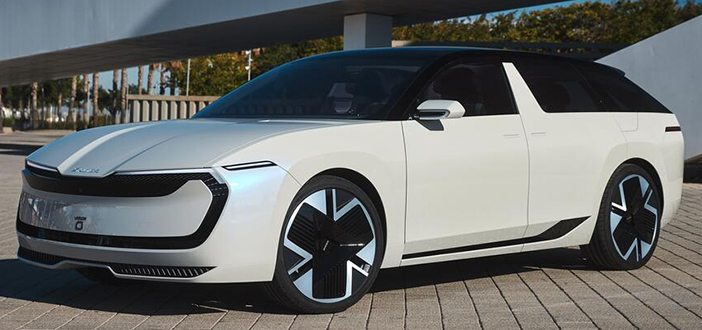
+++ The SKODA VISION O CONCEPT , unveiled at the Munich motor show earlier this year, has taken a further step towards reality with the debut of a fully functioning prototype. The electric estate remains some distance from showrooms, however, and senior Skoda executives say that any production version is at least 5 years away. Tipped to morph into a successor to the Skoda Octavia (it’s sized between the current Octavia and Superb), the production Vision O is likely to offer a mix of plug-in hybrid and pure-electric powertrains rather than be a pure EV. It also previews the Czech brand’s next-generation design language and serves as a test bed for the next wave of its ‘Simply Clever’ features, notably a removable Bluetooth speaker, modular boot storage and four door-mounted umbrellas. I had a brief drive in the prototype, which is a full concept that has been draped over the top of a Superb PHEV, with only the battery being used as a means of propulsion. The conceptness is obvious from the start, as the doors aren’t fully synced up to the disappearing door handles. The drive selector too isn’t fully operational, so a makeshift rocker is instead used. My drive is restricted to 15 kph, so I’m not able to learn too much about how the car will feel in the real world. But I do find that the unassisted steering is actually pretty heavy and true, while the seating position feels like you’re perched on top of something. Inside, there’s a tonne of physical buttons, which makes selecting features on the move easier, while the new Horizon Display (a full-width digital screen stretching across the dashboard and a portrait format infotainment screen below it) shows a lot of information. +++